
The paperwork says G62.9 and then it moves on, as if that settles something.
You’ll find it on the after-visit summary, or the explanation of benefits your insurer mails weeks later, or the prior authorization form the pharmacy needed, or, most frustratingly, on the denial letter. A code, five characters, no translation. And because it appears in the same block as your name and date of birth, it reads like a verdict.
It isn’t a verdict. It’s a billing code — and knowing how to read it tells you two useful things: what your doctor documented about you, and how a reviewer somewhere is going to interpret that documentation. The second one matters more than most people realize, because the difference between two nearly identical codes can be the difference between an approved claim and a denied one.
So here’s the decoder.
Where the Code Lives and How to Find It
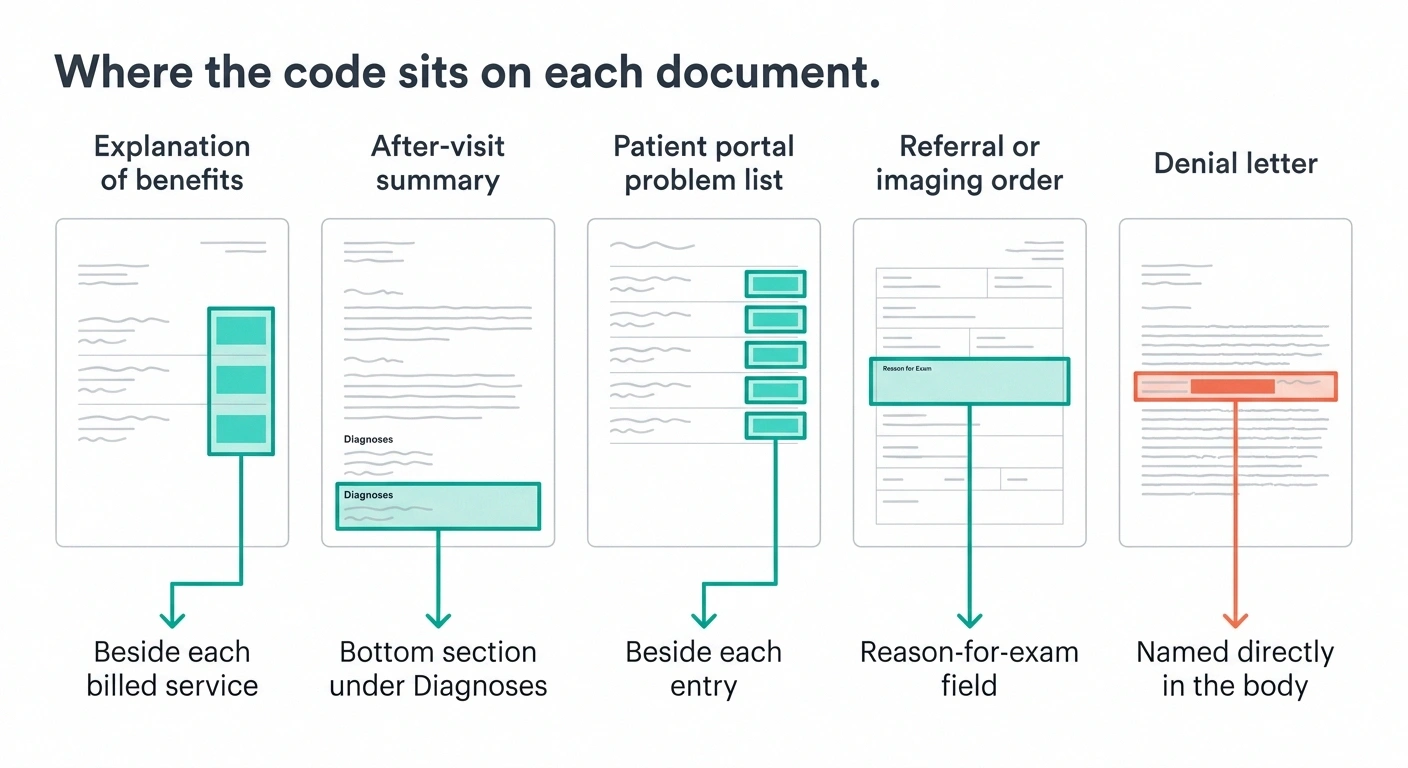
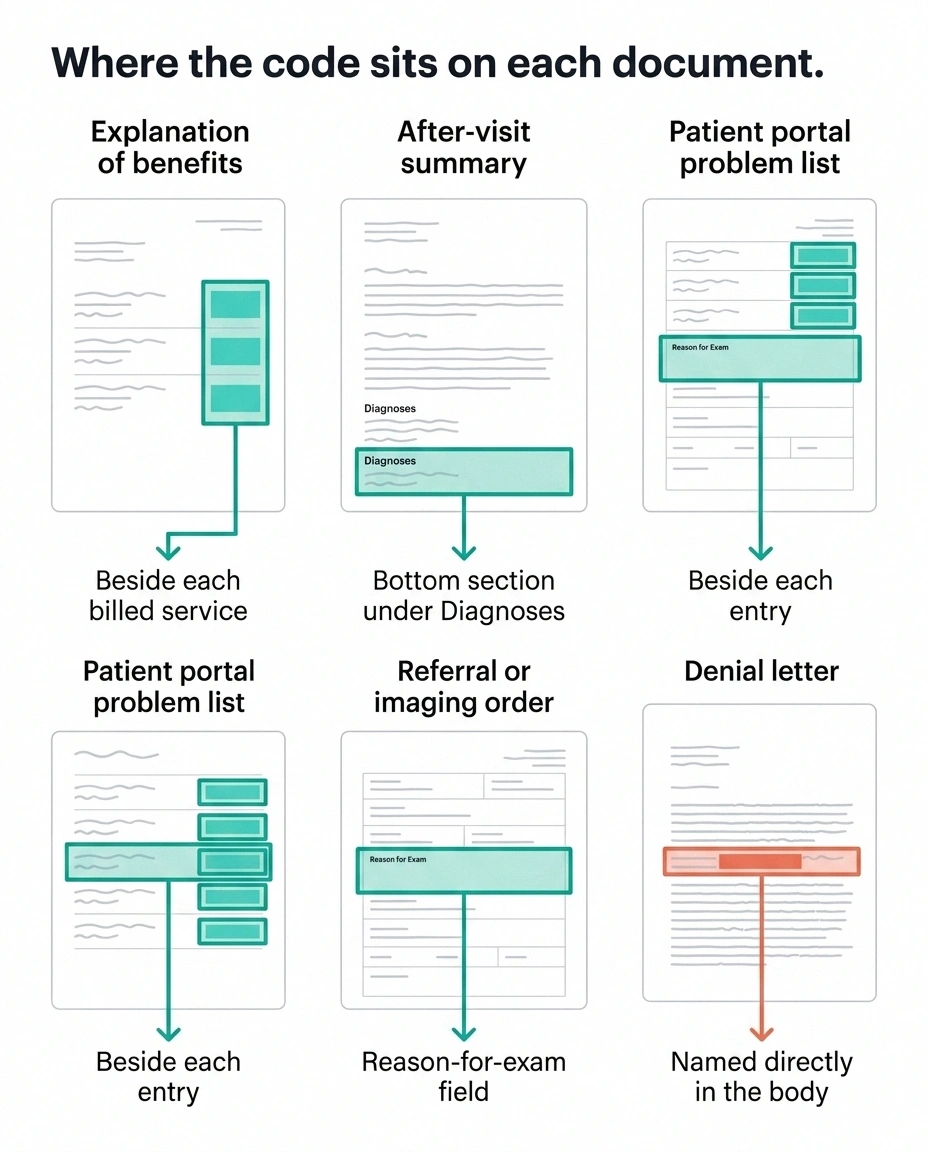
ICD-10-CM is the diagnosis coding system every US provider uses. Each visit generates one or more codes describing what you were seen for, and those codes travel with the bill.
The explanation of benefits is the most useful one, because it shows the code your insurer actually received rather than the code your chart holds. Those are not always the same.
- Explanation of benefits
- Listed beside each billed service. This is what the payer saw.
- After-visit summary
- Near the bottom, under Diagnoses or Assessment.
- Patient portal problem list
- Beside each entry, sometimes only after expanding the item.
- Referral or imaging order
- Usually printed in the reason-for-exam field.
- Denial letter
- Named directly, and this is the version that matters most for an appeal.
They show up in a handful of predictable places. The after-visit summary or discharge paperwork usually lists them near the bottom under a heading like Diagnoses or Assessment. Your patient portal typically has a problem list, and the codes sit beside each entry, sometimes only visible if you expand the item. The explanation of benefits from your insurer lists the diagnosis codes attached to each billed service. Referral orders and imaging requisitions carry them. And denial letters name them directly, which is usually the moment people start caring about this topic.
Neuropathy codes nearly all start with the letter G, which is the chapter for nervous system diseases, or with E, which covers endocrine and metabolic conditions including diabetes. A code starting with M is musculoskeletal, which usually means it belongs to a different complaint — though not always, since some M codes such as the radiculopathy group describe nerve-root problems that produce very similar symptoms. Worth asking about rather than assuming it is unrelated.
The Codes That Actually Appear on Neuropathy Claims
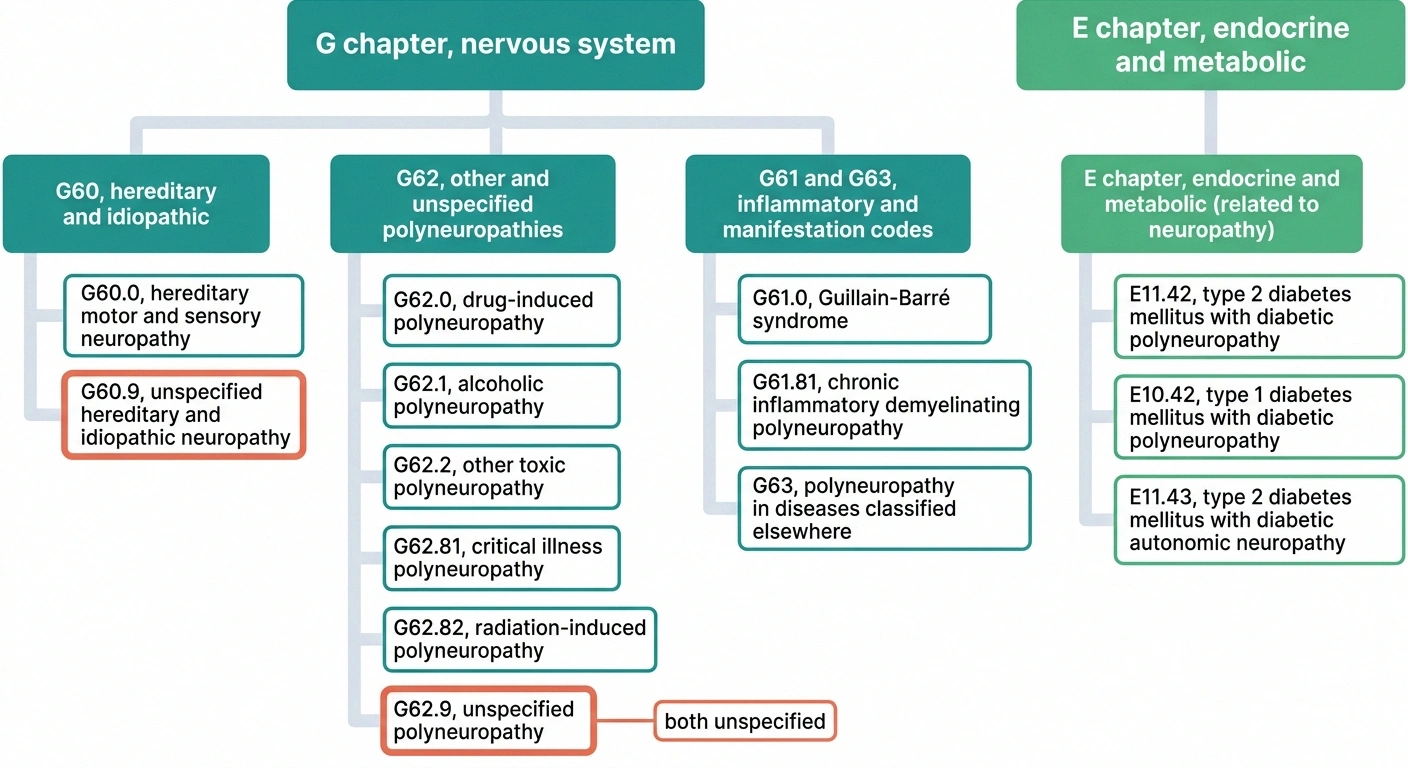
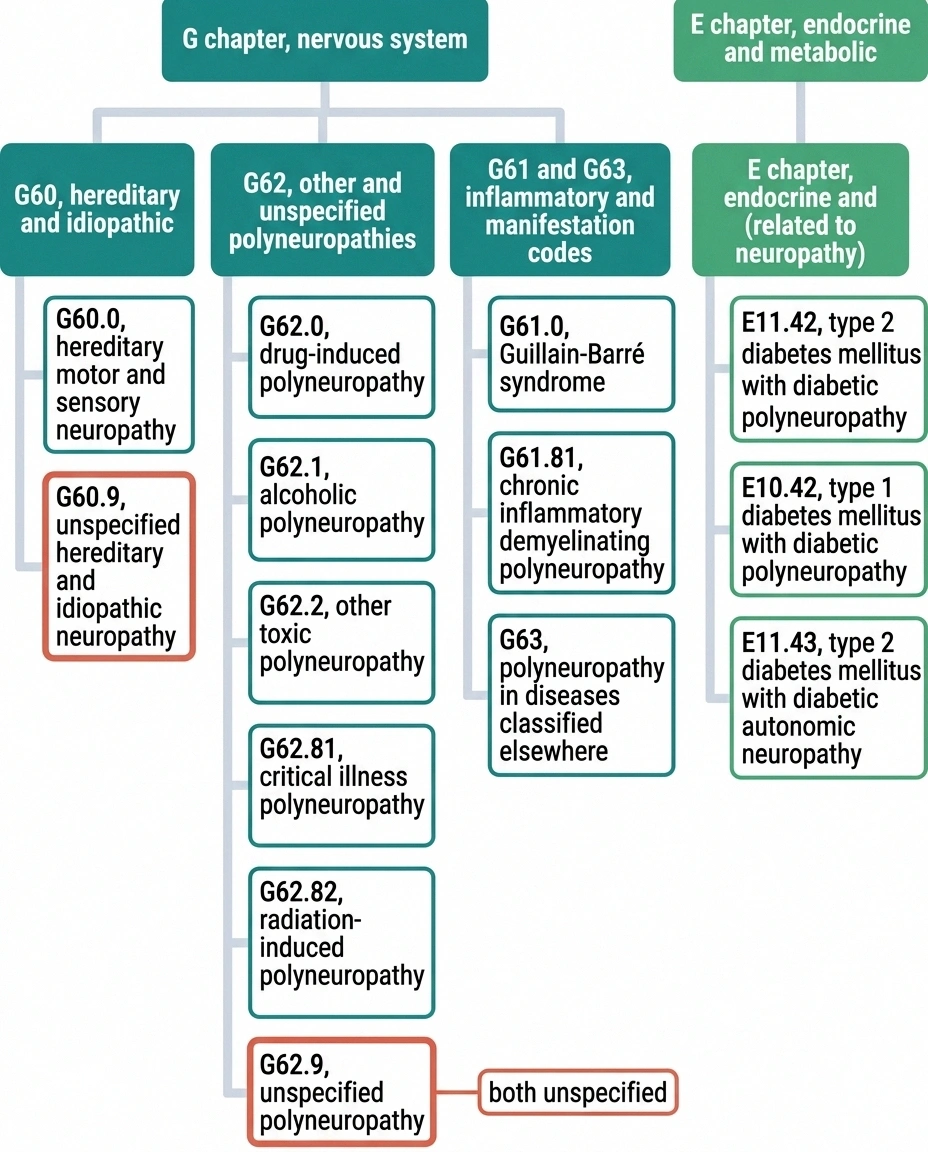
There are hundreds of possible codes. Perhaps a dozen account for nearly everything a person with peripheral neuropathy will ever see on their own paperwork.
G62.9: Polyneuropathy, unspecified. The most common one, and the one that generates the most questions. It means widespread damage across multiple peripheral nerves with no cause recorded on the claim. Not no cause — no cause recorded.
G60.9: Hereditary and idiopathic neuropathy, unspecified. Used when the neuropathy is thought to be inherited or genuinely idiopathic, meaning the workup was done and came back without an answer. In practice it and G62.9 get used somewhat interchangeably, which is one of the quiet inconsistencies of this system.
G60.0: Hereditary motor and sensory neuropathy. This is where Charcot-Marie-Tooth and its relatives live. A genetic diagnosis, not a placeholder.
E11.42: Type 2 diabetes mellitus with diabetic polyneuropathy. The single most consequential code in this list, for reasons covered in the next section. E10.42 is the type 1 equivalent.
E11.43: Type 2 diabetes with diabetic autonomic polyneuropathy. Used when the nerves controlling blood pressure, digestion, sweating or bladder function are involved.
G62.0: Drug-induced polyneuropathy. For neuropathy attributed to a medication. Chemotherapy-related cases usually land here, often paired with a second code identifying the drug.
G62.1: Alcoholic polyneuropathy. Self-explanatory, and worth knowing it exists as a distinct code, since it appears on paperwork and lands differently than a neutral one.
G62.2: Polyneuropathy due to other toxic agents. Heavy metals, industrial exposures, and toxins that aren’t prescription drugs.
G62.81: Critical illness polyneuropathy. Nerve damage following a prolonged ICU stay, which is more common than most people realize.
G62.82: Radiation-induced polyneuropathy. Damage from radiation therapy, sometimes appearing years afterward.
G61.0 and G61.81: Guillain-Barré syndrome and CIDP. The inflammatory neuropathies, immune-mediated and treated very differently from the rest of this list.
G63: Polyneuropathy in diseases classified elsewhere. A manifestation code. It never appears alone and never appears first; the underlying disease gets coded ahead of it. If you see G63 on your paperwork, look for the code immediately above it, because that one names the cause.
G90.09 and related G90 codes — autonomic nervous system disorders. Where non-diabetic autonomic involvement gets recorded.
One structural note that confuses people: polyneuropathy codes carry no left or right designation. If your paperwork shows a code with laterality, you’re probably looking at a mononeuropathy code from the G56 or G57 families — carpal tunnel, ulnar entrapment, peroneal palsy. Those are single-nerve problems and they do get sided.
The Diabetes Fork
If you take one thing from this article, take this.
A reviewer reads what is written and does not infer the connection. That is the entire difference between these two rows.
| Coded as | What it states | How it reads at review |
|---|---|---|
| E11.42 single combination code | Type 2 diabetes, and the neuropathy is a complication of it | Established condition with a documented cause. Carries risk-adjustment weight. |
| E11.9 + G62.9 two separate codes | Diabetes, and separately, nerve damage of unknown cause | Two unlinked problems, one still unexplained. Weaker support at prior auth and disability review. |
E10.42 is the type 1 equivalent. E11.43 and E10.43 cover autonomic involvement.
When someone has diabetes and neuropathy, the coding system offers two paths. Path one uses E11.42, a combination code that says in a single entry: this person has type 2 diabetes, and the neuropathy is a complication of it. Path two uses two separate codes — one for diabetes, one for G62.9 unspecified polyneuropathy — which says: this person has diabetes, and separately, this person has nerve damage of unknown cause.
Clinically these can describe the same patient. Administratively — which is where the money and the approvals live — they’re very different claims.
The combination code establishes causation inside the record. That matters for prior authorization on neuropathy medications, for durable medical equipment like therapeutic footwear, for coverage of specialist visits, and for disability determinations where the reviewer is assessing a documented, established condition. It also carries risk-adjustment weight, which is why coding education materials push specificity so persistently.
The split version leaves the connection unstated, and reviewers don’t infer connections. They read what’s written.
The practical upshot: if you have diabetes and diagnosed neuropathy, and your paperwork shows G62.9 rather than E11.42, that’s worth a question at your next visit. Not an accusation — coding drift like this happens routinely when a code gets carried forward from an early visit before the picture was clear, and then nobody revisits it. It just quietly stops matching reality. The same applies to Medicare coverage decisions, where specificity frequently determines what gets approved.
What Unspecified Quietly Costs You
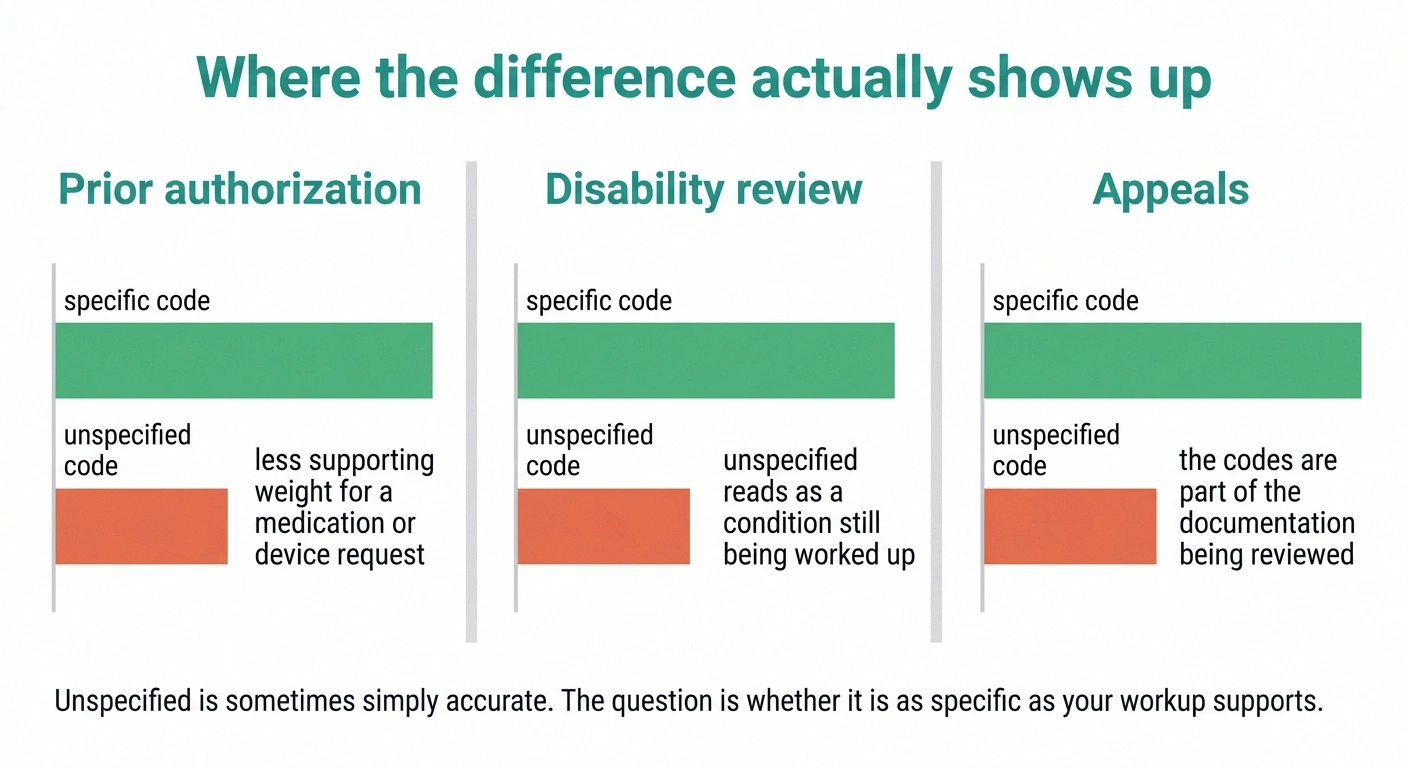
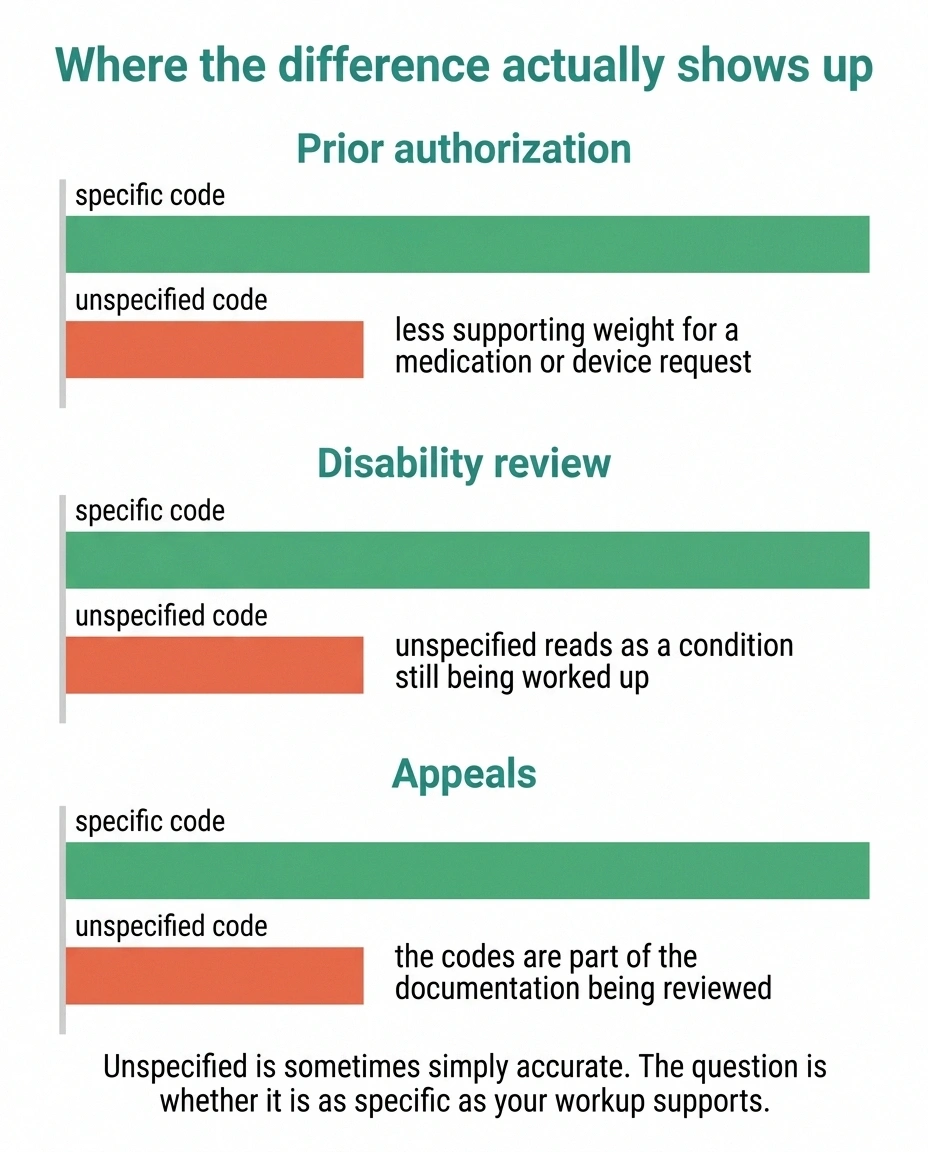
G62.9 and G60.9 are both perfectly valid, billable codes. Nobody is doing anything wrong by using them. But they carry a signal, and the signal isn’t neutral.
To a claims reviewer, an unspecified code reads as incomplete documentation. That doesn’t automatically deny anything. What it does is remove supporting weight at exactly the moments you need it.
At prior authorization. When a plan evaluates whether to cover a medication or a device, specific codes with an established cause make a stronger case than an unspecified one.
At disability review. This is where it bites hardest. Adjudicators assess severity, duration and cause. A file full of unspecified codes suggests a condition still being worked up rather than an established one, and that impression is difficult to overcome later with narrative alone. Anyone pursuing disability benefits for neuropathy or a VA disability rating should look at what codes their record actually carries before filing rather than after.
At appeals. Appeals are largely a documentation exercise. The codes are part of the documentation.
Now, the fair counterpoint: sometimes unspecified is simply accurate. A meaningful share of peripheral neuropathy is genuinely idiopathic after a complete workup, and in that case an unspecified code honestly reflects medical reality. The question isn’t whether the code is specific. It’s whether it’s as specific as your actual workup supports.
If your record shows G62.9 and you’ve had bloodwork identifying B12 deficiency, or you’re on a drug known to cause neuropathy, or you have a diagnosed autoimmune condition, then your documentation supports more than the code is claiming. Reviewing your own blood test results is often what reveals the gap.
When the Code Is Genuinely Wrong

Most mismatched codes are stale rather than incorrect, and honestly they’re not worth a fight. A few are — and these are the ones.
Chasing every imprecise code will exhaust your goodwill with a practice you need. These four are the ones that do real work.
The cause is documented but not coded. Your chart establishes a cause, the code says unspecified. This is the common and fixable case.
The code names a cause that isn’t yours. G62.1, alcoholic polyneuropathy, on the record of someone who doesn’t drink is the example that matters most. It’s a code with social consequences that follows you through a shared medical record, and it should be corrected.
The diabetes link is missing. Covered above, and it’s the highest-value correction available to most people.
The code is for the wrong condition entirely. Occasionally a code from a different body system appears, usually a data entry slip. Straightforward to fix once flagged.
What’s not worth pursuing: two similar unspecified codes used inconsistently across different practices, or a slightly imprecise code on a routine visit that isn’t attached to any coverage decision. Save the effort for the codes doing real work.
How to Ask for a Change Without Making It Awkward

The framing that works is a question about the record, not a challenge to the clinician’s judgment. Coding is usually handled by staff working from chart notes, so an outdated code generally reflects a process gap rather than anyone’s opinion about you.
Coding is usually done by staff working from chart notes, so an outdated code is a process gap rather than a clinical opinion. Ask about the record, not the judgment.
I noticed my visit summary shows G62.9, unspecified polyneuropathy. My chart has the B12 results from March and the diabetes diagnosis. Would a more specific code be appropriate going forward, given what the workup showed?
One mechanical note: changing a code on an already-submitted claim requires a corrected claim, which is more work than changing what gets used from now on. Lead with going forward unless you are appealing a specific denial, in which case ask directly whether the claim can be resubmitted with the corrected code.
Something in this shape works well: “I noticed my visit summary shows G62.9, unspecified polyneuropathy. My chart has the B12 results from March and the diabetes diagnosis. Would a more specific code be appropriate going forward, given what the workup showed?”
That does three things at once — it identifies the code, it points at the documentation supporting a change, and it asks rather than asserts.
Two mechanics worth knowing. Changing a code on a claim already submitted requires a corrected claim, which is more work than changing what gets used going forward, so lead with the future unless a specific denial is at stake. And if a denial is at stake, ask directly whether the claim can be resubmitted with the corrected code, since that’s frequently the fastest route to resolution. The insurance coverage guide covers the appeals path in more detail.
What the Code Does Not Mean

A few things worth releasing, because people carry unnecessary weight about this.
The code isn’t a severity rating. G62.9 says nothing about how bad your symptoms are. Severity lives in the clinical notes, in test results, and in functional descriptions. Two people with identical codes can be in completely different situations.
Unspecified isn’t a judgment about you. It’s a statement about what’s recorded, and often a statement about how much time the visit had.
The code isn’t your prognosis. Where you sit in the progression of neuropathy and what your trajectory looks like are clinical questions the coding system doesn’t attempt to answer.
A specific code doesn’t require certainty. Codes reflect the working diagnosis at the time. They get revised as the picture develops, which is normal and expected rather than a sign of earlier error.
The reason to understand any of this isn’t to become your own coder. It’s that these five characters function as shorthand for your condition in every automated system that touches your care, and knowing what yours says lets you notice when it stops matching your reality. That’s the whole benefit — and it’s a real one, because nobody else is checking. If your codes look stale and you’re not sure what your workup actually established, the diagnosis overview is a reasonable place to see which tests should be on the record, and the medication list is worth a scan if G62.0 might apply to you and nobody has considered it.
Frequently Asked Questions
What is the ICD-10 code for peripheral neuropathy?
There isn’t one single code. G62.9, polyneuropathy unspecified, is the most commonly used when no cause is recorded. G60.9 covers hereditary and idiopathic neuropathy. If diabetes is the cause, E11.42 is used for type 2 and E10.42 for type 1. The correct code depends on what the medical record establishes about the cause.
What does G62.9 mean on my paperwork?
It means polyneuropathy, unspecified: damage affecting multiple peripheral nerves, with no cause documented on that claim. It does not mean the cause is unknowable or that nobody looked. It means the cause was not recorded in the coding for that visit. It carries no information about severity.
What is the difference between G60.9 and G62.9?
G60.9 covers hereditary and idiopathic neuropathy, used when the condition is thought to be inherited or genuinely without identifiable cause after workup. G62.9 covers polyneuropathy of unspecified cause more generally. Both are billable and both are unspecified, and in practice they are sometimes used interchangeably for similar presentations.
Does my ICD-10 code affect my insurance coverage?
It can. Specific codes that establish a cause tend to support prior authorization requests, durable medical equipment approvals and coverage decisions more strongly than unspecified codes. The diabetes combination codes are the clearest example, since they document the causal link inside a single entry rather than leaving it to be inferred.
Can I ask my doctor to change my diagnosis code?
Yes, and it is a reasonable request when the record supports greater specificity. Frame it as a question about whether a more specific code fits what the workup found, and point to the documentation. Changing a code on an already-submitted claim requires a corrected claim, so it is simpler to change what gets used going forward unless a specific denial is being appealed.
What is the ICD-10 code for diabetic neuropathy?
E11.42 for type 2 diabetes with diabetic polyneuropathy, and E10.42 for type 1. When autonomic nerves are involved, E11.43 and E10.43 apply. These are combination codes that record both the diabetes and the neuropathy complication together, which is what makes them stronger documentation than coding the two conditions separately.
Why does my code say unspecified when my doctor knows what caused it?
Usually because a code entered early in the workup was carried forward and never updated after the cause was established. Codes are frequently assigned by administrative staff working from chart notes, so a cause documented in the narrative may not make it into the code. This is the most common and most correctable coding gap.
Is there a separate code for neuropathy in the feet?
Not for polyneuropathy, which by definition affects multiple nerves and carries no location or laterality designation. Codes for single nerves in a specific limb exist in the G56 and G57 families, covering conditions like carpal tunnel syndrome and peroneal nerve palsy, and those do include left, right and bilateral designations.
About the Author