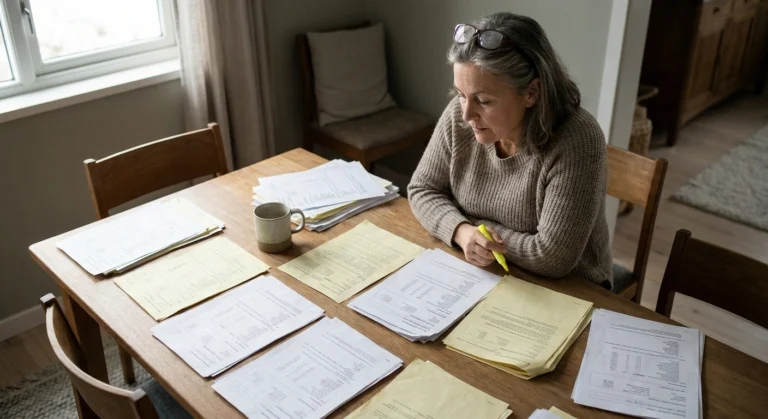
The appointment letter for a tilt table test is almost always a masterpiece of saying nothing.
Arrive at such a time. Nothing to eat after midnight. Allow two hours. Wear comfortable clothing. And then a phone number, in case of questions, which is answered by a scheduler who has never been strapped to the table.
What the letter leaves out is the part people actually want to know. You’ll be tilted upright and deliberately kept there until either your body proves it can handle it or it very visibly can’t. Some people faint — that’s not a complication, it’s frequently the point. And knowing that going in changes the experience from frightening to merely uncomfortable, which is a bigger difference than it sounds.
Here’s the whole thing, start to finish, plus how to read the report you’ll be handed afterward.
Why Anyone Orders This Test
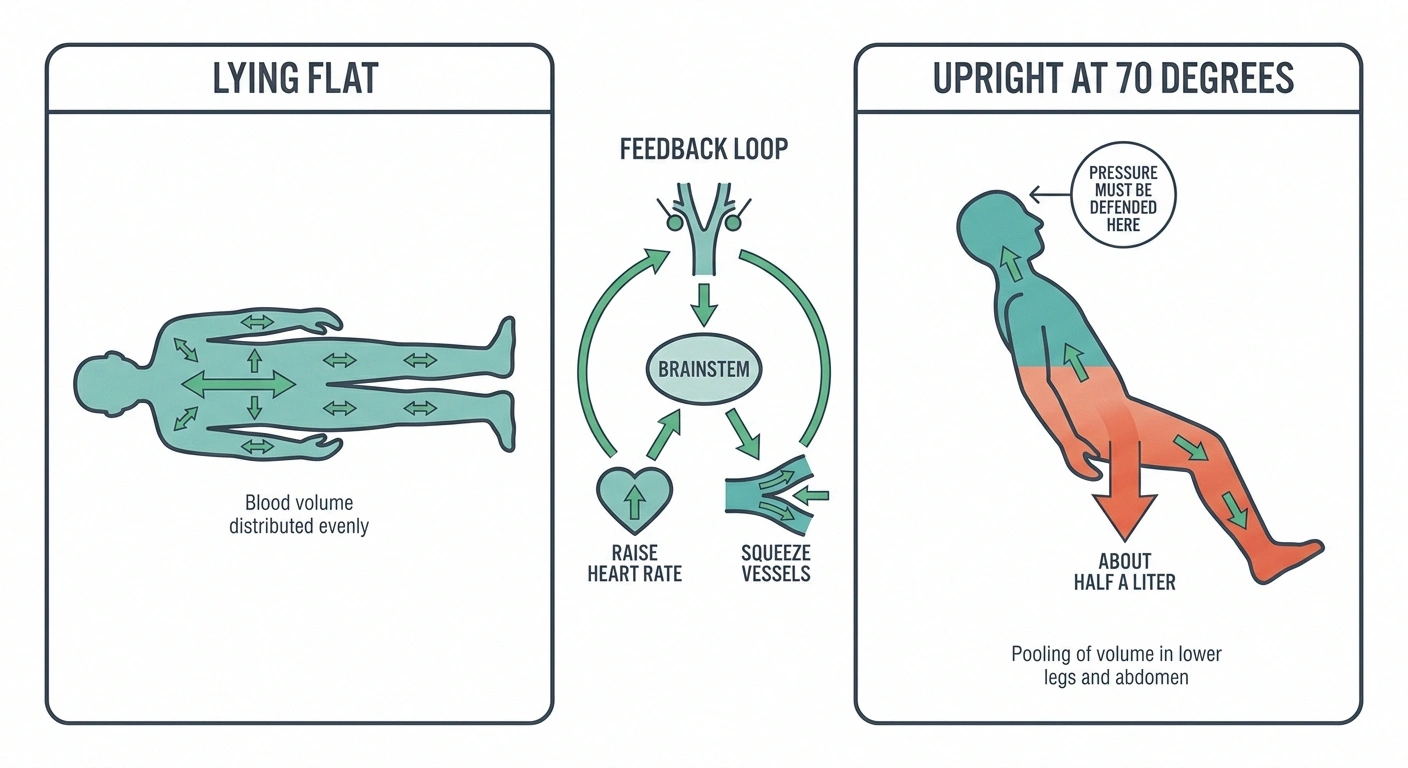
Standing up is harder than it looks. The moment you go vertical, gravity pulls something like half a liter of blood down into your legs and abdomen. If nothing intervened, the pressure at your head would drop and you’d be on the floor within seconds — which is roughly what happens to a fighter pilot in a hard turn.
What intervenes is a reflex loop. Stretch sensors in your carotid arteries and aortic arch detect the pressure drop within a heartbeat or two. They report to the brainstem. The brainstem sends sympathetic signals back out: squeeze the blood vessels in the legs and gut, speed the heart slightly, and tighten the veins so blood returns faster. Pressure at the head holds steady. You don’t notice any of it.
That entire loop runs on small unmyelinated autonomic nerve fibers. Which are exactly the fibers that autonomic neuropathy damages — and exactly the fibers that get missed by a standard nerve conduction study, since that test only reads large fast fibers.
So the tilt table is a stress test for a reflex. It removes the muscle-pump help you’d get from actually standing, holds you at a fixed angle so the challenge is measurable and repeatable, and watches what your blood pressure and heart rate do about it.
What Actually Happens in the Room
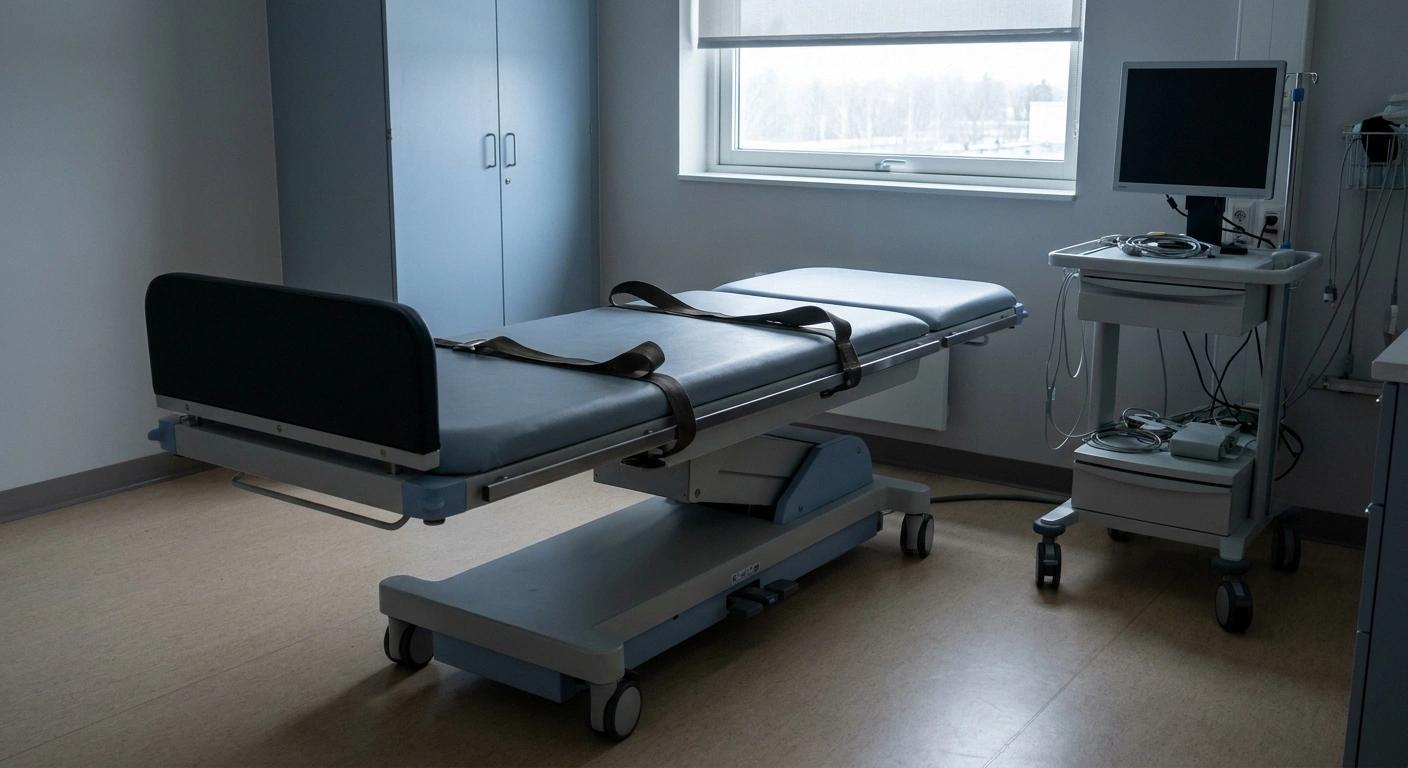
The physical setup is odd looking and entirely benign. A padded table with a footboard at the bottom, motorized to tilt from flat to upright, and enough monitoring leads to make you feel briefly like a science experiment.
Timings vary by lab. What doesn’t vary is the order, and knowing which stage you’re in makes the uncomfortable part considerably shorter psychologically.
Before you go in. Fasting is usually six to eight hours, which is why these tests get booked in the morning. Small sips of water are typically allowed. Ask specifically about medications, because some of what you take may be the very thing being tested around.
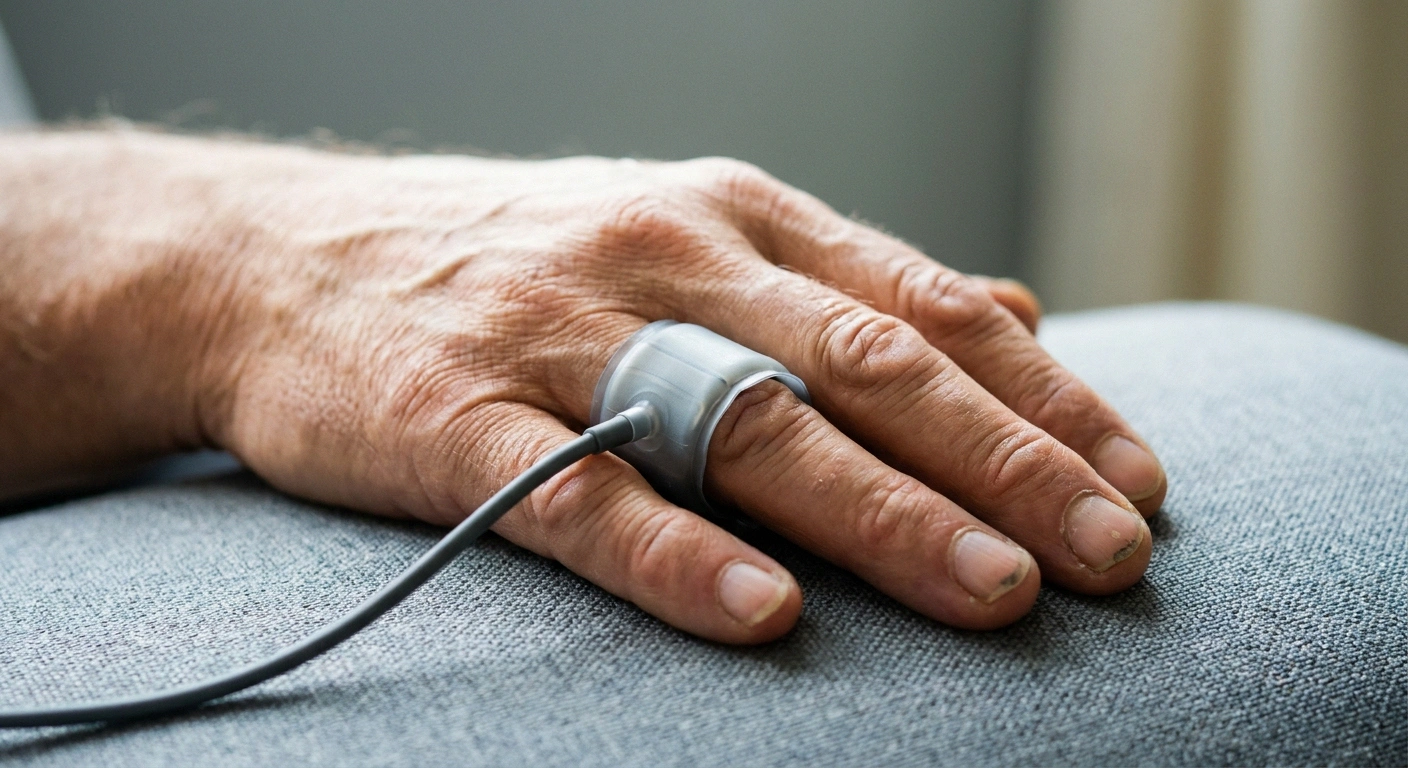
Getting wired. ECG electrodes on the chest. A blood pressure cuff on one arm, and often a second continuous monitor on a finger that reads pressure beat by beat rather than every few minutes. An IV goes into a hand or forearm, usually while you’re still lying flat.
The lying-still part. Ten to twenty minutes flat, quiet, so your numbers settle into a real baseline. It’s dull. It’s also where the comparison values come from — without a clean baseline the rest of the numbers mean nothing.
The straps. Wide belts across the chest, hips, and legs, plus a footboard for your feet to rest on. They aren’t restraints in any meaningful sense — they’re there so that if you do faint, you don’t slide.
Tilting. The table moves to somewhere between 60 and 80 degrees, most often 70. This is not standing upright. It’s a steep recline with your weight on your feet, and that’s deliberate — your leg muscles stay relaxed and can’t pump blood back up for you.
Waiting. Anywhere from ten to forty-five minutes, depending on the protocol and on what your numbers do. You’ll be asked to stay still and to report symptoms out loud as they come. Say them. Lightheaded, warm, nauseated, tunnel vision, ringing ears, sweaty palms. The technician is charting every one of them against the numbers, and the symptom timeline is half the value of the test.
Coming down. If you faint or your pressure drops far enough, the table returns to flat quickly, and most people recover within a minute or two of being horizontal.
The Second Half Nobody Mentions
If the passive tilt doesn’t provoke anything, many centers move to a drug challenge phase. This is the part that surprises people, so here it is plainly.
You’ll be given either sublingual nitroglycerin, which dilates blood vessels and makes it harder to maintain pressure, or an isoproterenol infusion, which pushes the heart to beat faster and more forcefully. Either one makes the challenge stiffer. The idea is that a reflex which barely coped under passive tilt will show its limits under provocation.
Nitroglycerin commonly causes a headache, sometimes a considerable one, lasting maybe twenty minutes. Isoproterenol causes a pounding heartbeat and a jittery, anxious feeling. Neither is dangerous in this setting, and both wear off, but neither is pleasant, and knowing it’s coming means you don’t spend those minutes wondering if something has gone wrong.
Reading Your Result
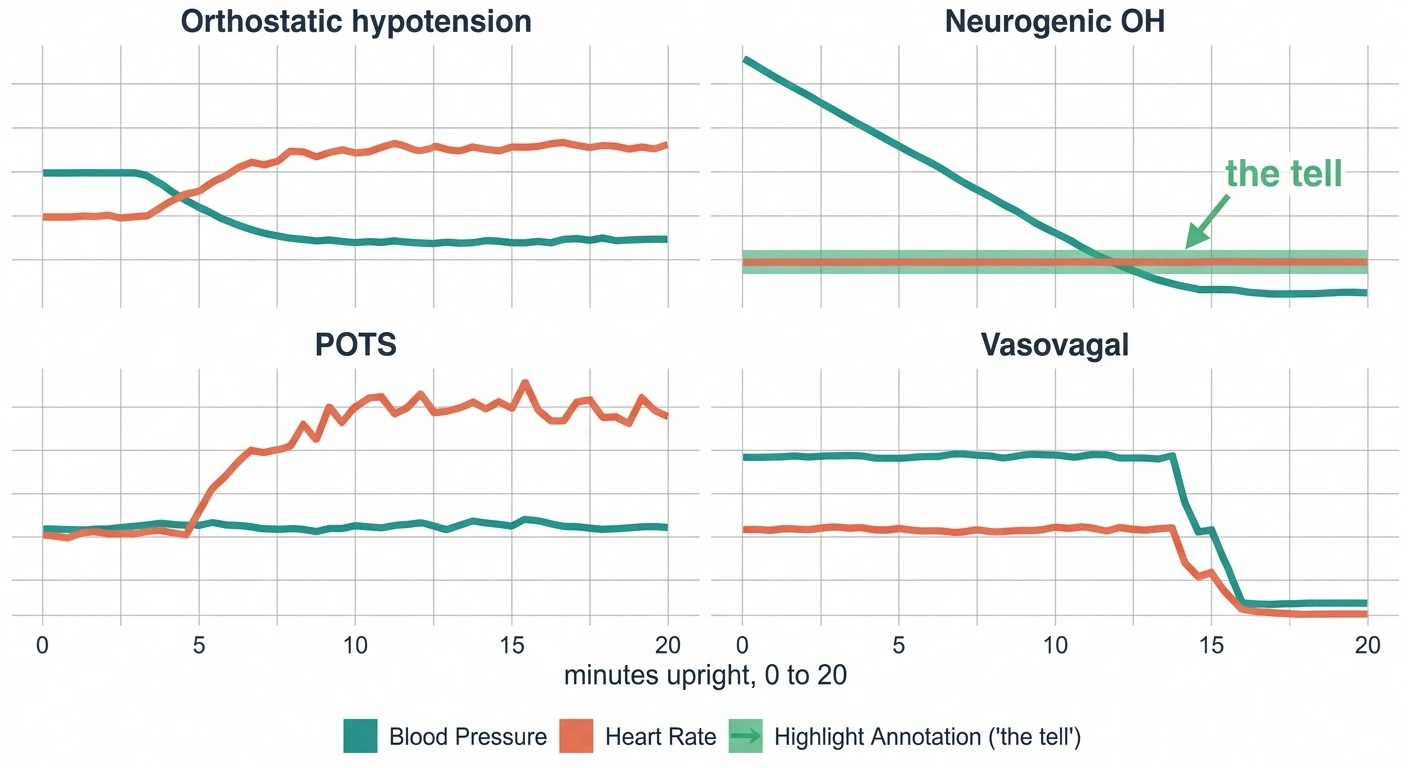
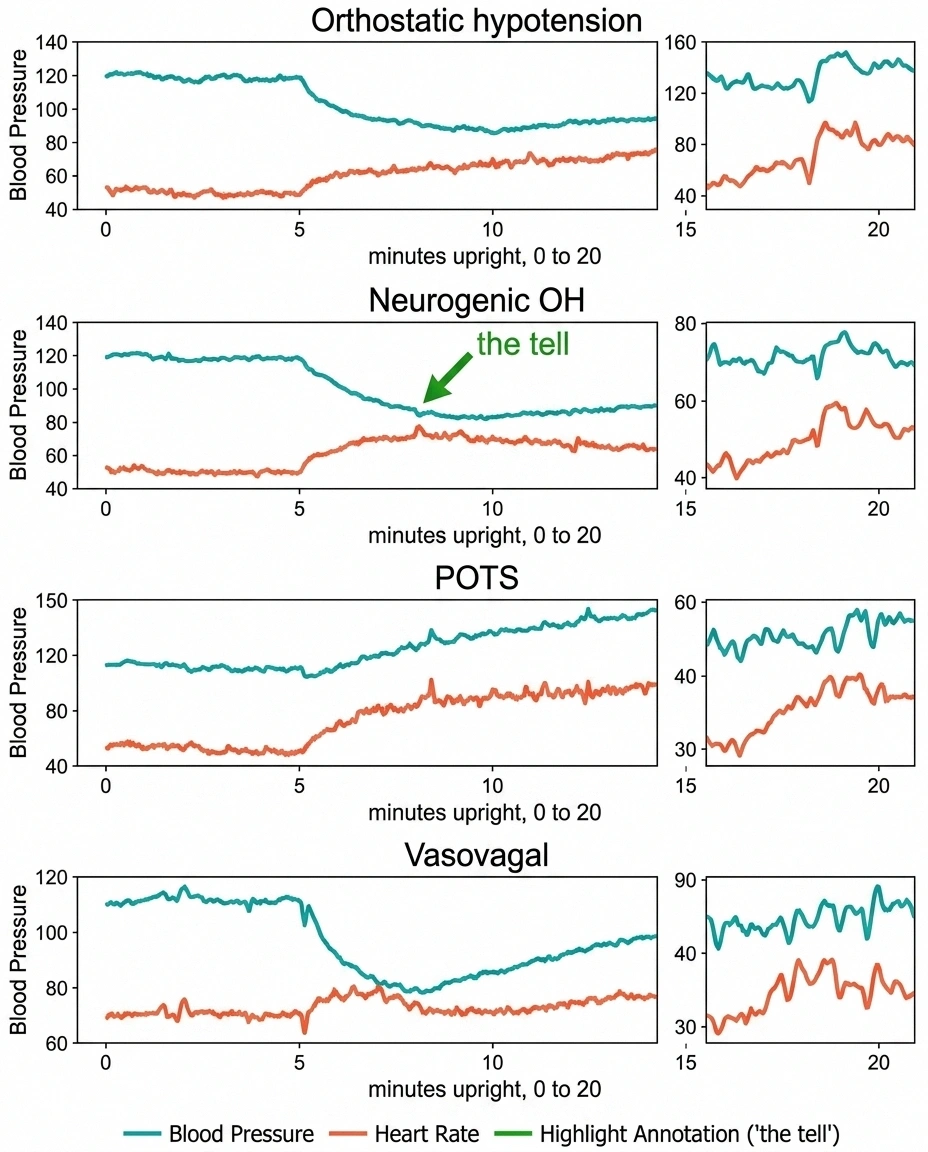
The report will name a pattern. There are three that matter, and they lead to different places.
The heart rate column is the one most people skip and the one that separates nerve damage from every other cause of a falling blood pressure.
| Pattern | Blood pressure | Heart rate | Points toward |
|---|---|---|---|
| Orthostatic hypotension | Falls 20+ systolic or 10+ diastolic within 3 min | Rises to compensate | Volume, medication, deconditioning |
| Neurogenic OH | Same fall, often larger | Barely moves | Autonomic nerve damage |
| POTS | Holds | Rises 30+ bpm within 10 min | Small fiber involvement, volume, deconditioning |
| Vasovagal | Fine, then sudden collapse | Often drops with it | Reflex overreaction, not reflex failure |
Orthostatic hypotension. The formal definition is a drop of at least 20 mmHg in systolic pressure, or at least 10 mmHg diastolic, within three minutes of being tilted upright. Blood pools, the vessels don’t clamp down enough to compensate, pressure falls and keeps falling.
Neurogenic orthostatic hypotension. This is the finding that points hardest at nerve damage, and it’s identified by what’s missing. In ordinary orthostatic hypotension from dehydration or blood loss, the heart races to compensate. In the neurogenic version, pressure falls and the heart rate barely moves, because the nerves that would order it to speed up aren’t delivering the message. A big pressure drop paired with a flat heart rate is the signature — the alarm is sounding and nobody is answering it.
POTS. A heart rate increase of at least 30 beats per minute within ten minutes of tilt, without a significant blood pressure drop. The pressure holds — but only because the heart is working far harder than it should have to. This overlaps considerably with small fiber damage, which our piece on POTS and small fiber neuropathy gets into properly.
Vasovagal syncope. A period of tolerating the tilt fine, then a fairly sudden combined collapse of blood pressure and often heart rate together, with fainting. This is a reflex overreacting rather than a reflex failing, and it’s a different problem with different management.
What a Normal Result Rules Out, and What It Doesn’t
This part gets people, and it’s worth being clear about.
A normal tilt table test means your cardiovascular autonomic reflexes held up under this specific challenge on this specific morning. That’s genuinely useful information. It does not mean your autonomic nervous system is healthy — those are two different claims.
The autonomic system runs your sweating, your digestion, your bladder, your pupils, and your body temperature alongside your blood pressure. Those branches can be damaged while the cardiovascular branch is still coping. Someone with significant gastroparesis or with feet that have completely stopped sweating can absolutely pass a tilt table test.
Timing matters too. Autonomic function shifts with hydration, sleep, recent meals, medication timing, and the temperature of the room. A borderline result on a Tuesday can look different on a Thursday.
Which is why a tilt table is rarely ordered alone.
The Rest of the Battery
A full autonomic workup typically runs four tests in one session, and the tilt is only one of them.
Heart rate response to deep breathing. You breathe slowly and rhythmically, usually six breaths a minute, while your heart rate is recorded. A healthy heart rate rises and falls noticeably with each breath. Loss of that variation is one of the earliest measurable signs of cardiac autonomic damage, and it often shows up years before any symptom does.
The Valsalva maneuver. You blow into a tube against resistance for fifteen seconds while continuous blood pressure is recorded. The shape of the pressure trace afterward, particularly whether there’s a proper overshoot when you stop blowing, tells the technician a great deal about baroreflex function.
QSART. Capsules are placed on the forearm, two spots on the leg, and the foot. A small amount of acetylcholine is driven into the skin with a mild electrical current, and the sweat response is measured. It reads the small nerve fibers that control sweating, and it’s often abnormal in small fiber neuropathy when everything else is normal. It stings mildly — a warm prickle rather than anything sharp.
The tilt. Usually last, since it’s the one most likely to make you feel unwell.
Together these four sketch a map of which autonomic functions are affected and how badly. Any one alone is a single data point.
Preparing So the Test Is Actually Worth Doing
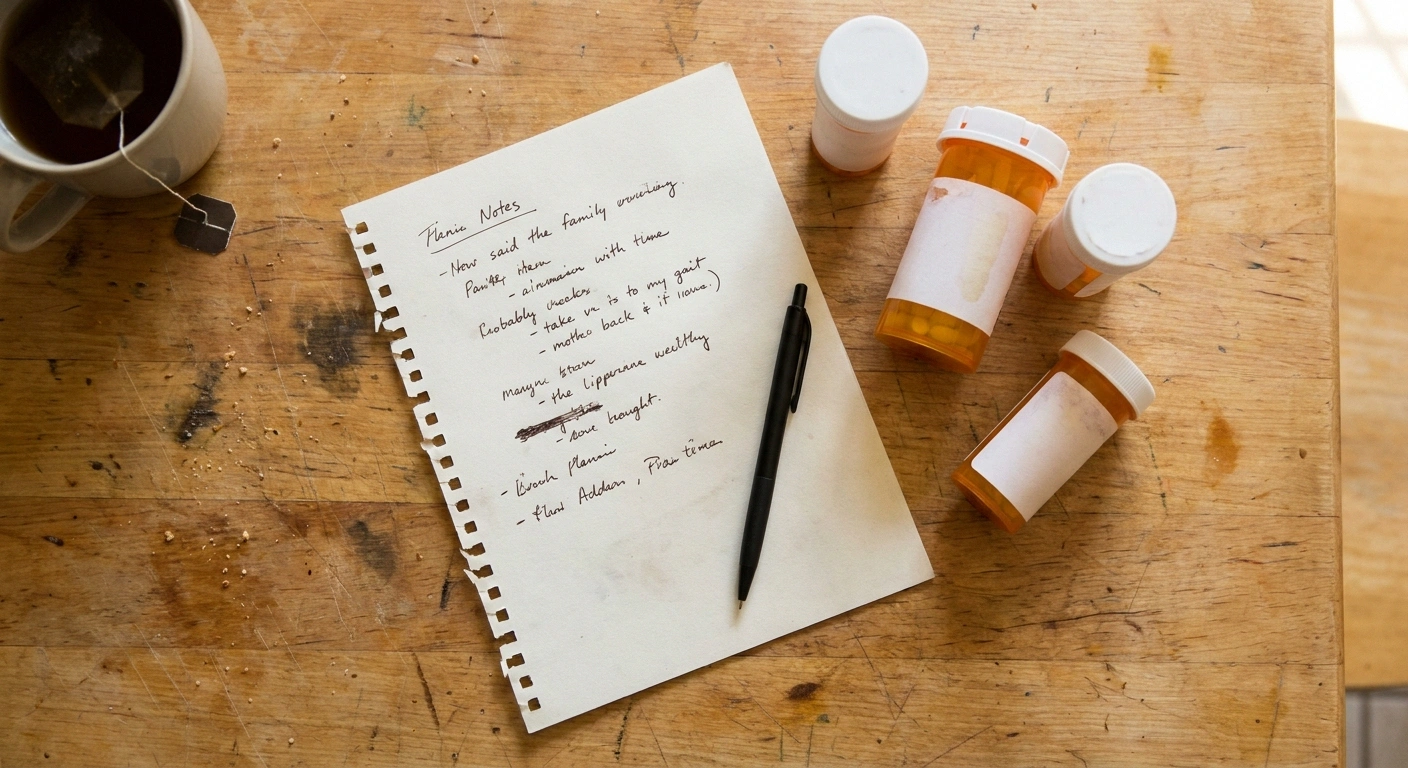
An unprepared tilt table test can produce a result that’s technically valid and clinically meaningless. A few things are within your control.
This is the single most common reason a tilt table test produces an uninterpretable result. Phone the ordering physician’s office, not the testing lab, and ask for the answer in writing. Read your list aloud including doses.
Name every one of these if you take it:
Blood pressure medication of any kind. Diuretics. Beta blockers. Midodrine or droxidopa. Fludrocortisone. Antidepressants, particularly SNRIs and tricyclics. Bladder medications. Alpha blockers for prostate symptoms. Sildenafil or tadalafil. Anything taken for migraine.
Never stop a medication on your own judgment for this. Some are held, some are deliberately continued because the question is how you do while on them, and stopping the wrong one carries a real risk of its own.
Sort out medications in advance, in writing. This is the big one. Blood pressure medications, diuretics, beta blockers, midodrine, fludrocortisone, some antidepressants, and several bladder medications all change what the test will show. Some need holding, some absolutely do not, and the answer depends on why you’re being tested. Get the instruction from the ordering physician, not from a scheduler, and get it before the day.
Hydrate up until the fast starts. Then follow the fasting instruction exactly.
Bring a symptom history. Write down what happens to you in real life, when, and what makes it better or worse. If your worst episodes come in hot showers, after large meals, or in the first hour after waking, say so. That context shapes how a borderline number gets interpreted.
Arrange a ride. Some people feel fine afterward. Others feel wrung out for hours, particularly after a drug challenge phase.
Wear separates. A two-piece outfit makes the electrode placement far less awkward than a dress.
What Happens With the Answer
A diagnosis is only worth the change it produces, so here’s what typically follows.
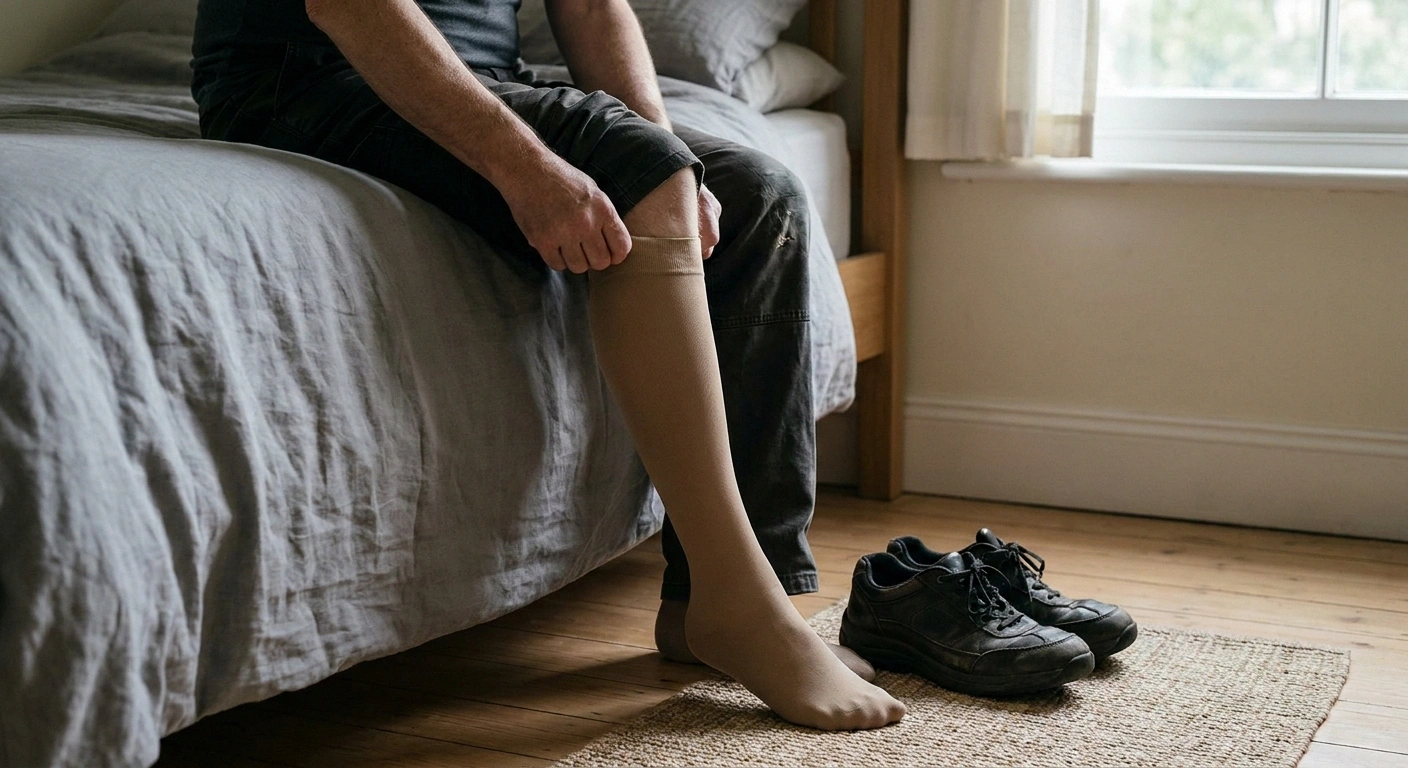
Confirmed neurogenic orthostatic hypotension moves the conversation to management. That starts with the unglamorous foundation: more salt and fluid if your heart and kidneys allow it, compression garments that reach the thigh or abdomen rather than knee-high socks, sleeping with the head of the bed raised, and standing up in stages instead of all at once. When those aren’t enough, midodrine and droxidopa are the medications most often reached for.
It also opens a conversation that surprises many people: supine hypertension. A significant share of those with neurogenic orthostatic hypotension have blood pressure that runs too high when lying flat and too low when upright. Treating one can worsen the other, which is why this needs handling as one problem rather than two.
A POTS pattern points toward a different set of first moves, with graded reconditioning exercise doing more heavy lifting than most people expect.
And whatever the pattern, a documented tendency to lose blood pressure on standing is a fall risk that deserves naming out loud. Fainting on a padded table with straps is one thing. Fainting on a tiled bathroom floor at three in the morning — alone, in the dark — is another, and the practical strategies in our guide to balance and fall prevention apply directly here.
The test itself is a strange couple of hours. But it turns a vague complaint about dizziness into a number with a name attached, and that’s the thing that finally gets treated.
Why This Test Gets Ordered So Late
Most people who end up on a tilt table have been describing the same symptoms for years before anyone books it. That delay is worth understanding, because a bit of it is fixable from your side of the desk.
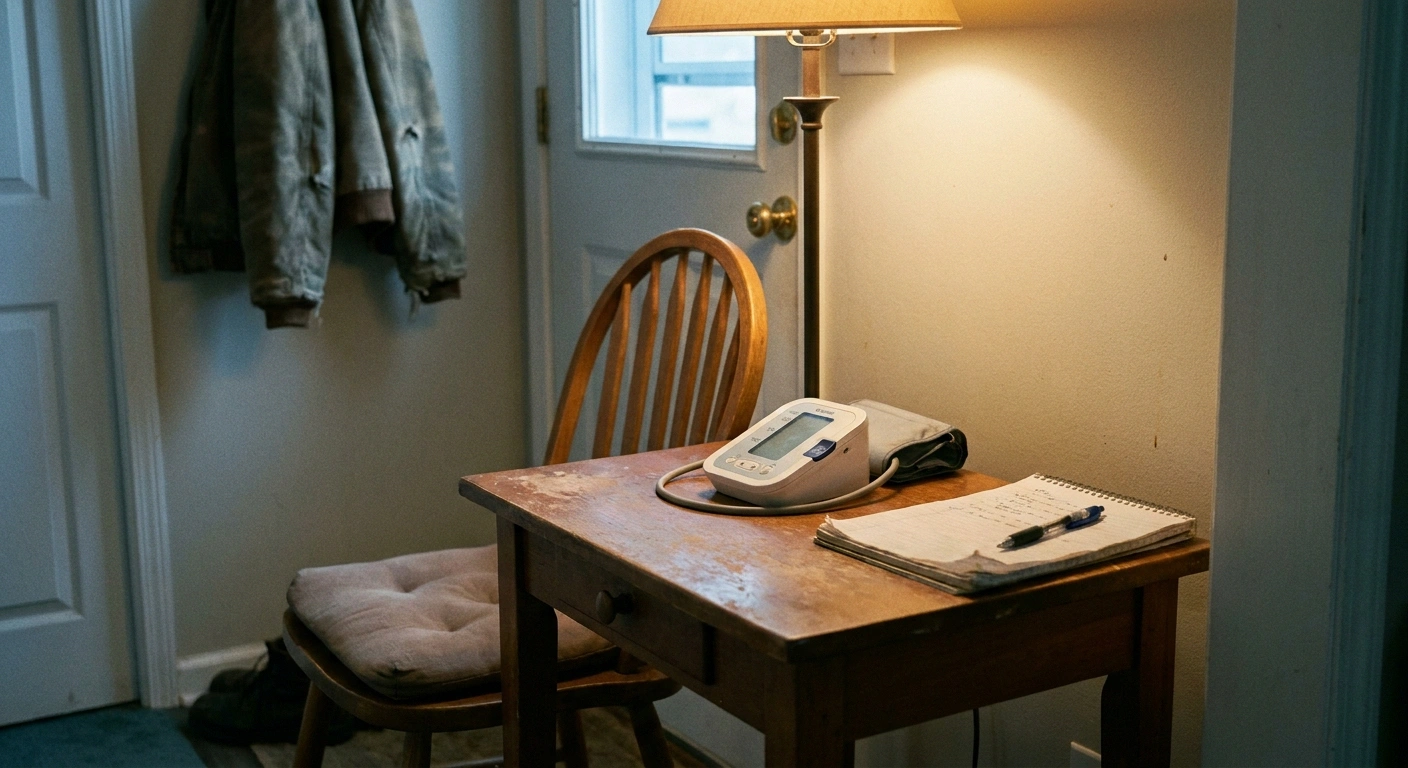
Copy this layout onto a page. Do it twice a day, morning and evening, for fourteen days. Rest flat for five full minutes before the first reading or the numbers mean nothing.
| Lying flat, 5 min rest | BP ___ / ___ HR ___ |
| Standing, 1 minute | BP ___ / ___ HR ___ |
| Standing, 3 minutes | BP ___ / ___ HR ___ |
| Standing, 5 minutes | BP ___ / ___ HR ___ |
| Symptoms and time of day | ___________________ |
Have someone nearby the first few times. If you feel faint, sit down immediately and record that as the result, since a reading you couldn’t finish is itself the finding.
Part of it is vocabulary. Autonomic symptoms come out of patients’ mouths as dizzy, foggy, wiped out, weird. All four are easy to file under anxiety, dehydration, or age, and all four sit a long way from the phrase that would actually trigger a referral, which is something closer to “I get lightheaded within a minute of standing and it eases when I sit.”
Part of it is that the bedside version usually comes first, and it should. A nurse takes your blood pressure lying down, then after one, three, and five minutes of standing. It’s cheap and it catches the obvious cases. What it misses are the delayed drops that only show up after ten or fifteen minutes upright, and the heart rate patterns that need continuous beat-to-beat recording to see at all.
And part of it is that autonomic testing labs are genuinely scarce. Many regions have one, attached to a university hospital, with a months-long wait.
What moves things along is data you bring. Buy a home blood pressure cuff and record readings lying down, then at one and three minutes standing, in the morning and again in the evening, for a couple of weeks. Note symptoms next to the numbers. A page of that, handed over at an appointment, is far harder to file under stress than a verbal account of feeling off. It’s also the single most common reason I’ve seen someone finally get the referral.
Frequently Asked Questions
Does a tilt table test hurt?
The test itself isn’t painful. The IV placement is the only needle involved. What people find unpleasant is the sensation of nearly fainting, which can include nausea, sweating, warmth, and tunnel vision, and the side effects of the provocation drugs if that phase is used. Nitroglycerin often causes a headache and isoproterenol causes a pounding heartbeat.
Will I definitely faint during the test?
No. Many people complete the test without fainting, and a non-fainting result can still be diagnostic if the blood pressure or heart rate pattern is abnormal. Fainting is one possible outcome rather than the goal, and the staff are watching continuously and can return the table to flat within seconds.
How long does the whole appointment take?
Plan on one to two hours from arrival to leaving. The upright tilt phase is usually ten to forty-five minutes, but the baseline period, setup, drug challenge phase if used, and recovery time all add to it.
Can I stop the test if I want to?
Yes. You can ask to be returned to flat at any point. Tell the staff what you’re feeling as you feel it rather than trying to push through silently, since the symptom timeline is part of the data being collected.
Should I hold my blood pressure medication beforehand?
Only if the ordering physician tells you to. Some medications need to be held to get a clean result and others should absolutely be continued, and stopping the wrong one on your own can be genuinely risky. Get the instruction directly from the physician who ordered the test, in writing, before the appointment day.
What if my test is normal but I still have symptoms?
A normal result rules out a cardiovascular autonomic pattern on that day under that challenge. It doesn’t rule out autonomic damage affecting sweating, digestion, or bladder function, and it doesn’t rule out small fiber neuropathy. QSART, skin biopsy, and heart rate variability testing look at different parts of the system, and a normal tilt is a reason to keep investigating rather than to stop.
Is a tilt table test the same as a stress test?
No. A cardiac stress test measures how your heart and coronary arteries handle exercise. A tilt table test measures how your autonomic nervous system handles the challenge of being upright, with no exercise involved at all. They answer different questions and are read by different specialists.
About the Author