
There’s a word that shows up in the CIDP and Guillain-Barré research and almost never makes it into the exam room: complement.
I heard it for the first time in a support group, from a woman whose son had spent eleven days on a ventilator with Guillain-Barré. His neurologist had used the phrase “complement-mediated damage” and she had nodded, the way we all nod, and then gone home and typed it into a search bar and found nothing she could read.
So this article is the thing she was looking for. What complement is, how it takes nerves apart, why it explains the timing of both of these illnesses so well, and why a whole class of new drugs is aimed squarely at it. No pretending it’s simpler than it is. But no jargon left standing either.
Complement Is Not What the Name Suggests
The name is a historical accident. In the 1890s researchers found something in fresh blood that “complemented” antibodies, helping them kill bacteria. The name stuck, and it’s terrible, because it makes the system sound like a supporting player.
It isn’t. Complement is roughly thirty proteins circulating in your blood right now — made mostly by your liver — and it is one of the oldest pieces of immune machinery you own. It predates antibodies by hundreds of millions of years. Fish have it. Sea urchins have a version of it.
The proteins are named with a C and a number: C1 through C9, plus a set of factors and regulators. They float around inactive, doing nothing, until one of them gets clipped. And then something remarkable and slightly frightening happens.
Each clipped protein becomes an enzyme that clips the next one. C1 activates C4 and C2, which together clip C3, and each activated C3 can clip many more. One triggering event becomes ten, becomes a hundred, becomes thousands, in seconds. Biologists call it a cascade, which undersells it. It’s closer to a chain reaction.
That amplification is the whole point. It’s how a handful of antibodies stuck to a bacterium becomes an overwhelming attack on that bacterium. It’s beautiful engineering, and it is why complement is so dangerous when it’s pointed at the wrong thing.
Three Ways to Light the Fuse
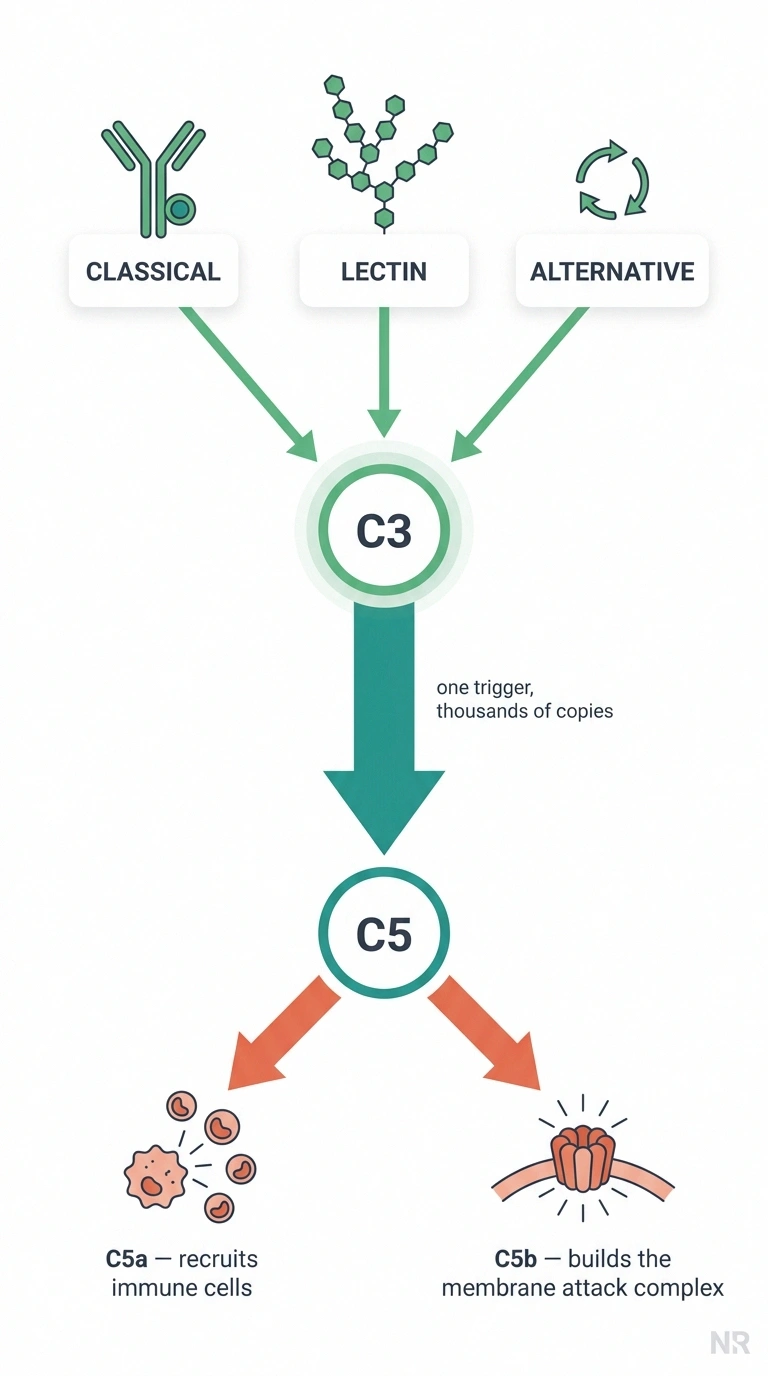
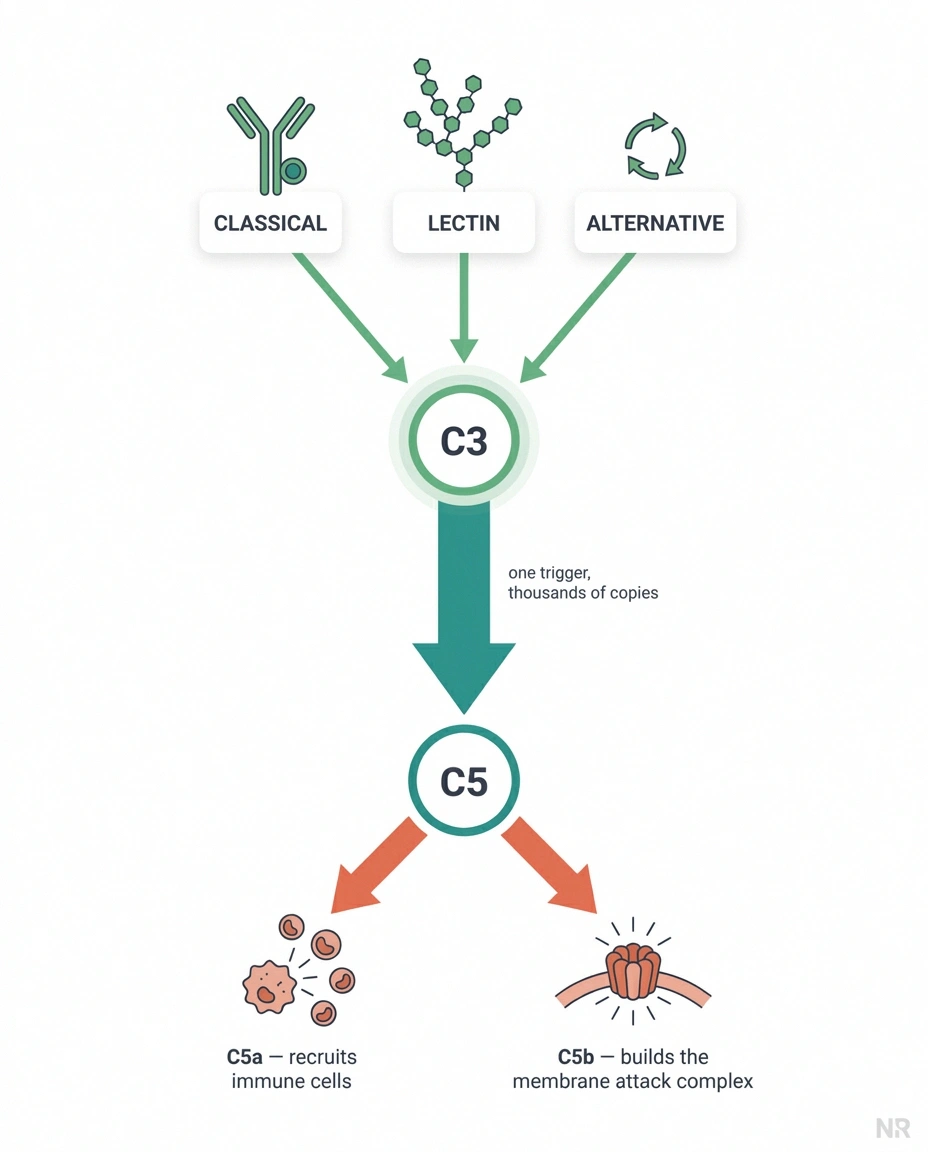
The cascade has three separate on-ramps, and knowing which one matters is the difference between the drugs that are being tested now.
The cascade runs top to bottom. Blocking it high stops everything downstream but also removes complement’s normal defensive jobs; blocking it low is narrower. That tradeoff is the whole design argument between these drugs.
| Step | What happens there | Blocked by |
|---|---|---|
| C1q | Recognizes clustered antibody, starts the classical pathway | Tanruprubart (GBS, phase 3) |
| C1s | The enzyme C1q switches on; first amplification step | Riliprubart (CIDP, phase 3) |
| C3 | Convergence point for all three pathways; huge amplification | Not targeted in neuropathy trials |
| C5 | Splits into C5a (recruits macrophages) and C5b (builds the pore) | Eculizumab (off-label, case reports) |
| C5b-9 | Membrane attack complex assembles; pore opens in the nerve membrane | Nothing acts here directly |
Anything acting at C5 or above removes your main defense against meningococcal bacteria, which is why vaccination comes before the first dose rather than after it.
The classical pathway. Antibodies bind to a target. A protein called C1q recognizes the tail ends of those clustered antibodies, latches on, and activates its partner C1s. From there the cascade runs. This is the pathway that matters most in the autoimmune neuropathies, because it’s the one antibodies switch on.
The lectin pathway. Triggered by certain sugar patterns on microbial surfaces. No antibody required.
The alternative pathway. Ticking over constantly at a low idle, sampling surfaces. Your own cells carry regulator proteins that shut it down instantly. Bacteria don’t, so it sticks to them and amplifies. It also functions as a massive amplification loop for the other two pathways once they’re running.
All three converge on the same place: cleaving C3, then C5. And what happens after C5 is where nerves get hurt.
The Two Business Ends of the Cascade
When C5 is cleaved it splits into two fragments, and they do different jobs.
C5a is a distress flare. It’s a small soluble fragment called an anaphylatoxin, and it diffuses away from the site and screams for backup. Macrophages and neutrophils follow the C5a gradient to its source. It also makes local blood vessels leakier, which lets more immune cells and more antibody into tissue that’s normally kept fairly separate from the bloodstream.
C5b builds a hole. C5b recruits C6, C7, C8, and then multiple copies of C9, and the assembly inserts itself into a cell membrane and forms an open pore. Its formal name is the membrane attack complex. Researchers write it as MAC or C5b-9.
A cell with unrepaired pores in its membrane cannot hold its internal chemistry apart from the outside world. Calcium floods in. Sodium follows. Water follows sodium. The cell either dies or is left badly injured and leaking.
Hold that image, because it’s the mechanism underneath both illnesses in this article.
Why Peripheral Nerves Are Such a Soft Target
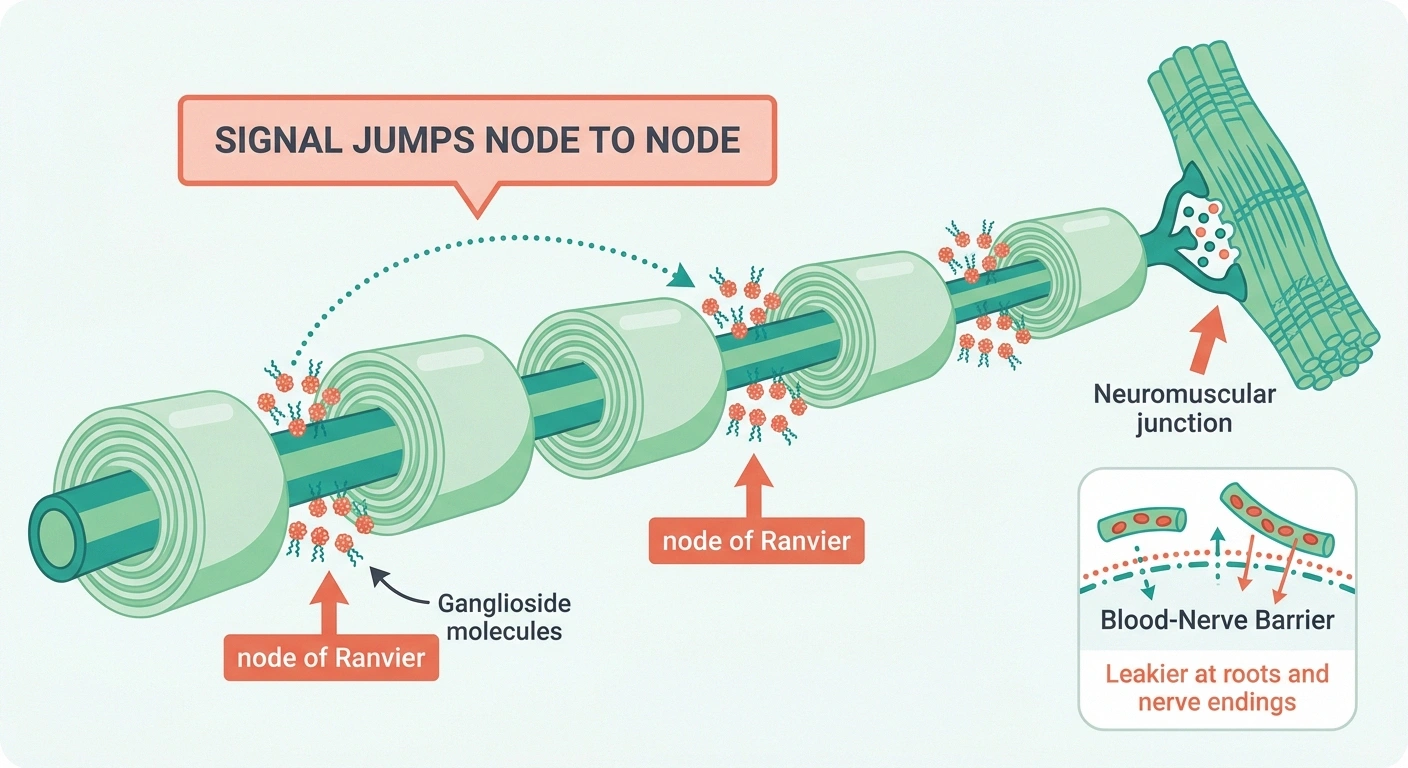
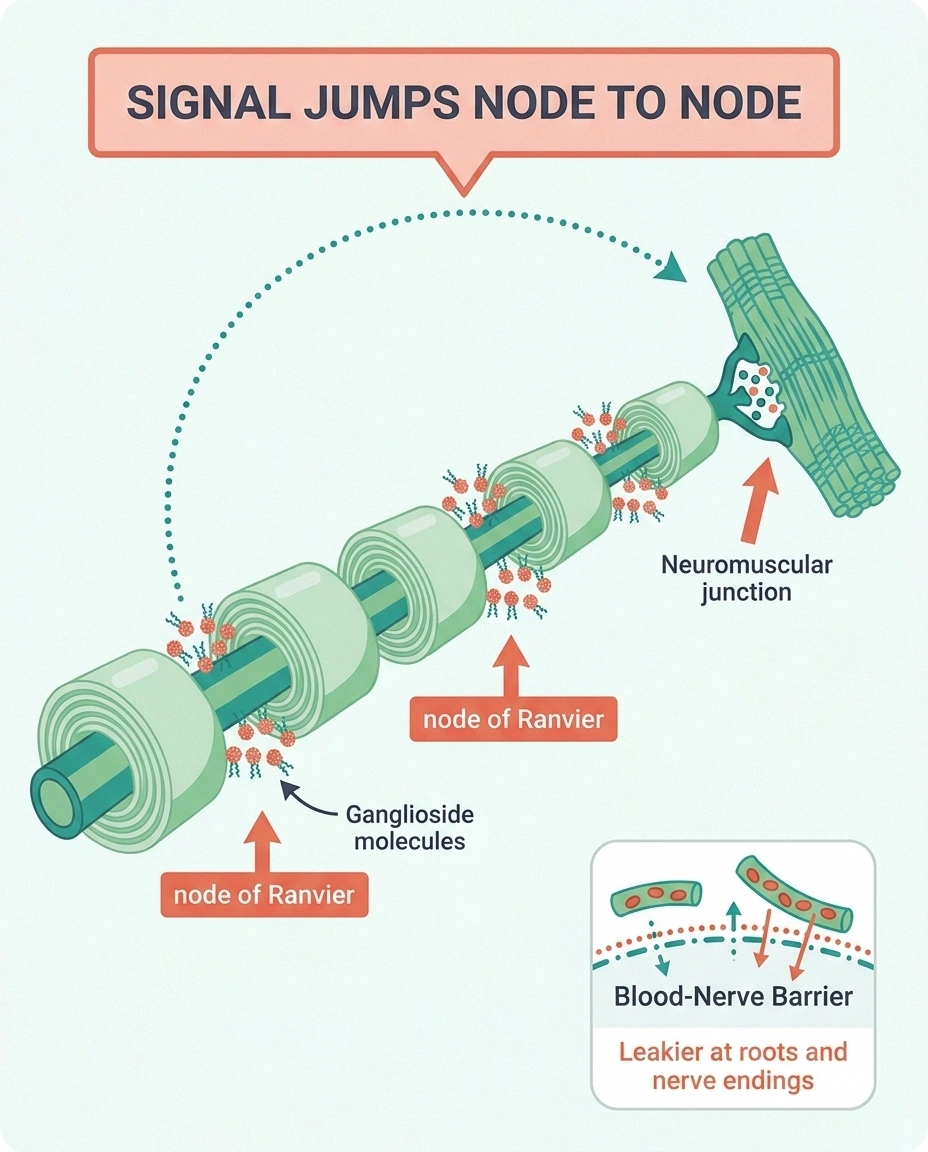
Your brain and spinal cord sit behind the blood-brain barrier, which does a formidable job of keeping circulating antibodies and complement proteins out. Peripheral nerves have a blood-nerve barrier too, and it is genuinely leakier. At the nerve roots where they exit the spine, and at the far ends where motor nerves meet muscle, it’s leakier still.
That’s not a design flaw so much as a tradeoff — peripheral nerves need to sense and repair, and that requires traffic — but it means the nerves running down your arms and legs are more exposed to whatever is circulating than nearly any other neural tissue you have.
Then there’s the matter of what’s on the surface. Nerve membranes are studded with gangliosides, which are fat-and-sugar molecules concentrated at the most electrically critical points on the nerve. Some bacteria happen to display sugar patterns that look remarkably like human gangliosides. Campylobacter jejuni, a common cause of food poisoning, is the classic offender.
Your immune system builds antibodies against the bacterium, wins that fight, and then those same antibodies find a molecular near-match on your own nerves. That’s molecular mimicry, and it’s the central story of how a stomach bug becomes paralysis a couple of weeks later. If you want the wider picture of how these misfires happen, our overview of autoimmune neuropathy and the immune system covers the territory beyond complement alone.
Guillain-Barré: The Fast Version

In the axonal variants of Guillain-Barré syndrome, anti-ganglioside antibodies bind at two particularly vulnerable spots: the nodes of Ranvier, which are the tiny bare gaps between myelin segments where the electrical signal regenerates, and the nerve terminals where nerve meets muscle.
Those antibodies fix complement. C1q docks, the cascade runs, C5a pulls macrophages to the site, and the membrane attack complex assembles right on the axon membrane at the node. Animal work has shown the sequence directly, and shown that blocking it early prevents the injury.
This explains a few things that puzzle patients.
It explains the speed. A cascade that amplifies thousands-fold in seconds doesn’t need weeks. Weakness that goes from tingling feet to unable-to-climb-stairs in three days is what a chain reaction looks like from the inside — not a slow illness that happens to be moving fast, but a fundamentally different kind of process.
It explains why the nodes matter so much. Damage a node and the signal can’t jump properly to the next one, which is why conduction slows or blocks before any nerve fiber has actually died. That difference between a blocked nerve and a dead one is the difference between weeks of recovery and months, and it’s worth understanding the distinction between demyelinating and axonal damage if you’re trying to make sense of your own nerve conduction results.
And it explains why the treatments are what they are. Plasma exchange physically removes circulating antibodies and complement proteins from the blood. IVIG appears to work in several ways at once, and one of them is scavenging activated complement fragments before they can assemble on nerve. Both of these treatments are, in part, complement interventions that were in use for decades before anyone framed them that way.
CIDP: The Slow Version
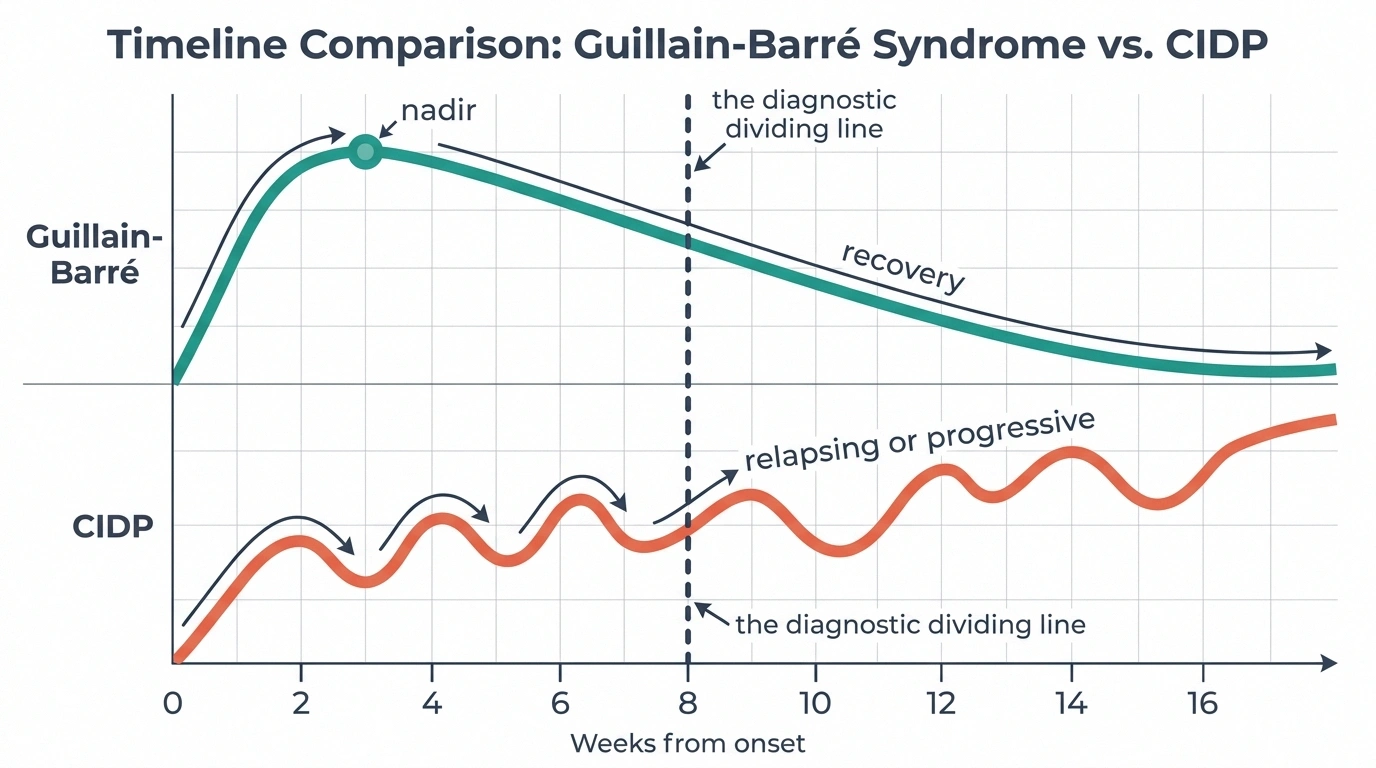
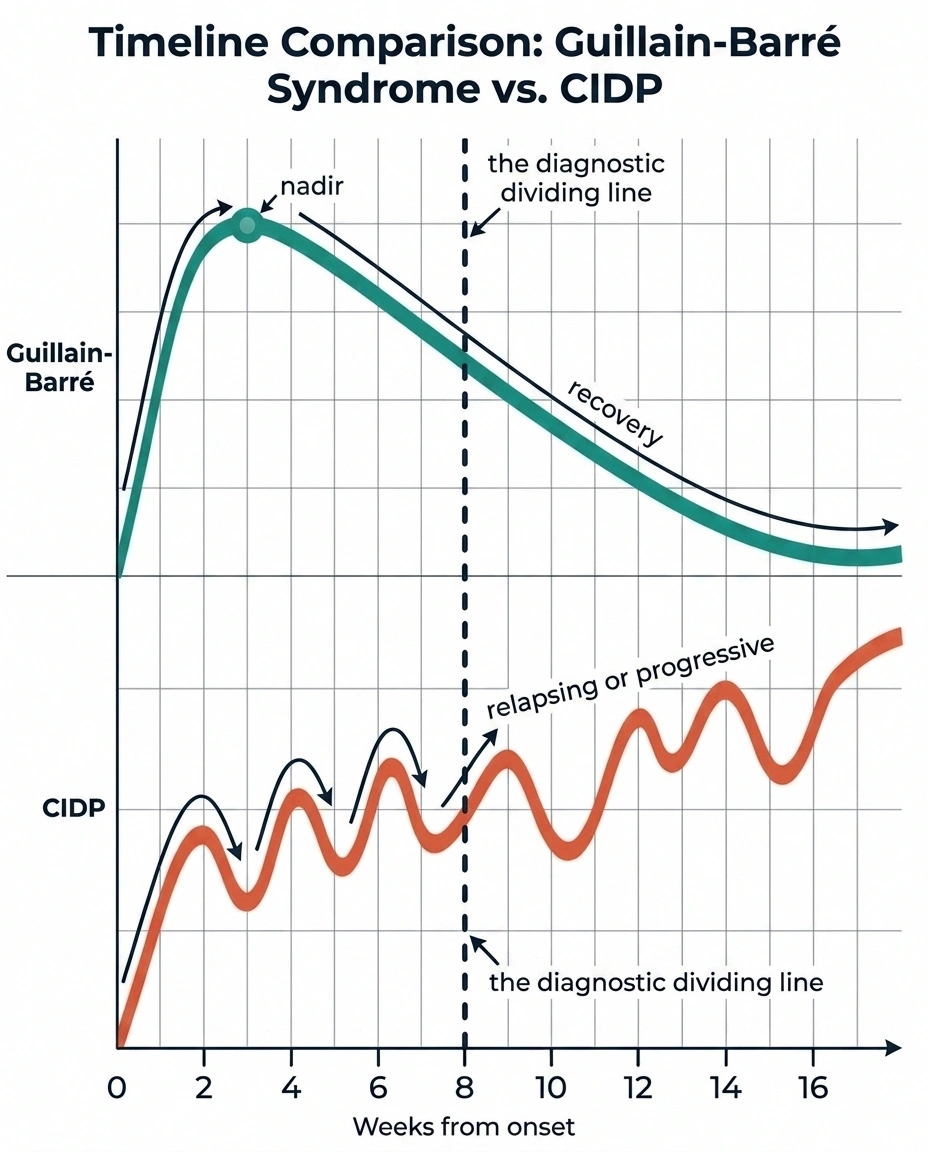
CIDP runs on a longer clock, over months rather than days, and its relationship with complement is a little different but still central.
The diagnostic dividing line between these two is the eight-week mark, and it exists because of how long the complement attack keeps being renewed.
Guillain-Barré. Reaches worst point within 4 weeks, most often inside 2. One wave of antibody, one burst of complement activation, then the immune response burns out on its own. Recovery starts once the attack stops, which is why treatment given early changes the ceiling and treatment given late mostly does not.
CIDP. Progresses beyond 8 weeks, or relapses. The antibody supply keeps being replenished, so complement keeps being activated in waves. This is why CIDP needs maintenance treatment while Guillain-Barré usually does not, and why a CIDP relapse tends to follow a dose interval rather than an infection.
The evidence here is more direct than most patients realize. A 2016 study measured complement activity in people with CIDP who hadn’t yet been treated and found elevated levels of both C5a and the soluble terminal complement complex in serum and in spinal fluid. More striking, the degree of terminal complement activation tracked with how severe the disease was. More cascade activity, more disability, measured rather than inferred.
That’s the kind of finding that turns a mechanism from an interesting theory into a treatment target.
In CIDP the damage lands more often on myelin than directly on the axon. Complement deposits on the outer surface of the myelin sheath, macrophages arrive following the C5a signal, and they strip myelin off the nerve fiber. Do that repeatedly, over months, with partial repair in between, and you get the thickened onion-bulb appearance pathologists describe on nerve biopsy — layer on layer of stripped and rebuilt myelin. If the role of myelin itself is fuzzy, our piece on the myelin sheath and what demyelination means is the plain-language version.
There’s also a subgroup where complement is largely beside the point, and it matters enormously for treatment. In the autoimmune nodopathies, the culprit antibodies are of a class that barely activates complement at all. They cause harm by physically disrupting the protein architecture at the node instead. Those patients often respond poorly to IVIG and well to therapies that remove the antibody itself. Same-looking disease, different machinery, different answer — which is a good argument for pushing on antibody testing if the standard treatment isn’t landing.
How Complement Activity Gets Measured

You are unlikely to be handed a complement panel at a routine appointment, and it’s worth knowing why.
- CH50
- Whether the classical pathway works end to end. Low usually means an inherited deficiency, not active nerve inflammation. Not a disease-activity number.
- sTCC or C5b-9
- Soluble terminal complement complex. Membrane attack complexes that assembled and washed off into fluid. Elevated in untreated CIDP, and the level tracks with severity.
- C5a
- The recruitment signal. Elevated in serum and spinal fluid in active disease. Mostly a research measurement at this point.
- NfL (neurofilament light chain)
- Not a complement marker at all. A structural protein released when axons break. Rising means damage is happening now; falling on treatment is the most direct evidence that a drug is protecting nerve. This is the number to ask about.
Total complement activity, sometimes ordered as CH50, tells you whether the whole classical pathway is functionally intact. It’s used mainly to hunt for inherited deficiencies, not to grade nerve inflammation. C3 and C4 levels are ordered fairly often in lupus and some kidney disease, where consumption of complement drops the circulating levels measurably. In the neuropathies, the numbers aren’t reliable enough at the individual level to steer treatment.
The measurements that actually track nerve disease are C5a and the soluble terminal complement complex, plus neurofilament light chain, which isn’t a complement marker at all but a protein released when axons are damaged. Neurofilament is the one to watch. It’s moving from research labs into clinical use fastest, and it does something no complement assay does — it reports on whether nerve is being destroyed right now, this month, in you.
For the moment, the clinical picture and nerve conduction studies are still what guide care. The blood markers are catching up.
The Drugs Built to Interrupt the Cascade

Here’s where the story gets genuinely encouraging, and where I want to be careful not to oversell.
Written to be asked out loud. Each one has a decision attached to the answer, which is what separates a useful question from an interesting one.
- Has my antibody panel been run, and does it include the nodal antibodies such as NF155, CNTN1 and Caspr1? A positive result argues against IVIG as first choice.
- Is my neuropathy considered complement-mediated, or is another mechanism more likely here?
- Has a neurofilament level been measured, and can it be repeated to track whether treatment is protecting nerve?
- Am I eligible for any of the complement trials currently recruiting, and would you refer me?
- If my current treatment is only partly working, what is the trigger point for changing it rather than waiting?
Eculizumab was the first complement inhibitor approved for human use, developed for other conditions entirely. It binds C5 and stops it being cleaved, so no C5a and no membrane attack complex. It has been used off-label in refractory CIDP with published case reports of clear improvement, including in children with recurrent demyelinating neuropathy. It has never been through a large CIDP trial.
Riliprubart takes a different tack, blocking C1s and shutting the classical pathway at the top rather than at C5. Its phase 2 work in CIDP is the most substantial complement data in this disease so far. Among participants switched from standard treatment, most stayed stable or improved. Roughly half of the participants who had already failed standard therapy responded. Motor function was stable or better in the high 80s to low 90s percent at 24 weeks, and neurofilament levels dropped, which suggests the drug is reducing actual axon damage rather than just making people feel better. Two phase 3 trials, MOBILIZE and VITALIZE, are running now.
Tanruprubart targets C1q, the very first recognition protein in the classical pathway, and is aimed at Guillain-Barré rather than CIDP. A phase 3 trial of a single infusion reported better disability scores, less need for mechanical ventilation, benefit visible within the first week, and effects sustained over six months. In a disease where the standard treatments have barely changed in thirty years, that is a real development.
The catch is not small. Blocking complement blocks it everywhere, and complement is your primary defense against a specific family of bacteria: the meningococci that cause meningitis. Anyone on a C5 inhibitor is vaccinated against meningococcal disease beforehand and often kept on standing antibiotics. This is a managed risk, not a theoretical one — and it’s the main reason these drugs won’t ever be handed out casually.
The other catch is timing. If your nerve damage was done last year, blocking the cascade today cannot undo it. These drugs stop ongoing injury. Repair is a separate and much slower process — one your body has to do itself, at its own pace, over months.
What Any of This Changes for You

If you’re living with CIDP or recovering from Guillain-Barré, the mechanism isn’t just trivia. A few things follow from it.
Speed matters more than it feels like it should. A cascade that’s actively running is doing damage on a timescale of days. Delay in starting treatment is one of the few variables with a consistent relationship to long-term outcome — and it’s the one most affected by whether a patient pushes.
Not responding to IVIG is information, not failure. If IVIG hasn’t worked, that’s a reason to ask whether the nodal antibodies are in play, and whether antibody-directed treatment or plasma exchange fits better. The question “which antibody do I have” is now a real question with real consequences.
Trials are worth asking about. The complement drugs are in active recruitment, and refractory patients are exactly who several of these studies are looking for.
And there’s something quieter, too. A lot of people carry a background suspicion that their body simply broke for no reason. It didn’t. A specific, ancient defense system was pointed at the wrong target by a specific antibody, and researchers now know enough about that chain of events to interrupt it at three different points. That’s not a cure. It’s still a considerably better place to stand than not knowing.
Frequently Asked Questions
Is complement the same thing as inflammation?
No, though they travel together. Complement is a specific set of about thirty blood proteins that activate in a cascade. Inflammation is the broader tissue response that includes swelling, immune cell recruitment, and increased blood flow. Complement is one of the things that triggers inflammation, and the C5a fragment in particular is a powerful recruiter of inflammatory cells.
Can a regular blood test tell me if complement is attacking my nerves?
Not reliably at this point. Standard C3, C4 and CH50 tests measure whether the system is present and functional, not whether it’s damaging peripheral nerve. The markers that correlate with nerve disease, such as C5a, the soluble terminal complement complex, and neurofilament light chain, are mostly used in research settings, though neurofilament testing is becoming available in more clinical labs.
Does complement play a role in diabetic neuropathy too?
There is research suggesting complement activation contributes to nerve damage in diabetes, but the mechanism is different from the antibody-driven attack seen in CIDP and Guillain-Barré. It appears to be one contributor among several rather than the primary driver, and complement-blocking drugs are not being developed for diabetic neuropathy the way they are for the autoimmune neuropathies.
If complement inhibitors work so well, why isn’t everyone on them?
Several reasons. Most are still in trials rather than approved for these conditions. They suppress an important defense against meningococcal bacteria, so they require vaccination and careful monitoring. They are expensive and given by infusion. And they stop ongoing damage rather than reversing damage already done, so they help most in active disease.
Will blocking complement stop me fighting off infections?
Partly. The main documented risk is with encapsulated bacteria, especially meningococcus, which is why vaccination before starting and sometimes ongoing antibiotics are standard practice. Your antibodies, T cells, and other immune defenses continue working normally.
How fast does the complement cascade actually run?
Seconds to minutes from trigger to membrane attack complex formation. That biological speed is part of why acute Guillain-Barré can progress from mild tingling to significant weakness within days, and why treatment delay carries real consequences.
Is there anything I can do at home to reduce complement activity?
No supplement or dietary approach has been shown to meaningfully modulate complement activation in autoimmune neuropathy. This is one area where the answer is genuinely medical treatment rather than self-management. What you can influence is everything around it: staying mobile, protecting your feet, managing fatigue, and getting seen quickly when symptoms change.
About the Author