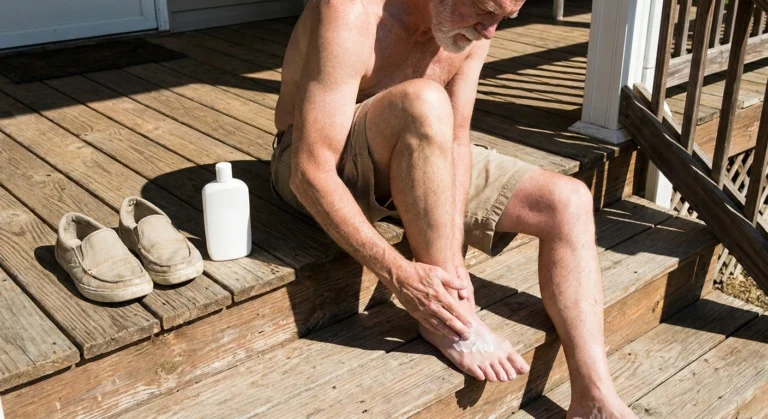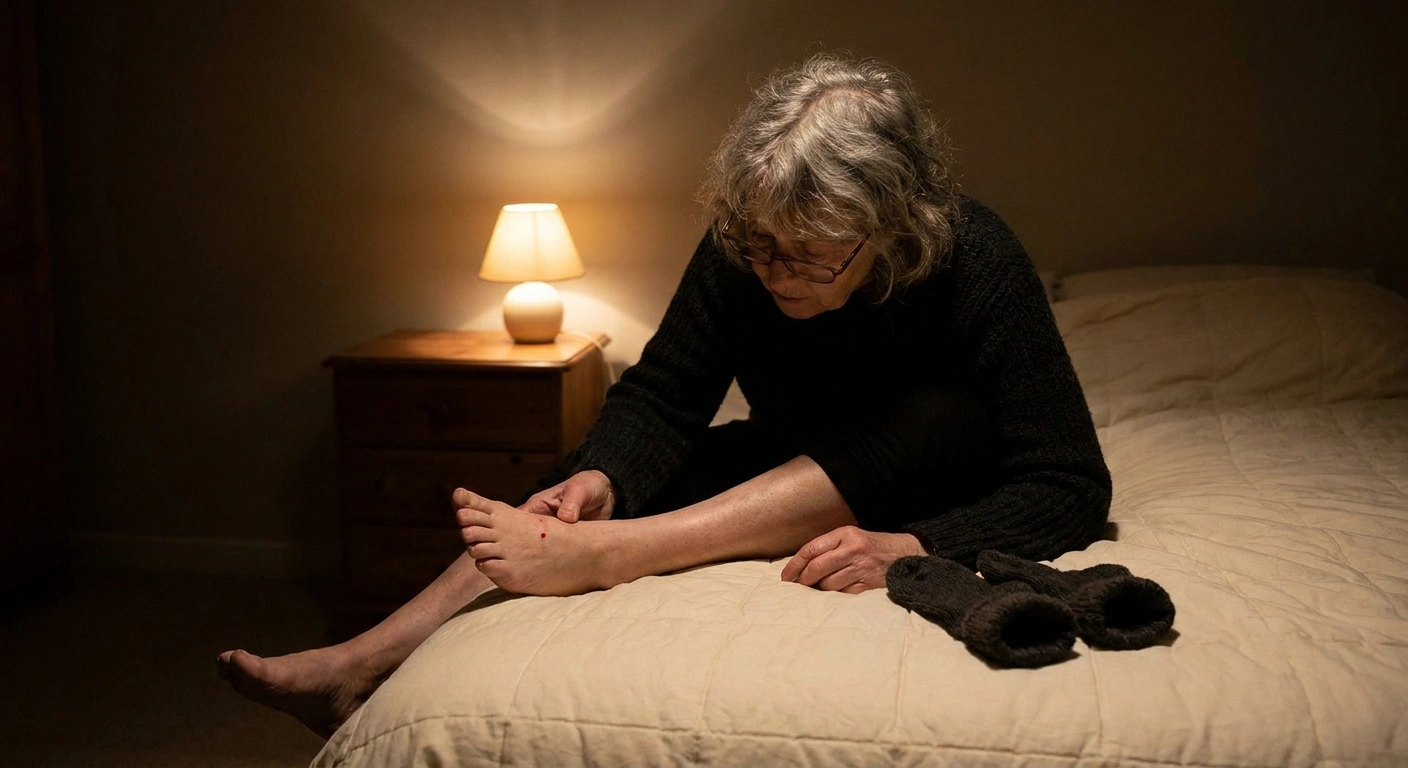
You peel off your socks before bed and there it is: a red bump on the top of your foot, or a cluster of little white-topped blisters around the ankle. You never felt a thing — not then, not since. No itch, no sting, no “ouch.” That’s the strange reality of numb feet. The insect did its job, and your nerves forgot to send the memo.
Here’s what to do in the next five minutes, before you read another word. Wash the spot with soap and water. Take a photo of it. Then draw a thin line around the edge of any redness with a washable marker or a pen. Those three steps cost nothing and give you something no doctor can recreate later — a starting point.
The rest of this guide explains why bites and stings are a bigger deal when you can’t feel your feet, how to tell an ordinary bite from one that’s turning into an infection, and the short list of signs that mean “get seen today.” I’m a patient advocate who lives with neuropathy, not a clinician, and I’ll flag where the line between home care and medical care sits.
Why a Bite You Can’t Feel Is a Different Problem
For most people, a bug bite is a nuisance. It itches, they put something on it, it goes away. Three things change that picture when your feet are numb.
You find it late. Pain and itch are an early-warning system. Without them, a bite can sit for a day or two before you see it, often only because you happened to look. By then, any infection has had a head start.
You may scratch without knowing. Plenty of us rub one foot against the other in bed or scratch at an ankle while reading, half-asleep. With reduced feeling, it’s easy to break the skin over a bite without realizing it. That broken skin, not the insect itself, is the usual doorway for infection. As Cleveland Clinic puts it, an insect can’t give you cellulitis, but the opening it leaves can let bacteria in.
Healing can be slower. If your neuropathy comes with diabetes or poor circulation, small wounds on the feet heal more slowly and infections can spread faster. Cleveland Clinic notes specifically that diabetic neuropathy in the feet raises the risk of cellulitis because foot injuries go unnoticed. And a foot infection is how a lot of the serious problems described in my guide to diabetic foot ulcers and neuropathy get started.
None of this means every mosquito bite is an emergency. Almost all of them aren’t — thank goodness. It means your eyes have to do the job your nerves used to do.
The Usual Suspects Below the Knee
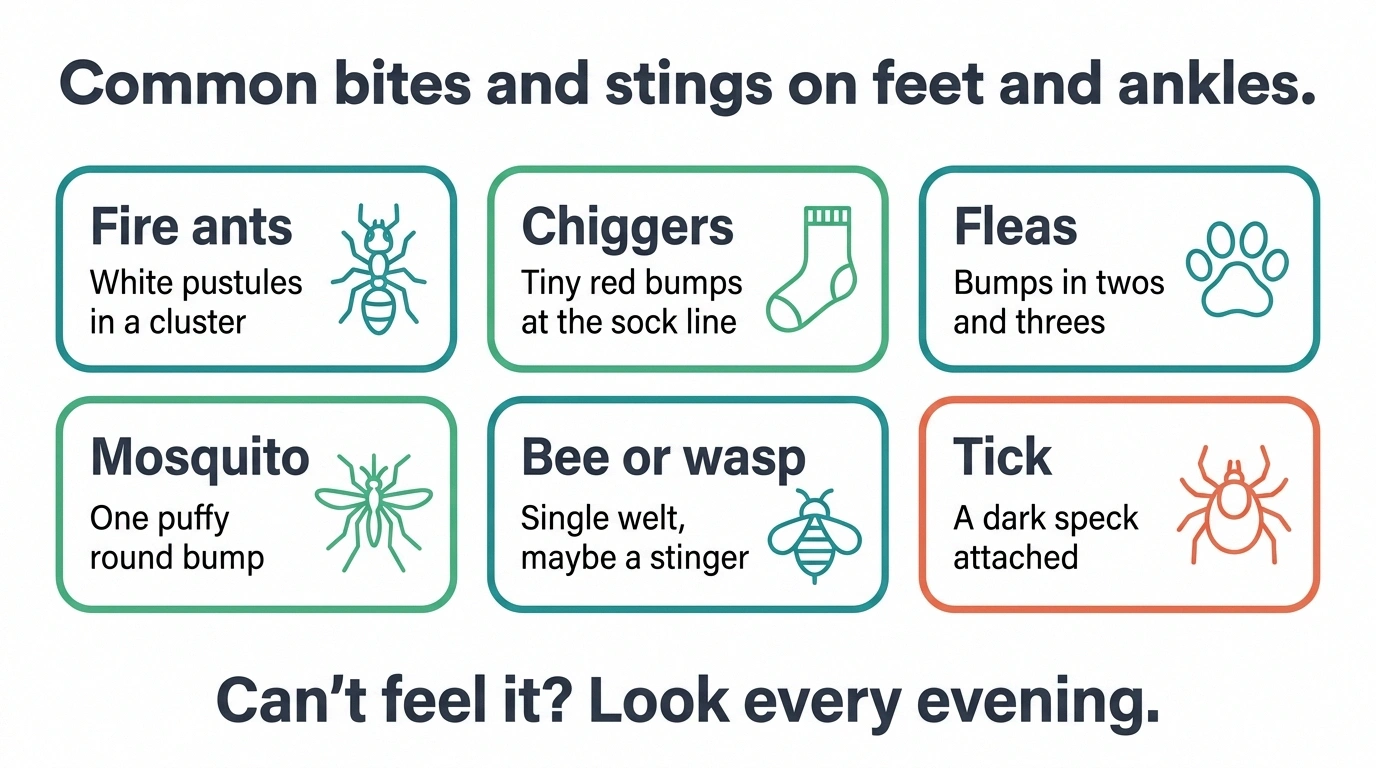
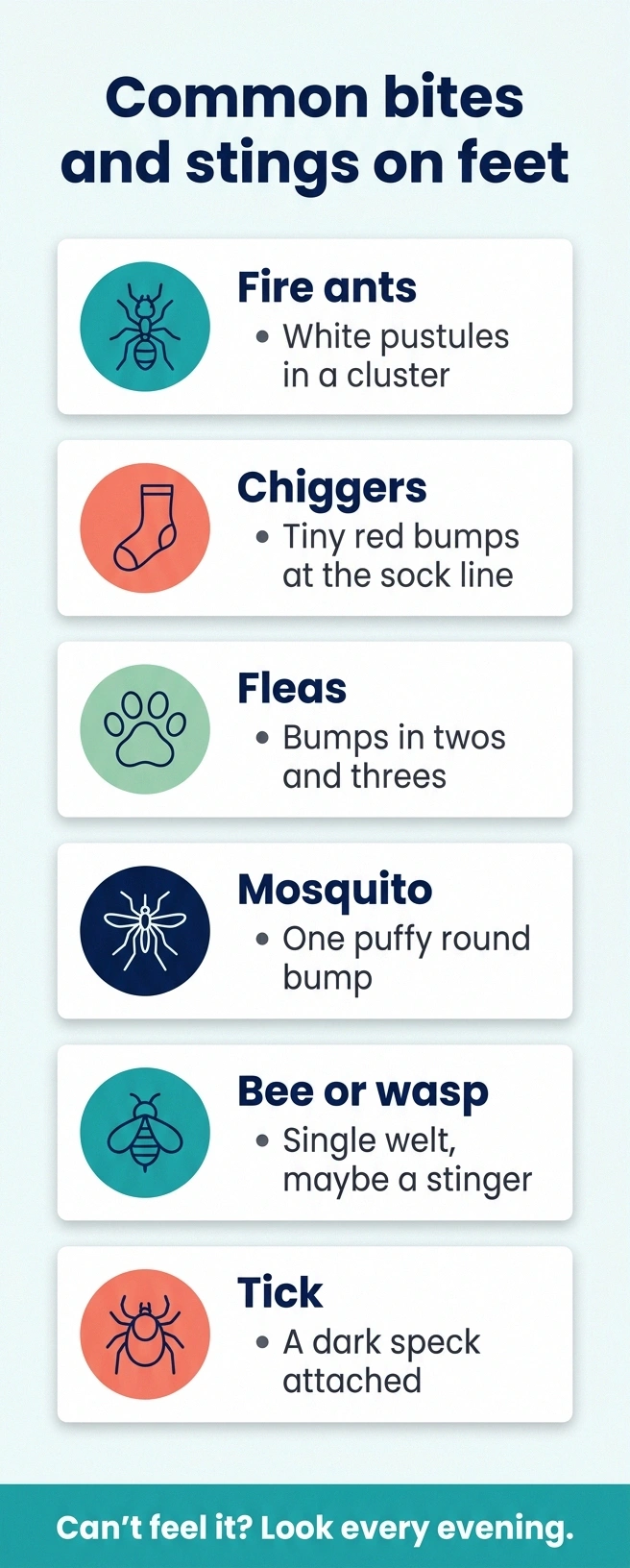
Feet and ankles are close to the ground, so a handful of insects account for most of what we find. Knowing the pattern helps you guess what you’re dealing with:
| What you see | Likely culprit | Typical course |
|---|---|---|
| White-topped pustules in a cluster or line | Fire ants | Pustules by about 24 hours, crusting over several days |
| Many tiny red bumps at the sock line | Chiggers | Most intense days 1 to 2, fading over 1 to 2 weeks |
| Small bumps in twos and threes on the ankles | Fleas | Keep appearing until pets and home are treated |
| One puffy, round bump | Mosquito | Gone in a few days |
| A dark speck attached to the skin | Tick | Remove now; watch the spot for 30 days |
| A growing, hot lump with a pus-filled center | Often not a bug at all: a staph abscess | Gets worse, not better; needs a same-day visit |
- Fire ants: several stings in a cluster or a line, often on the feet and ankles after standing near a mound. Within a day, they form tiny white pustules. Common across the southern US.
- Chiggers: clusters of small, very red bumps around the ankles, the sock line and anywhere clothing presses. Usually after walking in tall grass or brush.
- Fleas: small red bumps in groups of two or three around the ankles and lower legs, often with a pet in the house.
- Mosquitoes: single, puffy, round bumps on exposed skin, usually around dusk.
- Bees and wasps: a single painful-for-everyone-else welt, often from stepping barefoot on clover or near a dropped soda can. Honeybees may leave a stinger behind.
- Ticks: not a bump at first but the tick itself, attached. Behind the knee, at the ankle, at the sock line and between the toes are common spots.
- Spiders: true spider bites are less common than people think, which is a whole section of its own below.
One more category is worth naming because it fools people with neuropathy: sometimes there’s no insect at all. A crawling, prickling or biting sensation on the skin can be a nerve symptom called formication. If you keep feeling “bites” but never find a mark, my piece on formication and neuropathy explains what’s going on.
The First Ten Minutes After You Find One
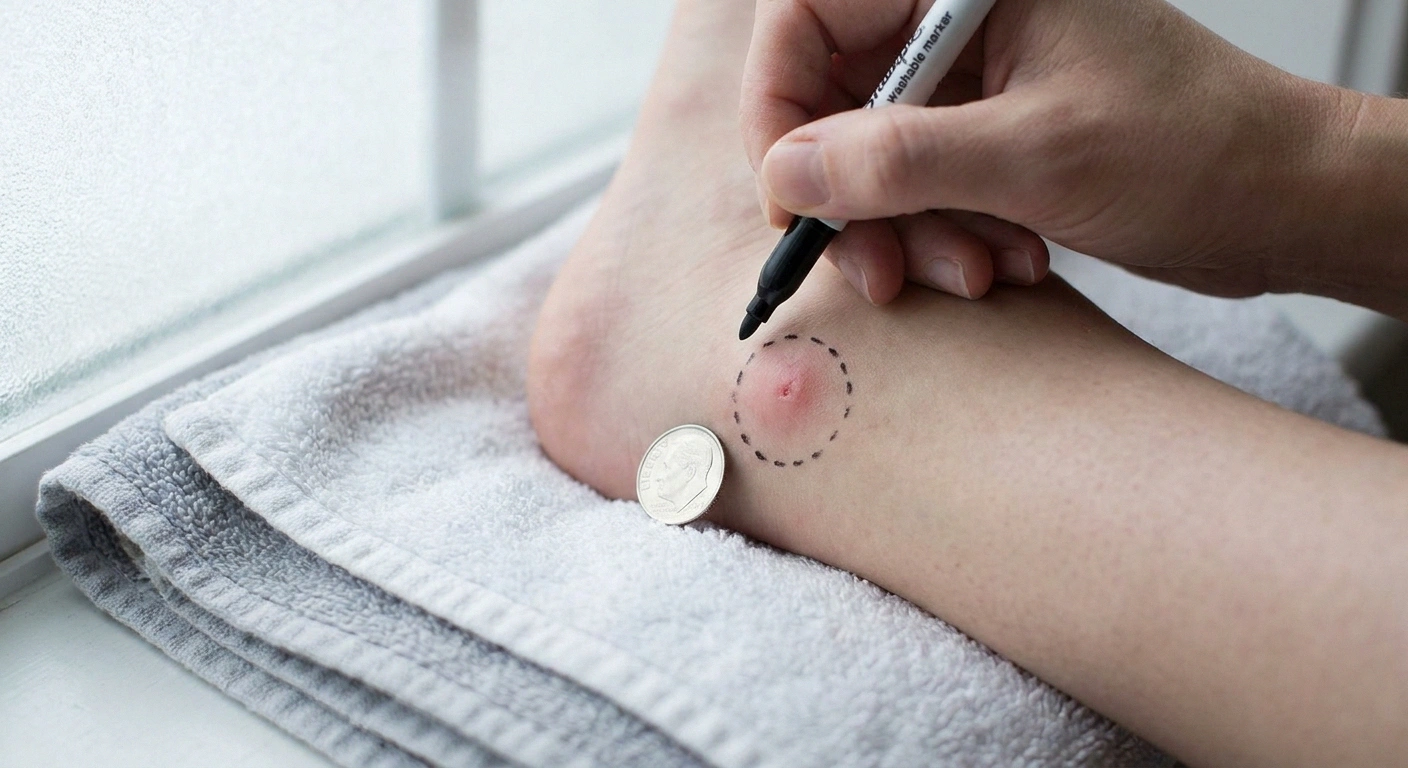
Here’s the routine I use, in order. It’s simple enough to do sitting on the edge of the bed.
Three checks, three photos
| Hour 0 | Wash, mark the border, photo with a coin beside it |
| Hour 12 | Photo from the same angle; compare redness with the line |
| Hour 48 | Photo again. Smaller or the same: keep watching. Bigger, warmer or weeping: get it seen today |
A ballpoint pen line can wash off in the shower. Redraw it after bathing, slightly outside the old line if the redness has truly grown, and note the time.
- Sit down and get good light. Use a lamp and, for the sole or the back of the heel, a hand mirror or a phone camera. If you can’t see well or bend easily, ask someone to look.
- Remove anything left behind. A honeybee stinger can be scraped sideways off the skin with a fingernail or the edge of a card. For a tick, use fine-tipped tweezers, grasp it as close to the skin as you can, and pull straight up with steady pressure. Don’t twist it, burn it or smother it in petroleum jelly.
- Wash with soap and lukewarm water, then pat dry. Check the water with your elbow or a thermometer first. Numb feet can’t judge temperature.
- Cool it, carefully. A cool, damp cloth or an ice pack wrapped in a thin towel for up to 10 minutes eases swelling. Never put ice straight on numb skin. My guide to using ice packs safely with neuropathy explains why.
- Mark and photograph it. Trace the edge of any redness with a washable marker and take a photo with something for scale, like a coin. Write the date and time on a note.
- Treat the itch you can’t feel. It sounds odd — but an itch you don’t notice can still make you scratch in your sleep. An over-the-counter oral antihistamine or a thin layer of hydrocortisone cream on unbroken skin can calm the reaction. Check with your pharmacist about which antihistamine suits your other medicines, since some cause drowsiness or confusion in older adults.
- Cover it loosely with a non-stick bandage if it’s somewhere a shoe or sock will rub, and change into clean socks.
Then set a reminder on your phone to look again in the evening and the next morning. Most bites look their worst at about a day and then fade. The ones that don’t are the ones you’re watching for.
Fire Ants Deserve Their Own Section

If you live in the South, you probably know fire ants already. If you have numb feet, they’re worth extra respect, because you can stand on a mound and collect a dozen stings before you notice the ants on your shoes.
The sting itself burns for most people. Within about four hours, small blisters form, and by around 24 hours they turn into the classic white-topped pustules. Here’s the part most people get wrong — those pustules are sterile. They’re caused by chemicals in the venom, not by infection. Medical references describe them lasting several days before they break and crust over.
Popping or scratching them is what turns a sterile pustule into an infected one. Medical references specifically note that people with diabetes face a higher risk of that kind of secondary infection, because of the circulation and nerve changes in their feet.
So for fire ant stings:
- Brush the ants off quickly (they cling and keep stinging), then step away from the mound.
- Wash, cool and mark the area as described above.
- Leave the pustules alone. Don’t pop them, lance them or pick at them. Cover them loosely if shoes rub.
- If one breaks on its own, wash it gently with soap and water and keep it covered.
- Watch for redness or swelling that shows up or grows a day or two after the stings, rather than right away. That timing points toward infection rather than the sting reaction.
The 48-Hour Watch: Bite or Infection?

Normal bite reactions usually peak within the first day and settle after that. Infection runs the other way: it gets worse with time. Clinical sources point to these signs that a bite is becoming infected:
How fast to act on a bite on a numb foot
- Call 911
- Breathing trouble, face or throat swelling, fainting, or hives spreading over the body after a sting.
- Urgent care or ER today
- A red streak climbing the leg, fever or chills, or a whole foot that is hot, swollen and discolored.
- Same-day call to your doctor or podiatrist
- Redness past your line, pus, an open sore, or unexplained high blood sugar readings in someone with diabetes.
- Home care and watching
- A bump that stays inside the line and looks the same or better at 48 hours.
- Redness that spreads beyond the line you drew
- Swelling, warmth or tenderness that grows after the first 48 hours instead of easing
- Pus, cloudy drainage, or yellow crusting
- Red streaks running up the foot or leg from the bite
- Fever, chills, or just feeling unwell
Your marker line is your best friend here — truly. Cleveland Clinic suggests exactly this trick: if the redness, swelling or blisters spread past the border, contact a healthcare provider promptly. With numb feet, “promptly” means the same day.
Two more clues matter especially for us. First, warmth: rest the back of your hand on the bite, then on the same spot on the other foot. A clearly warmer foot is a warning even when nothing hurts. Second, a change in blood sugar: if you have diabetes and your readings climb for no clear reason, an infection somewhere can be the cause. Doctors who treat diabetic foot infections rely heavily on what they can see and touch (redness, warmth, swelling), precisely because neuropathy hides the pain that would normally announce a problem.
A spreading red area with fever, a red streak climbing the leg, or a foot that’s suddenly swollen, hot and discolored needs urgent care today, not a wait-and-see.
Spider Bite, or Something Else?
When a painful-looking red lump appears on a foot, “spider bite” is often the first guess, from patients and sometimes from clinicians. It’s frequently the wrong one — and the wrong guess can delay the right treatment.
A letter in American Family Physician and a case series from a Texas clinic both described patients told they had spider bites who actually had abscesses caused by community-acquired MRSA, a type of staph bacteria resistant to some common antibiotics. True brown recluse bites are uncommon and, even when they happen, most don’t turn serious.
Why does the label matter? Because an abscess usually needs to be drained and cultured, and sometimes treated with specific antibiotics, while a true insect bite usually just needs time. One rough clue mentioned in these sources: insect and spider bites tend to weep clear fluid, while staph abscesses usually fill with pus. If a “bite” is growing, has a pus-filled center, or is very warm and firm, it’s worth a same-day visit. Ask whether the clinician plans to culture it.
Ticks on Feet You Can’t Feel
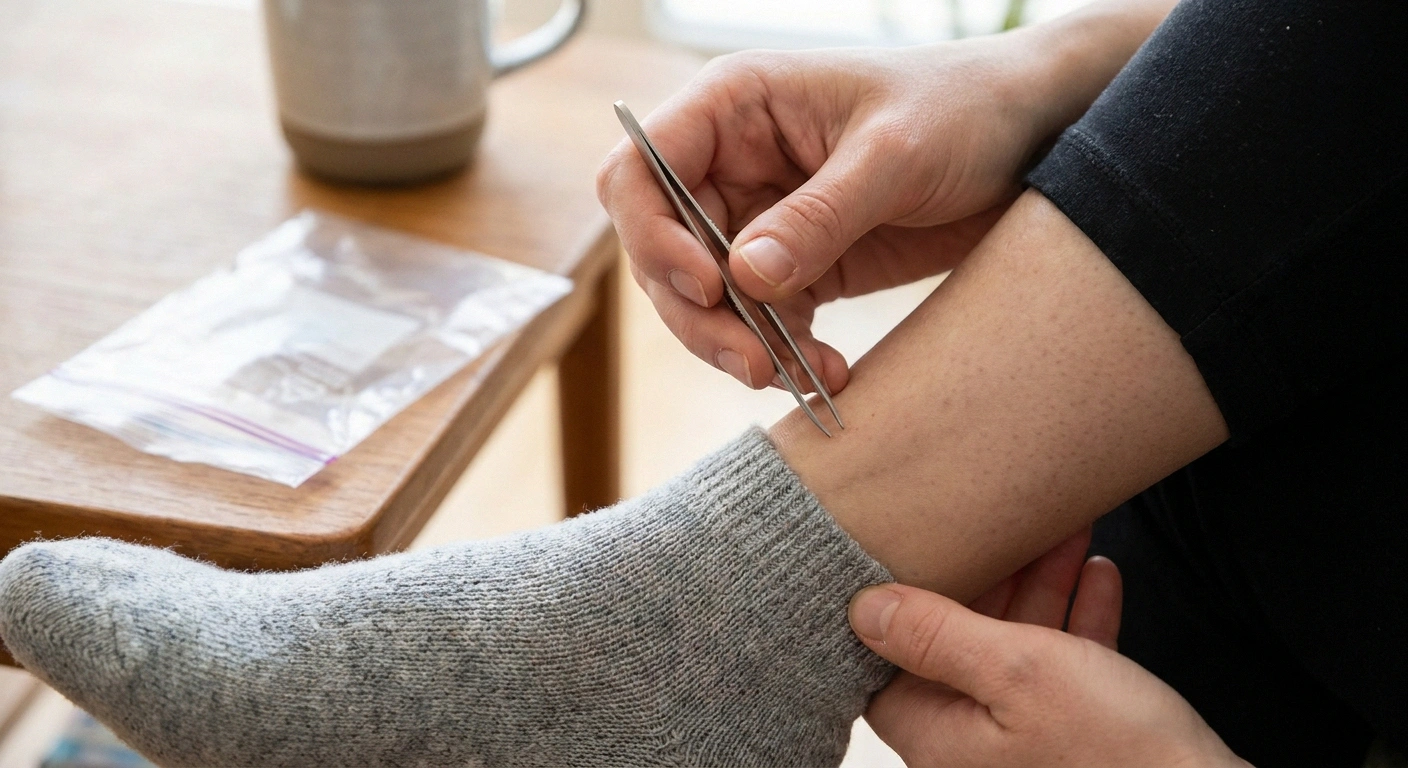
Ticks rarely hurt when they bite, even with perfectly healthy nerves. With neuropathy, you’re relying entirely on looking. After any time in grass, woods or brush (including your own backyard in tick country), check your feet, ankles, the backs of your knees and the sock line. A tick on the foot can be as small as a poppy seed.
Keep the tick, at least for a while
Drop it into a small zip-top bag or tape it to a card, and write the date and where on the body it was attached. If a rash or fever shows up in the following weeks, knowing what kind of tick it was and roughly how long it was attached helps the clinician decide on testing or treatment. A photo works if you’d rather not keep it.
Prompt removal matters — a lot. According to the CDC, the tick that spreads Lyme disease generally needs to be attached for 36 to 48 hours or more to pass on the infection, so a nightly check is genuinely protective. After removing a tick, wash the area and note the date.
Over the next few weeks, watch for an expanding red rash (sometimes, but not always, with a bull’s-eye look), fever, aches or fatigue, and report them. There’s a twist here worth knowing: Lyme disease can itself cause nerve problems, including neuropathy. My guide to Lyme disease and neuropathy covers that connection.
When a Sting Is an Emergency
Allergic reactions have nothing to do with how well you can feel your feet, but they’re the one situation where minutes matter. Call 911 if, after any sting, someone has:
- Trouble breathing, wheezing or a tight throat
- Swelling of the lips, tongue, face or eyes
- Hives or flushing spreading over the body, far from the sting
- Dizziness, fainting, a racing heart, or confusion
- Vomiting or severe stomach cramps
If you’ve been prescribed an epinephrine auto-injector, use it and still call 911. A large, swollen area right around the sting (even if the whole foot puffs up) is usually a big local reaction rather than anaphylaxis. That’s uncomfortable and worth a call, but it isn’t the same emergency.
Keeping Bugs Off Your Feet in the First Place

Prevention is mostly about covering skin and looking before you step. A few habits make a real difference:
- Wear closed shoes outdoors, including on the lawn and the patio. Barefoot or open sandals in the grass is how most foot stings happen. My guides to the risks of going barefoot with neuropathy and to safer summer sandals go further.
- Socks matter. Light-colored socks make ticks easier to spot. Tucking pant legs into socks helps on trails.
- Use repellent on ankles and socks. EPA-registered repellents with DEET or picaridin work on skin. Permethrin is used on clothing and shoes (never on skin) and is especially good against ticks and chiggers.
- Look before you stand still. Glance down for ant mounds before you stop to chat in the yard, at a ballfield, or at a picnic.
- Shake out shoes that sit in a garage, porch or closet before putting them on.
- Gardening: wear closed shoes and gloves, and check your ankles afterward. My gardening tips for neuropathy cover more.
- Treat pets for fleas, since flea bites cluster on ankles.
And the big one — make the bite check part of a daily foot inspection you already do. My two-minute daily foot check takes care of it.
What Not to Do
Some popular home remedies do more harm on numb feet than anywhere else:
- Don’t pop, squeeze or cut blisters or pustules. That’s an open door for bacteria.
- Don’t use heat. Hot soaks, heating pads and hair dryers on a numb foot can cause burns you won’t feel. Some people use heat for itching; skip it.
- Don’t soak for long. Long foot soaks soften skin and make it easier to break.
- Don’t apply harsh chemicals such as bleach, rubbing alcohol on broken skin, or homemade pastes.
- Don’t wrap it tight. A snug bandage or compression sock over a swollen bite can cut off circulation you can’t feel.
- Don’t wait out spreading redness. “I’ll see how it looks next week” is the most expensive sentence in foot care.
Most bites and stings on numb feet heal without any trouble at all. The few that don’t are caught early by people who look, mark and check again. That’s a habit any of us can build.
Frequently Asked Questions
Why are bug bites more dangerous with neuropathy?
Because you may not feel the bite, the itch or early infection, so problems are found later. You may also scratch without noticing and break the skin. If you also have diabetes or poor circulation, small foot wounds can heal more slowly and infections can spread faster.
How can I tell if a bug bite on my foot is infected?
Watch for redness spreading past a line you draw around it, swelling or warmth that gets worse after the first 48 hours, pus or yellow crusting, red streaks, or fever and chills. With numb feet, any of these should be seen the same day.
Should I pop fire ant blisters?
No. Fire ant pustules are sterile, caused by venom rather than bacteria. Popping or scratching them can let bacteria in and cause an infection. Leave them alone, keep them clean and cover them loosely if shoes rub.
Can I put ice on a bite if my feet are numb?
Yes, carefully. Use a cool damp cloth or an ice pack wrapped in a thin towel for up to 10 minutes, and check the skin afterward. Never put ice directly on numb skin, and never use heat.
Is it a spider bite or an infection?
Many lesions called spider bites turn out to be staph abscesses, including MRSA. A lump that grows, fills with pus, or feels hot and firm should be checked the same day and may need draining and a culture.
How often should I check my feet for ticks?
Check your feet, ankles, sock line and the backs of your knees after any time outdoors in grass or woods, and every evening during tick season. The tick that spreads Lyme disease generally needs to be attached for 36 to 48 hours or more to transmit it.
When is an insect sting an emergency?
Call 911 for trouble breathing, swelling of the face, lips or throat, hives spreading over the body, dizziness or fainting after a sting. Use an epinephrine auto-injector if you have one, and still call.
About the Author