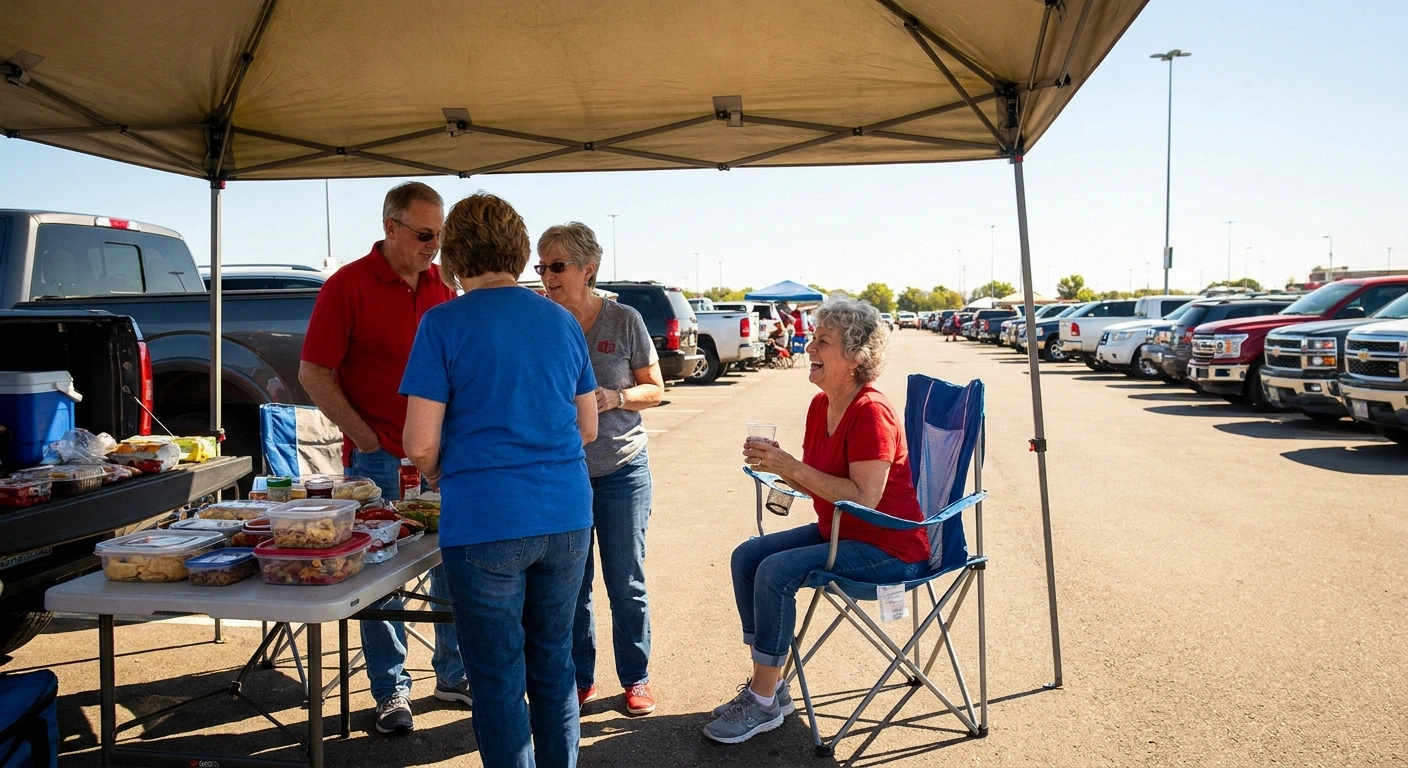
Stadium parking lots are built to drain water, not to be walked on.
That sounds like a small thing until you have feet that cannot report what they are standing on. Every lot is graded on a slope. The asphalt is patched and cracked. There are concrete curb stops at knee height that disappear from view the moment a truck parks next to them, and there are power cords snaking between setups by noon. Add four hours of standing, a half-mile walk to the gate, and weather with nowhere to hide from it, and you have one of the more demanding days a person with neuropathy can choose to have.
Which is not a reason to skip it. Tailgating is one of the genuinely good things, and the people who love it tend to love it for decades. It just rewards a plan more than most outings do.
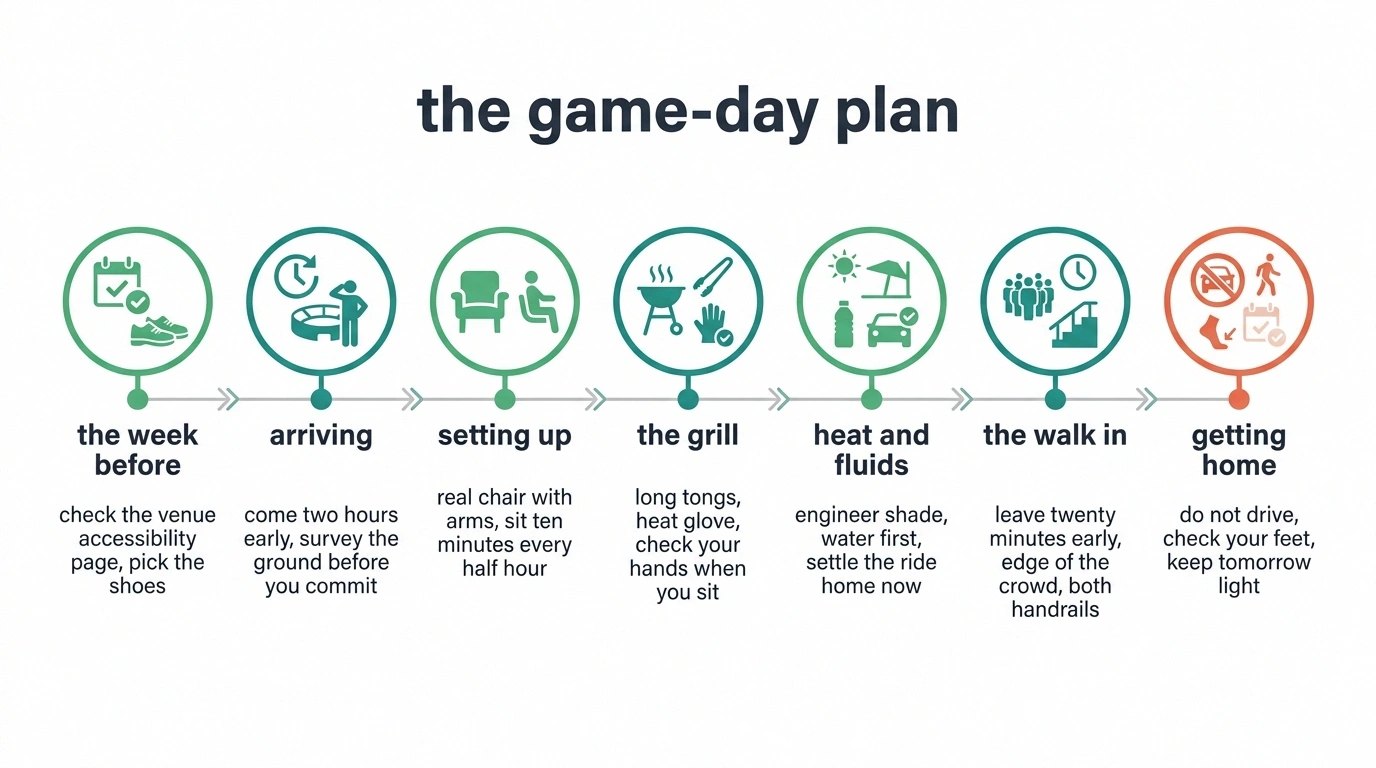
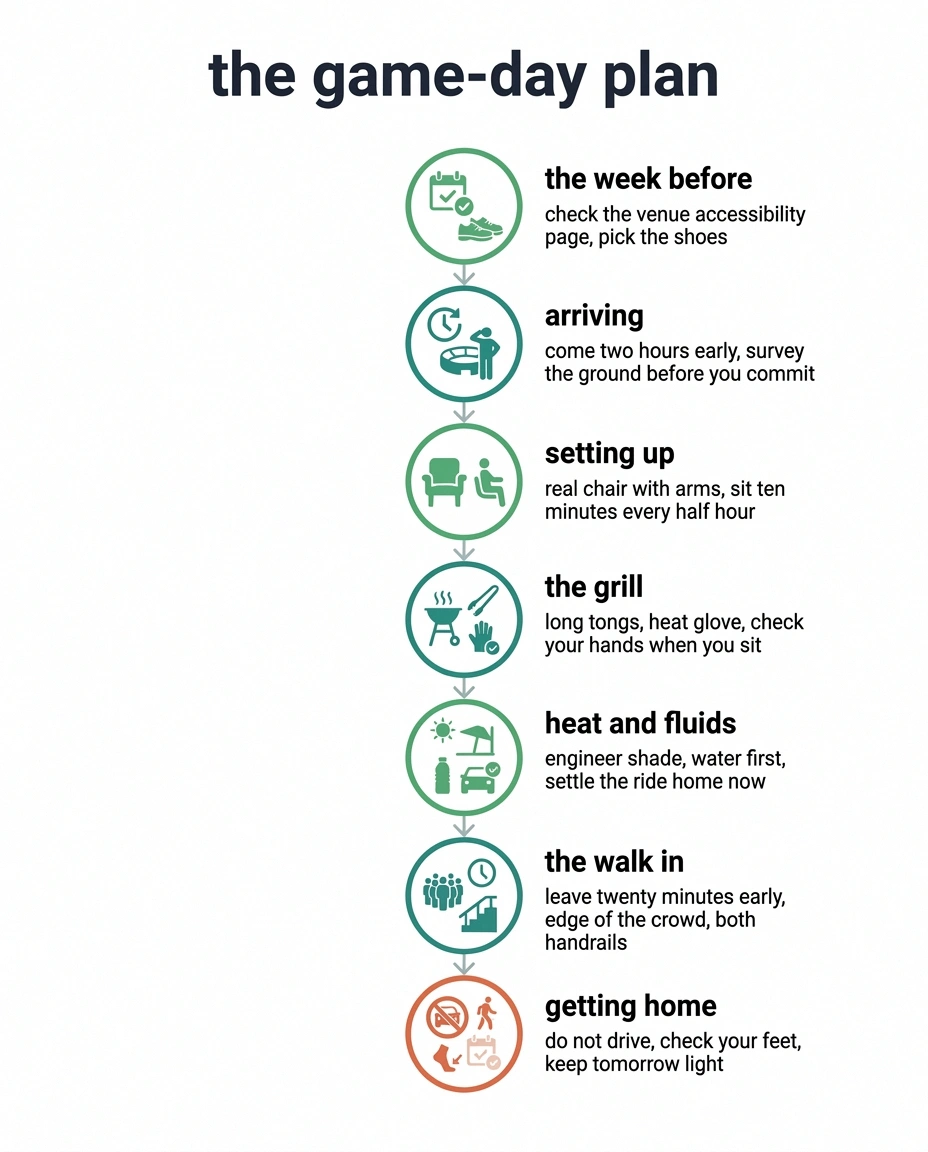
Here is the day, start to finish, with the decisions that matter at each stage.
The Week Before
Almost everything that makes game day go well is decided before it starts.
Four questions for the venue, worth one phone call
Guest services answers these routinely and none of it is posted at the gate. Ask for guest relations rather than the ticket office.
- “Which lot is closest to an accessible entrance?”
- Accessible parking and the shortest walk are not always the same lot, and staff know which is which.
- “Is there a drop-off point at the gate?”
- If it exists, one person can be dropped at the gate while the other parks and walks back alone. This single answer can change whether the day is possible.
- “Do you have cart or wheelchair escort service?”
- Many venues run one on request and do not advertise it. Some will meet you at your vehicle.
- “Where is the nearest elevator to my section?”
- Worth knowing before you are in a crowd on a ramp deciding in real time.
Look up the venue's accessibility page. Every major stadium has one, and most people never read it. You will find accessible parking locations, gate-side drop-off points, elevator access, wheelchair escort services, and sometimes designated accessible tailgate areas. Some venues will bring a cart to you. None of that is advertised at the gate, and all of it is available if you know to ask.
Sort out parking placement, not just parking. If you have an accessible parking placard, this is the day it earns its keep. If you have been meaning to look into whether you qualify, our guide on getting a handicap parking permit with neuropathy covers what the process involves. Beyond the placard, think about what you want to be near. Being close to a restroom beats being close to the action, and level ground beats a good view every single time.
Decide about the mobility aid now. Not in the lot, when the surface has already made the argument for you. A cane on uneven asphalt does two useful jobs: it gives you a third point of contact and it tells the people around you to leave a little space, which in a crowd is worth as much as the stability. If you have one, bring it. Our overview of walking aids and canes for neuropathy covers choosing between the options.
Check the forecast twice. Once for the temperature at kickoff, and once for the temperature four hours before, which is when you will actually be standing outside. September afternoons in a parking lot with no shade run considerably hotter than the forecast suggests. November evenings run colder than the number implies once you have been sitting on aluminum for two hours.
Pick the shoes on Tuesday. Team-branded footwear is almost universally terrible: thin soles, no support, sized optimistically. Wear the shoes that work, in the team colors if you can manage it, and accept the compromise. A firm sole that transmits ground contact helps more than cushioning does when your feet are reporting poorly. The reasoning behind that is in our guide to the best shoes for neuropathy.
Arriving and Setting Up
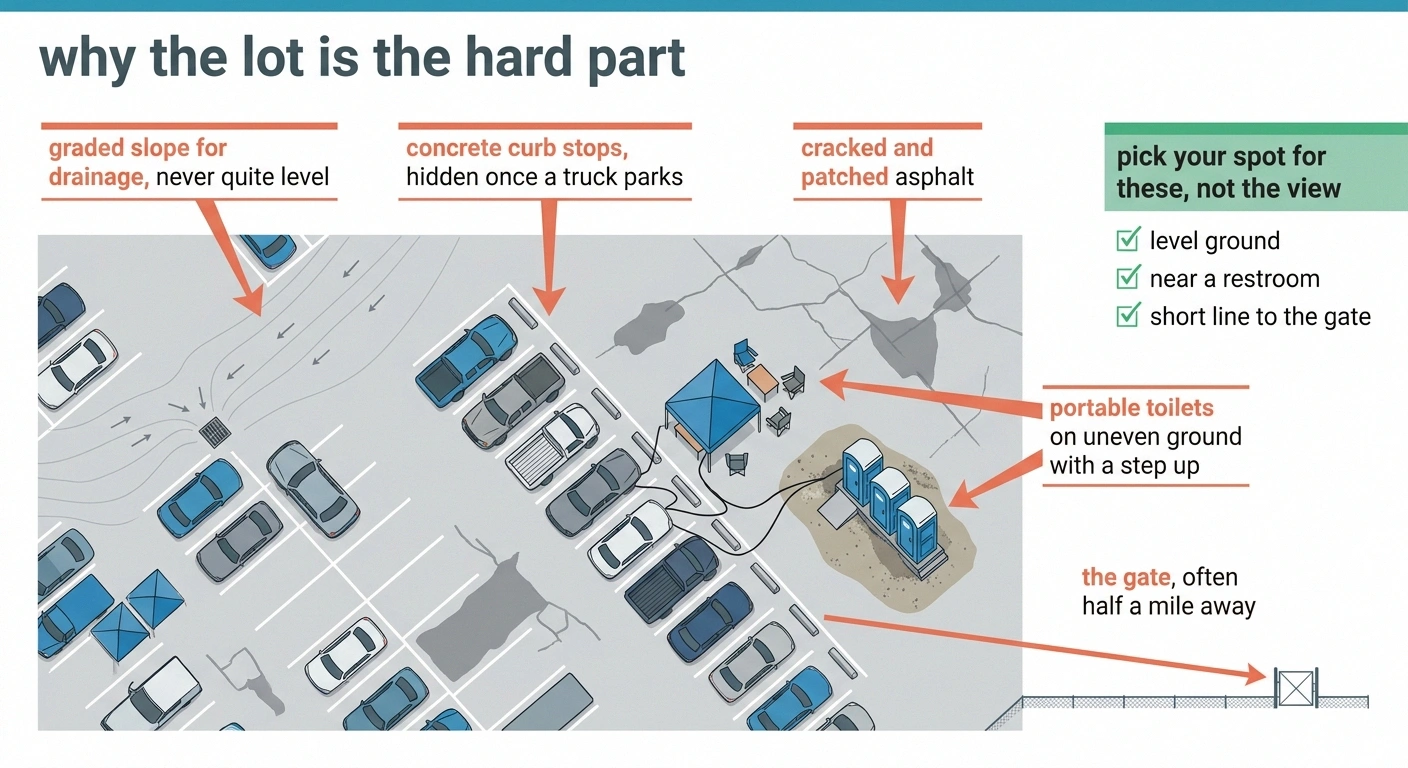
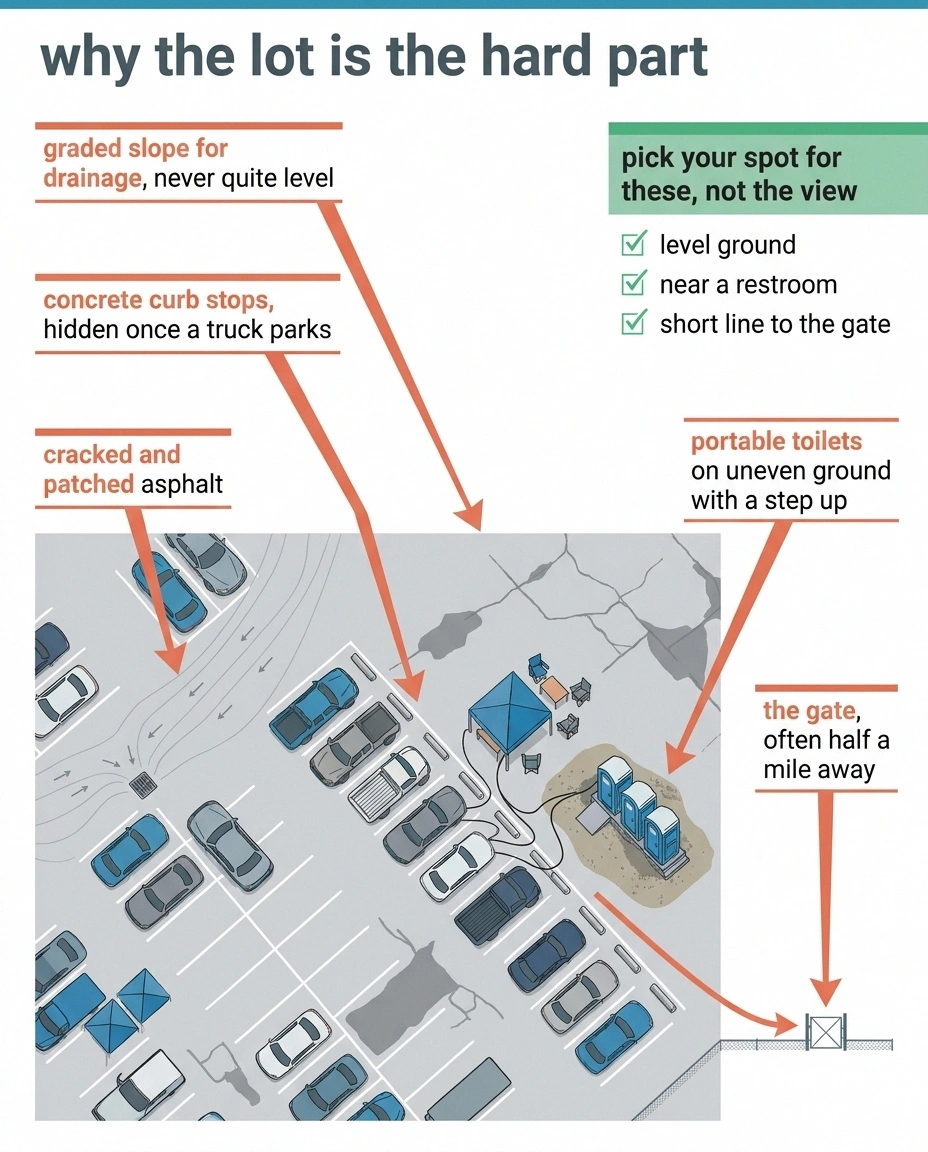
Come early. This is the highest-value habit on the list. Arriving two hours before the crowd means you park where you want, walk without being jostled, and set up without hurrying. Arriving in the crush means navigating a moving obstacle course on a surface you cannot feel.
Pack for the problem, not for the picnic
Each item on this list exists because of one specific thing that goes wrong in a parking lot.
| Bring | Because |
|---|---|
| High folding chair with arms | Rising from a low seat loads your legs at the moment balance is worst |
| Cane, even a folding one | Third point of contact on graded asphalt, and it earns you space in a crowd |
| Second pair of socks | Damp socks cause both cold injury and blisters you will not feel arrive |
| Heat-resistant glove and long tongs | A towel slips and conducts heat once damp |
| Foam square or folded blanket | The ground pulls heat out faster than another sock layer replaces it |
| Shade, brought not hoped for | The truck shading you at noon may leave at halftime |
| Small flashlight | The walk back to the vehicle is the one nobody plans for |
Survey before you commit. Take thirty seconds to look at your spot. Is the ground level or is it pitched toward a drain? Is there a curb stop where someone will walk? Where will the shade be in two hours, given that the sun moves and the truck currently shading you may leave at halftime?
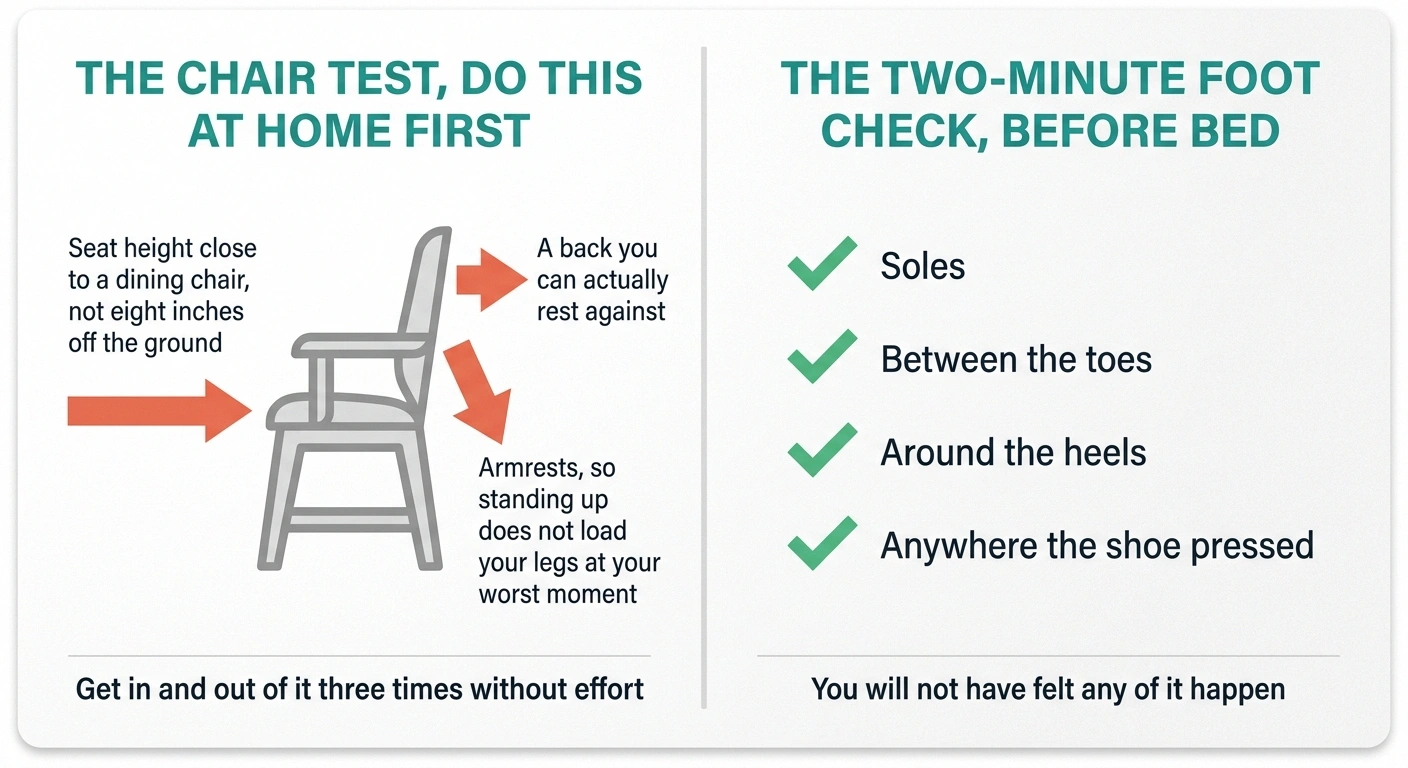
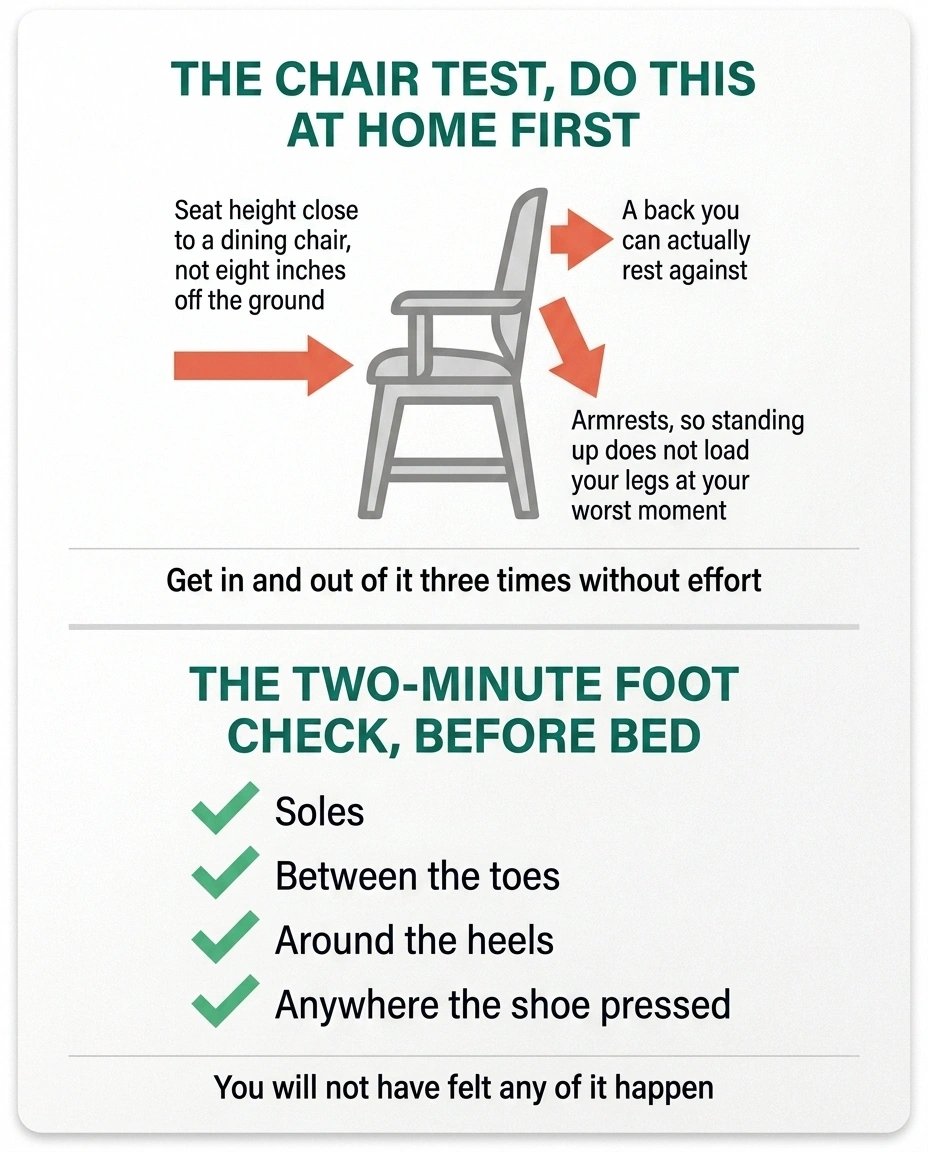
Bring a real chair. Not the low nylon camp chair that sits eight inches off the ground. You want a seat height close to a dining chair, a back you can actually rest against, and arms. Arms matter enormously, because standing up from a low seat without them means loading your legs at exactly the moment your balance is worst. The same considerations that go into choosing a comfortable chair at home apply in a parking lot, minus the upholstery.
Sit before you need to. The instinct is to stay upright while everyone else is standing and take a seat once your feet start complaining. Reverse it. Sit for ten minutes every half hour from the beginning, whether or not anything hurts yet. That is the difference between finishing the day and finishing the first quarter.
Claim a job that lets you sit. Every tailgate has one. Handing out drinks, running the music, keeping score of whatever nonsense game is happening. Being useful from a chair beats standing to prove you can.
The Grill, the Cooler, and Your Hands
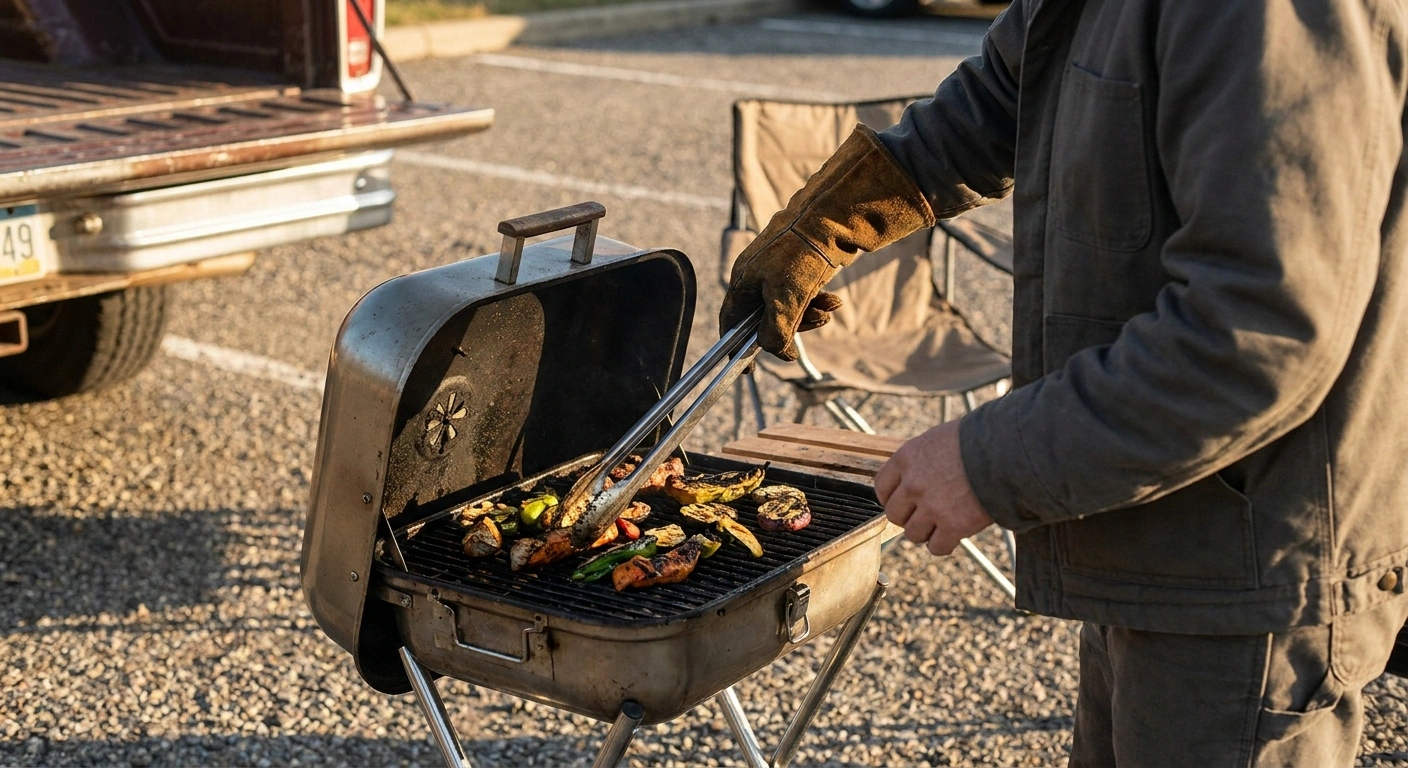
Numb hands and a hot grill are a genuinely dangerous pairing, and the danger is not that you will burn yourself badly in one dramatic moment. It is that you will make contact, not register it, and not find the burn until hours later.
A few habits that cost nothing:
- Long tongs, always. The extra six inches of handle is the whole safety margin.
- Heat-resistant gloves rather than a folded towel, which slips and conducts heat once it is damp.
- Let someone else lift the lid on a hot grill. Steam burns are the ones people miss most often.
- Check your hands and forearms deliberately when you sit down, since you will not feel a small burn arrive.
- Coolers are the other half of this. Ice packs and dry ice sitting against numb skin cause cold injuries the same way heat does, so no reaching into the bottom of the cooler with a bare arm and holding it there.
Our guide to grilling and outdoor cooking safely with numb hands goes into the setup in more detail, including which tools are worth replacing.
Heat, Cold, and Fluids
Parking lots are heat islands. Acres of black asphalt with no shade will run noticeably hotter than the surrounding air, and many people find their neuropathy symptoms flare in heat. If autonomic nerves are involved, sweating may not regulate properly either, which makes overheating both more likely and harder to notice.
Same lot, opposite problem
Early season heat
Asphalt runs hotter than the forecast, with no shade anywhere.
Cool the neck and inner wrists with cold water, which works faster than drinking it.
If autonomic nerves are involved, sweating may not regulate, so overheating arrives without the usual warning.
Late season cold
Numb feet cannot report that they are getting dangerously cold.
Insulate from the ground first, then add layers. The concrete is what is taking the heat.
Check your feet by hand every hour or so rather than going by feel.
Check the forecast for four hours before kickoff, not for kickoff. That is when you are actually standing outside.
Shade is worth engineering rather than hoping for. A pop-up canopy, the shadow of the vehicle, or a folding umbrella clamped to a chair. Cold water on the back of the neck and the inside of the wrists cools you faster than drinking it does. If heat is a reliable trigger for you, the strategies in our article on beating the summer heat with neuropathy are worth reading before a September game.
Late-season games flip the problem. Numb feet cannot tell you they are getting dangerously cold, which means the usual warning signal is missing. Wool socks, a second pair in the car, and something insulating between your feet and the ground. A square of foam or a folded blanket under your feet does more than another layer of sock, because the ground is what is pulling the heat out.
On drinks: alcohol deserves an honest mention here rather than a lecture. It worsens balance immediately, dehydrates you across a long afternoon, blunts the feedback that tells you something is wrong with your feet, and over years it is directly toxic to peripheral nerves. If you are going to drink, pair each one with water, eat properly, and settle the ride home before the first pour. Staying ahead on fluids is the more important half, since dehydration and cramping travel together.
The Walk to the Gate
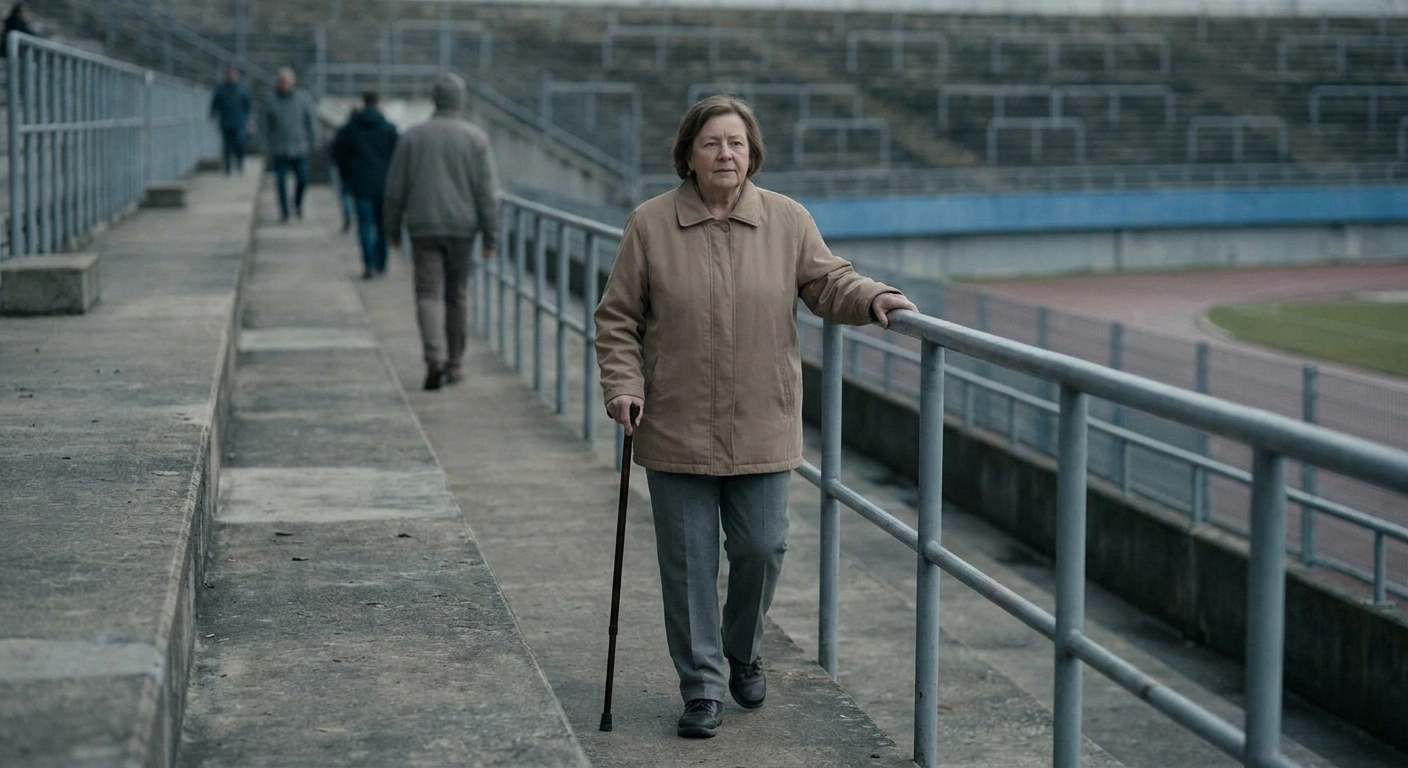
This is the part people underestimate. From a good tailgate spot to your seat can easily be a half mile, often up ramps, sometimes ending in stairs, in a crowd moving faster than you want to.
If you remember nothing else, remember three things
Sit before it hurts. Ten minutes every half hour from the moment you arrive, not from the moment your feet complain. Rest taken early buys hours; rest taken late buys minutes.
Leave twenty minutes before the group wants to. Every stumble risk in the day comes from moving at someone else's pace through a crowd on ground you cannot feel.
Decide the driver at breakfast. After four hours on asphalt your feet will be worse than they were this morning, and pedal feel goes with them. This is not a decision to make in a dark lot at nine at night.
Everything else on this page is optimization. These three are the ones that decide whether you make it to the fourth quarter.
Leave earlier than the group wants to leave. Twenty minutes of margin removes all the pressure to keep pace with people whose feet work.
Walk at the edge of the flow rather than in the middle of it. Being able to stop without someone walking into your back matters more than the shorter line.
Use the handrail on ramps and stairs, both directions. Going down is the harder direction when you cannot feel where your foot has landed, and it is where most stumbles happen. The broader set of habits is in our guide to neuropathy and fall prevention.
Ask about the elevator. Most venues have one, most people do not know where it is, and staff will tell you.
If the walk itself is the barrier, gate-side drop-off changes the math entirely. Someone drives you to the gate, you walk in, and they park and walk back alone.
Restrooms, Which Deserve Their Own Section
Portable toilets in a lot are one of the higher-risk moments of the whole day. They sit on uneven ground, there is a step up, the interior is dark, the floor is often wet, and there is nothing stable to hold.
Go before you need to, so you are not hurrying. Go in daylight if the game runs into the evening. Use the permanent restrooms inside the stadium when you have the choice, since they are lit and level and have something to hold onto. And if a friend walks over with you, that is not a fuss, it is just how the two of you go to the restroom now.
Getting Home and the Day After
Do not be the driver if the day has been long. Reduced sensation in the feet affects pedal feel, and after several hours of standing on asphalt your feet will be worse than they were at breakfast. Decide this in the morning, not in the parking lot at nine at night.
Before bed, check your feet properly. Look at the soles, between the toes, and around the heels for blisters, red pressure marks, or small cuts you never felt. This is the single most important thing you will do all day, and it takes two minutes. New shoes plus a long walk plus reduced sensation is the exact combination that produces a wound nobody noticed, and on a numb foot a small unnoticed wound is how bigger problems start. Our daily foot care routine covers what you are looking for.
Then plan for the next day to be quiet. A flare after a big outing is normal and not a sign you did something wrong. It is the cost of the day, and it passes. Keeping the following day clear turns that recovery from a problem into a plan.
One more thing worth doing: jot down what worked and what did not while it is fresh. Which chair, which shoes, how far the walk actually was, how long you lasted before the first flare. By the next home game you will not remember, and that short note is what makes the second game easier than the first. If standing at events is a recurring part of your life, our guide to standing at concerts, weddings, and other long events covers the same terrain in other settings.
Frequently Asked Questions
Is tailgating realistic with neuropathy?
For most people, yes, with planning. The main challenges are uneven parking lot surfaces, several hours of standing, weather exposure with no shade, and a long walk to the gate. Arriving early, bringing a proper chair with arms, sitting on a schedule rather than waiting for pain, and parking near a restroom on level ground address most of it.
What kind of chair should I bring?
One with a seat height close to a dining chair, a supportive back, and arms. Low camp chairs are the common mistake, because rising from eight inches off the ground without arms to push against loads your legs at the moment your balance is least reliable. Test it at home before game day and make sure you can get in and out of it three times without effort.
How do I handle the walk from the lot to my seat?
Leave twenty minutes earlier than the rest of your group, walk at the edge of the crowd rather than in the middle, and use handrails on ramps and stairs in both directions. Ask stadium staff where the elevator is. Many venues also offer gate-side drop-off and wheelchair escort services, both listed on their accessibility pages.
Can I drink alcohol at a tailgate if I have neuropathy?
Alcohol worsens balance immediately, contributes to dehydration over a long afternoon, and reduces the feedback that would tell you your feet are in trouble. Long-term heavy use is directly toxic to peripheral nerves. If you drink, alternate with water, eat properly, keep the total low, and arrange your ride home in advance.
What should I do about my feet in a cold-weather game?
Wool socks, a dry spare pair left in the car, and insulation between your feet and the ground, which matters more than an extra sock layer because the ground is what draws the heat away. A square of closed-cell foam or a folded blanket under your feet works well. Since numb feet cannot warn you they are getting too cold, check them by hand periodically rather than going by feel.
How do I avoid burns at the grill with numb hands?
Use long tongs, heat-resistant gloves rather than a folded towel, and let someone else lift the lid on a hot grill so you avoid the steam. Inspect your hands and forearms deliberately each time you sit down, since a small burn on numb skin will not announce itself. Treat the cooler the same way and avoid resting a bare arm against ice or ice packs.
Should I bring a cane even if I usually manage without one?
On a parking lot surface, it is worth it. Lots are graded, cracked, and full of curb stops and cables, and the crowd means you will be walking while distracted. A cane adds a point of contact and signals to people around you to leave space, which is useful in itself on a crowded concourse.
What should I do the day after?
Check your feet carefully that night for blisters, redness, and small cuts you would not have felt, and keep the following day light. A flare after a long day outdoors is expected rather than a sign of harm. Writing down what worked, including which shoes and chair you used and how long you lasted, makes the next game noticeably easier to plan.
About the Author