Every article about walking with neuropathy tells you to walk on flat, even ground.
Thank you. Now where?
That is the actual question, and almost nobody answers it. You are standing in your kitchen with your shoes on, willing to do the thing everyone recommends, and the advice you have been given amounts to a description of a surface rather than a place you can go. Meanwhile the route you would naturally pick, the one out your front door, may have three problems you have not thought to look for.
Route selection is a skill. It can be taught in about ten minutes, and once you have it you can evaluate any route near your home without walking a step of it first.
The Loop Principle
Start here, because this single idea prevents more bad afternoons than everything else combined.
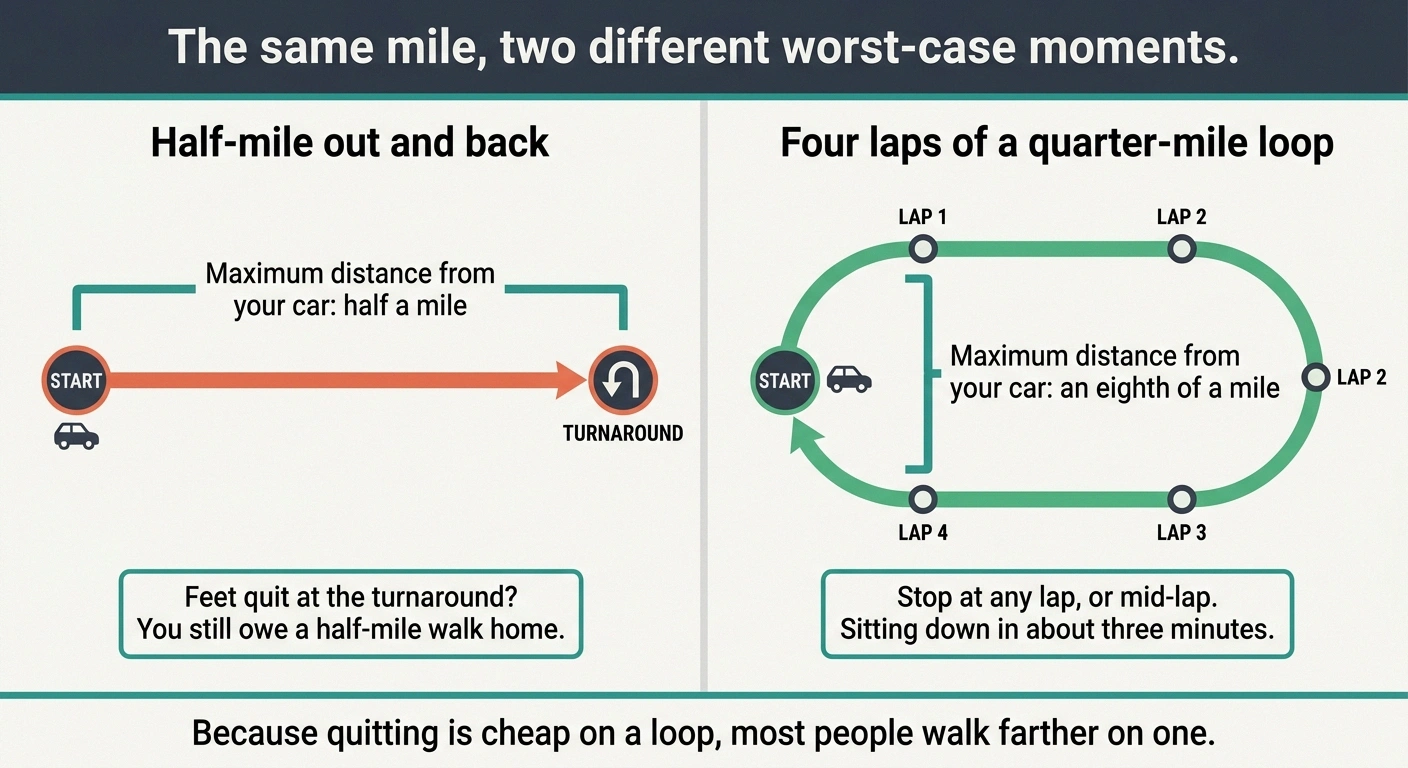
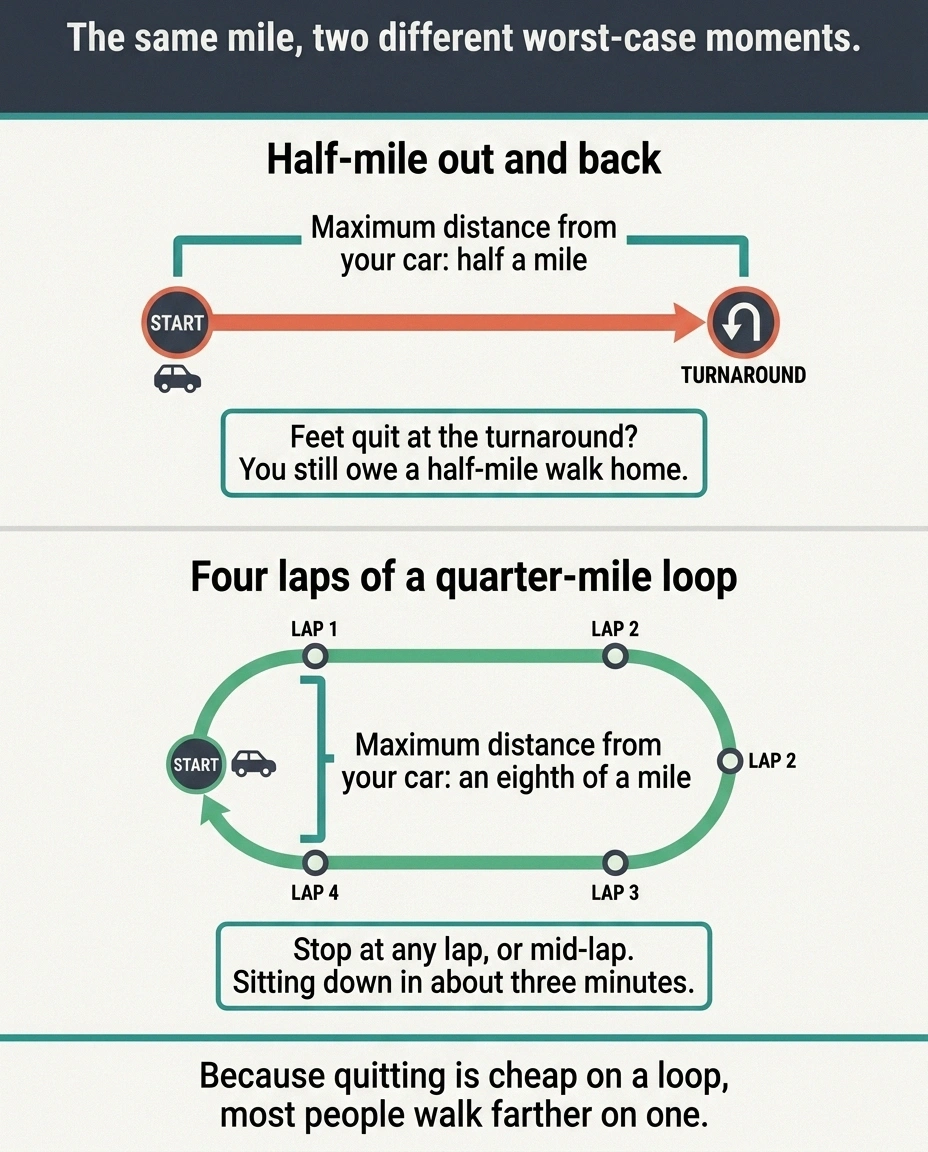
The same mile, two different worst-case moments
Half-mile out and back
Maximum distance from your car: half a mile. If your feet quit at the turnaround, you still owe a half-mile walk home on feet that are already done.
Four laps of a quarter-mile loop
Maximum distance from your car: an eighth of a mile. You can stop at any lap, or mid-lap, and be sitting down in about three minutes.
The counterintuitive part: because quitting is cheap on a loop, most people walk farther on one. On an out-and-back, quitting early still costs the full return trip, so people push past the point they should have stopped.
Most people walk out and back. Head down the road, turn around at some point, come home. It is the obvious shape and it has a flaw built into it.
On an out-and-back route, the moment you reach your limit is the moment you are farthest from where you started. If your feet begin burning at twenty minutes, you now have a twenty-minute walk home on feet that are already telling you to stop. The route guarantees that your worst moment coincides with your greatest distance from safety.
A loop fixes some of this. A small loop, repeated, fixes it entirely.
Four laps of a quarter-mile loop covers the same mile as a half-mile out and back. But on the loop you are never more than an eighth of a mile from your car, your bench, or your front door. You can stop at any lap. You can stop mid-lap and be home in three minutes.
This changes the psychology as much as the logistics. On an out-and-back, quitting early still costs you the full return trip, so people push past the point where they should have stopped. On repeated loops, quitting is genuinely cheap, which paradoxically means most people walk farther, because they are not rationing effort against a distance they are obligated to cover.
School tracks, park loops, the perimeter of a shopping center before it opens, a block that circles back on itself, even a long hallway walked back and forth. Anything that keeps returning you to your starting point.
Scoring a Route Instead of Listing Approved Ones
You know your neighborhood better than any article does. What you need is a rubric, not a list.
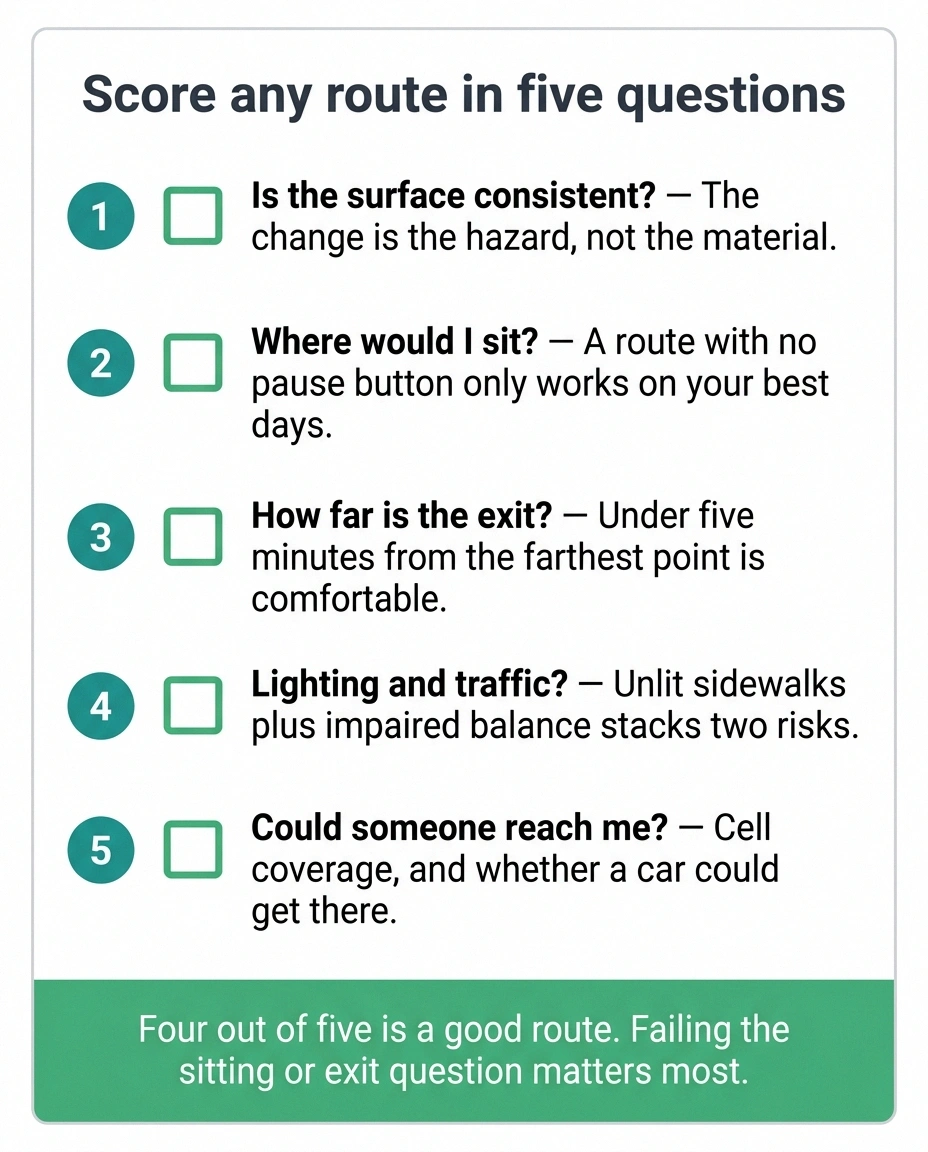
Score any route in five questions
Four out of five is a good route. Failing the sitting question or the exit question is worth taking seriously no matter how pleasant the walk is.
- Is the surface consistent?
- The change is the hazard, not the material. A numb foot builds a rhythm and stops checking.
- Where would I sit?
- Count real sitting places. A route with no pause button only works on your best days.
- How far is the exit?
- Under five minutes from the farthest point is comfortable. Over fifteen needs a plan.
- Lighting and traffic?
- Unlit sidewalks plus impaired balance stacks two risks. Shade counts in summer.
- Could someone reach me?
- Cell coverage, and whether a car could actually get to where you are.
Run any candidate route through these five questions.
Is the surface consistent? Consistency matters more than any particular material. A numb foot builds a rhythm and stops checking, so the danger is the change, not the surface itself. A smooth sidewalk that turns to broken pavement for thirty feet is more hazardous than a gravel path that is gravel the whole way, because on the gravel you never stopped paying attention.
Where would I sit? Count actual sitting places along the route. Benches, low walls, a picnic table, your own car. If there are none, the route has no pause button, and a route with no pause button is a route that only works on your best days.
How far is the exit? At the farthest point of the route, how long to reach a car, a bathroom, a door? Under five minutes is comfortable. Over fifteen deserves a real answer for what happens if today goes badly.
What is the lighting and traffic situation? If your balance is affected, evening walks on unlit sidewalks stack two risks together. Shade matters in summer for the same reason a bench does.
Can someone reach me? Cell coverage, and whether a car could get to you. A trail a mile from the nearest road is a different proposition than a park path fifty feet from a parking lot.
A route scoring well on four of five is a good route. Failing the exit question or the sitting question is worth taking seriously regardless of how pleasant the walk is.
Surfaces, Honestly Ranked
The standard guidance says flat and even, which is right but incomplete.
Surfaces, with the catch attached
Availability beats theoretical perfection. The best surface is the good one you will actually get to twice a week.
| Surface | Why it works | The catch |
|---|---|---|
| Indoor track or mall | Even, climate controlled, benches and bathrooms | Hours may be limited to early morning |
| Rubberized school track | Forgiving, measured, inherently a loop | School-day access restrictions |
| Asphalt path or greenway | Smooth and continuous when maintained | Root heaves near tree lines |
| Concrete sidewalk | Available everywhere, close to home | Panel joints, root lift, driveway slopes |
| Treadmill | Handrails, stop button, zero distance to safety | Does not train real-ground balance |
| Grass, gravel, trails, sand | Pleasant, and often the reason people walk | Hidden holes and debris; highest fall risk |
Indoor tracks and shopping mall concourses sit at the top for most people. Climate controlled, perfectly even, benches throughout, bathrooms, and other humans nearby. Many malls open early specifically for walkers.
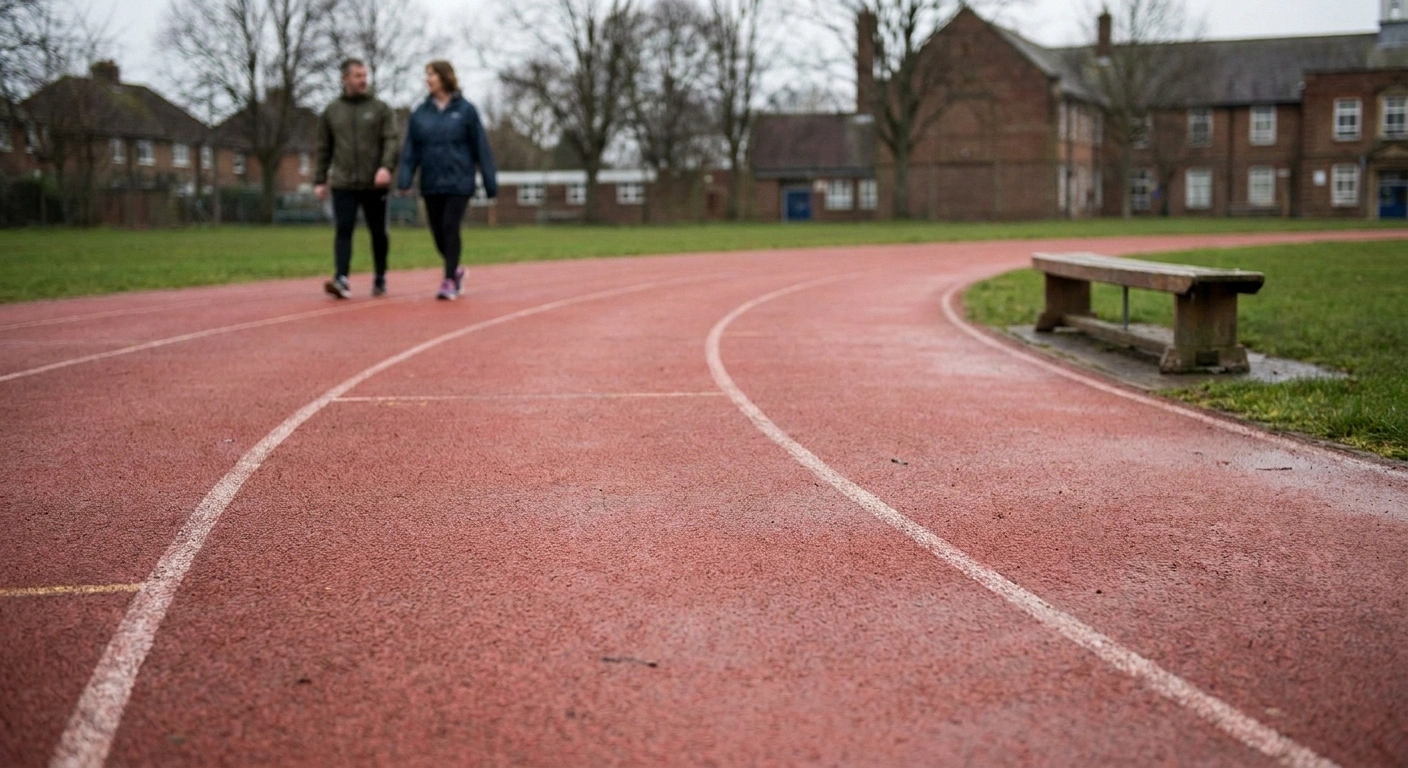
Rubberized school tracks are excellent. Forgiving underfoot, precisely measured so you always know your distance, inherently a loop, and usually with somewhere to sit.
Smooth asphalt paths and greenways work well when maintained. Watch for root heaves at path edges and where tree lines run close.
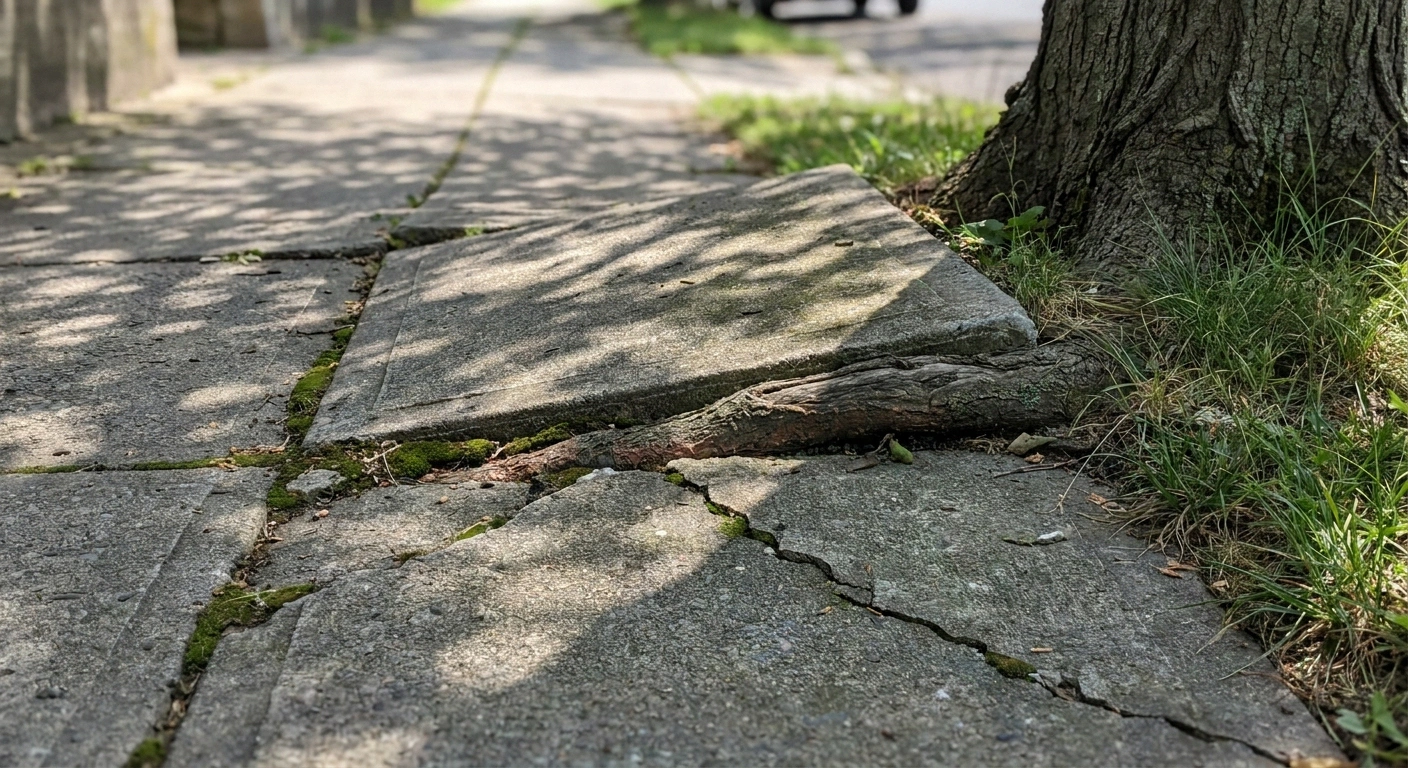
Concrete sidewalks are the most available option and the most variable. Panel joints lift, tree roots buckle them, and the transitions at driveways create small unexpected slopes. Perfectly usable if you have walked it once with your eyes open.
Treadmills deserve more credit than they usually get from people who prefer outdoors. Absolute surface consistency, handrails, an emergency stop, no weather, and zero distance from safety. Their weakness is that they do not train the balance adjustments real ground demands, so they work best as one option among several rather than the only one.
Grass and unpaved trails are where things get harder. Grass hides holes, sprinkler heads, and slopes, and it is genuinely deceptive because it looks flat and forgiving. Loose gravel, cobblestones, and root-crossed trails all raise fall risk substantially when foot sensation is reduced.
Sand deserves its own mention because people assume a beach walk is gentle. It is not; it is unstable, sloped toward the water, and hides sharp debris, and we covered walking on sand with neuropathy separately for that reason.
Scouting Without Walking
Here is a trick worth knowing: you can evaluate most of a route from a chair.
Satellite view shows you the shape. Does the route actually loop, or does it dead-end and force a return trip? Where is the parking? How far is the farthest point from it?
Street view is the more useful tool, because it shows you surface quality directly. You can see whether sidewalks are continuous or interrupted, whether curb cuts exist at corners, where benches sit, how much shade there is at midday, and whether the route crosses anything unpleasant. Ten minutes of this saves you a wasted trip and a walk you had to abandon.
It is not perfect. Imagery can be years old, and a sidewalk that was smooth in 2023 may not be now. But it reliably rules routes out, which is most of the work.
Building Up Without Setting Yourself Back
Route choice and distance progression are the same decision, because a route that is right at ten minutes may be wrong at forty.
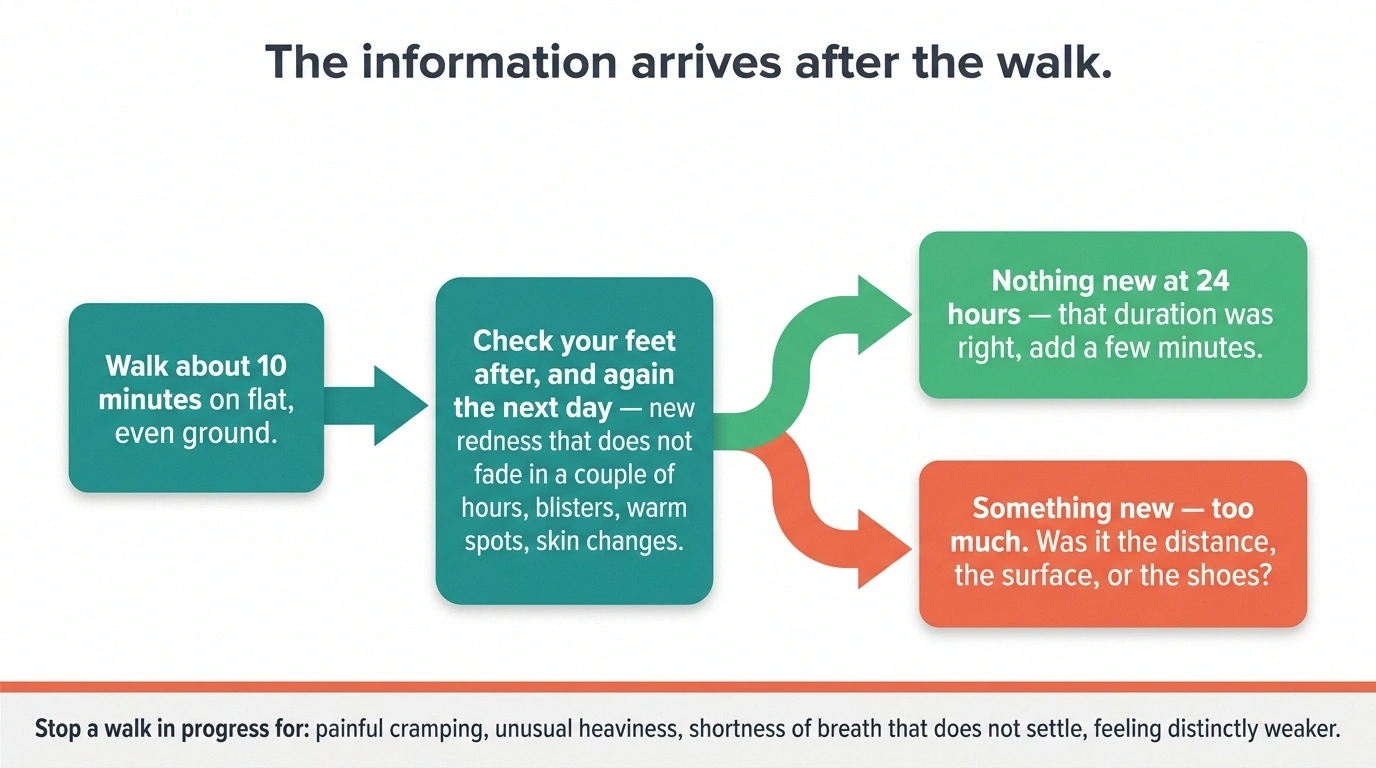
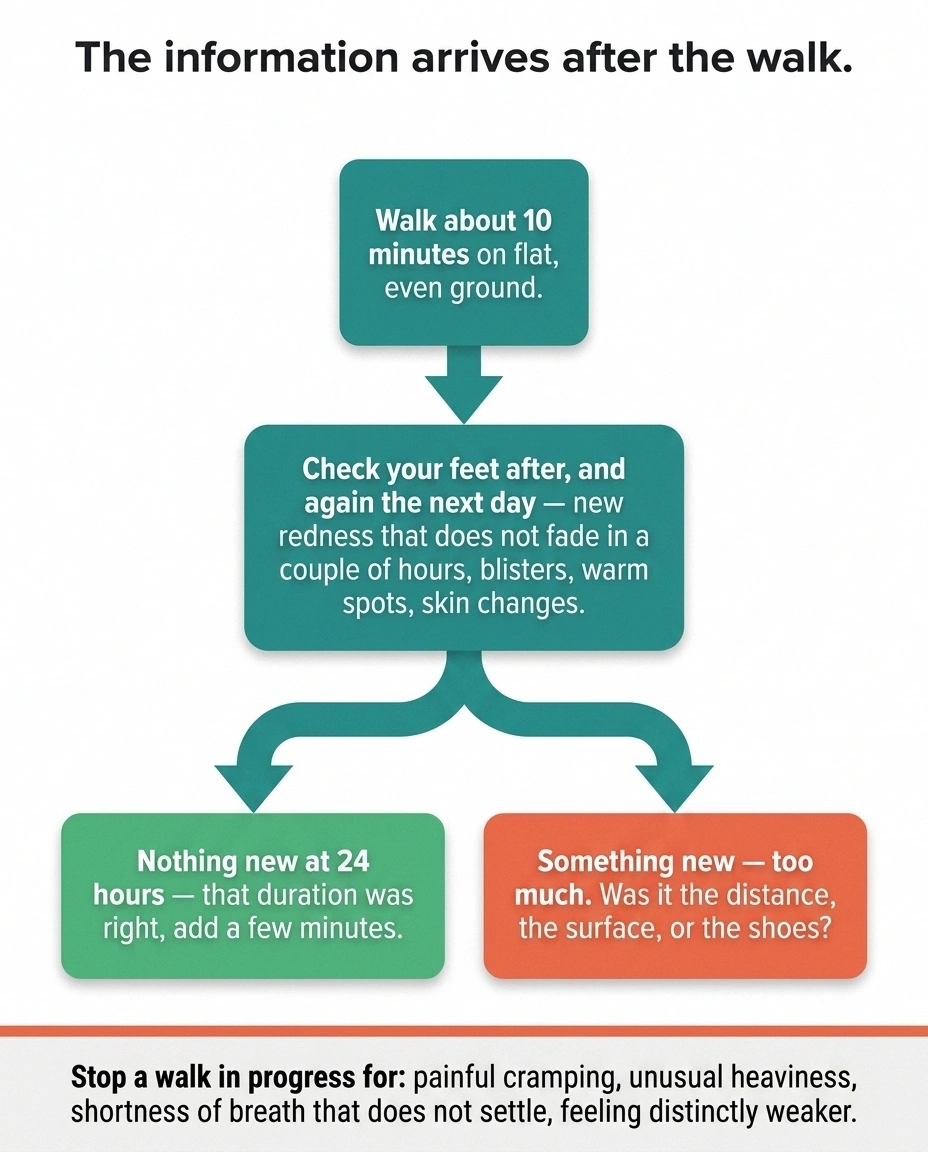
The information arrives after the walk, not during it
Start at about ten minutes on flat, even ground. Then check your feet after, and again the next day, looking for new redness that does not fade within a couple of hours, blisters, warm spots, or any skin change.
Nothing new at 24 hours: that duration was right. Add a few minutes.
Something new: too much. Identify which of the three was the culprit, the distance, the surface, or the shoes, rather than abandoning walking.
Stop a walk in progress for: painful cramping, unusual heaviness in feet or hands, shortness of breath that does not settle, or feeling distinctly weaker partway in.
The standard progression is sound and worth following exactly. Begin with about ten minutes on a flat, even surface. Then wait, because the meaningful information does not arrive during the walk.
Check your feet after, and check them again the next day. You are looking for new red areas that do not fade within a couple of hours, blisters, warm spots, or any change in skin. Nothing new after twenty-four hours means the walk was appropriate and you can add a few minutes. Something new means that distance, on that surface, in those shoes, was too much, and the useful response is to identify which of the three was the problem rather than to abandon walking.
This is why daily foot inspection is not a separate chore from walking. It is the feedback mechanism that makes walking safe, and without it you are increasing load on feet that cannot report back.
Signals to stop a walk in progress: painful muscle cramping, an unusual heaviness in your feet or hands, shortness of breath that does not settle, or feeling distinctly weaker partway in. Soreness lasting a day or two afterward suggests you moved up too fast.
Shoes Decide Which Routes Exist
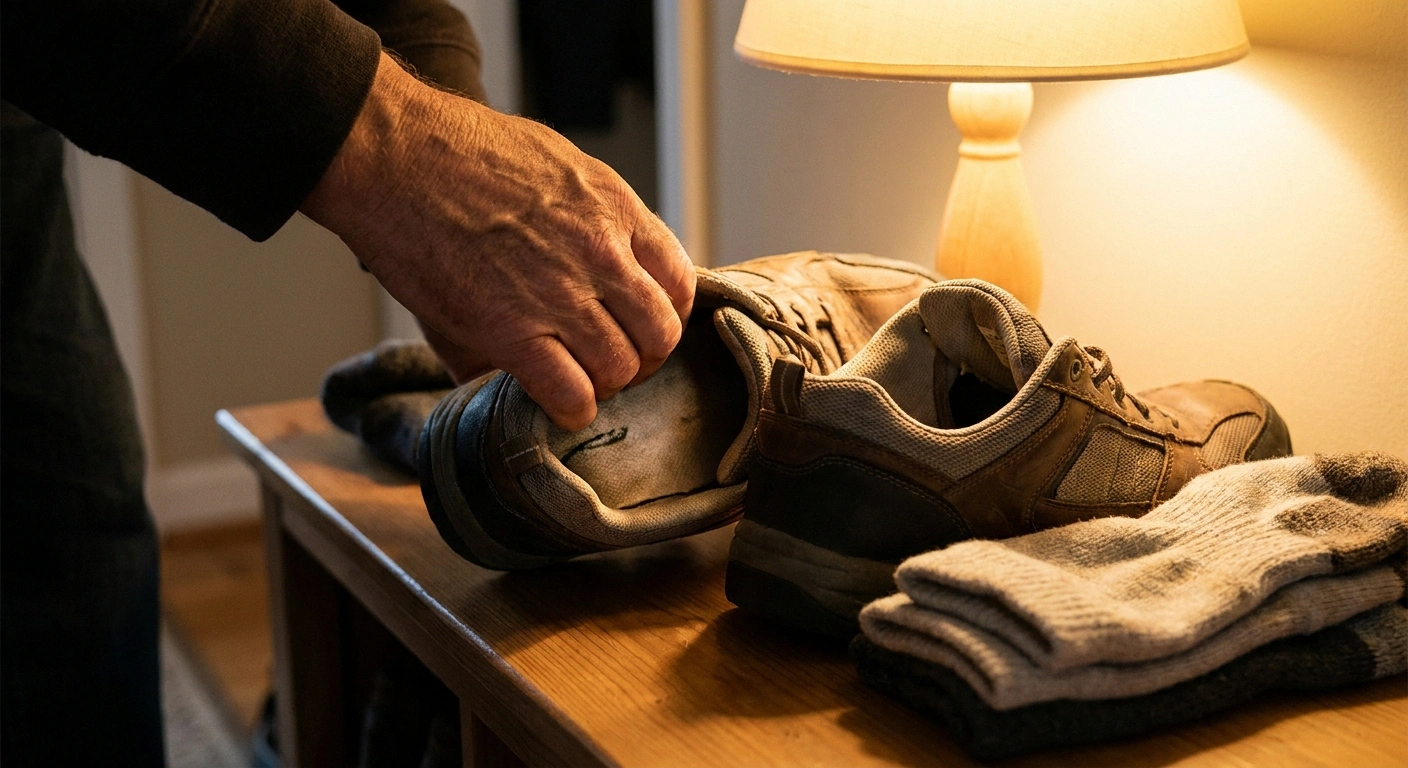
Your footwear determines your available route list more than your fitness does.
A firm supportive sole that will not let a stone press through, a wide toe box, and genuine cushioning are the requirements, and they are what make a mixed-surface route survivable. Thin flexible soles narrow your options to perfectly smooth ground.
Check inside the shoe with your hand every time before putting it on. A numb foot will walk on a small pebble for a mile without complaint. Our guide to shoes for neuropathy covers fitting in detail, and there is a good reason we advise against going barefoot even at home.
If you use a cane or a walker, that shapes route selection too. Grass and gravel are difficult for wheels and small tips, curb cuts become mandatory rather than convenient, and path width starts to matter. Our article on canes and walking aids covers the fitting side.
Two Routes, Not One
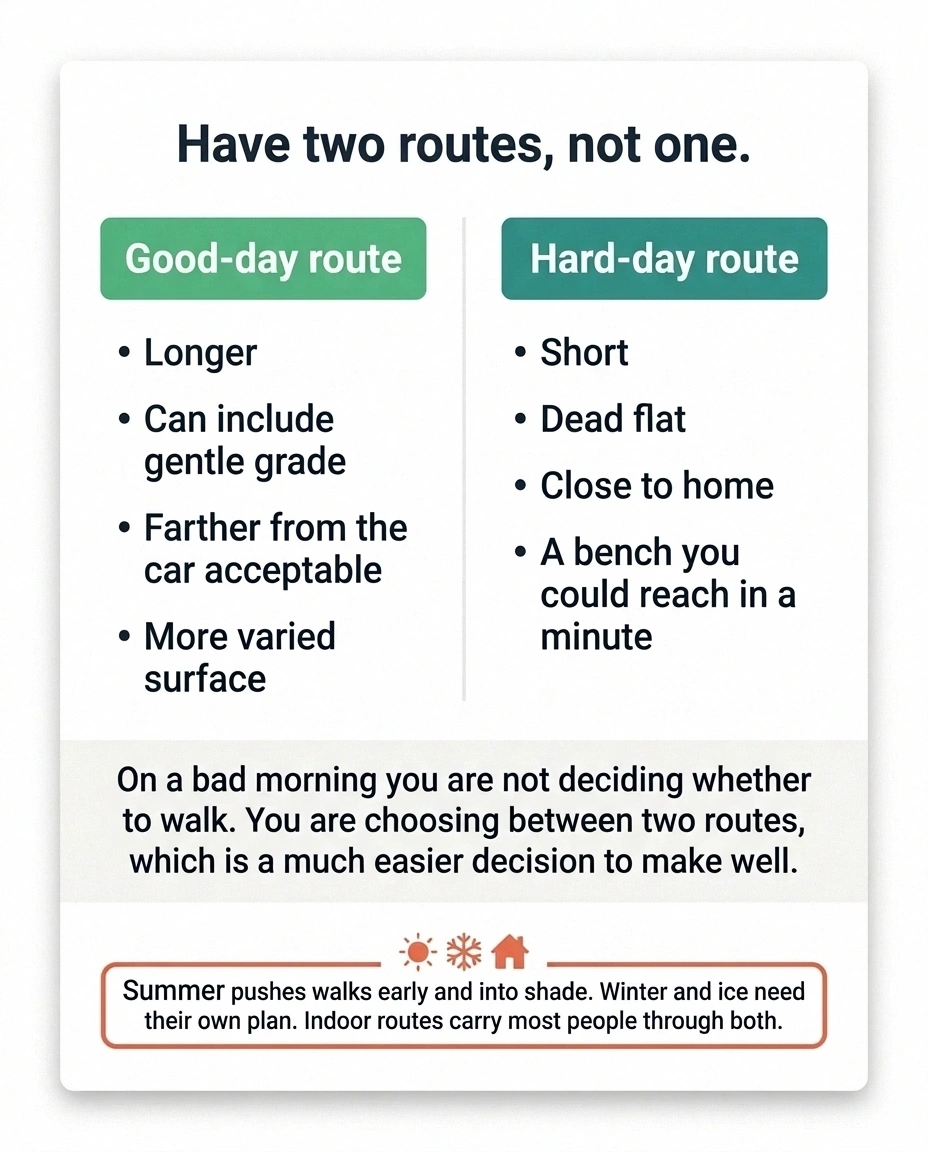
Most people pick a route and stop thinking about it, which works until the day it does not.
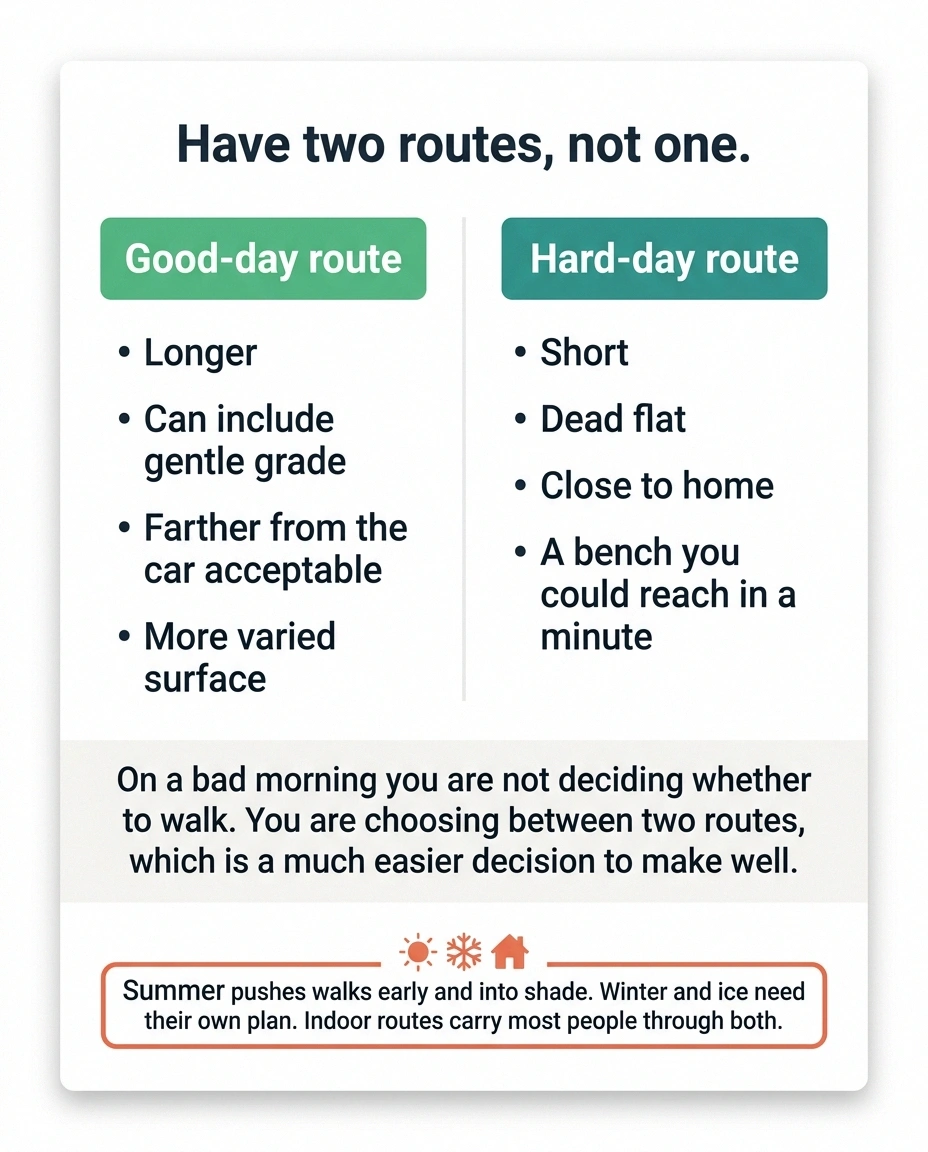
Have a good-day route and a hard-day route. The good-day route can be longer, less flat, and farther from the car. The hard-day route is short, dead flat, and close to home, with a bench you could reach in a minute. On a bad morning you are not deciding whether to walk, you are choosing between two routes, and that is a much easier decision to make well.
Seasons need the same treatment. Summer heat pushes walks to early morning and toward shade or indoor options, which matters because heat affects neuropathy symptoms directly. Winter is a genuinely different problem, and walking safely on ice and snow deserves its own planning. Indoor routes are what carry most people through both extremes.
What This Looks Like Tonight
Pick one candidate near your home. Look at it on satellite view and check whether it loops. Look at it on street view and check the surface and the benches. Score it against the five questions.
If it passes, walk ten minutes of it. Check your feet after, and again tomorrow.
That is the entire method, and it is worth the effort because walking remains one of the genuinely useful things available to you. Our main article on whether walking helps neuropathy covers why it earns the trouble, and gentle exercises for seniors fill the gap on days a walk is not happening.
The route is not a detail. It is what determines whether the walk goes well.
Frequently Asked Questions
What surface is best for walking with neuropathy?
Indoor tracks and mall concourses top most lists because they combine perfect evenness with climate control, benches, bathrooms, and other people nearby. Rubberized school tracks come close and add the advantage of measured distance and an inherent loop shape. Among outdoor options, smooth asphalt paths generally beat concrete sidewalks because they lack panel joints and driveway transitions. What matters most is consistency rather than any specific material, since a foot with reduced sensation adapts to a steady surface and gets caught out by sudden changes in it.
Is a treadmill better than walking outdoors with neuropathy?
It is safer in several concrete ways: the surface never varies, handrails are available, there is an emergency stop, weather is irrelevant, and you are never any distance from sitting down. The tradeoff is that a moving belt does not require the continuous balance corrections that real ground demands, so it does less for the stability skills that prevent falls elsewhere. Many people find the best arrangement is both, using the treadmill on bad-weather days or when symptoms are flaring and walking outside when conditions allow.
How far should I walk with neuropathy?
Distance is the wrong starting unit. Begin with roughly ten minutes on flat even ground, then inspect your feet afterward and again the following day. If no new redness, blisters, or warm areas appear within twenty-four hours, that duration was appropriate and you can add a few minutes. This works better than any prescribed distance because it responds to your specific feet, your shoes, and the surface you actually walked on, and it catches problems while they are still reversible.
Is walking on grass good for neuropathy?
Generally less suitable than it appears. Grass looks soft and forgiving, which is precisely the problem, because it conceals holes, sprinkler heads, uneven ground, and subtle slopes that a foot with reduced sensation cannot detect until balance is already compromised. Debris hidden in grass is another concern for feet that will not register a cut. Mown, level, familiar grass on your own property is a reasonable option; unfamiliar grass in a park is worth more caution than its appearance suggests.
Should I walk alone with neuropathy?
Many people do so safely, and the answer depends more on route design than on the walking itself. Choosing a loop over an out-and-back means you are never far from your exit point, which removes most of the risk that walking with someone would otherwise cover. Carrying a phone, telling someone your route and expected return, and confirming cell coverage all help. Balance problems or a history of falls shift the calculation toward company, at least until a specific route has proven reliable.
What time of day is best for walking with neuropathy?
It varies by person, so it is worth experimenting deliberately rather than assuming. Some people find symptoms are quietest in late morning, after stiffness has eased but before fatigue accumulates. Others walk better in the evening. Heat sensitivity pushes summer walks toward early morning, while balance concerns argue against walking after dark on unlit routes. Consistency generally matters more than the specific hour, since a regular time makes the habit hold.
How do I check a route before walking it?
Satellite view answers the shape questions: whether the route loops or dead-ends, where parking sits, and how far the farthest point is from it. Street view answers the surface questions, showing sidewalk continuity, curb cuts, bench placement, shade, and general pavement condition. Ten minutes of this rules out unsuitable routes without spending your feet on them. Imagery can be a few years old, so treat it as a screening tool rather than a guarantee.
About the Author