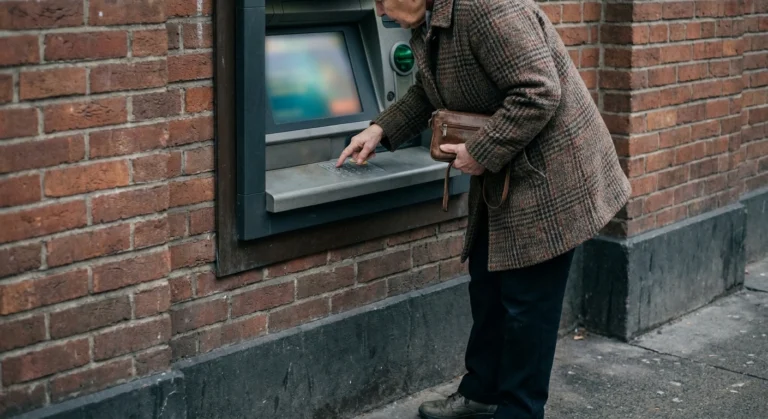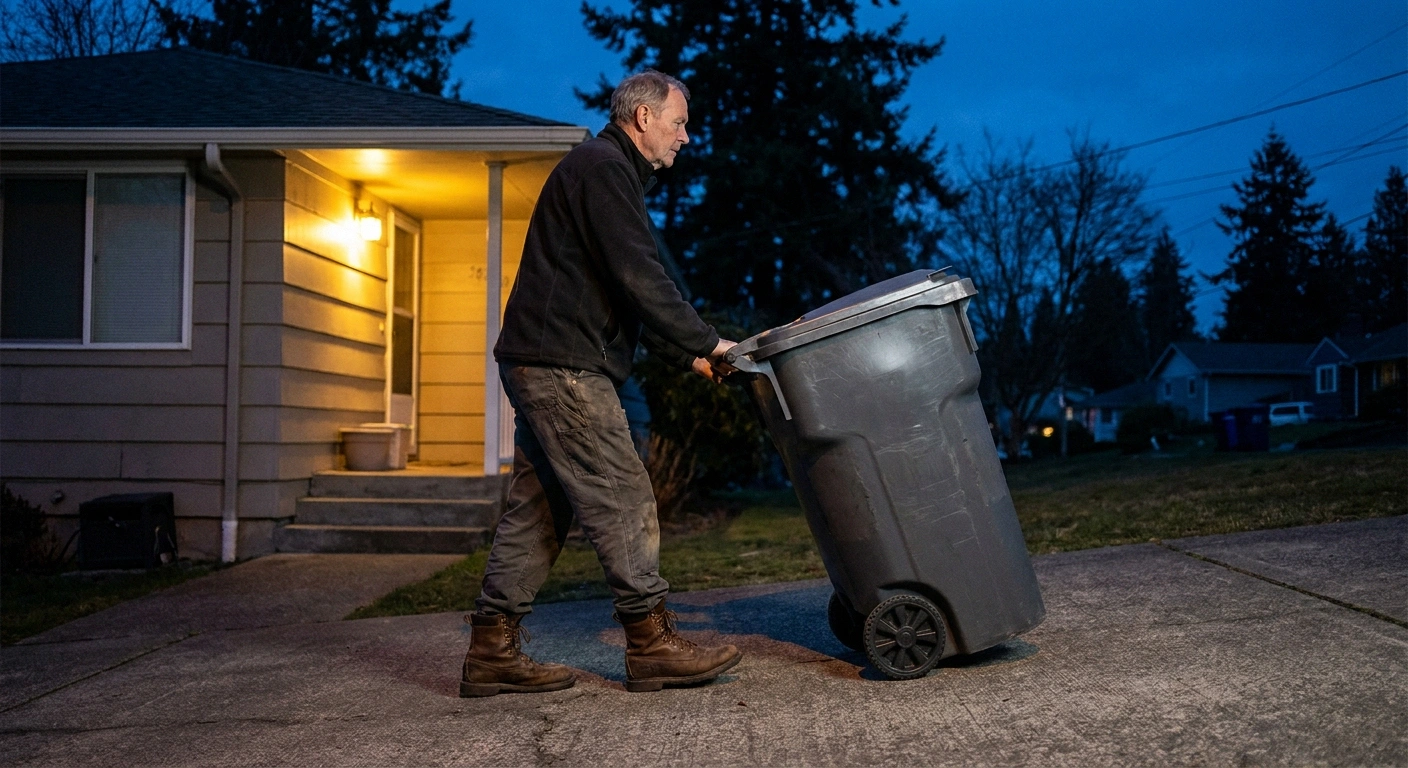
One line on the CDC's fall-risk self-check reads, “I have lost some feeling in my feet.” A few lines down, another reads, “I have some trouble stepping up onto a curb.” Put those two sentences together — add a heavy wheeled cart, a porch step and a dark evening — and you've more or less described trash day for a lot of people with neuropathy.
It's one of those chores nobody thinks about until it gets hard — then it becomes a weekly balance test you can't skip. I'm a patient advocate, not a doctor or a safety engineer. Everything below draws on guidance from the CDC and the National Institutes of Health, the FDA, workplace lifting advice from NIOSH, and the published rules of about a dozen city sanitation departments, dated because those rules change. Where something is my own practical suggestion rather than official advice, I'll say so.
Why Trash Day Tests Your Balance
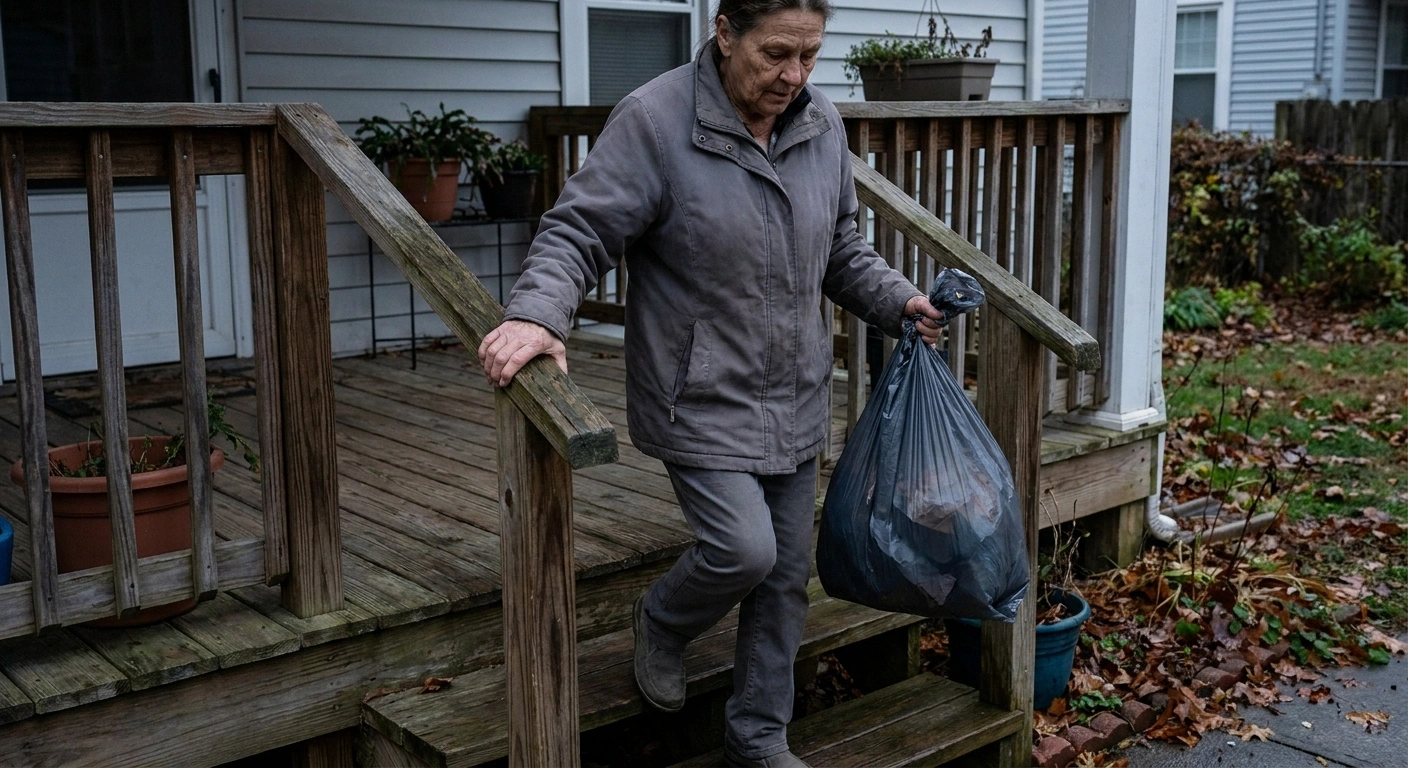
The numbers on falls are sobering. Falls are the leading cause of injury death among adults 65 and older, and the CDC counts more than 43,000 of those deaths in 2024, along with about 4.5 million emergency room visits. Over 14 million older adults, about 1 in 4, report falling every year, and the age-adjusted fall death rate climbed 21% between 2018 and 2024, from 64.7 to 78.4 per 100,000.
Neuropathy isn't on the CDC's main list of fall risk factors, but its own prevention materials connect the dots. The STEADI self-check warns that numb feet can lead to stumbles and falls, and a 2024 CDC footwear sheet lists reduced sensation from neuropathy among the foot problems that raise fall risk. The NIDDK adds that peripheral neuropathy can bring loss of balance, trouble sensing movement or position, and a loss of muscle tone that can reach both hands and feet.
Trash day stacks those problems together. A bag can block your view of your feet. A hand holding a bag can't hold a railing. A cart pulls you forward on a slope, and the curb at the end is exactly the kind of step that self-check asks about. Still, giving up the job entirely isn't automatically the safe answer. The CDC points out that people who become less active get weaker, which raises their chances of falling, so the goal is to make the chore safer or share it, not to stop moving.
And if you do fall, tell your doctor, even if you feel fine. The CDC says fewer than half of older adults who fall mention it, and falling once doubles your chances of falling again. Falls are also the most common cause of traumatic brain injury in older adults, so a fall that includes a blow to the head needs prompt medical attention.
Set Up the Route Before Trash Night
Most of the CDC's home-safety advice was written for inside the house, but its stairs checklist is labeled for indoors and outdoors. Keep objects off the steps, fix loose or uneven steps, put handrails on both sides that run the full length of the stairs, and add light at the top and bottom. The same brochures say to wear well-fitting shoes with good support inside and outside the house, and the NIDDK says never to walk barefoot or in just socks.
- A textured sole, to keep you from slipping.
- A thin, firm midsole, so you can still feel the ground underneath.
- Laces or straps that hold the shoe onto your foot as you walk.
- No backless shoes such as mules or clogs, and no walking out in just socks.
- Retire slippery or worn soles, which the sheet calls a balance hazard, especially in wet weather.
- If you have diabetes, a foot deformity or a past foot ulcer, ask your podiatrist which shoes protect your feet best.
That rules out the shuffle to the curb in slippers or clogs. NIH News in Health adds that doctors can prescribe special footwear or a walking cane, and that holding the handrail every time you use stairs keeps you safer. If you've been advised to use a cane, use it the way you were shown, and if you need it for balance, treat a heavy rolling cart as a job to hand off rather than one to manage one-handed. My guides to choosing a cane or walking aid and shoes that grip and stay on go deeper.
Light the Path
The CDC notes that as we get older, we need brighter light to see well. My own suggestion, not an official one: a motion-sensor floodlight over the path from your door to the bins means you're never fumbling for a switch with your hands full. If your bins live by the garage, walk the route once in daylight and pick the flattest, smoothest line, even if it's a few steps longer. And if your porch or garage steps worry you, my page on safer steps covers railings and lighting in more detail.
Lighten Every Load
Here's a number that surprised me. On one New York town's chart, empty wheeled trash cans with hinged lids weigh 17 to 33.5 pounds before any trash goes in. Most of us never notice, the town points out, because we roll or drag them instead of lifting them.
| Wheeled can with hinged lid | Empty weight | Trash allowed under the town's 50-pound limit |
|---|---|---|
| 32 gallons, one brand | 17 lb | 33 lb |
| 32 gallons, another brand | 20 lb | 30 lb |
| 48 gallons | 23 lb | 27 lb |
| 65 gallons | 33.5 lb | 16.5 lb |
Other limits, as of October 2026: Austin caps bags beside the cart at 35 pounds and 40 gallons; Jacksonville's manual-pickup areas cap bags and cans at under 40 pounds; Seattle caps each extra item at 60 pounds. These protect collection crews, so treat them as ceilings, not targets.
Sources: Town of Huntington, New York, Trash Can Weights; City of Austin; City of Jacksonville; Seattle Public Utilities.
NIOSH's lifting guidance was written for workplaces, but the basics carry over: lift only as much as you can safely handle by yourself, keep the load close to your body, use both hands, push up with your legs rather than your back, and step to the side instead of twisting. It also says to avoid carrying loads so bulky they block your view, and to slide, push or roll instead of carrying when that's an option.
Cities set their own limits — mostly to protect their crews. As of October 2026, Austin says bags set beside the cart must weigh 35 pounds or less, and San Antonio warns against overfilling carts because the lid must close completely. Several cities, including Phoenix, Jacksonville, Fort Worth and San Antonio, offer smaller carts. A practical tip of my own: tie kitchen bags off when they're half full and make two easy trips instead of one heavy one. My page on pacing chores around fatigue explains why splitting jobs works.
Rolling the Cart to the Curb
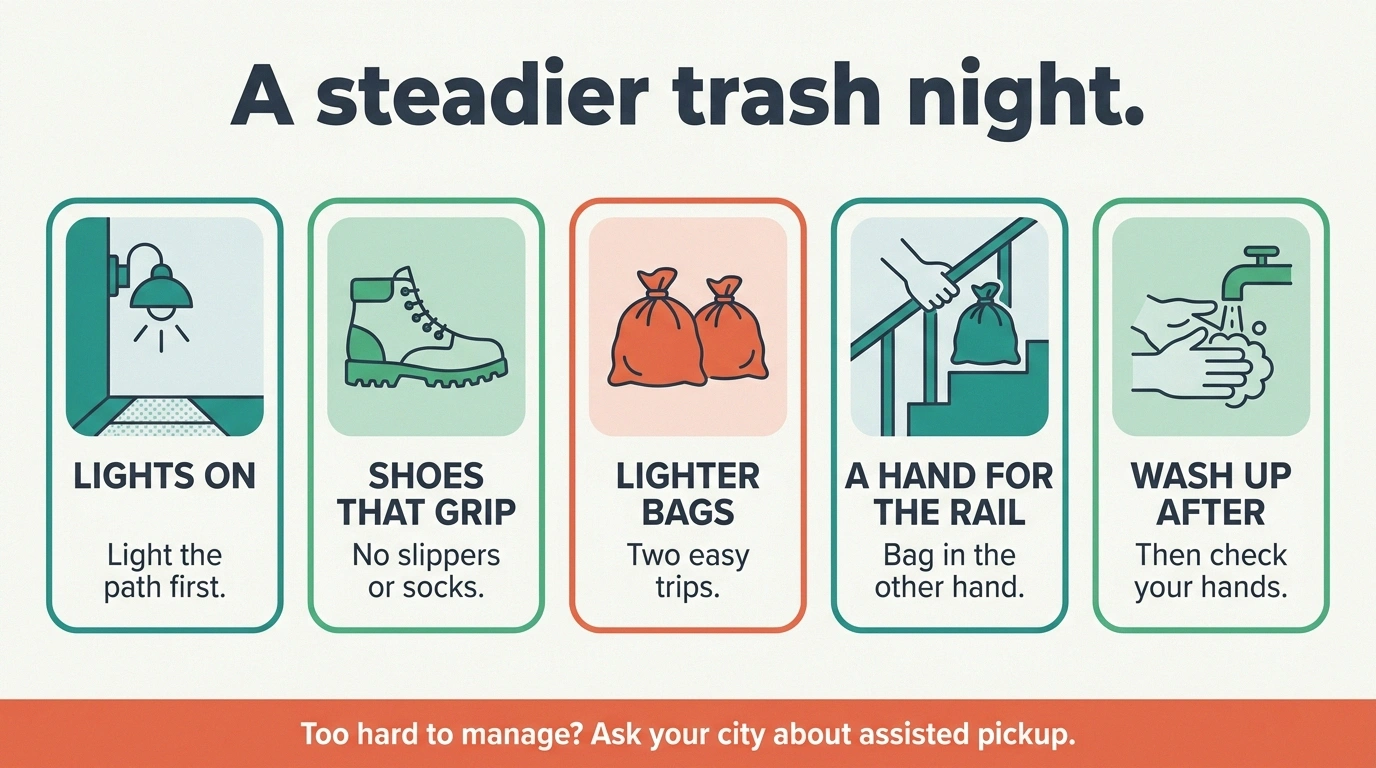
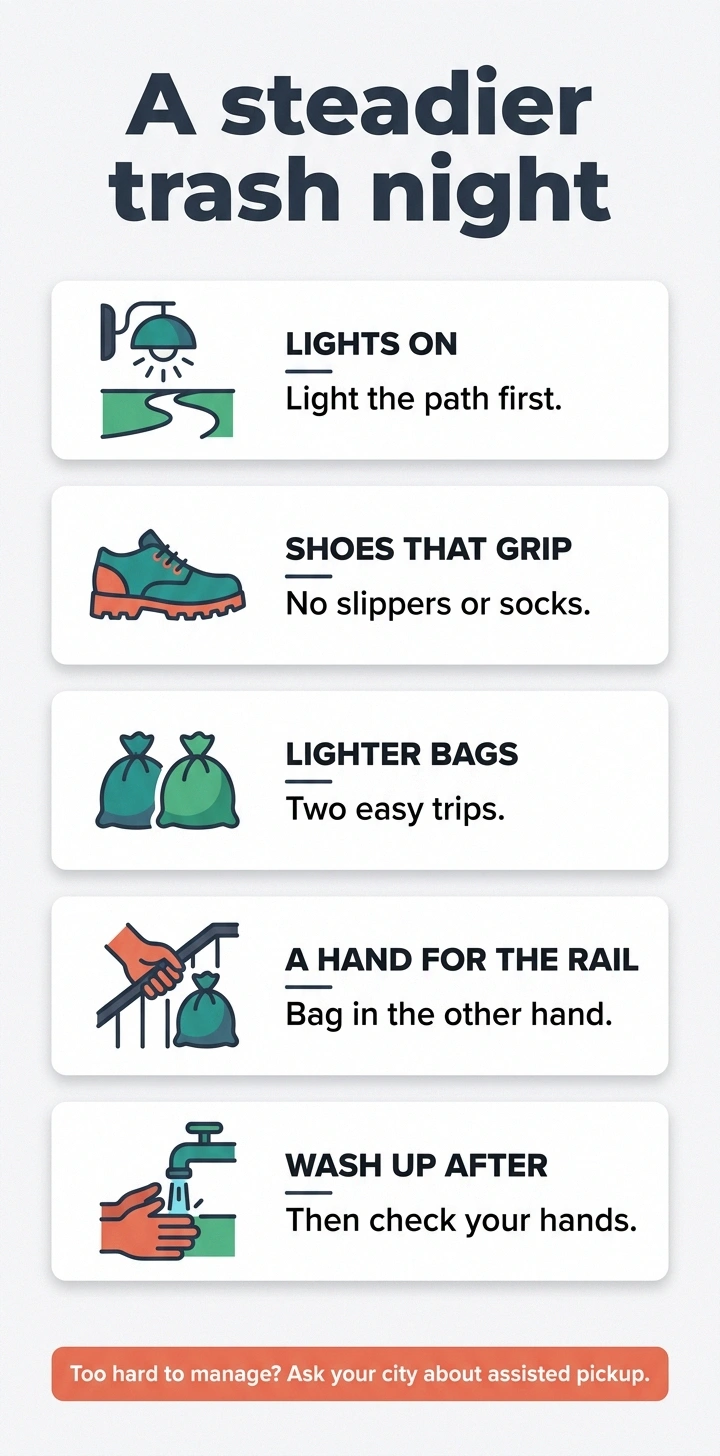
The only official line I found about pushing versus pulling comes from that same NIOSH guidance: “When there is a choice, push instead of pull.” It's workplace advice about strain, not balance, and nothing I found tested it with trash bins or neuropathy. Pushing keeps the cart where you can watch it, but a tall bin can still hide the ground right in front of you, which is why NIOSH's other point matters: make sure you have a clear view of the path. Use both hands when you can, and try to avoid slopes and steps while moving a load.
A few more tips from my own experience, not from any study. Never lean on a rolling cart for balance — it will roll. Tip it back gently and keep it close. If your driveway slopes, take it slowly with both hands on the handle, and save the job for someone else on wet or icy days. In fall, wet leaves add one more hazard, which my page on raking leaves covers along with boots that grip.
Curbs and Where the Cart Goes
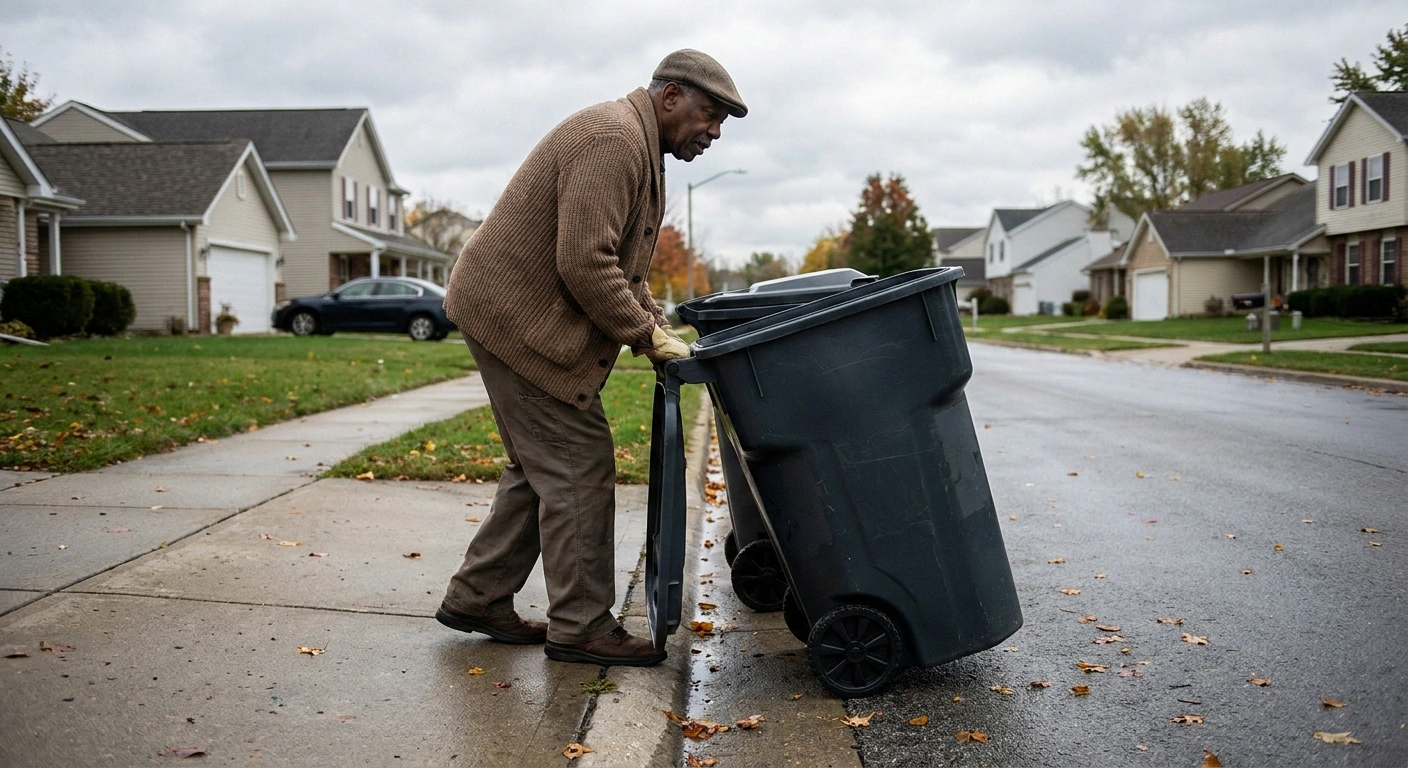
Curbs are where many of us slow down — and that's wise. Some cities ask you to line the cart up a certain way. As of October 2026, Charlotte asks residents to place the cart within 6 feet of the curb with the handle facing the property, while Denver asks for carts in the street next to the curb. Check your city's page so you aren't stepping on and off the curb more than you have to.
Protect Hands You Can't Fully Feel
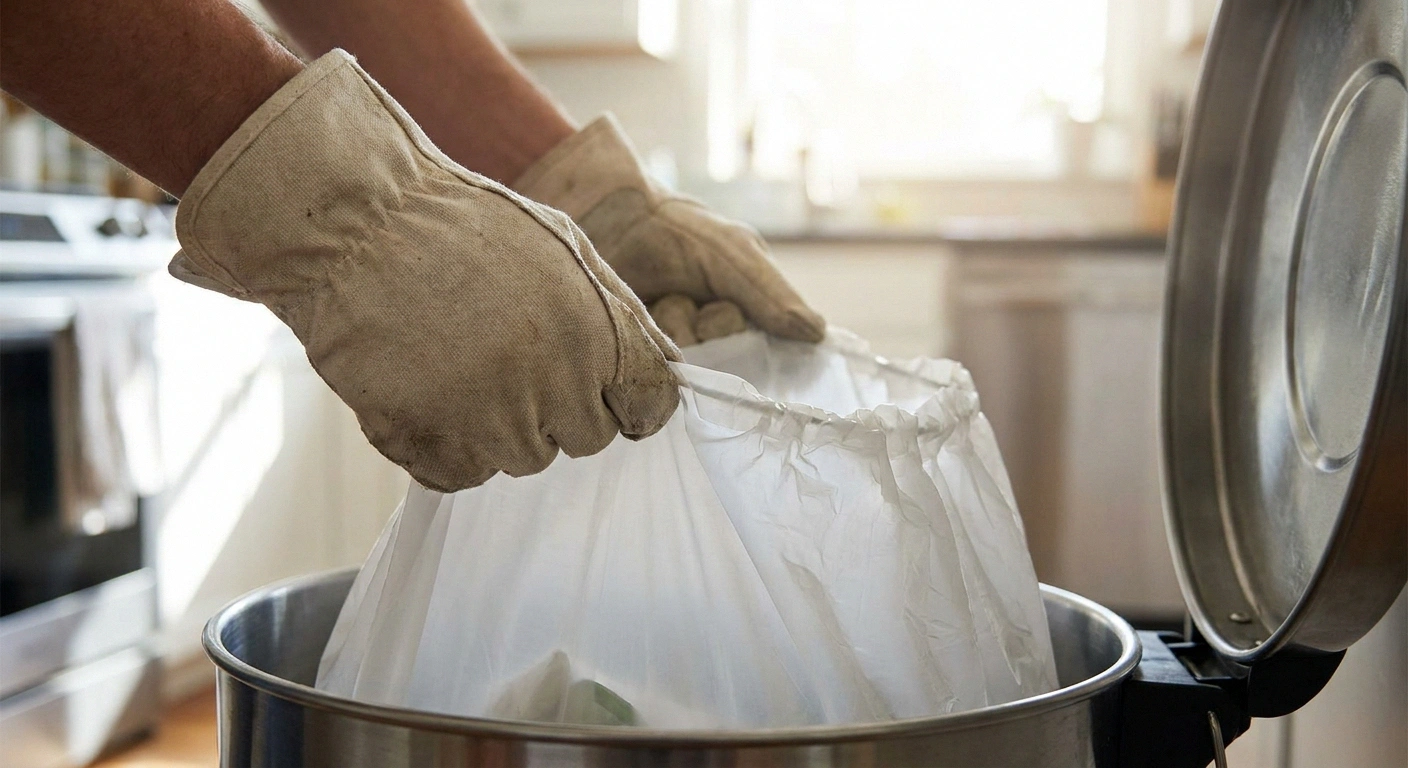
Neuropathy in the hands brings its own trash-day risks. The NIDDK says nerve damage can make it hard to sense pain or temperature, and it warns that people with numb feet may not notice injuries that lead to sores. The same logic applies to fingers. A sliver of broken glass or the sharp lid of a can is easy to miss when your fingertips don't report it.
Gloves help — with a catch. NIOSH found that a single pair of heat-resistant gloves can cut grip strength by up to 40 percent, and two pairs by up to 60. So choose gloves that protect without turning your hands into mittens when you need to tie a bag or work a latch. Cities have rules that protect you as well as their crews. As of October 2026, Austin asks residents to wrap broken glass in newspaper and put it in a labeled box, and Jacksonville wants containers free of sharp or jagged edges.
When you come back inside, wash up. The CDC lists touching garbage among the key times to wash your hands, for at least 20 seconds, and it says warm or cold water both work, so there's no reason to use hot water you can't feel. Then take a quick look at both hands, the same way the NIDDK suggests checking your feet each evening. That hands check is my own habit, not an official rule. If you find a cut, wash it and cover it with a bandage, as the NIDDK advises for feet, and get anything deep, dirty or slow to heal looked at, since diabetes can make wounds slow to heal and more likely to get infected. For more on hand symptoms, see my page on neuropathy in the hands.
Needles, Lancets and Old Pills
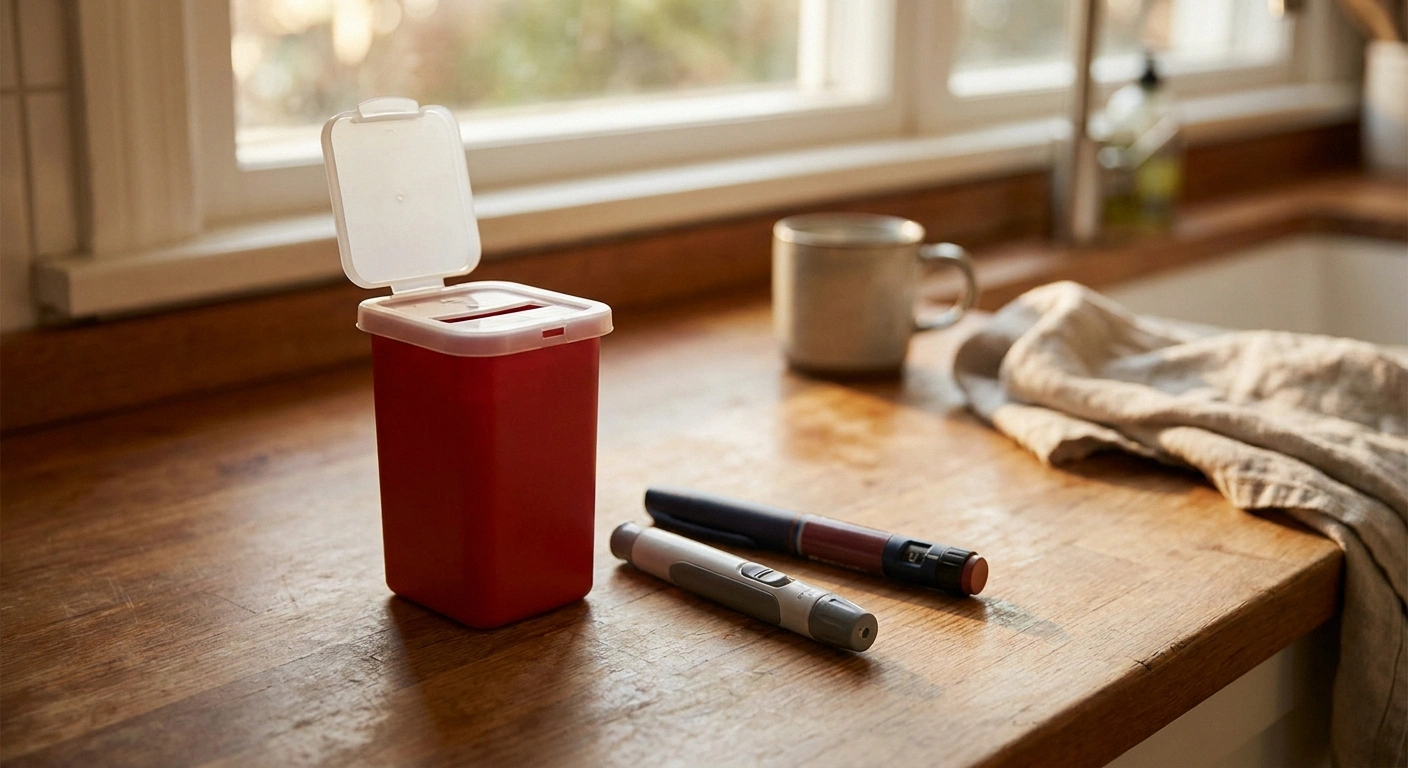
If you have diabetes, your trash probably includes lancets, pen needles or syringes, and the FDA is firm about them. “Never place loose needles and other sharps,” it says, in household or public trash cans or recycling bins, and never flush them. Loose sharps put trash workers, housekeepers, family members and children at risk.
The FDA's method has two steps. First, put every used needle or lancet into a sharps disposal container right away. Then, when the container is about three-quarters full, follow your community's rules for getting rid of it, and never reuse it. FDA-cleared containers are sold at pharmacies, medical supply companies and online, and the FDA notes that your insurer may cover them. If you can't get one, it says some community guidelines accept a heavy-duty plastic household container instead, such as a laundry detergent jug: leak-resistant, upright, with a tight-fitting, puncture-resistant lid and labeled as hazardous waste. Sharps containers don't go in the recycling bin.
Local rules really do differ. As of October 2026, Austin accepts needles and syringes in household trash when they're inside a hard plastic or metal container with a tightly secured lid, and Jacksonville asks you to place sealed medical waste containers in the center of your bag or cart. For old medicines, the FDA's first choice is a drug take-back location or a prepaid mail-back envelope. If neither is available and the drug isn't on its flush list, the FDA describes mixing pills with something unappealing like used coffee grounds or cat litter, sealing it in a bag, and putting it in the trash, though some cities, San Antonio among them, list medicine among items not allowed in the garbage cart.
When Snow and Ice Move In
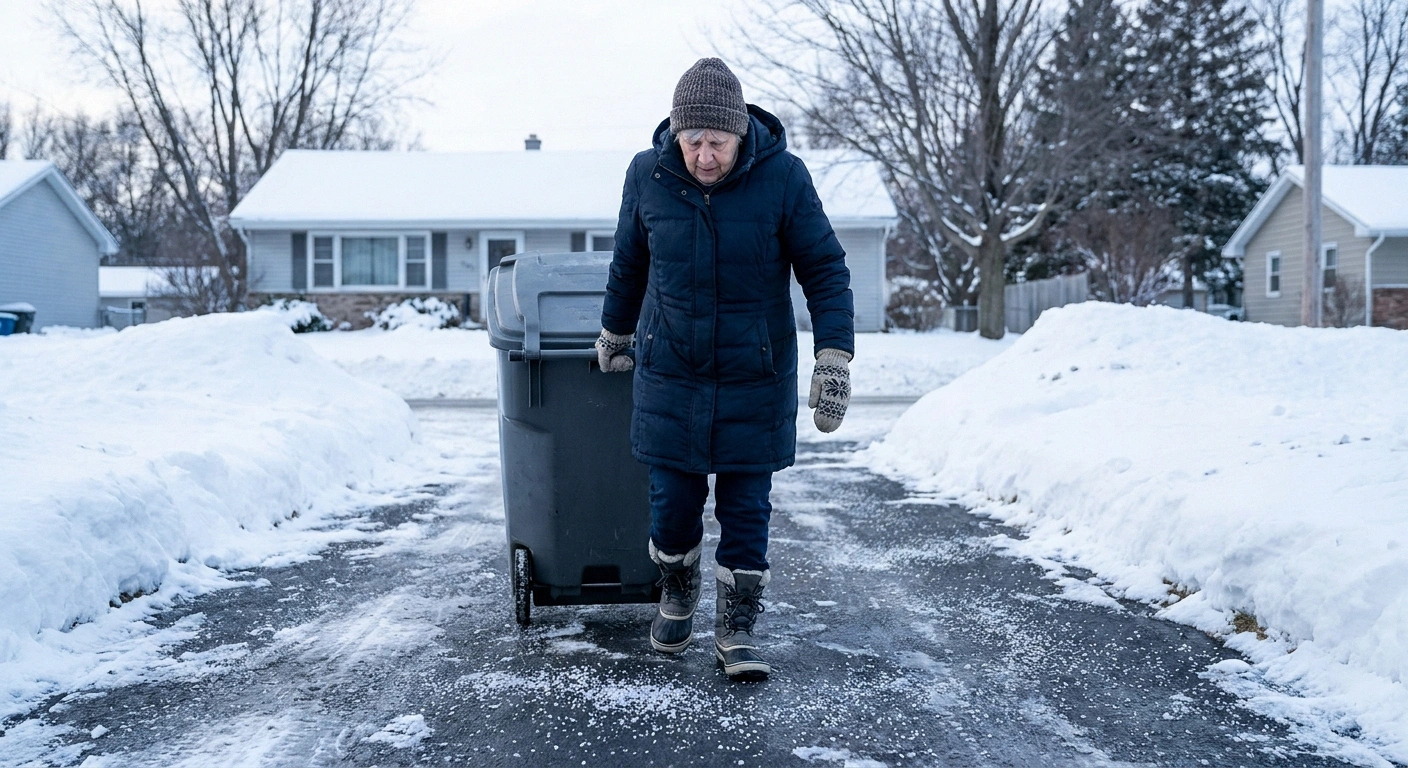
“Walking on ice is extremely dangerous,” the CDC says, noting that many cold-weather injuries come from falls on icy sidewalks, steps, driveways and porches. Its advice: avoid walking on ice, keep steps and walkways clear with rock salt or another de-icer, use sand for traction, make trips outside as brief as possible, and wear mittens, which it says are warmer than gloves. If you have to do heavy outdoor chores, dress warmly and work slowly.
Numb skin adds a cold-weather twist. The CDC warns that frozen skin goes numb, so a person can have frostbite without realizing it until somebody else notices, and it adds that affected areas “can easily burn,” so rewarm cold hands gently and never with a heat source you can't feel. And NIH's Dr. Basil Eldadah has noted that for older people, even mild exposure to cold can lead to hypothermia. My page on walking on ice and snow covers cleats and technique.
Snow also changes the timing. As of October 2026, Boston tells residents to put containers out as late as possible in snow season, but no later than 6:00 a.m., since bins set out early are more likely to be covered by snow or blocked from view, and never to tuck them behind or under snowbanks. Columbus requires a clear path to the collection point, snow and ice included, even for residents who get help.
How Early Can the Bins Go Out?
Many of us like to put the bins out in daylight the evening before, but cities set their own windows. As of October 2026, Houston, Dallas and Fort Worth allow carts out from 6 p.m. the night before, Denver from 7 p.m., and Jacksonville from 5 p.m. for items placed separately at the curb. Seattle, Phoenix, Austin, San Antonio and Columbus list only a morning deadline, between 5:30 and 7 a.m. In late fall and winter, 6 or 7 p.m. may already be dark, so the porch-light advice above matters more than ever.
| City | Earliest | Out by | Back in by |
|---|---|---|---|
| Houston | 6 p.m. the day before | 6 a.m. | 10 p.m. on collection day |
| Dallas | 6 p.m. the evening before | 7 a.m. | 8 a.m. the next day |
| Fort Worth | After 6 p.m. the night before | 7 a.m. | Midnight |
| Denver | 7 p.m. the night before | 6 a.m. | Not stated |
| Charlotte | The day before | 6 a.m. | Midnight |
| San Antonio | Not stated | 7 a.m. | 10 p.m. on collection day |
| Seattle | Not stated | 7 a.m. | Not stated |
| Phoenix and Austin | Not stated | 5:30 a.m. | Not stated |
| Columbus | Not stated | 6 a.m. | Not stated |
| Boston, snow season | As late as possible | 6 a.m. | Not stated |
Sources: each city's sanitation or solid waste web pages, checked October 3, 2026. Check your own city's page, since these windows can change.
Help Your City May Offer
Here's the part I wish more people knew. Some cities will collect trash from your door, your side yard or your garage for residents who can't get carts to the curb, but the programs go by so many names they're hard to find: special collection assistance, Helping Hands, walk-up service, backyard collection, carryout, exemption service. As of October 2026, Houston, Dallas, San Antonio, Seattle, Charlotte, Columbus and Fort Worth all describe programs like this on their official sites.
| City | What it's called | Who signs off | Worth knowing |
|---|---|---|---|
| Houston | Special collection assistance | A physician, or an optometrist for legal blindness | No additional cost; everyone in the home must qualify; starts 7 to 10 days after the certification and a home inspection |
| Dallas | Helping Hands | A licensed medical professional | For people living without an able-bodied person in the home; renew every two years; the regular monthly fee still applies |
| San Antonio | Walk-up service (a medical waiver) | Not stated on the page | For residents physically unable to roll carts to and from the curb |
| Seattle | Backyard pickup | Medical verification may be required | Extra fee, waived only if all four conditions apply; covers garbage, not recycling or compost |
| Charlotte | Disability collection (backyard) | A physician | Service begins within 2 weeks; re-verification when the city asks |
| Columbus | Exemption service | A physician, for every member of the household | For people with no family member or neighbor who can help; not for bulk or yard waste |
| Fort Worth | Disabled carryout service | A physician, or an optometrist for legal blindness | No one living in the home or employed by the resident can move the carts; temporary service ends on the date the doctor sets |
Sources: official pages and forms from each city's solid waste or sanitation department, checked October 3, 2026. Rules change, so confirm with your city before applying.
The rules have a family resemblance. Most ask for a doctor's certification, and most require that nobody else in the home can do the job; Fort Worth counts a paid helper as someone who can. Expect a home visit or inspection in some cities. Dallas requires you to renew every two years, and Seattle's backyard service carries a fee unless you meet all of its waiver conditions. Jacksonville and Phoenix say they'll consider accommodations case by case.
If a private company hauls your trash, ask it — and ask your town. In one California county, the hauler's franchise agreement requires roll-out service at no extra cost for households where everyone over age 12 is unable to move the carts, so help may be written into a contract you've never seen. When you call, have your doctor's contact information handy and a short description of what you can't manage.
Asking for an Accommodation
If your city has no program, you can still ask. Under the Americans with Disabilities Act, the federal rules for state and local governments say a public entity “shall make reasonable modifications” to its policies when needed to avoid discrimination on the basis of disability, unless the change would fundamentally alter the service. I'm not a lawyer, and this isn't legal advice: what counts as reasonable gets decided case by case. But a polite written request to your solid waste department, explaining what you can't do and what would help, is a perfectly fair place to start.
If You're the Family Member Helping
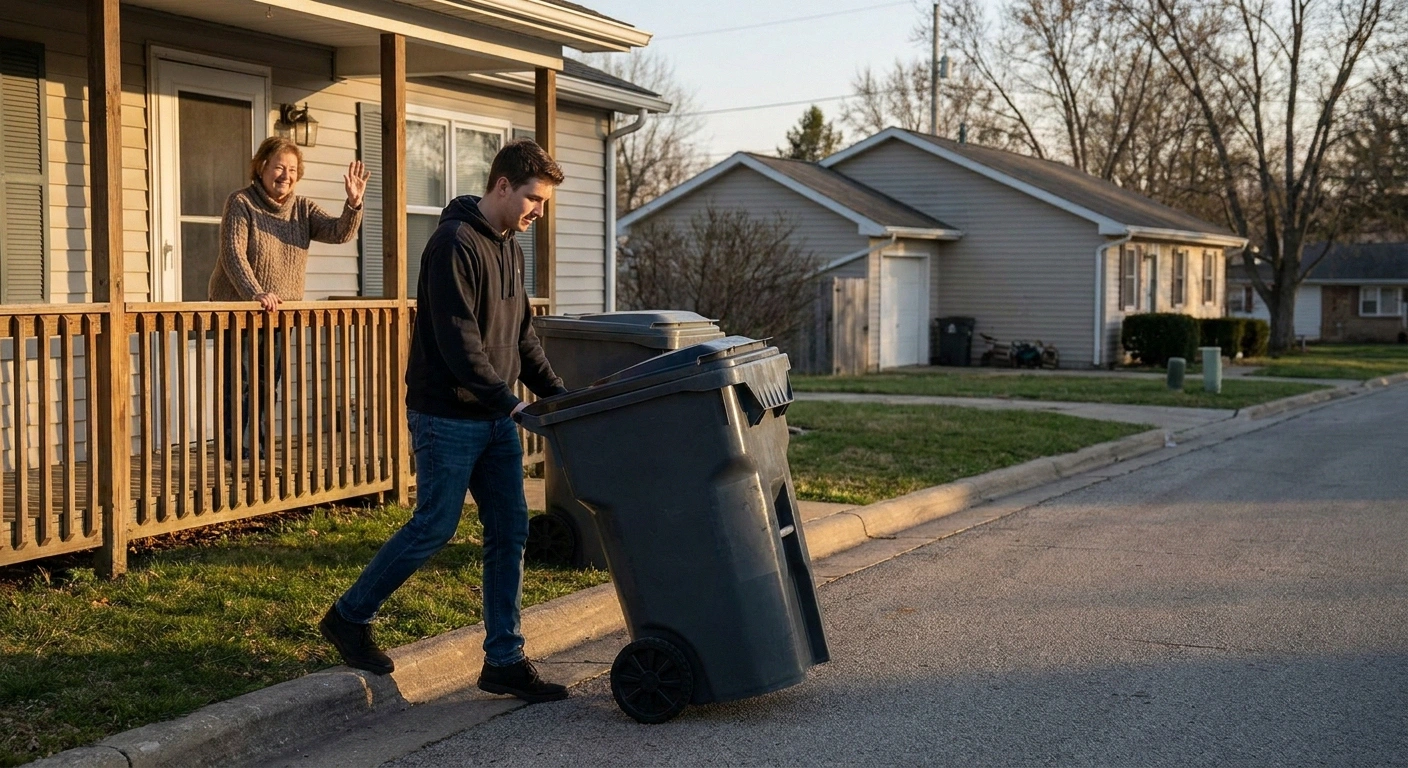
The CDC's caregiver brochure puts it simply: most falls happen at home. If someone you love is still wrestling the bins to the curb, offer to take over trash night, or set up a standing deal with a neighbor.
You can also help fill out a city assistance form, which often needs a doctor's signature and a description of the problem. And keep an eye on yourself, too; my page on caregiver burnout is there for the long haul.
Frequently Asked Questions
Will the city pick up my trash at the door if I have a disability?
Some cities offer assisted collection for residents who cannot get carts to the curb, under names like walk-up, backyard, carryout or Helping Hands. As of October 2026, Houston, Dallas, San Antonio, Seattle, Charlotte, Columbus and Fort Worth describe such programs. Most require a doctor's certification and that no one else in the home can do it.
Is it better to push or pull a trash can?
Workplace guidance from NIOSH says to push instead of pull when there is a choice, and to keep a clear view of the path. It was not written about trash bins or balance, so treat pushing the cart ahead of you as a sensible tip rather than proven advice.
Can insulin needles and lancets go in the household trash?
Never loose. The FDA says to put used sharps in a sharps disposal container right away and to follow your community's rules once it is about three-quarters full. Some cities, such as Austin and Jacksonville, accept sealed containers in household trash, but rules vary, and sharps containers never go in recycling.
How heavy is an empty trash can?
On one New York town's chart, empty wheeled cans with hinged lids weigh 17 to 33.5 pounds before any trash goes in. Several cities offer smaller carts on request, which may be easier to handle.
What should I do about trash day in snow and ice?
The CDC says to avoid walking on ice and to keep walkways clear with salt or sand. Some snowy cities, such as Boston, ask residents to set bins out as late as possible but no later than 6 a.m. If the path is icy, ask a neighbor or family member to take the bins out.
How early can I put my trash bins out the night before?
That depends on the city. Houston, Dallas and Fort Worth say 6 p.m. the evening before, Denver says 7 p.m., and several cities give only a morning deadline, according to their pages as of October 2026. Check your own city's sanitation page.
About the Author