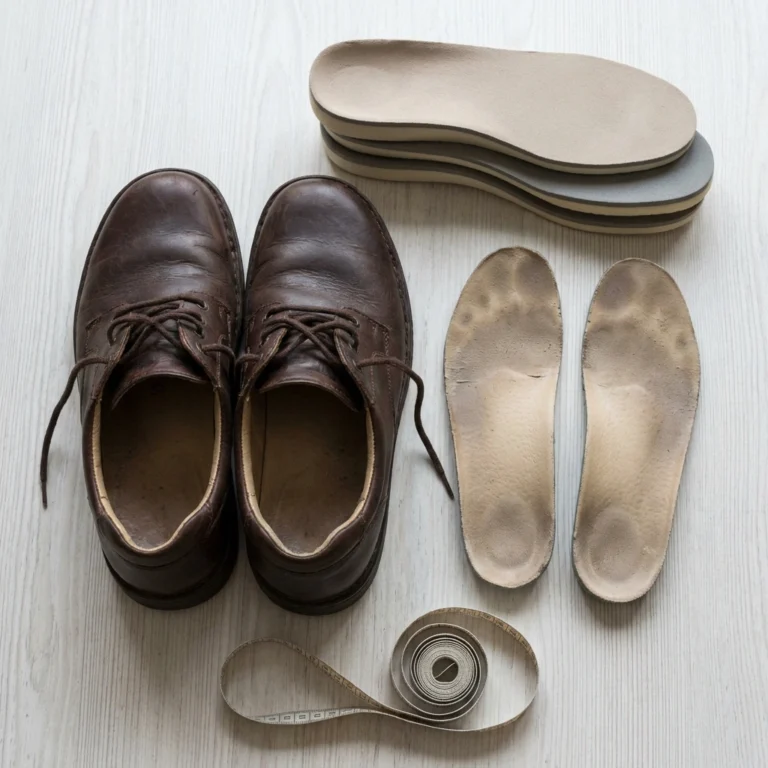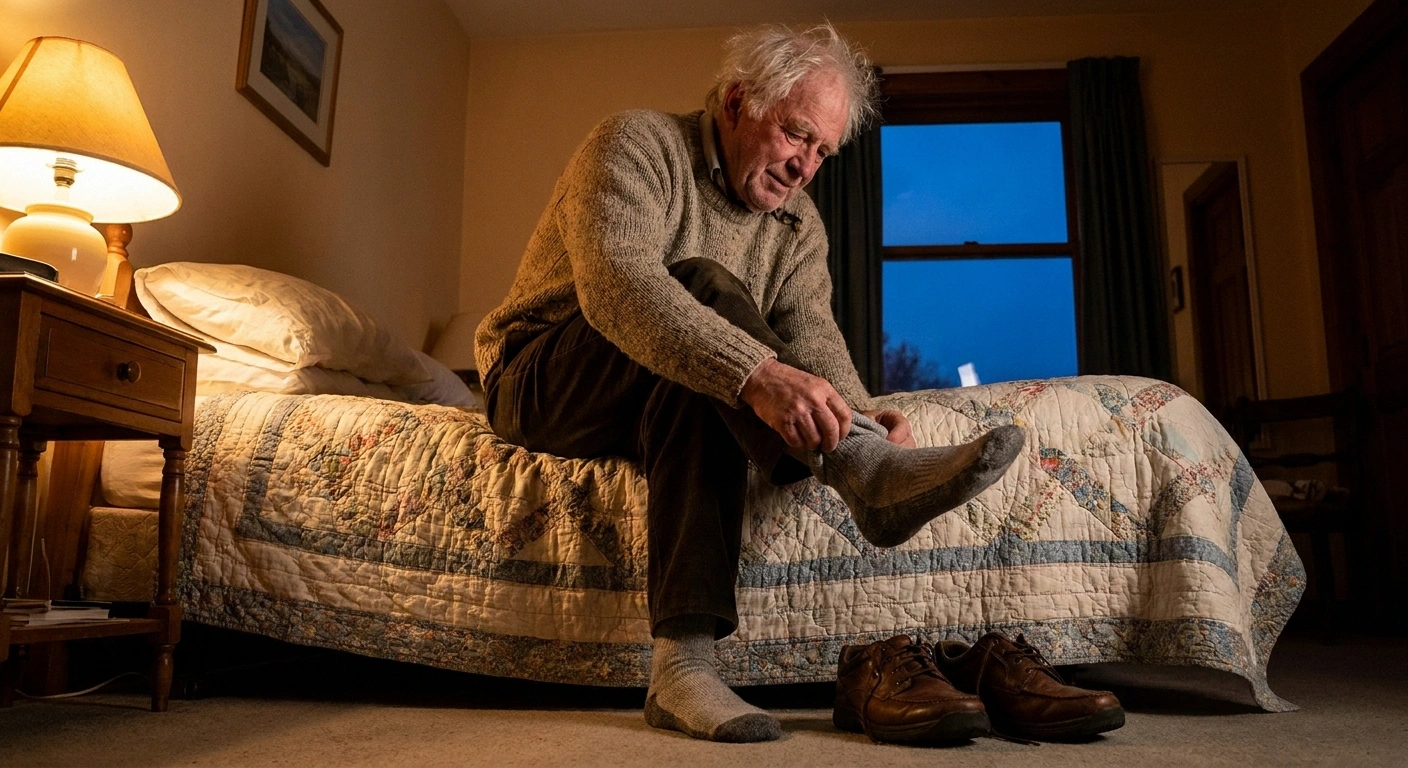
Peel off your socks after a long day and look at them. Damp at the toes? A sour smell when you set your shoes by the door? Skin between the toes that looks white and a little soggy? If you have neuropathy, those small signs deserve more attention than they’d get from most people — and not for the reason you might think.
Here’s the surprise I ran into while researching this: nerve damage from diabetes more often leaves feet dry — not sweaty. So if your feet are the damp ones, the cause is often ordinary foot sweat, warm shoes, or a medicine on your list. That doesn’t make it harmless. When you can’t feel your feet well, damp skin between the toes is exactly where blisters, athlete’s foot and infections get started without announcing themselves.
Below is what I’ve learned about why feet sweat and smell, why moisture matters more when your feet are numb, and the routine I use to keep mine dry without soaking them. Most of it comes from NIDDK, the NIH’s diabetes institute, plus MedlinePlus, the NHS and published studies. Where something is just my habit, I’ll say so.
Doesn’t Neuropathy Usually Dry Feet Out?
Often, yes. The nerves that run your sweat glands are part of the autonomic nervous system, the automatic wiring that also handles digestion and blood pressure. NIDDK says damage to those nerves can make you sweat a lot at night or while eating, can stop sweat glands from working at all, or can leave some parts of your body sweating while others stay dry. MedlinePlus lists “sweating too much or too little” among the signs of autonomic nerve damage.
| What you notice | What it may point to |
|---|---|
| Dry, cracked feet with a damp face, chest or back | The more typical autonomic nerve pattern in diabetes |
| Heavy sweating while you eat | Gustatory sweating: reported by about 10% with type 1 and 13% with type 2 diabetes in a Danish survey, versus 5% without diabetes |
| Damp feet since starting a new nerve-pain medicine | A possible side effect worth raising with the prescriber |
| Sweaty soles you’ve had since your twenties | Often primary sweating, unrelated to your nerves |
| Night clothes and sheets soaked in a cool room | Night sweats, which deserve a doctor’s visit, especially with weight loss you can’t explain |
| Sudden sweating with shakiness | Possible low blood sugar if you use insulin or a sulfonylurea: check your level |
In diabetes, the feet are usually the dry part. A 2012 skin-biopsy study found people whose feet didn’t sweat had the most nerve loss around their sweat glands, and that nerve loss tracked with higher A1c. A 2020 study of 308 people with diabetes found that dry foot skin, measured with a simple sweat test, predicted foot ulcers over 6 years. If that’s your pattern, with dry feet and a damp upper body, NR’s guide to sweating changes in autonomic neuropathy covers it in depth.
Patchy or “both at once” sweating is real too, which is why I don’t trust any one-line rule here. In my support group, I’ve heard people describe sweaty soles one season and cracked, dry heels the next. Your feet don’t have to follow the textbook.
Other Reasons Your Feet Might Be the Damp Ones
Feet are one of the body’s main sweat spots. MedlinePlus says you sweat mainly under your arms and on your feet and palms, and when sweat mixes with bacteria on your skin, it can smell. A 2016 US survey estimated about 4.8% of adults deal with excessive sweating, and only about half had ever mentioned it to a clinician. A 2026 review puts “primary” sweating, the kind with no other cause, at 2 to 5% of people, and a podiatry review notes that sweaty soles are usually this primary type.
The NHS adds the everyday culprits: hot weather, exercise, standing all day, carrying extra weight, and hormonal changes such as menopause. None of those care whether your nerves are healthy — they happen to everyone.
Check Your Medicine List
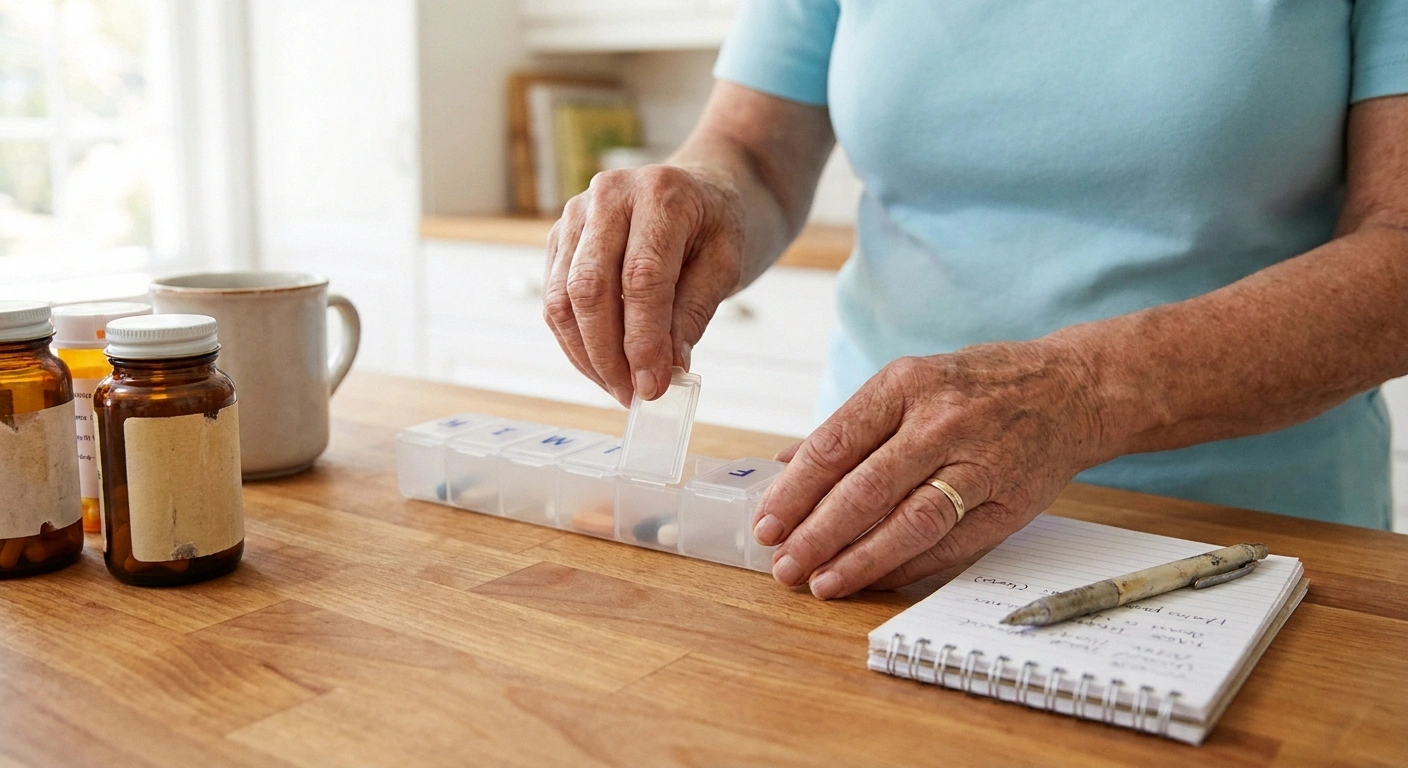
This one gets missed a lot. Duloxetine (Cymbalta), one of the most common prescriptions for diabetic nerve pain, lists hyperhidrosis, the medical word for heavy sweating, among its most common side effects in diabetic nerve-pain trials. In the label’s pooled pain trials, 6% of people on duloxetine reported it, compared with 1% on placebo. In a head-to-head study, people on duloxetine reported sweating more often than people on pregabalin.
A 2008 drug-safety review adds SSRI antidepressants, opioids, tricyclic antidepressants and dementia drugs called cholinesterase inhibitors to the list of medicines that can increase sweating. Some medicines do the opposite and reduce sweating, which raises heat-stroke risk. Tricyclics, such as amitriptyline, show up on both lists.
Please don’t stop a medicine because your feet are damp. The duloxetine label itself lists sweating among the reactions that can come from stopping it, and it says not to stop or change the dose without the prescriber. If sweating started after a new prescription, write down when it began and bring that to your next appointment. Switching or adjusting is the prescriber’s call, and they have options. NR’s page on duloxetine for nerve pain covers its other trade-offs.
Why Damp Skin and Numb Feet Are a Risky Mix
NIDDK puts the basic problem simply: once your feet lose feeling, a blister can go unnoticed, and blisters can turn into cuts and sores that become infected. Moisture makes that more likely in three ways.
In the French cellulitis study and the six-study analysis, diabetes by itself wasn’t linked to leg cellulitis. Broken or soggy skin between the toes was. That’s good news: it’s the part daily drying can change. Diabetes still raises the stakes once an infection starts, since wounds heal more slowly.
In 1,285 veterans followed for foot ulcers, toenail fungus went with about 1.6 times the risk, while athlete’s foot did not raise it. So thick, discolored toenails are worth showing your podiatrist too.
Damp skin rubs harder. A review of military and sports research found moist skin increases friction, the force behind blisters, and that blisters form most easily on thick-skinned spots like the soles. Very dry or soaking-wet skin actually has less friction — it’s the clammy in-between that does the damage. That’s no reason to let feet stay soaked, though; soggy skin breaks down in other ways, as the next point shows.
Soggy skin between the toes breaks down. NIDDK notes that skin between the toes tends to stay moist. In a study of 200 people with toe-web infections, the main setups were athlete’s foot, heavy sweating and humidity, and 20% went on to develop cellulitis, a spreading skin infection. A French study found that broken skin — including a cracked toe web — was strongly tied to leg cellulitis, and toe-web problems accounted for an estimated 61% of the cases in that population.
Athlete’s foot opens the door. A meta-analysis of six case-control studies found athlete’s foot roughly tripled the odds of leg cellulitis. In one Tokyo diabetic foot clinic, 59% of patients had it. I want to be careful here, because the evidence has limits. A review found too little data to say fungal foot infection is more dangerous in diabetes specifically, and a large study of veterans found toenail fungus, not athlete’s foot, predicted foot ulcers. What’s clear is simpler: wet, broken skin between the toes is a weak spot, and a numb foot won’t itch or sting to warn you. NR’s overview of diabetic foot ulcers explains why small skin breaks matter so much.
Where the Smell Actually Comes From
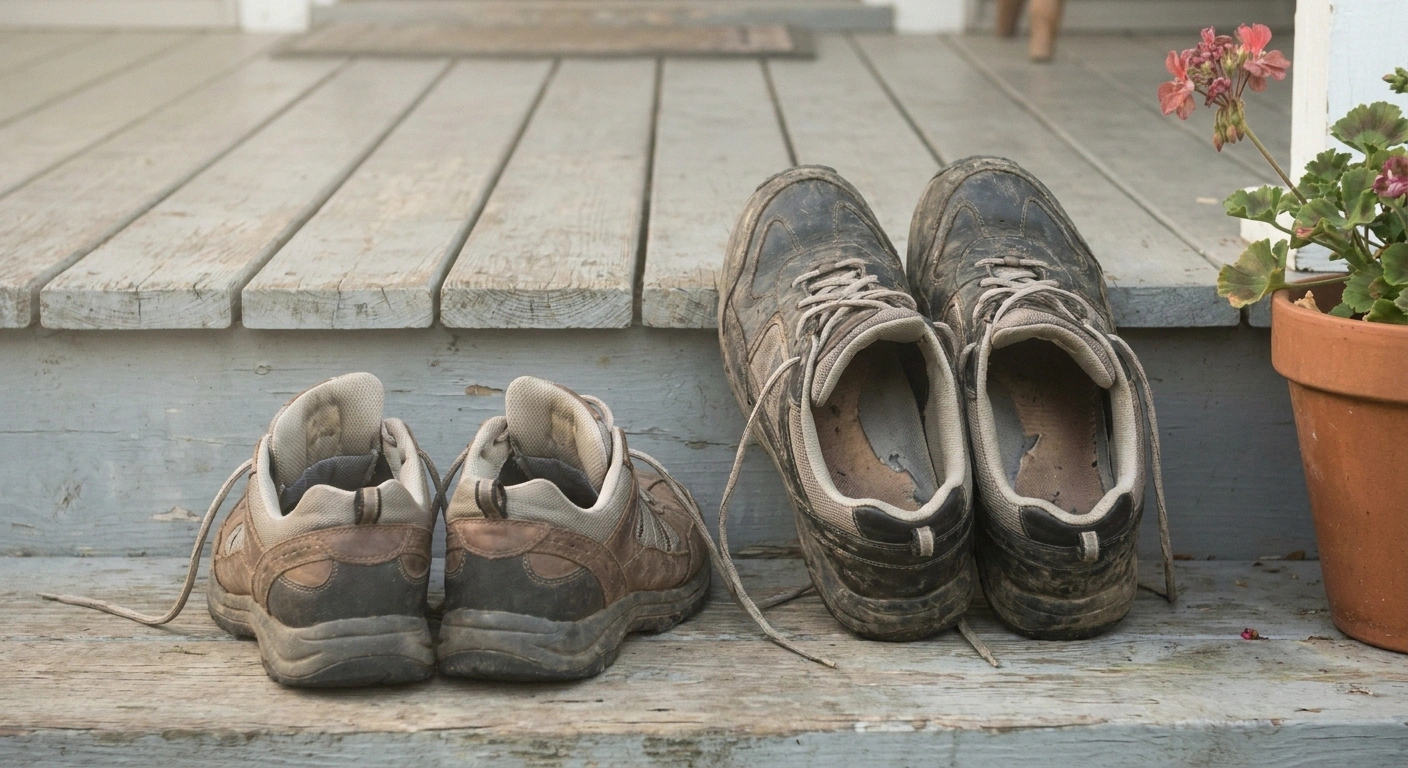
Sweat itself barely smells. The NHS says smelly feet are common and usually come from a buildup of sweat and bacteria, sometimes fungus. A 2006 lab study traced the classic cheesy foot smell to isovaleric acid, made when a normal skin bacterium, Staphylococcus epidermidis, breaks down leucine, an amino acid in sweat. A 2026 study added another bacterium, Kytococcus, to the picture.
That’s useful to know, because it tells you what actually works. Less sweat sitting on the skin, fewer bacteria, and shoes that dry out between wears all cut the smell at its source. Perfumed sprays only cover it up — the bacteria don’t mind.
Tiny Pits on the Soles
If the smell is strong and you notice little craters or pits on the bottoms of your feet, often starting near the toes, it may be pitted keratolysis. It’s a bacterial infection of the top layer of skin, and heavy sweating and odor are its most common symptoms. Kytococcus, the same bacterium from the odor study, is the usual cause, and it seems to thrive in sealed-in, sweaty shoes.
It’s treatable, but a 2014 review found the treatment evidence is mostly small case reports. The best results came from antibacterial treatment applied to the skin, combined with an antiperspirant, and the antibiotic creams used for it generally need a prescription in the US. A small trial in 60 working men found a 4% chlorhexidine antiseptic scrub was the most cost-effective option. With neuropathy, though, I wouldn’t self-treat any new pits, sores or rash on my soles. Get it looked at first.
My Nightly Routine, No Soaking
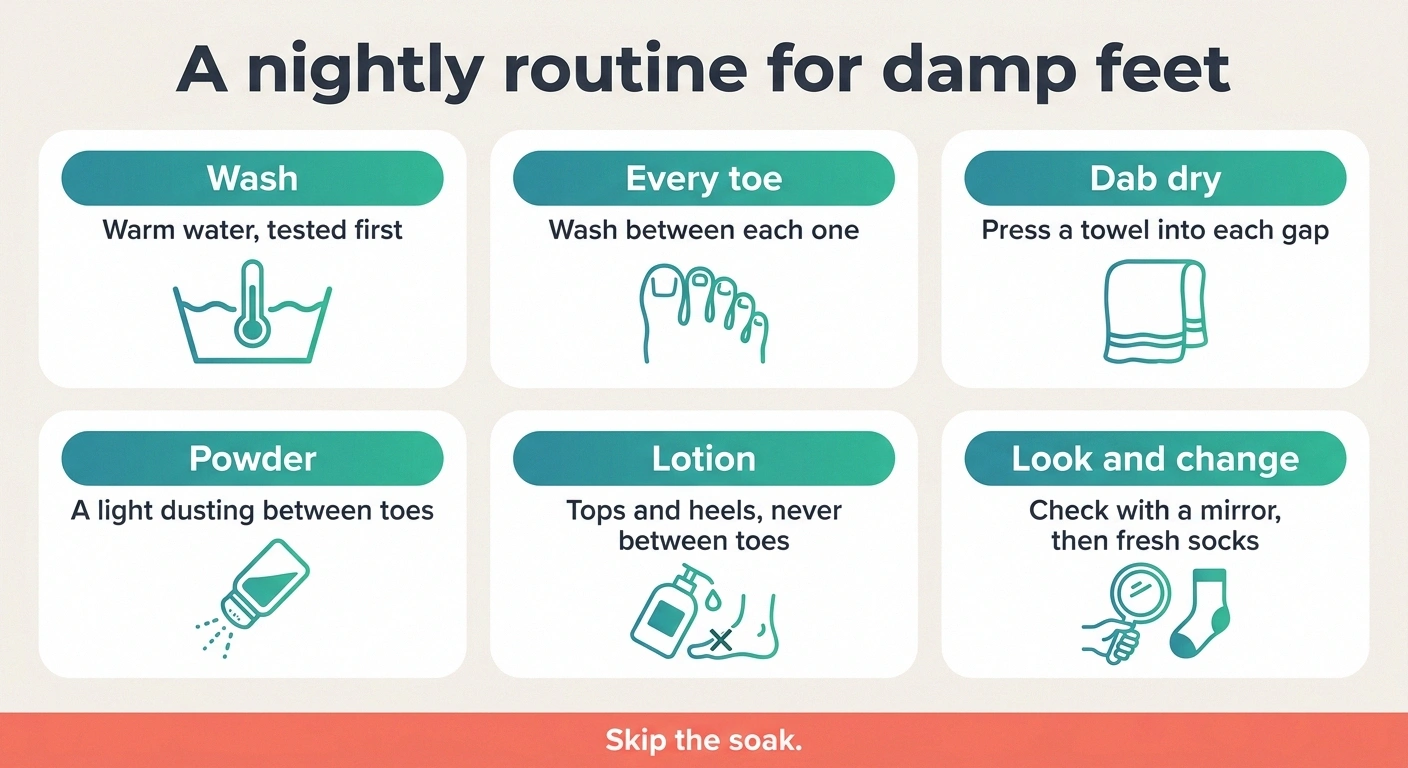
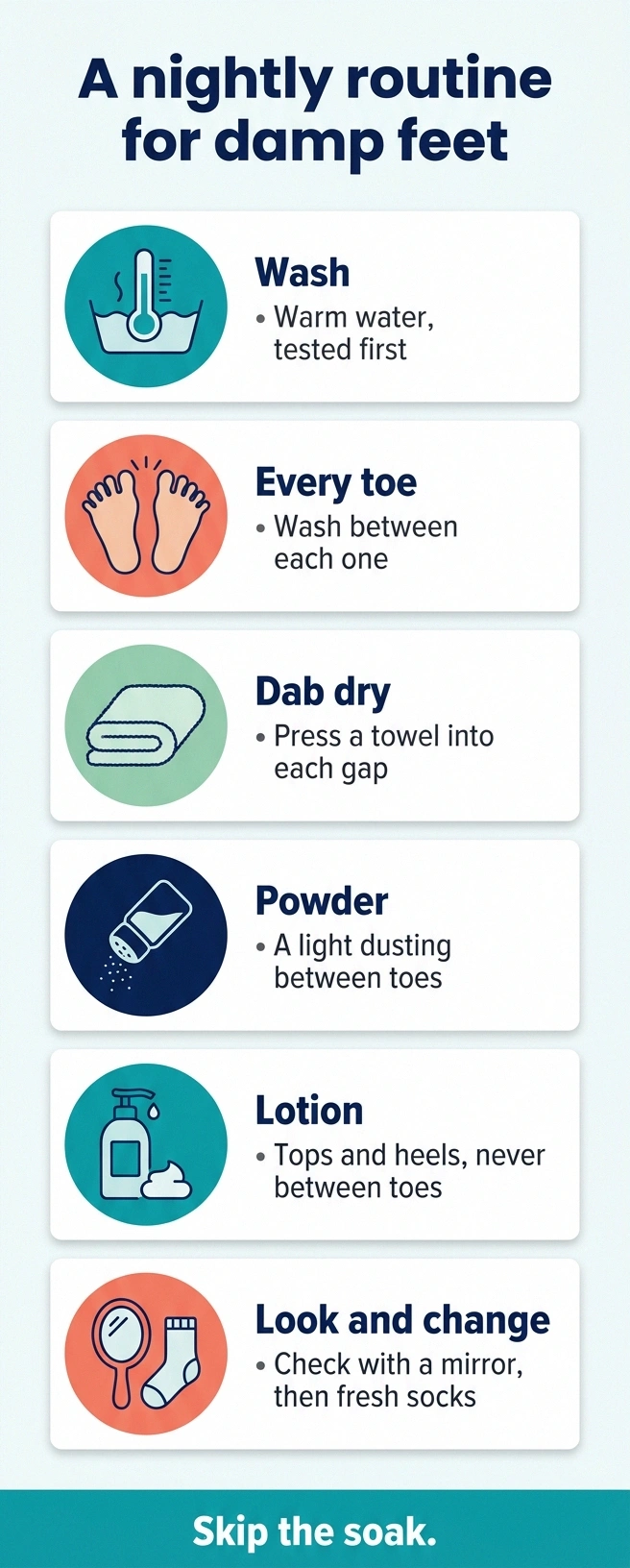
This is the routine I settled on after reading NIDDK’s foot-care page more times than I can count. It takes about five minutes.
1. Wash — don’t soak. NIDDK says to wash your feet with soap in warm, not hot, water, and to test it with a thermometer (90 to 95°F is safe) or your elbow, since numb feet can’t judge heat. It also says plainly: don’t soak your feet, since soaking dries the skin out too much. I wash them at the end of my shower, sitting on a shower stool.
2. Get between every toe. In a small Tokyo study of people with diabetes, those with athlete’s foot had scrubbed between their toes fewer times while washing, and people who had trouble reaching their feet were more likely to have it. If bending is hard, a long-handled sponge or a helper makes a real difference. That’s my workaround, not a study result.
3. Dab dry, especially between the toes. The NHS suggests drying thoroughly between the toes, dabbing rather than rubbing, and keeping a separate towel just for your feet that gets washed regularly. I fold a corner of my foot towel over one finger and press it into each gap.
4. Powder between the toes. NIDDK recommends putting talcum powder or cornstarch between your toes after washing, because that skin tends to stay moist and powder helps prevent infection. I use a light dusting on intact skin only; skin that’s open, weeping or looks infected needs a look from your doctor, not powder.
5. Lotion on the tops and soles, never between the toes. NIDDK is firm on this one: moistness between the toes can cause infection. Cracked heels still need moisture, just not in the gaps. NR’s guide to applying foot lotion with neuropathy shows how.
6. Look before you’re done. Itching and burning are the usual athlete’s-foot alarms, and numb feet may not send them. MedlinePlus says it most often shows up between the toes as cracked, scaly skin, and the NHS describes itchy white patches there. I use a mirror and a good lamp. NR’s daily foot inspection guide covers what to look for.
7. Fresh, dry socks. Clean socks every day, and a fresh pair any time the ones you’re wearing are damp. Check them with your hands or by looking, since numb feet may not notice.
Socks and Shoes That Breathe

NIDDK’s advice for people with diabetes: choose clean, lightly padded socks that fit well, with no seams if you can find them. Wear walking or athletic shoes for daily wear, because they support your feet and let them breathe, and skip shoes made of vinyl or plastic, since those materials neither stretch nor breathe. And don’t walk barefoot or in just socks, even indoors.
For sweaty feet, the NHS adds a few habits that line up well with that:
- Change your socks at least twice a day if you sweat heavily.
- Don’t wear the same shoes two days in a row, and let each pair dry out completely before the next wear.
- Choose breathable materials and avoid tight shoes.
What about fiber? Honestly, the studies don’t settle it. NHS pages favor cotton and other natural fibers. A 1990 study of 35 runners found acrylic socks caused fewer and smaller blisters than cotton, but a 1993 follow-up with a generic cushioned sole found no difference, which suggests padding matters as much as fiber. A Swiss military study found a merino-wool blend kept skin drier and felt more comfortable than polypropylene. None of these involved people with neuropathy. My rule of thumb: pick a sock that pulls moisture away from the skin, fits without seams or tight bands, and gets changed when it’s damp.
One small conflict worth knowing about: the NHS suggests avoiding enclosed sports shoes if your feet sweat heavily, while NIDDK recommends athletic shoes for protection. For numb feet, protection comes first. I wear breathable walking shoes and keep two pairs in rotation so each one dries for a full day. NR’s guide to choosing shoes for neuropathy has more on fit.
Powders and Antiperspirants
Foot powder or an antiperspirant is part of the NHS’s standard smelly-feet advice. Antiperspirants do work on feet. In a small 1992 Army study, two ordinary antiperspirants cut foot sweat by more than half during a treadmill march, but they also caused more skin irritation. On numb skin, irritation may not sting enough to warn you, so check the soles the next day.
- Wash and dry the soles thoroughly before putting it on.
- Don’t apply it right after bathing.
- Don’t use it on broken or irritated skin.
- Kidney disease? Check with a doctor before the first use.
Stronger over-the-counter foot antiperspirants use aluminum chloride. One product’s Drug Facts label says not to use it on broken or irritated skin, and to “Ask a doctor before use if you have” kidney disease. That second line matters for a lot of us, since kidney disease and diabetes often travel together. The label also says to stop and check with a doctor if a rash or irritation develops.
NIDDK notes that for too much sweating from autonomic neuropathy, doctors may suggest avoiding heat and humidity, or prescribe an antiperspirant or a medicine to decrease sweating. Prescription strength is a decision for your doctor or podiatrist.
One more honest note: a review of blister research found that antiperspirants and drying powders on the feet didn’t seem to lower the chance of friction blisters. They help with sweat and smell. They don’t replace good socks and well-fitting shoes.
When Everyday Steps Aren’t Enough
If sweaty soles are wrecking your socks no matter what you do, clinicians have a few more tools. A 2018 review in American Family Physician lists aluminum chloride as the usual first treatment, iontophoresis for the palms and soles, and Botox injections as a first- or second-line option.
Iontophoresis sends a mild electric current through tap water while your feet rest in shallow trays. A 2023 study of 30 people with sweaty soles found it effective with minimal side effects, and a UK audit found it worked on a Monday-Wednesday-Friday schedule for 4 weeks, but only as long as people kept it up. It isn’t for everyone. A German review lists metal implants such as pacemakers, or joint or bone implants within the electric circuit, as reasons not to use it, along with broken skin that can’t be protected and pregnancy. With ankle hardware or cracked heels, that rules out a lot of us.
Botox in the soles is off-label in the US. The FDA label covers severe underarm sweating only and says safety and effectiveness in other body areas haven’t been established. In a Greek case series of 129 people, it helped 72% at one month but only 34% by nine months, with the effect lasting about six months on average.
The NHS also mentions tablets that reduce sweating. They work on the whole body, which brings back that heat-stroke trade-off, so they’re very much a doctor’s call.
Home Remedies I Looked Into
Vinegar soaks, black tea soaks, baking soda, Epsom salt — every forum has a favorite. Here’s where they landed for me. NIDDK says not to soak your feet at all, which rules out the method before we even get to the ingredient. On Epsom salt, a 2017 review concluded that the idea of absorbing magnesium through the skin is “scientifically unsupported.” I couldn’t find a reliable study of vinegar, tea or baking-soda foot soaks for sweat or odor in anyone. The closest thing was a tiny study of a strong tannic acid lotion on sweaty palms, and iontophoresis beat it.
I used to do a weekly Epsom salt soak myself. I stopped once I read NIDDK’s advice, and my heels have been less cracked since. That’s one woman’s feet, not a study.
When to Call Your Doctor or Podiatrist
Most sweaty, smelly feet are a daily-care problem. These aren’t:
- Red, warm or painful skin on your foot. NIDDK calls these signs of a possible infection and says to call right away. With numb feet, don’t wait for the pain part: redness, warmth or swelling is enough. The NHS adds that redness may be harder to see on brown or black skin.
- A foot or leg that is hot, painful and red, which the NHS warns could mean a more serious infection.
- A cut, blister or bruise that doesn’t start to heal after a few days. That’s NIDDK’s line. If the skin is open and you can’t feel it, I’d call sooner.
- A wound that turns black and smelly. NIDDK says that can be a sign of gangrene. This is the one kind of foot odor that’s an emergency — and it’s nothing like sweaty-sock smell.
- Athlete’s foot when you have diabetes. The NHS says to see a doctor rather than just self-treat, since foot problems can be more serious.
- Sweating that’s new, happens at night, or has lasted 6 months. In a 415-patient study, sweating that started after age 25, or came at night was more likely to have an underlying cause, and diabetes was the most common one found.
Some sweating isn’t about your feet at all. MedlinePlus lists shaking and sweating among the common symptoms of low blood sugar, and NIDDK says lows during sleep can leave your pajamas or sheets damp. NIDDK also notes that autonomic neuropathy can cause hypoglycemia unawareness, so the usual warning signs may be faint. If you take insulin or a sulfonylurea, check your blood sugar when sudden sweating hits, and if it’s low, follow the plan your diabetes team gave you. NIDDK is clear that “Severe hypoglycemia is dangerous and needs to be treated right away,” and that family should call 911 right away after giving glucagon or if no glucagon kit is on hand. NR’s page on hypoglycemia unawareness goes deeper.
On coverage: Medicare Part B covers foot exams or treatment every 6 months if diabetic nerve damage has taken away the protective feeling in your feet, with the usual 20% coinsurance. It usually doesn’t cover routine foot hygiene, “like cleaning and soaking your feet,” but treating an infection is medical care. NR’s guide on when to see a podiatrist covers the rest.
Dry, Clean and Checked
If I had to fit this whole page on an index card, it would say: wash in warm water you’ve tested, dry between every toe, powder in the gaps, lotion everywhere else, fresh socks whenever they’re damp, rotate your shoes, and look at your feet every night. Skip the soaks. And if sweating is new, comes at night, or arrives with shakiness, treat it as a message from somewhere besides your socks.
Damp feet are common and fixable. With neuropathy, they’re just one more thing worth catching early, because your feet won’t always tell you themselves.
Frequently Asked Questions
Can neuropathy cause sweaty feet?
It can, but it is not the most common pattern. NIDDK says damage to the nerves that control sweat glands can cause too much sweating, no sweating, or patchy sweating. In diabetic neuropathy the feet more often become dry, so sweaty feet in someone with neuropathy often come from ordinary foot sweat, warm shoes or a medicine such as duloxetine.
Why do my feet smell even after washing?
Foot odor usually comes from bacteria breaking down sweat, which produces a strong-smelling acid. If the smell returns quickly, sweat-soaked socks or shoes that have not dried out are common reasons. A strong smell with tiny pits on the soles may be pitted keratolysis, a bacterial infection that a clinician can treat.
Should I soak my feet if they sweat or smell?
NIDDK advises people with diabetes not to soak their feet, because soaking dries the skin too much. Wash with soap in warm water tested at 90 to 95 degrees Fahrenheit or with your elbow, then dry carefully between the toes. No reliable study shows that vinegar, tea, baking soda or Epsom salt soaks fix sweaty or smelly feet.
Is it safe to use antiperspirant on my feet with diabetes?
Antiperspirant can reduce foot sweat, but it can also irritate the skin. Over-the-counter aluminum chloride foot products say not to use them on broken or irritated skin and to ask a doctor first if you have kidney disease. Because numb skin may not sting, check your soles for redness after you start.
Can duloxetine make your feet sweat?
Duloxetine’s label lists heavy sweating among its most common side effects in diabetic nerve pain trials, reported by 6 percent of people on the drug versus 1 percent on placebo in pooled pain trials. Stopping it can also cause sweating, so any change should be made with the prescriber.
What kind of socks are best for sweaty feet with neuropathy?
Studies on sock fiber are small and were done in runners and soldiers, so there is no single best fiber. Choose clean, lightly padded socks without seams that pull moisture away from the skin, and change them whenever they feel damp or at least twice a day if you sweat heavily.
Does Medicare cover foot care for sweaty feet?
Medicare Part B covers diabetic foot exams or treatment every 6 months for people whose diabetic nerve damage has taken away protective feeling in their feet. It usually does not cover routine foot hygiene such as cleaning and soaking, but treatment of a foot infection is medical care.
About the Author