My friend Carol got her bone density scan back last spring and called me sounding relieved. Osteopenia, mild, nothing her doctor seemed worried about. “So at least that’s one thing I don’t have to think about,” she said.
Eight weeks later she caught her heel on the lip of her garage step, went down sideways, and broke her wrist.
Carol’s scan wasn’t wrong. It just answered a question she wasn’t actually asking. A bone density scan measures one thing — how much mineral is packed into a section of bone. It doesn’t measure how likely you are to fall, and for someone with neuropathy, it doesn’t fully measure how strong the bone is either.
Those two gaps stack. And almost nobody explains them to the person holding the results.
The Number You Actually Want Is Not on the Scan
Let me put the research on the table first, because the size of the effect surprised me when I went looking.
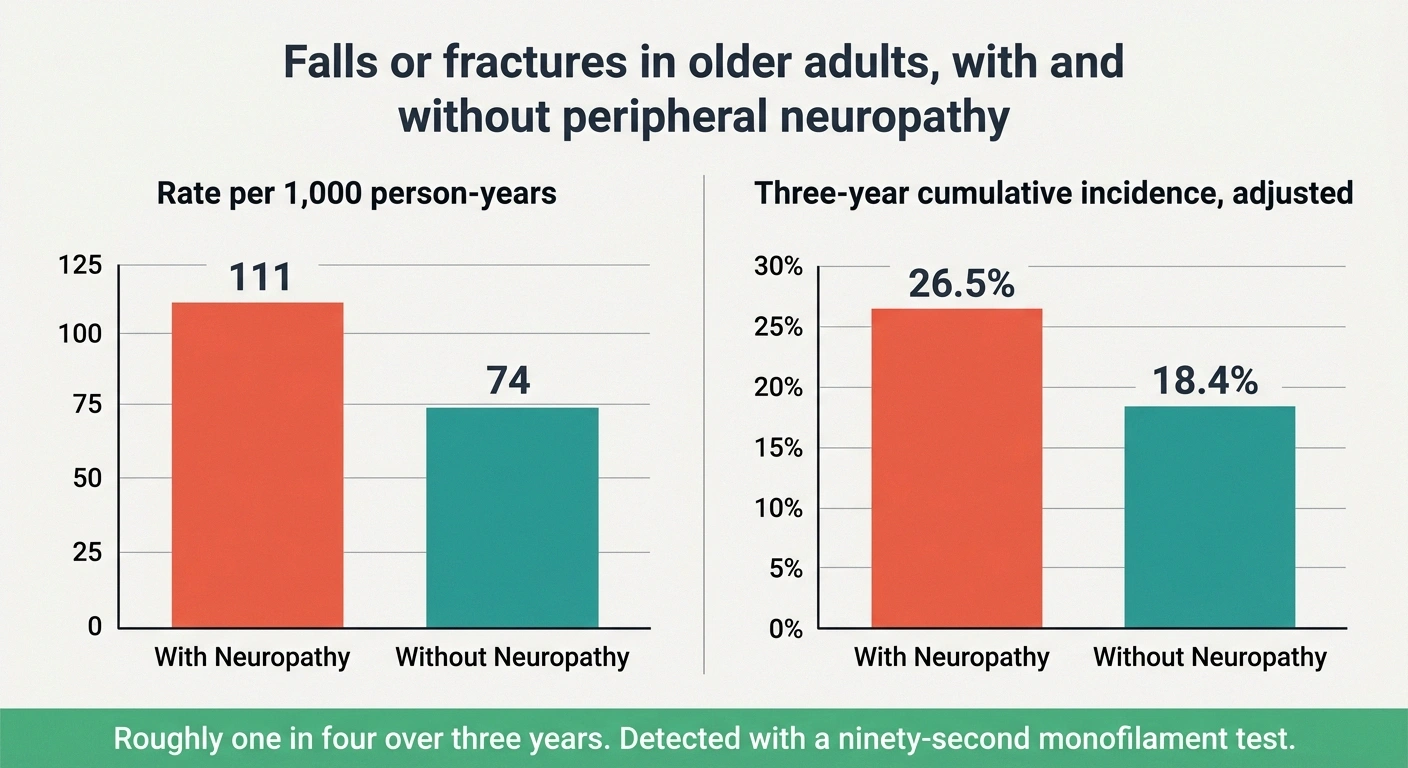
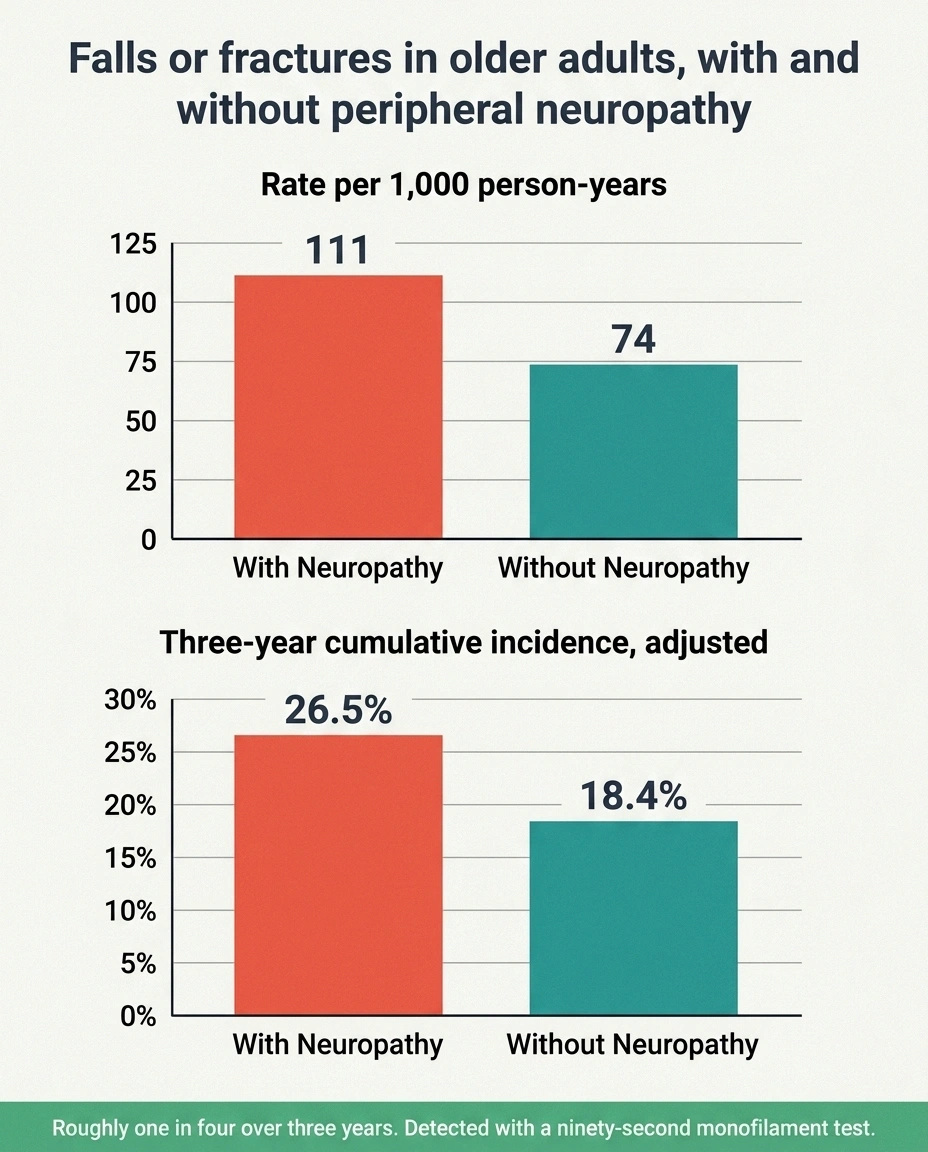
Adjusted for age, sex and race, the three-year cumulative incidence of a fall or fracture was 26.5 percent with neuropathy against 18.4 percent without.
Neuropathy here was identified by monofilament testing, which takes about ninety seconds and costs almost nothing. If you have never had one, that is the cheapest item on this page.
A large study followed older adults who’d been screened for peripheral neuropathy with a monofilament test — the simple nylon filament pressed against the sole of the foot. Over a median follow-up of about two and a half years, the people with neuropathy had falls or fractures at a rate of 111 per 1,000 person-years. The people without neuropathy: 74 per 1,000.
Adjusted for age, sex and race, the three-year cumulative incidence of a fall or fracture was 26.5 percent in the neuropathy group versus 18.4 percent without it.
Roughly one in four, over three years. That’s the number worth carrying around, and it’s derived from a test that takes about ninety seconds and costs almost nothing.
Separately, a systematic review and meta-analysis looking specifically at adults with diabetes found that peripheral neuropathy was associated with lower bone mineral density. And a 2026 study of younger elderly adults with type 2 diabetes found diabetic neuropathy linked to both lower bone density and higher fall risk in the same population.
So it isn’t only that neuropathy makes you fall more. The bone appears to be different too.
Pathway One: You Fall More, and You Fall With Less Warning
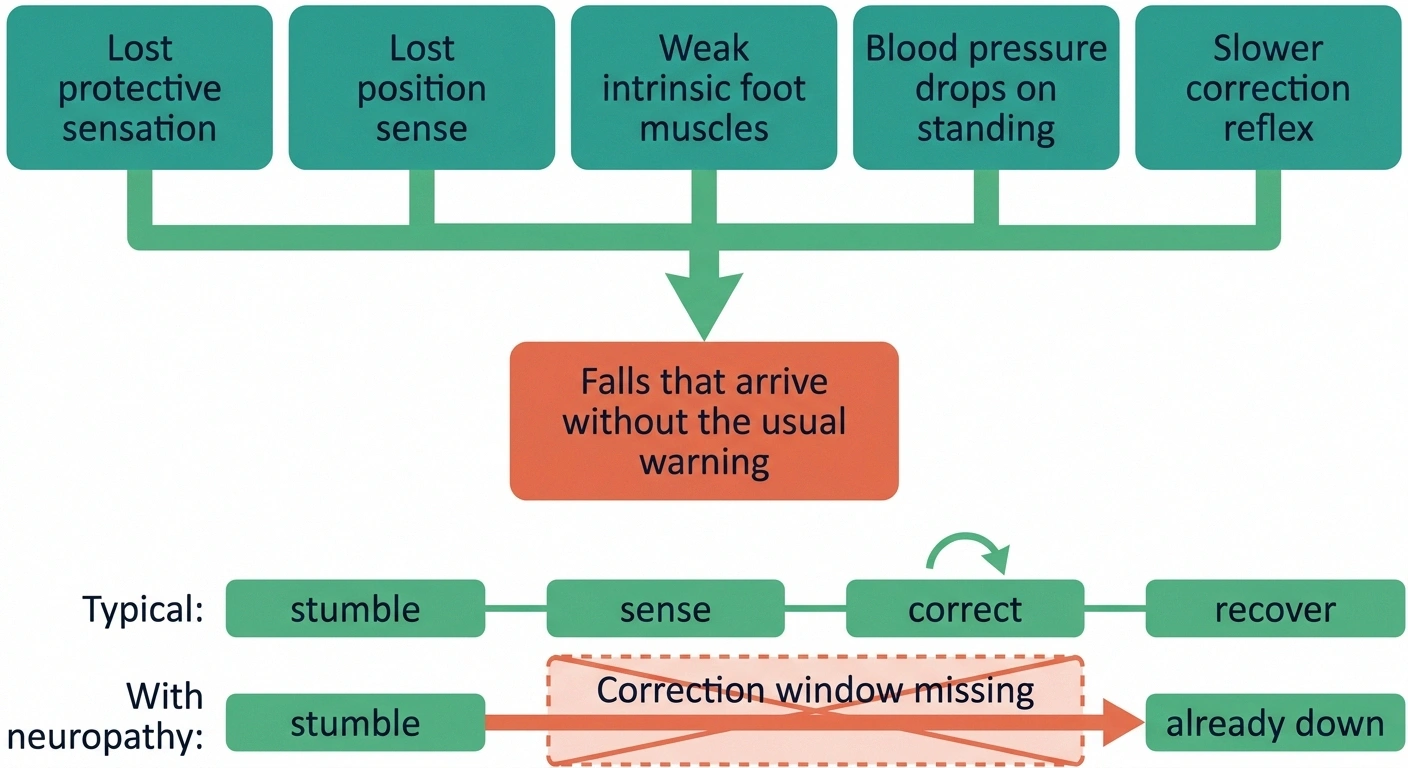
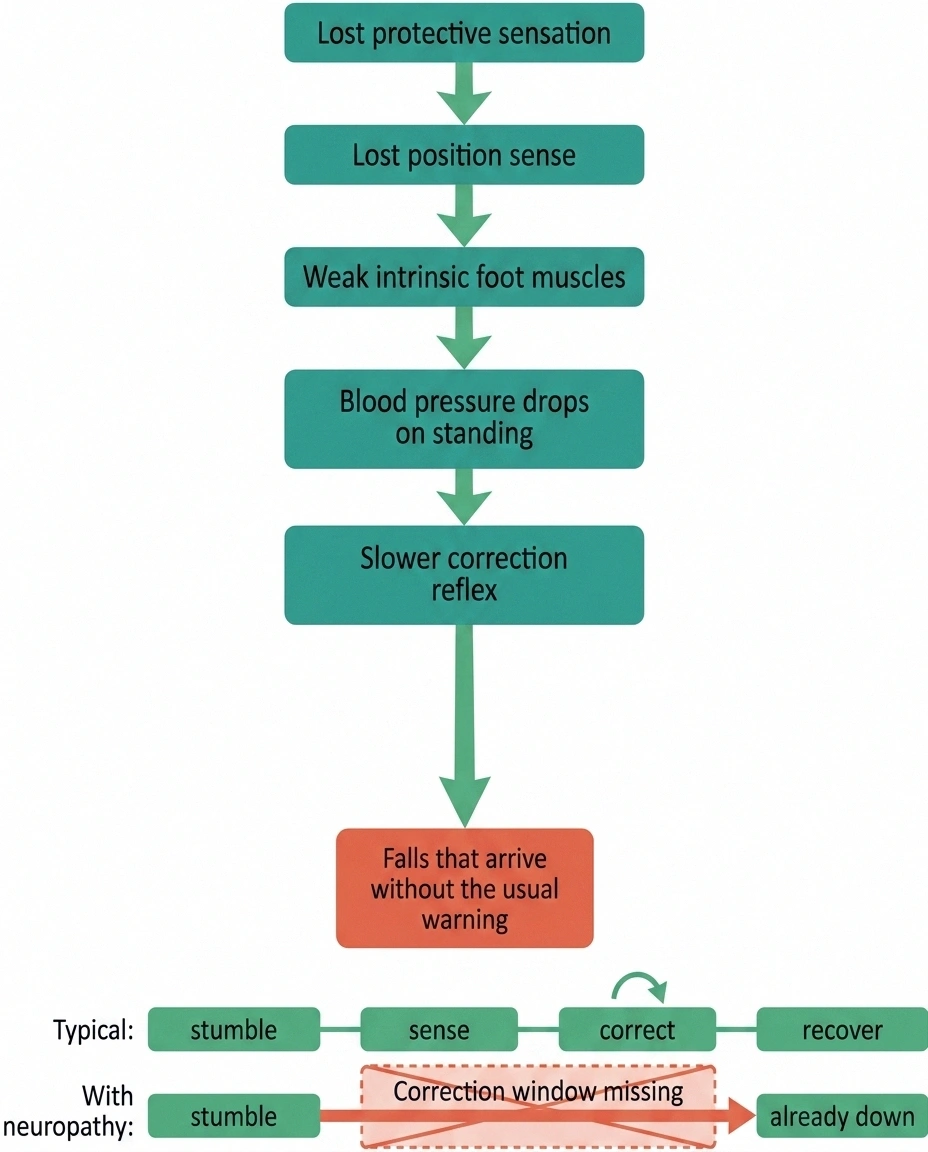
This part is intuitive once you lay out the pieces, and there are more pieces than most people count.
Lost protective sensation. Your feet normally report back constantly — pressure shifting toward the toes, the edge of a rug, the texture change from tile to carpet. When that stream thins out, you’re navigating on delayed information.
Lost position sense. This is separate from numbness and, honestly, more dangerous. Proprioception is how you know where your limbs are without looking. Lose enough of it and balance depends on vision, which is why so many people tell me their worst moments are in the dark or in the shower with their eyes closed. In its more severe form this becomes sensory ataxia.
Weak intrinsic foot muscles. The small muscles inside the foot make hundreds of tiny corrections per minute. Motor involvement weakens them, and the foot becomes a less capable platform.
Blood pressure drops on standing. When neuropathy involves autonomic fibers, standing up can produce a gray-out. A fall from a faint has no protective reflexes in it at all.
Slower correction. Recovering from a stumble is a reflex loop: sense the shift, correct, restabilize. Neuropathy lengthens the first step of that loop, and by the time the signal arrives the moment for a small correction has passed.
That last one explains something people describe again and again — that their falls don’t feel like losing balance so much as being suddenly, already down. The stumble and the fall have merged, because the interval where you’d normally save yourself has been eaten.
Our guide to balance problems and falls with neuropathy covers the mechanics of this in more depth.
Pathway Two: Good Score, Fragile Bone
Here’s the part almost nobody hears, and it’s the reason Carol’s relief was misplaced.
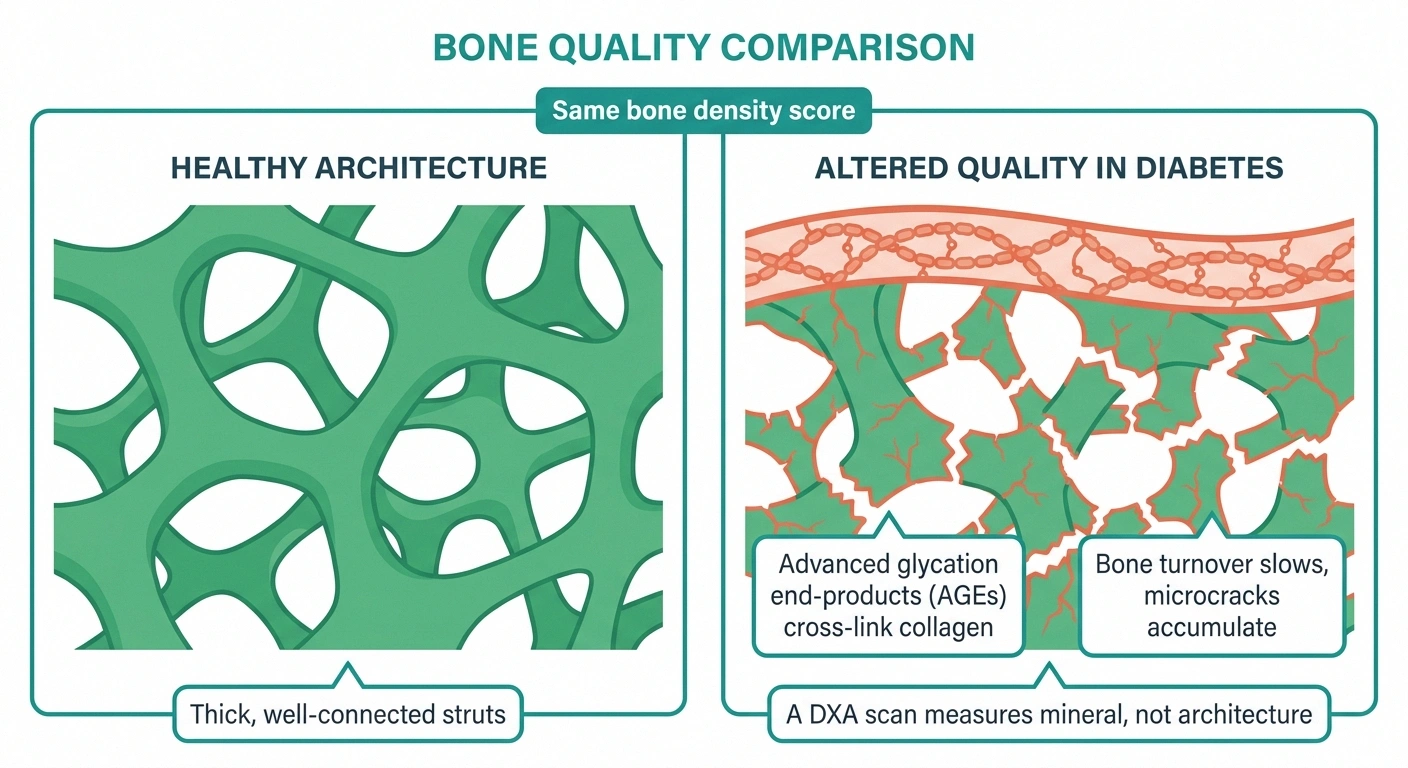
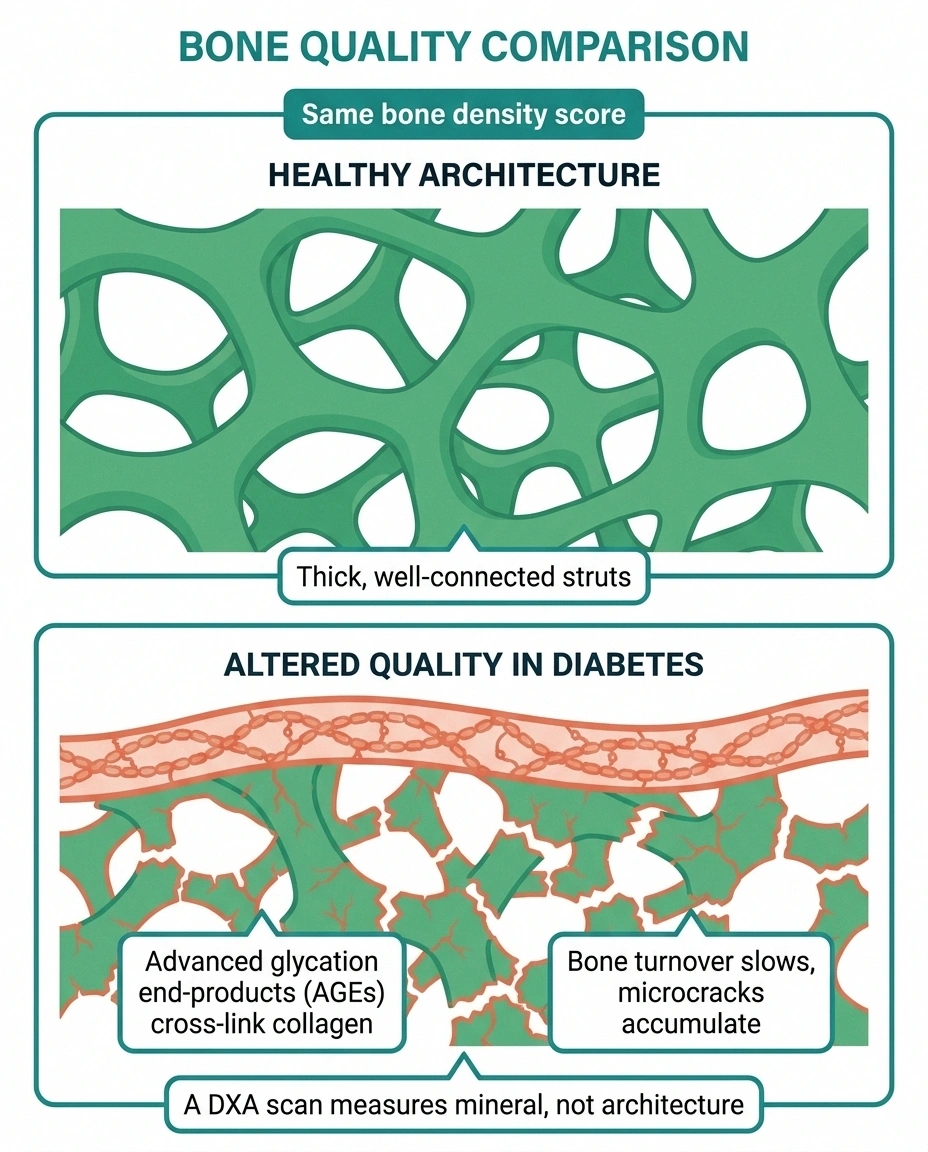
Bone strength is not the same thing as bone density. Density is how much mineral is in there. Strength also depends on the internal architecture — the arrangement of struts and plates in the spongy bone — and on the quality of the collagen scaffold that mineral is deposited onto.
In diabetes, the collagen scaffold changes. Sugars react with collagen to form advanced glycation end-products, which cross-link the protein and make it stiffer and more brittle. Bone turnover, the constant demolition-and-rebuild that removes microscopic damage, also slows down. Microcracks that would normally be repaired accumulate instead.
A DXA scan measures none of that. It weighs the mineral, and the mineral can look perfectly adequate while the material it’s sitting in has gotten brittle.
The consequence is well described in the literature: people with diabetes fracture at higher rates than their bone density scores predict. Increased fracture risk in diabetes is attributed not only to poorer bone material quality and altered microstructure, but also to the greater fall risk in those with neurological complications. Both pathways, running at once.
Insulin resistance itself has been associated with reduced bone quality, which is a tidy and slightly uncomfortable link — the same metabolic state driving the neuropathy is also working on the bone.
The Risk Calculator Has a Blind Spot
If your doctor has estimated your fracture risk, they likely used FRAX, the standard ten-year fracture risk tool. It’s a good instrument that asks about age, prior fracture, parental hip fracture, smoking, steroids, rheumatoid arthritis, alcohol, and bone density.
| Adjustment | What it does |
|---|---|
| Enter rheumatoid arthritis as a proxy | Uses an existing input field to approximate the extra risk diabetes carries |
| Lower the femoral neck T-score input | Compensates for density overstating true bone strength in diabetes |
| Add a trabecular bone score | Analyzes texture from the same DXA image, capturing some of the architecture density misses |
Diabetes isn’t one of its inputs.
Because diabetes raises fracture risk beyond what density explains, FRAX systematically underestimates risk in people with diabetes. This is known and discussed openly in the bone literature, and several workarounds circulate among clinicians: entering rheumatoid arthritis as a proxy risk factor, adjusting the femoral neck T-score input downward, or adding a trabecular bone score, which is a texture analysis of the same DXA image that captures some of the architectural quality density misses.
I’m not telling you to recalculate anything yourself. I’m telling you the question to ask, which is: “Does this estimate account for my diabetes, and would a trabecular bone score add anything?” That question lands very differently from “am I okay?” and it tends to get a much more thoughtful answer.
The Foot Emergency That Looks Like a Sprain
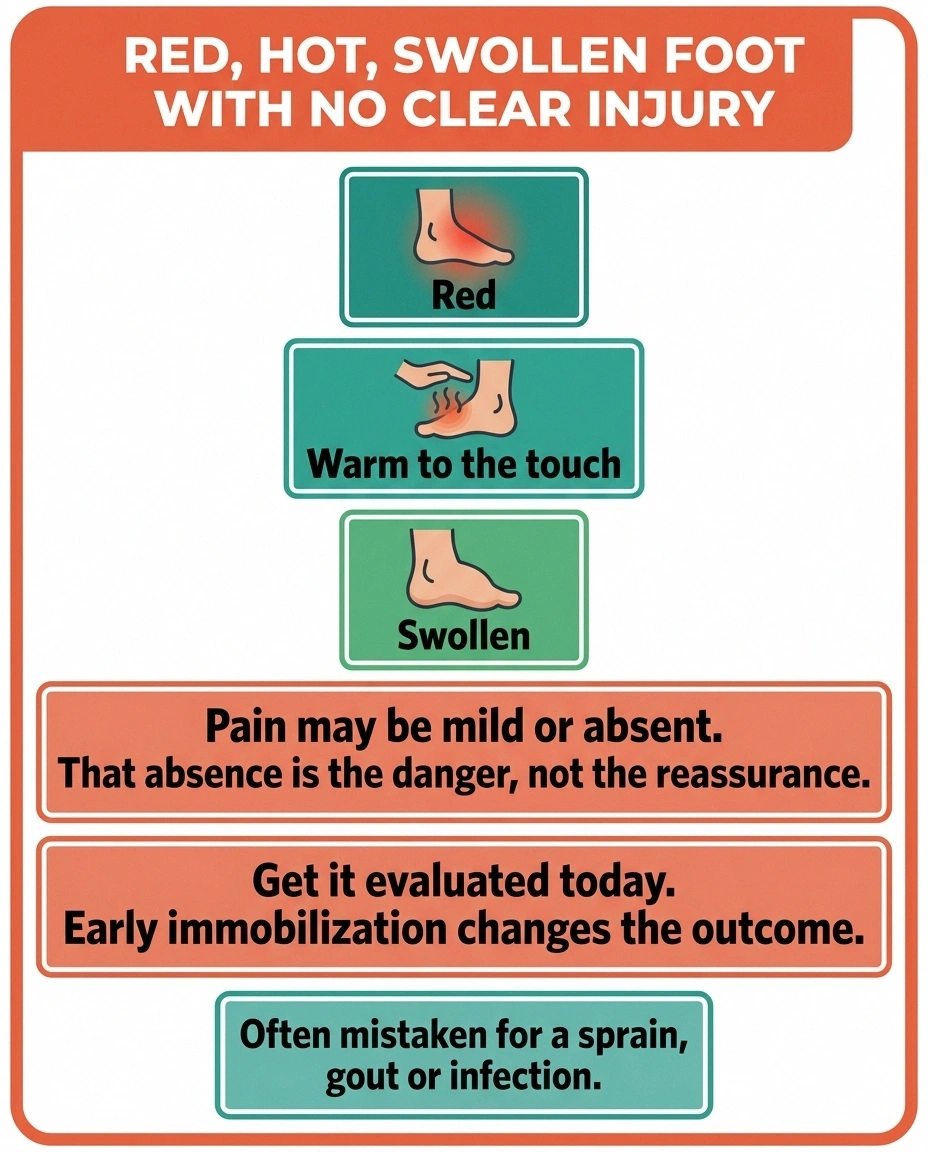
There’s a specific bone problem that belongs to neuropathy alone, and it moves fast enough that I want it in the middle of this article rather than buried at the end.
Especially if it does not hurt much. In a foot that has lost protective sensation, mild pain is not reassurance, it is the reason the bones keep being walked on while they come apart.
Charcot foot is routinely misread as a sprain, gout or cellulitis. The arch can collapse over a few weeks, and the difference between early immobilization and late is the difference between a foot that keeps its shape and one that does not.
The one-sentence rule: unexplained redness, warmth and swelling in a numb foot means stay off it and get it looked at today.
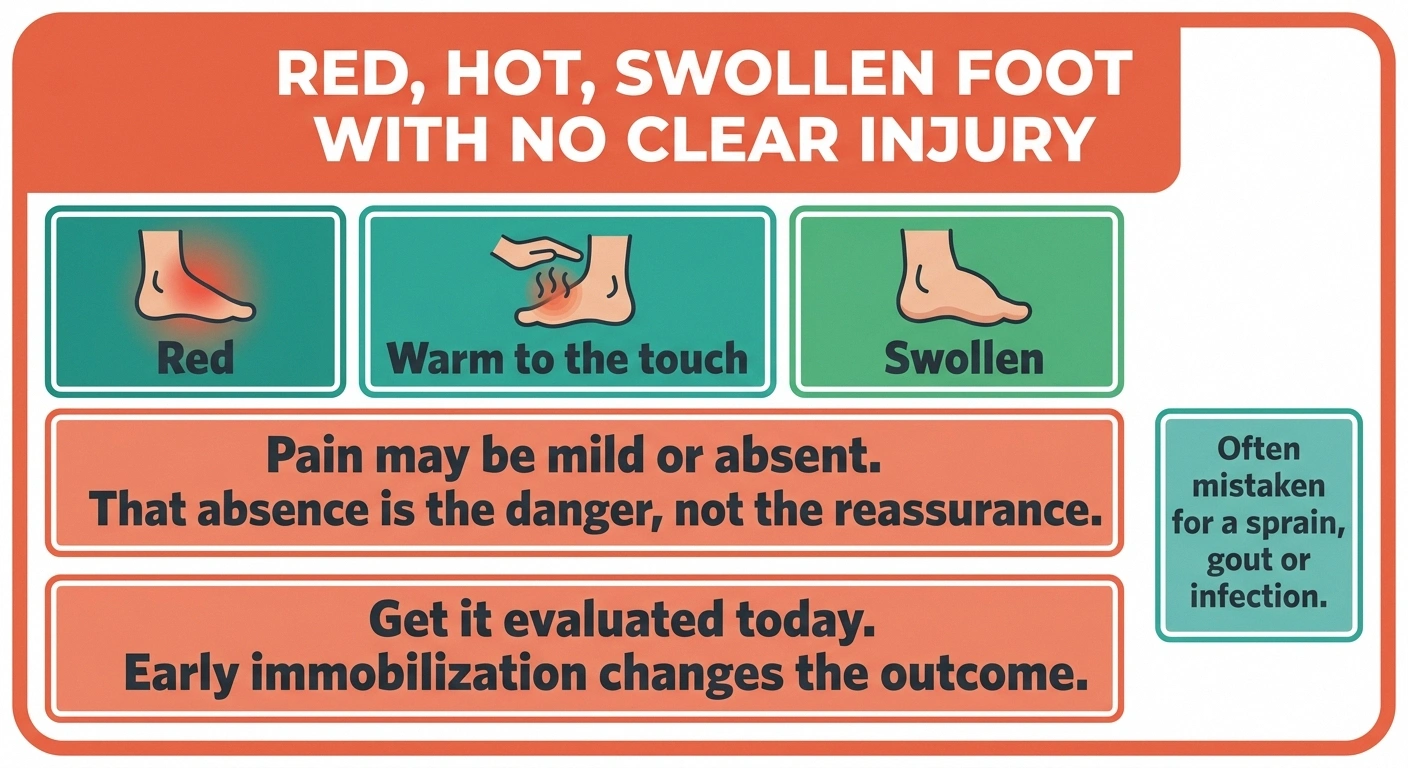
Charcot foot is progressive destruction of the bones and joints of the foot in someone with significant sensory loss. The foot becomes red, hot, and swollen. The bones fracture and the arch can collapse, sometimes over a matter of weeks.
What makes it so dangerous is what’s missing: the pain. A foot that has lost protective sensation doesn’t sound the alarm, so people keep walking on a foot that’s actively coming apart. The presentation gets mistaken for a sprain, an infection, or gout.
The rule I’d want everyone with sensory loss to know: a red, hot, swollen foot with no clear injury is urgent, today, even if it doesn’t hurt — especially if it doesn’t hurt. Early immobilization changes the outcome dramatically. Our full guide to Charcot foot covers the stages and treatment.
What Actually Lowers the Risk
Two pathways means two sets of levers, and the fall side is where most of the available benefit sits, because it’s the side you can change fastest.
Load the Bone, Because Nothing Else Substitutes
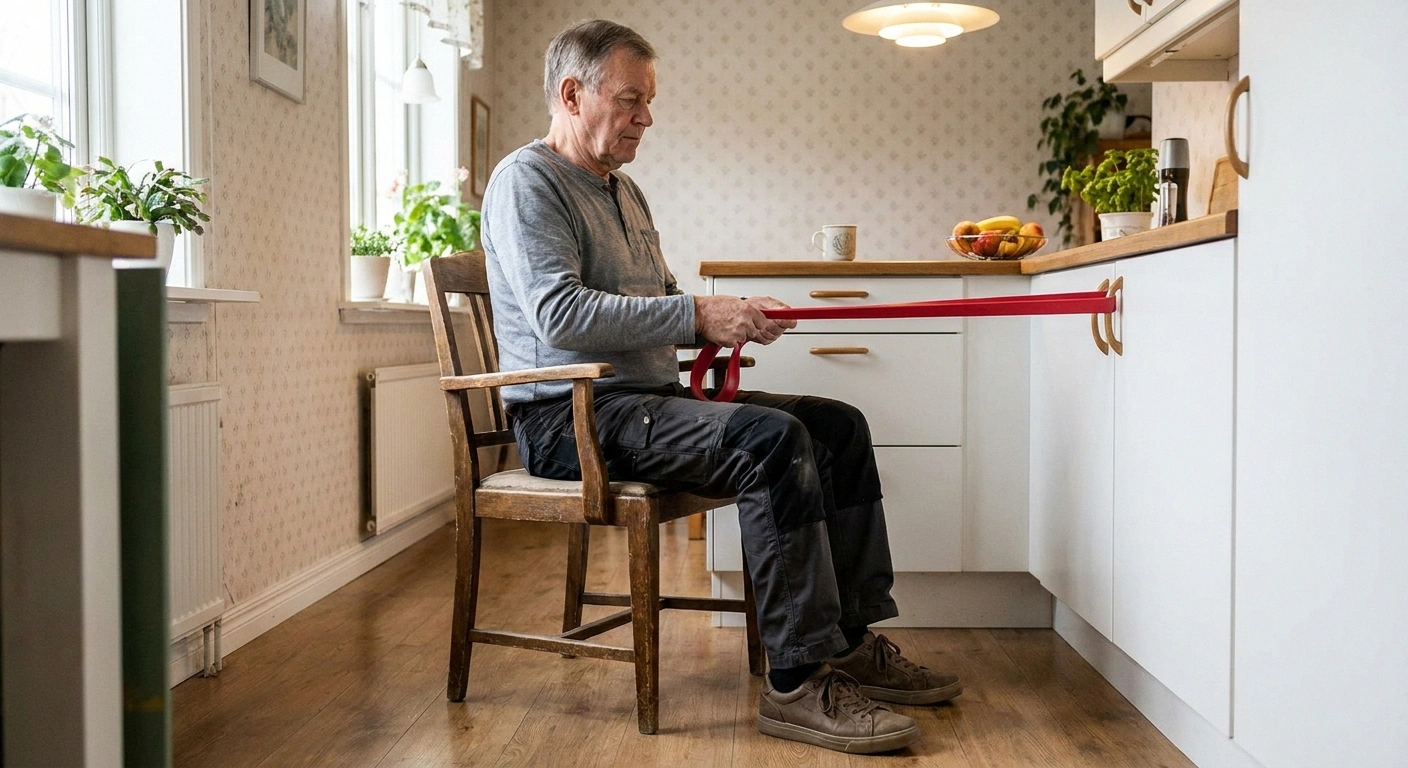
Bone responds to mechanical stress. That’s the entire signal. Take the load away and bone quietly downgrades itself to match the demand it’s actually getting, which is why the fear-of-falling spiral is so costly: less walking leads to less loading leads to weaker bone, and the same eventual fall does more damage.
Progressive resistance training is the strongest tool available, and neuropathy doesn’t disqualify anyone from it. It changes how it’s done. Seated and supported work, machines and bands rather than free weights that must be balanced, and holding onto something stable during standing work. Our strength training guide and our broader exercise guide both work through the adaptations.
Balance training deserves its own slot, separate from strength. It’s trainable even with reduced sensory input, because the nervous system learns to weight vision and inner-ear information more heavily. That’s a genuine adaptation, not a consolation prize. A physical therapist is the right person to build this, and a referral is worth requesting rather than waiting for it to be offered.
The Medication Conversation Most Worth Having
This is the highest-yield item on the whole list and it takes one appointment.
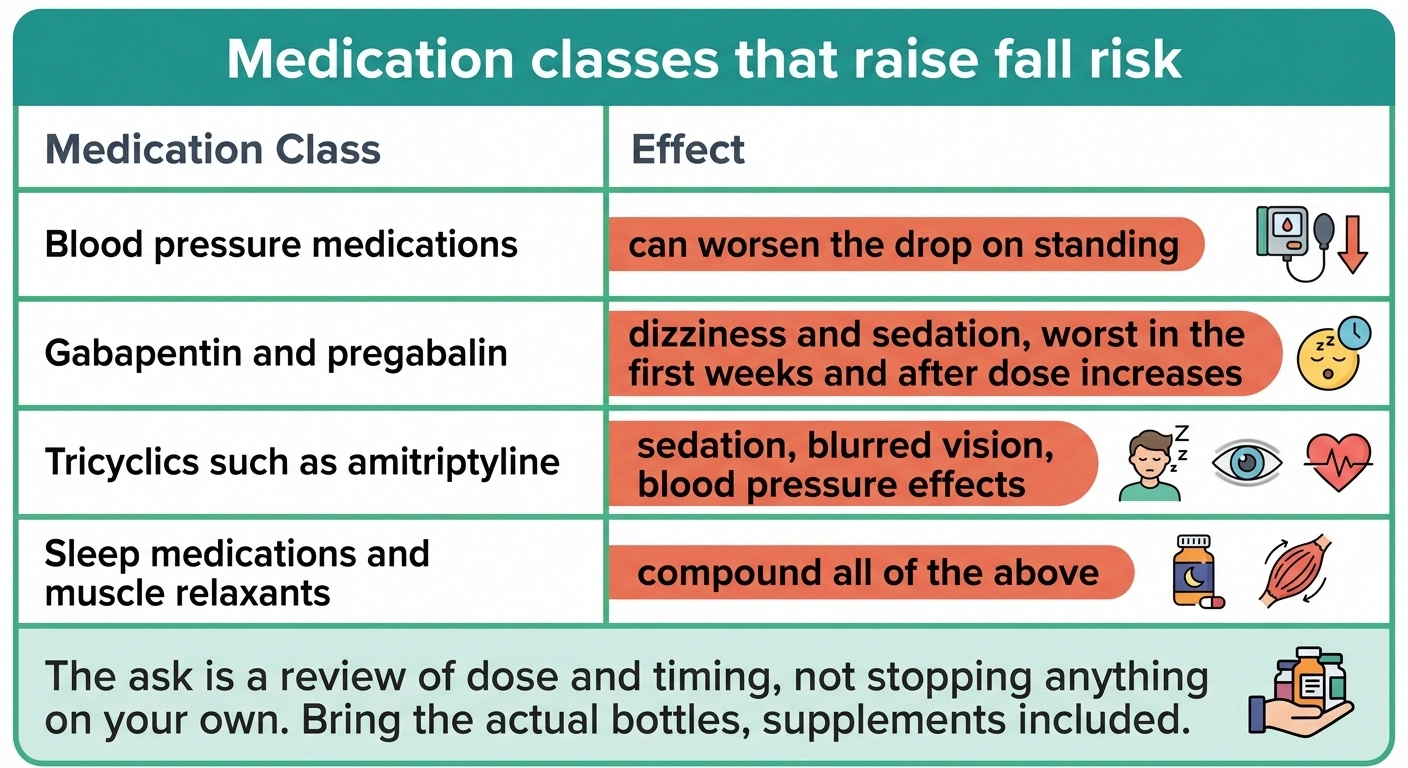
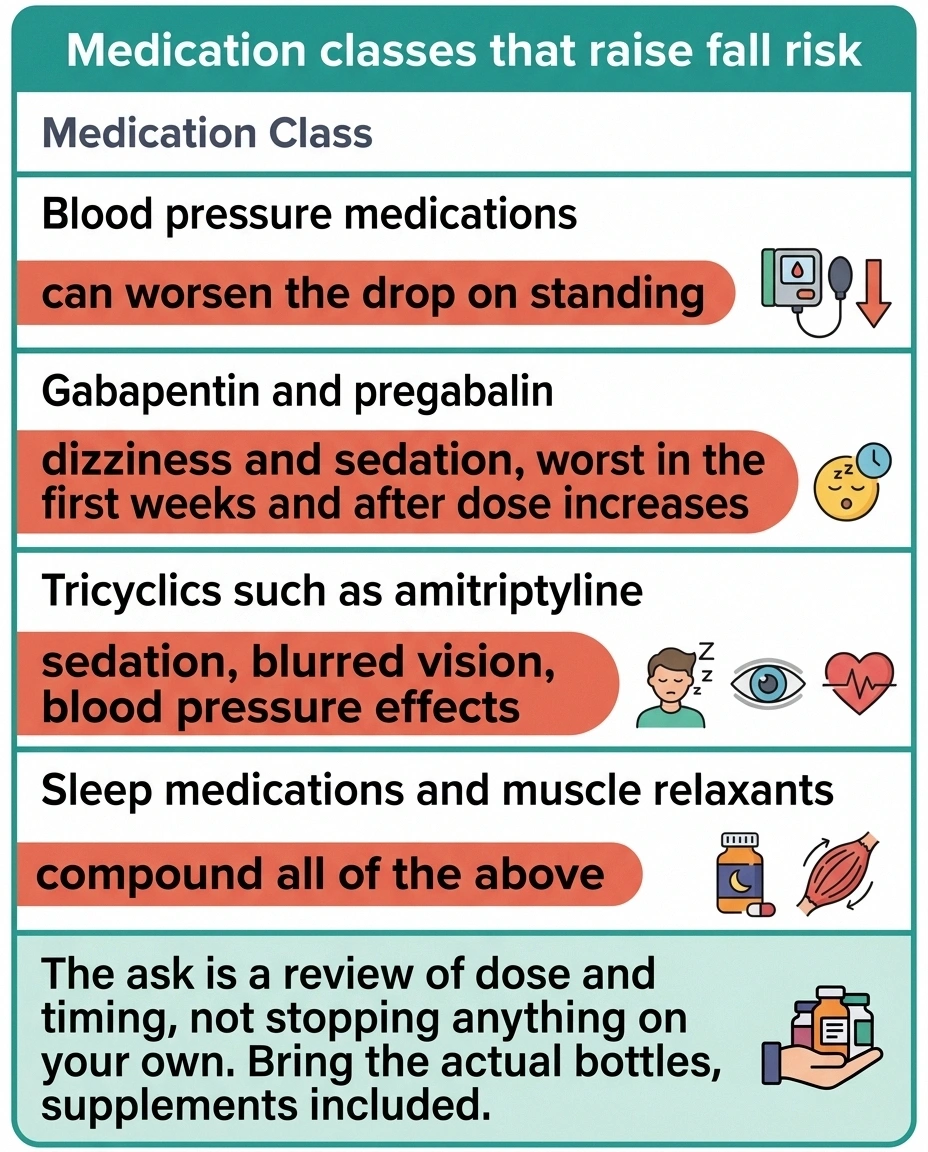
Several medication classes commonly prescribed to exactly this population raise fall risk. Blood pressure medications can worsen orthostatic drops. Gabapentin and pregabalin cause dizziness and sedation, particularly in the first weeks and after dose increases. Tricyclics like amitriptyline add sedation, blurred vision and their own blood pressure effects. Sleep medications and muscle relaxants compound all of it.
None of that means stopping anything. It means a deliberate review, asking whether doses can be trimmed, whether timing can be shifted so the sedating peak lands at bedtime, and whether anything on the list has quietly outlived its purpose. Bring the actual bottles — including supplements, which people consistently forget to mention.
Vitamin D, Calcium, and Protein
Deficiency is common in this group and worth correcting, both for bone and because vitamin D has its own relationship with nerve health. Get the level tested rather than guessing at a dose.
Calcium is better from food than pills where that’s achievable. Protein matters more than people expect, since muscle is what catches you and older adults routinely under-eat it.
Make the Fall Less Likely and Less Costly

Environment does real work here.
Light. When position sense is unreliable, vision is doing the balancing. Night lights along the route from bed to bathroom, and a lamp reachable from the bed.
Floors. Throw rugs go. Cords go. Thresholds get marked with contrasting tape if they’re a known catch point.
Footwear. Indoors too. Supportive shoes with a firm heel counter beat slippers every time.
Grab bars in the bathroom, which is where a disproportionate share of these falls happen — see our bathroom safety guide and the one on stairs. Our room-by-room home safety walkthrough pulls the whole list together.
A cane or a walker if it’s warranted. I know the resistance to this. But a properly fitted walking aid gives you an extra point of contact with the ground, which is exactly what a foot that can’t feel the ground needs. Fitted by a physical therapist, not bought off a shelf at the wrong height.
The Conversation to Have
If I were making the list for an appointment, it would be these five questions.
- 1. Have I had a bone density scan, and when is the next one due?
- Establishes a baseline and a rescreening interval rather than a one-time snapshot.
- 2. Does my fracture risk estimate account for diabetes?
- Opens the trabecular bone score conversation, which is the one most likely to change the number.
- 3. Can we review every medication for fall risk?
- Highest yield item on the list. Bring the actual bottles, supplements included.
- 4. What is my vitamin D level?
- Test rather than guess at a dose. Relevant to bone and to nerve health both.
- 5. Can I get a physical therapy referral for balance and strength?
- Specify that it needs to be adapted for sensory loss, or you will get a standard protocol.
Have I had a bone density scan, and when is the next one due?
Does my fracture risk estimate account for diabetes, and would a trabecular bone score be useful?
Can we review every medication I take for fall risk, including the ones for the neuropathy itself?
What’s my vitamin D level?
Can I get a physical therapy referral for balance and strength, specifically adapted for sensory loss?
That’s a fifteen-minute conversation covering both pathways. It’s a far better use of an appointment than asking whether the scan was okay.
What I Told Carol
Her wrist healed. The more useful thing that came out of it was the realization that her scan had never been the relevant number.
She’s doing supported resistance work twice a week now, her blood pressure medication was moved to the evening after her doctor found a standing drop, and there’s a night light in the hall. She still has neuropathy. She still has osteopenia. What changed is that both are being treated as parts of one problem instead of two unrelated lines on a chart.
That reframe is available to anyone reading this, and it costs one appointment.
Frequently Asked Questions
Does neuropathy cause osteoporosis?
Neuropathy is associated with lower bone mineral density, particularly in people with diabetes, though the relationship involves several overlapping mechanisms rather than direct causation. A systematic review and meta-analysis found peripheral neuropathy in adults with diabetes associated with reduced bone density. Contributing factors include reduced physical loading of bone when activity declines, shared metabolic effects such as insulin resistance, and in some cases autonomic involvement affecting bone blood flow. Neuropathy also raises fracture risk independently by increasing falls.
Why do people with diabetes break bones despite normal bone density?
Because bone density measures mineral content while bone strength also depends on internal architecture and collagen quality. In diabetes, advanced glycation end-products cross-link collagen and make it more brittle, and bone turnover slows so microscopic damage accumulates rather than being repaired. A DXA scan cannot detect either change. The result is that fracture rates in diabetes exceed what density scores predict, which is why standard risk calculators underestimate risk in this population.
How much does neuropathy increase fall and fracture risk?
In a large study of older adults using monofilament testing, those with peripheral neuropathy experienced falls or fractures at 111 per 1,000 person-years compared with 74 per 1,000 in those without. After adjustment for age, sex and race, the three-year cumulative incidence of a fall or fracture was 26.5 percent with neuropathy versus 18.4 percent without. That represents roughly one in four people with neuropathy experiencing a fall or fracture over three years.
Does FRAX underestimate fracture risk in diabetes?
Yes, because diabetes is not among the risk factors the tool accepts as input, while it demonstrably raises fracture risk beyond what bone density explains. Clinicians address this in several ways, including entering rheumatoid arthritis as a proxy risk factor, adjusting the femoral neck T-score input downward, or incorporating a trabecular bone score that analyzes bone texture from the same scan image. Asking whether diabetes was accounted for in your risk estimate is a reasonable question to raise.
Can you do weight-bearing exercise with neuropathy?
Yes, and it is one of the most valuable things available, since mechanical loading is the primary signal that maintains bone. The adaptations are about safety rather than intensity: using seated or supported positions, choosing machines and resistance bands over free weights that require balancing, keeping a stable support within reach during standing work, and inspecting the feet afterward for blisters or pressure marks that were not felt. A physical therapist can build a program suited to your degree of sensory loss.
What is Charcot foot and how is it different from a fracture?
Charcot foot is progressive destruction of the bones and joints of the foot occurring in people with significant sensory loss. The foot becomes red, hot and swollen, bones fracture, and the arch can collapse over weeks. What distinguishes it is the absence of proportionate pain, which allows people to keep walking on a foot that is actively deteriorating and leads to it being mistaken for a sprain, gout or infection. A red, hot, swollen foot without clear injury in someone with neuropathy requires urgent evaluation, and early immobilization substantially improves outcomes.
Do neuropathy medications increase fall risk?
Several commonly used ones do. Gabapentin and pregabalin cause dizziness and sedation, especially during the first weeks of treatment and after dose increases. Tricyclic antidepressants such as amitriptyline add sedation, blurred vision and blood pressure effects. Blood pressure medications can worsen drops on standing, and sleep medications and muscle relaxants compound these effects. The productive response is a structured medication review examining doses, timing and whether each drug still serves its original purpose, rather than stopping anything independently.
Does fear of falling make things worse?
It creates a measurable cycle. Fear reduces activity, reduced activity means less mechanical loading of bone and less use of the muscles that stabilize you, and both bone density and balance capacity decline as a result. The eventual fall then occurs against weaker bone and slower reflexes. Breaking the cycle does not mean ignoring genuine risk. It means shifting toward activity that is safe enough to actually do, such as supported strength work and supervised balance training, so that avoidance is not the only strategy.
About the Author