My friend Barbara sat across from me at a coffee shop last spring holding a manila folder in her lap. Inside the folder were three surgical consultations, all from the same city, all recommending nerve decompression surgery for her, all offering different combinations of procedures at different prices, and all delivered with the confidence of someone who had solved a problem before hearing it fully described. Barbara had made her decision by the time she sat down with me. She had also, wisely, changed her mind twice on the drive over. What she needed, she said, was a list of the right questions to ask before she committed to an operating room.
I am Janet Ellis. I am not a surgeon and I am not a doctor. I have spent the last several years reading everything I could find on nerve decompression surgery, talking with people who have had it work and people who have had it fail, and mapping the questions that separate the two outcomes more often than not. This is the list I gave Barbara. It is also, I hope, useful to you.
What Nerve Decompression Surgery Actually Is
Nerve decompression surgery is a category, not a single operation. It is any procedure that releases pressure on a peripheral nerve where the nerve is being pinched, kinked, or compressed by nearby tissue. The compression can come from a thickened ligament, scar tissue, an anatomical narrowing, a mass, or a repetitive-motion-related tunnel narrowing.
Nerve decompression is a category, not a single operation. Focal entrapment (carpal tunnel, cubital tunnel, common peroneal, tarsal tunnel) has strong evidence and reasonable predictability. Multi-level decompression for length-dependent diabetic neuropathy is unproven and specifically advised against by the American Academy of Neurology. The right surgery for the wrong indication is still the wrong surgery.
The best-known examples:
- Carpal tunnel release. Releases the transverse carpal ligament to decompress the median nerve at the wrist. The most common nerve decompression in the United States.
- Cubital tunnel release. Decompresses the ulnar nerve at the elbow. Sometimes involves transposition (moving the nerve to a new location) or medial epicondylectomy.
- Tarsal tunnel release. Decompresses the posterior tibial nerve at the inside of the ankle.
- Common peroneal decompression. Releases the common peroneal nerve at the outside of the knee, often for foot drop.
- Guyon canal release. Decompresses the ulnar nerve at the wrist (rare, often paired with carpal tunnel release).
- Thoracic outlet decompression. Releases the brachial plexus at the base of the neck.
- Radial tunnel release. Decompresses the posterior interosseous branch of the radial nerve at the forearm.
- External neurolysis. Removal of scar tissue around a previously injured or entrapped nerve, without cutting into the nerve itself.
There is also a more controversial category: multi-level peripheral nerve decompression for diabetic peripheral neuropathy, sometimes called Dellon-style decompression after the surgeon who popularized it. This procedure typically releases four sites in the lower leg (tarsal tunnel, common peroneal, deep peroneal, superficial peroneal) in patients whose diabetic neuropathy is length-dependent rather than focally entrapped. It has vocal advocates and vocal critics. The American Academy of Neurology’s 2006 evidence review concluded that the procedure is unproven for diabetic polyneuropathy and specifically advised against offering it as a treatment for length-dependent diabetic neuropathy. That position has been reaffirmed in subsequent updates. Some newer research on modified techniques exists (a 2025 Nature-family review discussed modified nerve decompression combined with MNGF treatment), but it remains investigational for length-dependent DPN. Focal entrapment is a different situation and is discussed separately below.
The First Question Before Any Others: Is My Neuropathy Focal or Length-Dependent?
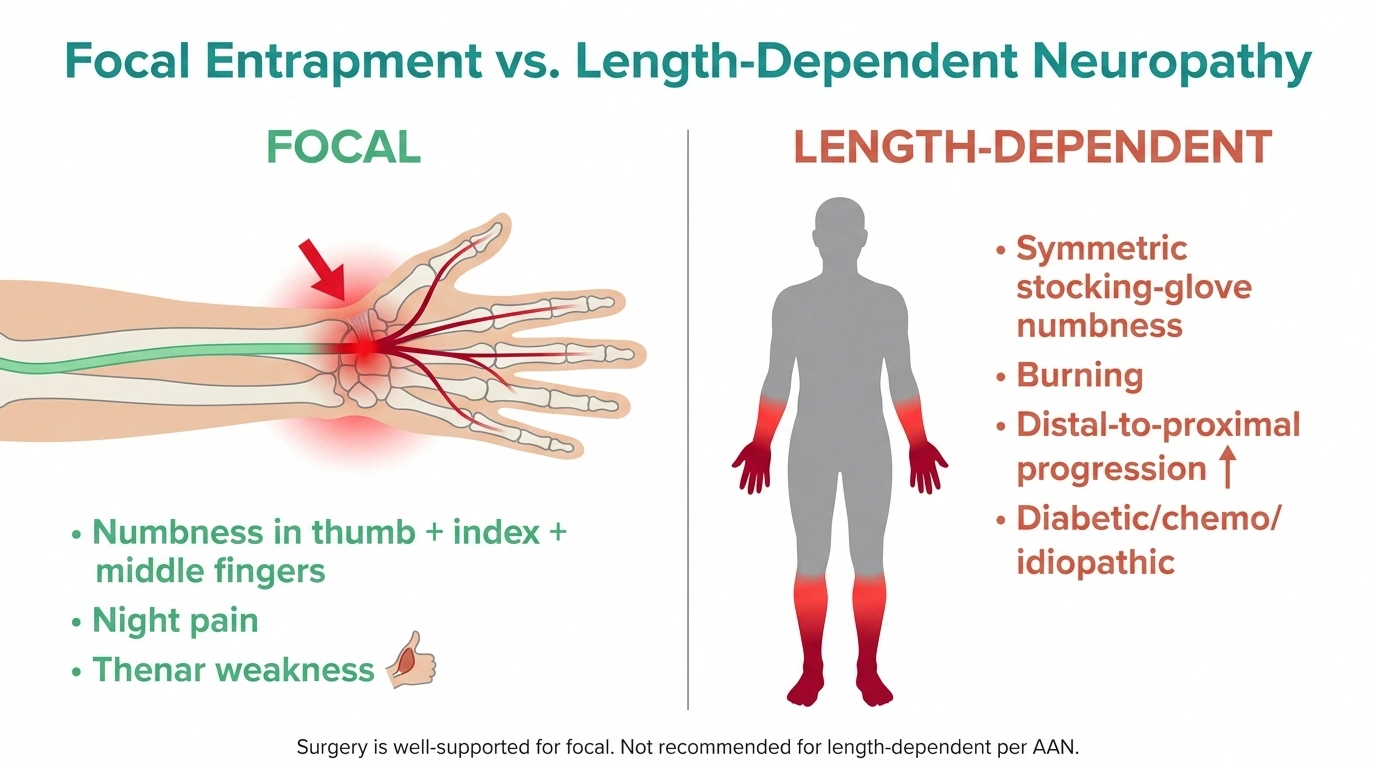
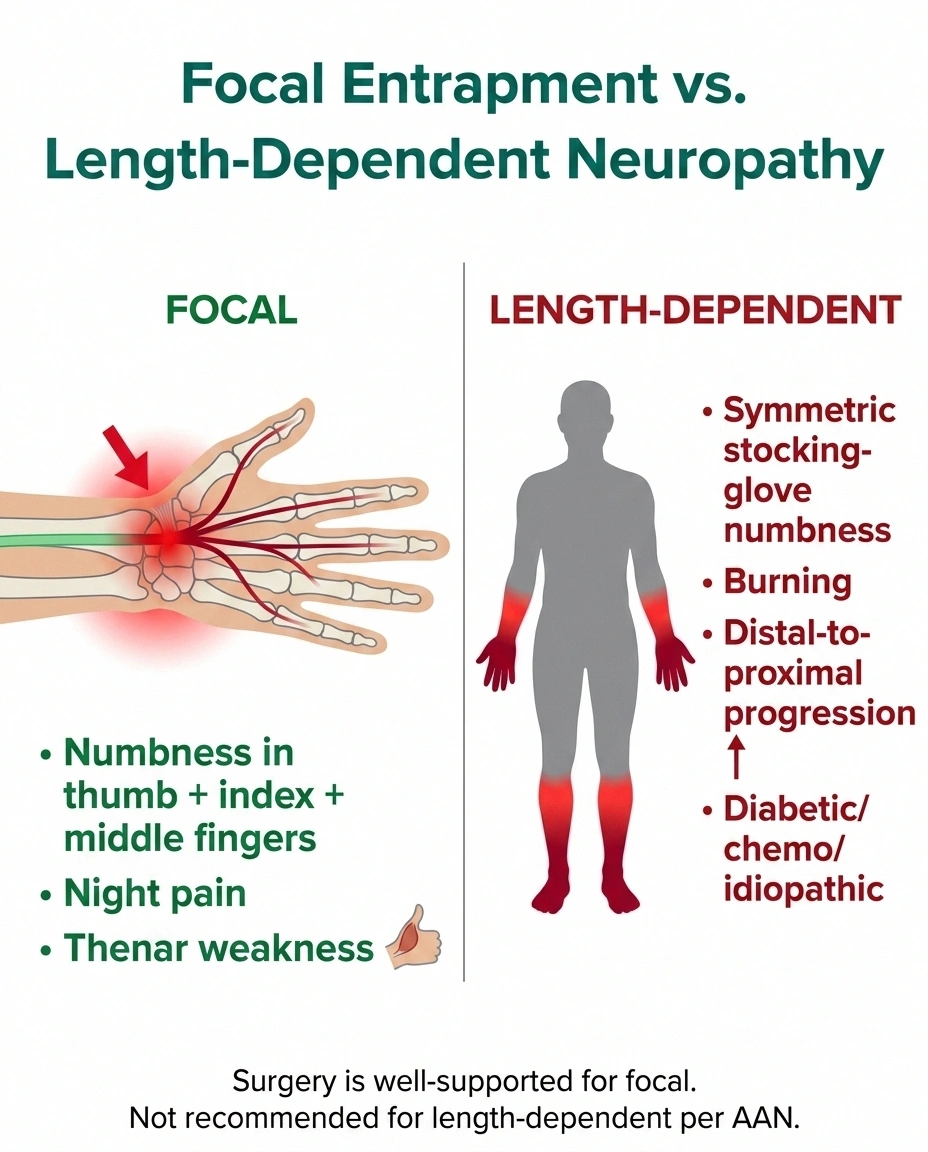
This is the question that determines whether surgery makes sense at all. It is the question your surgeon should already have answered before recommending decompression. If they cannot answer it clearly, that is your first red flag.
- One nerve, one anatomical site
- Symptoms follow the nerve’s specific distribution
- Clean conduction block on EMG at the tunnel
- Surgery has decades of outcome data
- Reasonable predictability of relief
- Symmetric “stocking-glove” pattern
- Starts at toes, progresses upward
- Diabetic, chemo, alcoholic, idiopathic
- Diffuse axonal damage, not a compression
- Multi-level decompression unproven; not AAN-recommended
Focal neuropathy means one specific nerve is compressed or damaged at one specific anatomical location. A pinched median nerve at the wrist. A pinched ulnar nerve at the elbow. A pinched common peroneal nerve at the knee. Symptoms follow the specific nerve’s distribution: numbness in the thumb, index, and middle fingers (median); tingling in the small and ring fingers (ulnar); foot drop with weakness in ankle dorsiflexion (peroneal). Nerve conduction studies show a clean block at the anatomical tunnel. Surgery for focal entrapment has decades of evidence, high patient-satisfaction rates, and reasonable predictability.
Length-dependent neuropathy is the classic “stocking-glove” pattern that affects the longest nerves first, symmetrically, from the toes upward and then eventually from the fingertips. Diabetic peripheral neuropathy, chemotherapy-induced neuropathy, alcoholic neuropathy, and most idiopathic neuropathy are length-dependent. Nerve damage is at the axon ends, throughout the body, and it is not caused by a compression at any specific anatomical location. Our page on small-fiber neuropathy and our diabetic neuropathy overview both walk through this pattern in detail. Surgery for length-dependent neuropathy is controversial at best and unproven at worst.
Some surgeons argue that patients with length-dependent neuropathy also have “double crush” — pre-existing length-dependent damage plus a superimposed focal entrapment, and that decompressing the focal site helps. This is plausible in individual cases and is very hard to prove in populations. The best evidence for surgical benefit is in patients with clear focal entrapment on nerve conduction studies, regardless of whether background length-dependent disease is present.
Questions About the Diagnosis
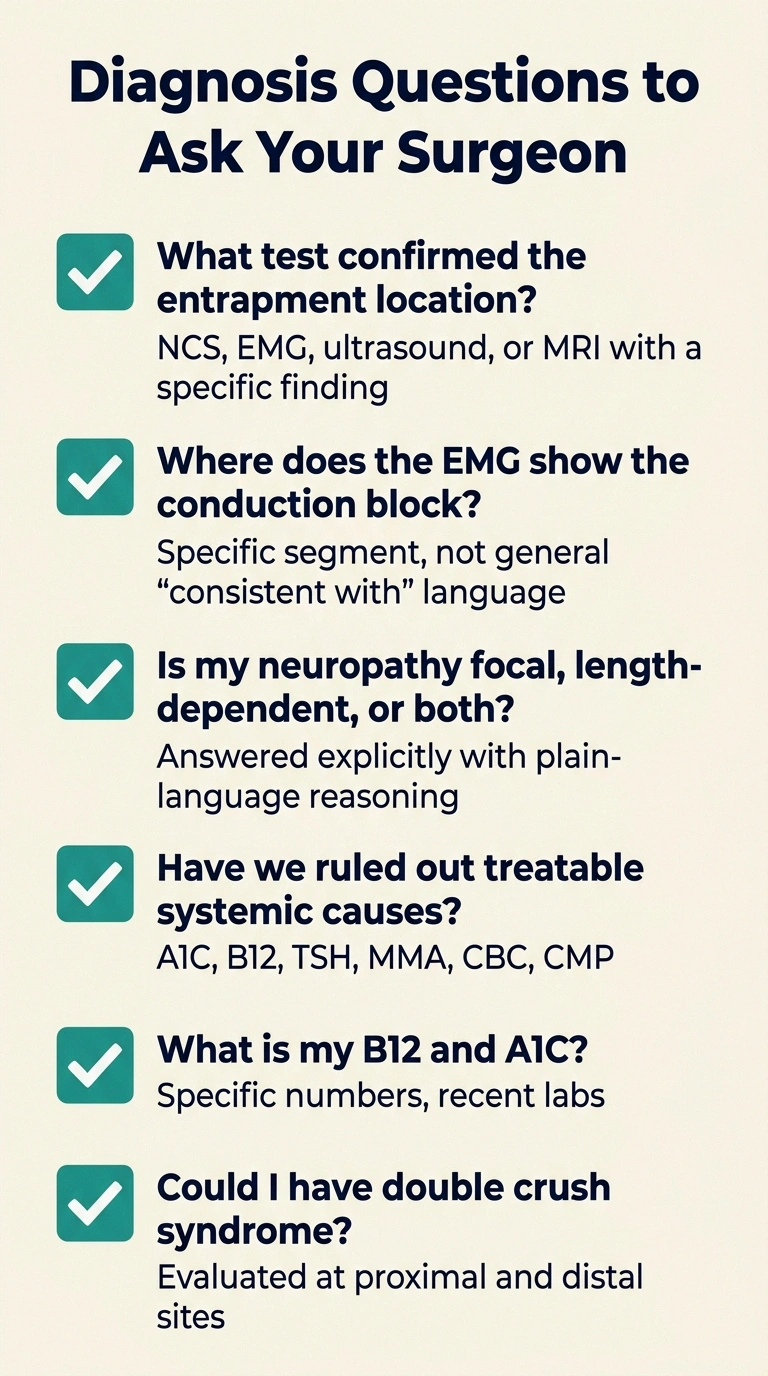
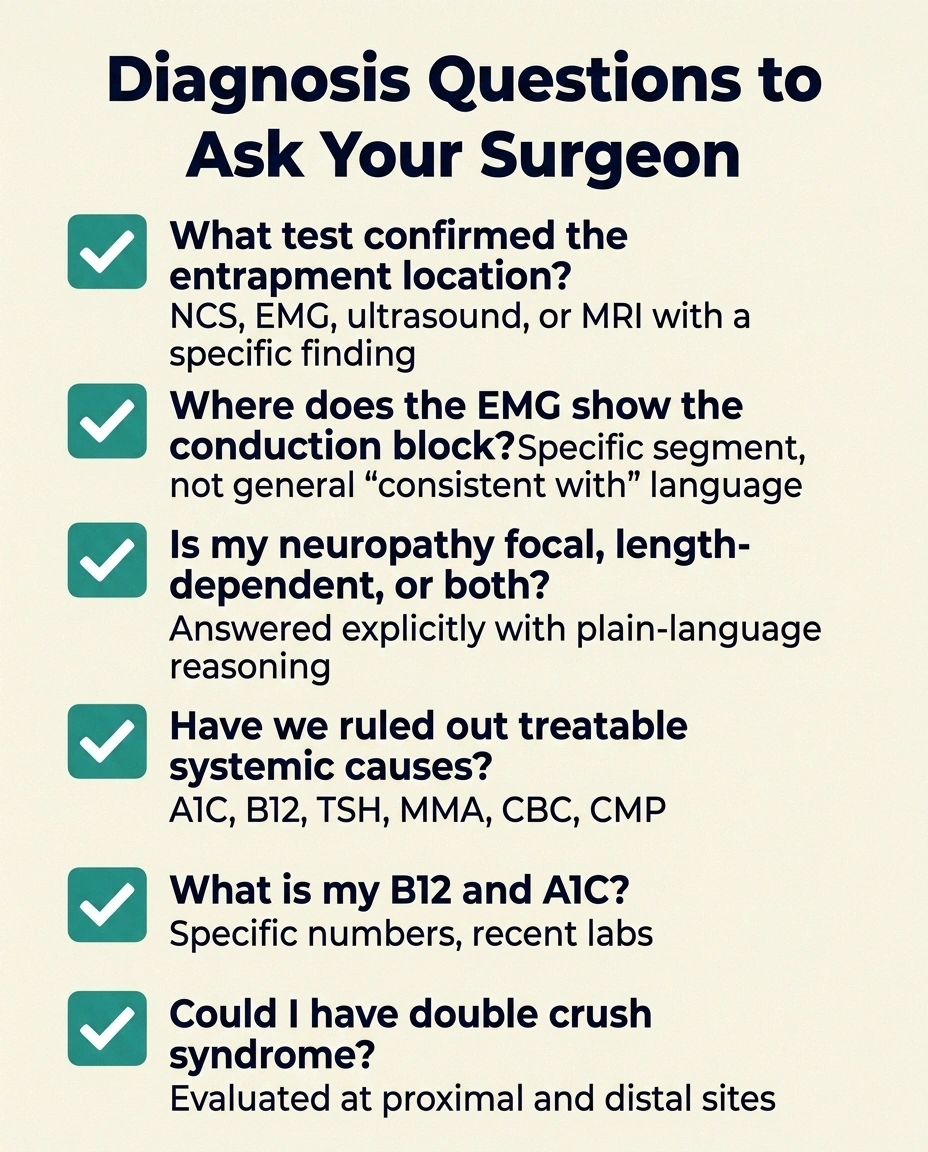
Before you sign a consent, get clear answers on these.
- What specific test confirmed the entrapment location? Nerve conduction study (NCS), electromyography (EMG), high-resolution ultrasound, MRI, or MR neurography. The answer should include a specific test with a specific result. If the answer is “your symptoms are classic,” ask again.
- Where does the EMG show the conduction block? Ask to see the report. A carpal tunnel EMG should show reduced median nerve conduction velocity across the wrist. A cubital tunnel EMG should show slowing across the elbow segment. If the report does not localize the block, the diagnosis is weaker than the recommendation suggests.
- Is my neuropathy focal, length-dependent, or both? This should be answered explicitly, in plain language, with reference to your specific test results.
- Have we ruled out treatable systemic causes? A complete workup for peripheral neuropathy typically includes A1C or fasting glucose, vitamin B12 and methylmalonic acid, thyroid-stimulating hormone, comprehensive metabolic panel, complete blood count, and (in specific situations) serum protein electrophoresis, ANA, and paraneoplastic panels. Our guide to what tests your doctor may order covers the workup. A surgical recommendation without a systemic workup is premature.
- What is my B12 status and A1C? Uncorrected B12 deficiency (see our vitamin deficiency neuropathy page) and uncontrolled diabetes are two of the most common reversible or partially reversible drivers of nerve symptoms. Surgery does not fix them.
- Could I have double crush syndrome? This matters because operating on one compression site may not resolve symptoms if a second compression is upstream or downstream.
Questions About the Surgeon’s Experience
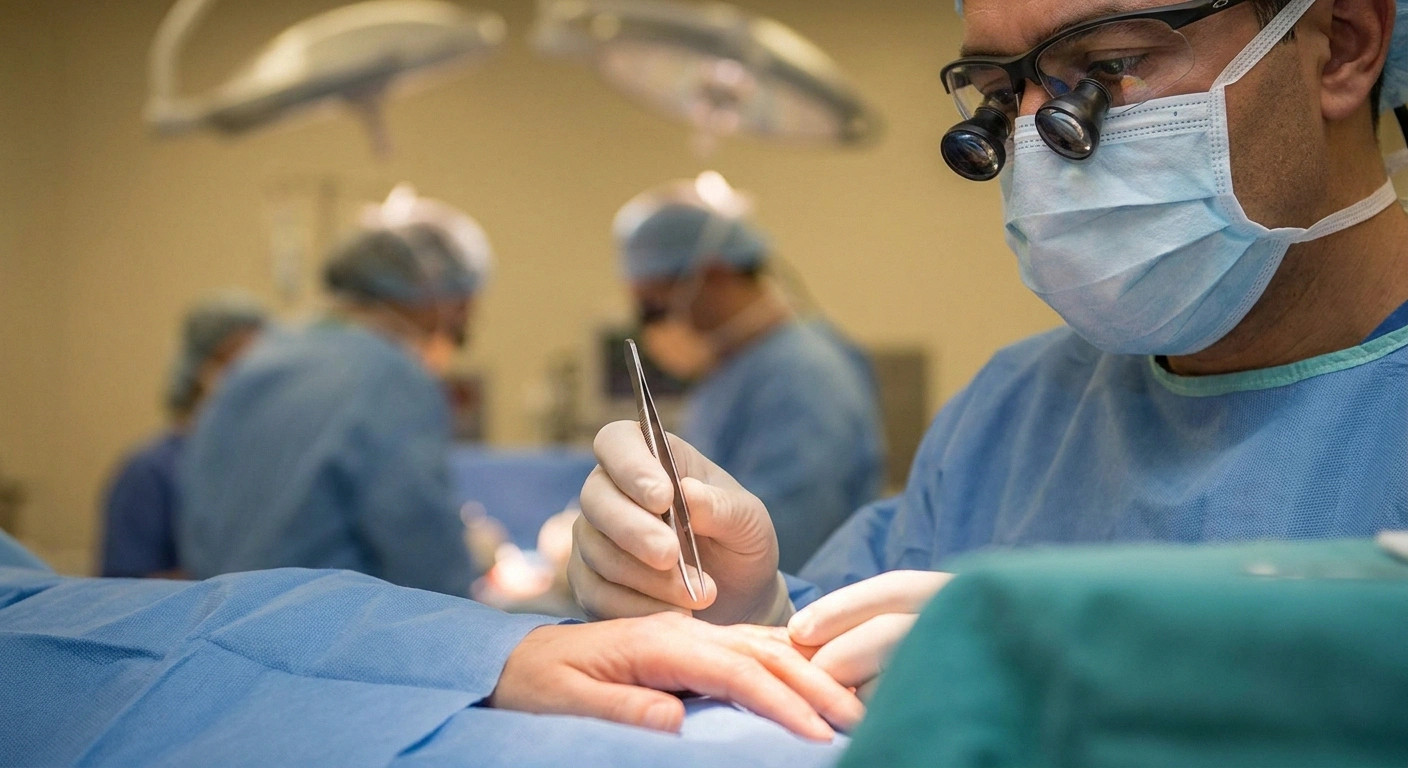
Volume matters in surgery, and it matters more for nerve procedures than for many others. A surgeon who does two carpal tunnel releases a year is not the same as a surgeon who does two hundred.
Published patient-satisfaction rates for carpal tunnel release run 70 to 90 percent, cubital tunnel release 60 to 80 percent, and tarsal tunnel release considerably more variable, often 40 to 70 percent depending on patient selection. Reported side-effect rates for nerve decompression procedures generally range from 10 to 24 percent depending on the specific procedure, patient factors, and surgical experience.
Translation: results are procedure-specific and surgeon-specific. General optimism does not substitute for the specific number for your specific operation.
- How many of this exact procedure have you done in the past 12 months? Not lifetime — recent. Skills degrade without volume.
- What is your training background? Hand surgery is a fellowship-level subspecialty; so is peripheral nerve surgery. Common paths: orthopedic surgery with hand fellowship, plastic surgery with hand fellowship, neurosurgery with peripheral nerve fellowship. A general orthopedist or general surgeon doing occasional carpal tunnels is not the same as a fellowship-trained hand surgeon.
- What is your patient-reported satisfaction rate for this procedure? A specialist should be able to give a range, and should be honest about the variability. Carpal tunnel satisfaction runs in the 70 to 90 percent range in the literature; cubital tunnel around 60 to 80 percent; tarsal tunnel considerably more variable, often 40 to 70 percent depending on selection.
- What is your complication rate — infection, nerve injury, hematoma, complex regional pain syndrome, revision? A confident answer should include numbers, not just “very rare.”
- What is your revision-surgery rate at 5 years? Some patients need a second operation because scar tissue reforms or the original decompression was incomplete. Ask the number.
- Do you use loupes, a microscope, an endoscope, or ultrasound guidance? The answer should match the specific procedure — endoscopic carpal tunnel is well-established; microscope-assisted external neurolysis is common; ultrasound-guided release is newer and appropriate for some cases.
Questions About Realistic Expectations
Nothing sinks a surgical outcome faster than an expectation gap. Better to know now.
- What percent improvement can I realistically expect in each symptom separately — numbness, pain, weakness, function? These do not improve at the same rate or to the same degree. Pain often improves first, numbness slowest, weakness most variable.
- How long until maximum recovery? Nerve regrowth is slow — about one inch per month at best. Meaningful recovery may take 6 to 18 months.
- Will my hand (or foot) ever feel completely normal again? The honest answer is usually no. Most patients regain function and lose pain, but a percentage of residual sensory abnormality is common.
- What percent of your patients need revision surgery within 5 years?
- What if the surgery does not work — will I be worse off than I am now? A small percentage of patients have less function or more pain post-surgery, from scar formation, incomplete release, or complex regional pain syndrome. The absolute risk is small; you should hear a real number.
- Is there a specific severity threshold beyond which surgery is less likely to help? Advanced axonal damage on EMG (thenar atrophy in carpal tunnel, dense sensory loss in tarsal tunnel) usually predicts less complete recovery. Waiting past that threshold has costs.
Questions About Specific Risks
- What is my risk of infection, nerve injury, hematoma, and CRPS specifically for this operation on my body? Age, diabetes, smoking status, and prior surgeries all modify risk.
- What anesthesia will I have? Options range from local infiltration alone (common for carpal tunnel), regional nerve block, monitored anesthesia care, to general anesthesia. Discuss risks and preferences.
- If I have diabetes, what A1C level do you require before surgery? Many hand surgeons defer elective procedures until A1C is under 8.0 (some under 7.5) to reduce infection risk.
- Am I on any medications that need to be held before surgery? Anticoagulants, some diabetes medications, immunomodulators — discuss with the prescriber.
- What is the risk of scar-tethering or recurrent entrapment? This is where microsurgical technique and post-operative therapy make a difference.
- What is the risk of tourniquet-related complications? Hand and forearm procedures often use a tourniquet; upper-extremity tourniquet time and pressure affect outcomes.
Questions About Recovery and Return to Activity
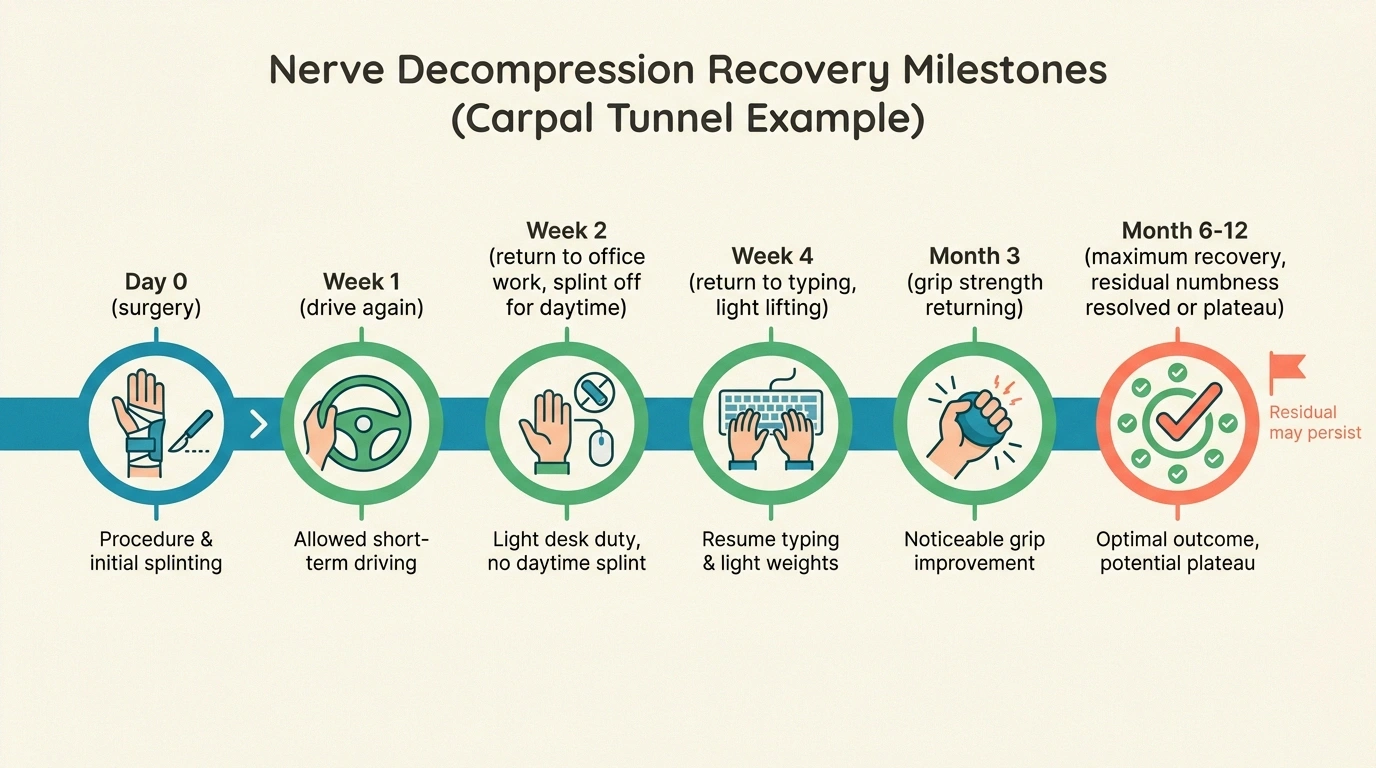
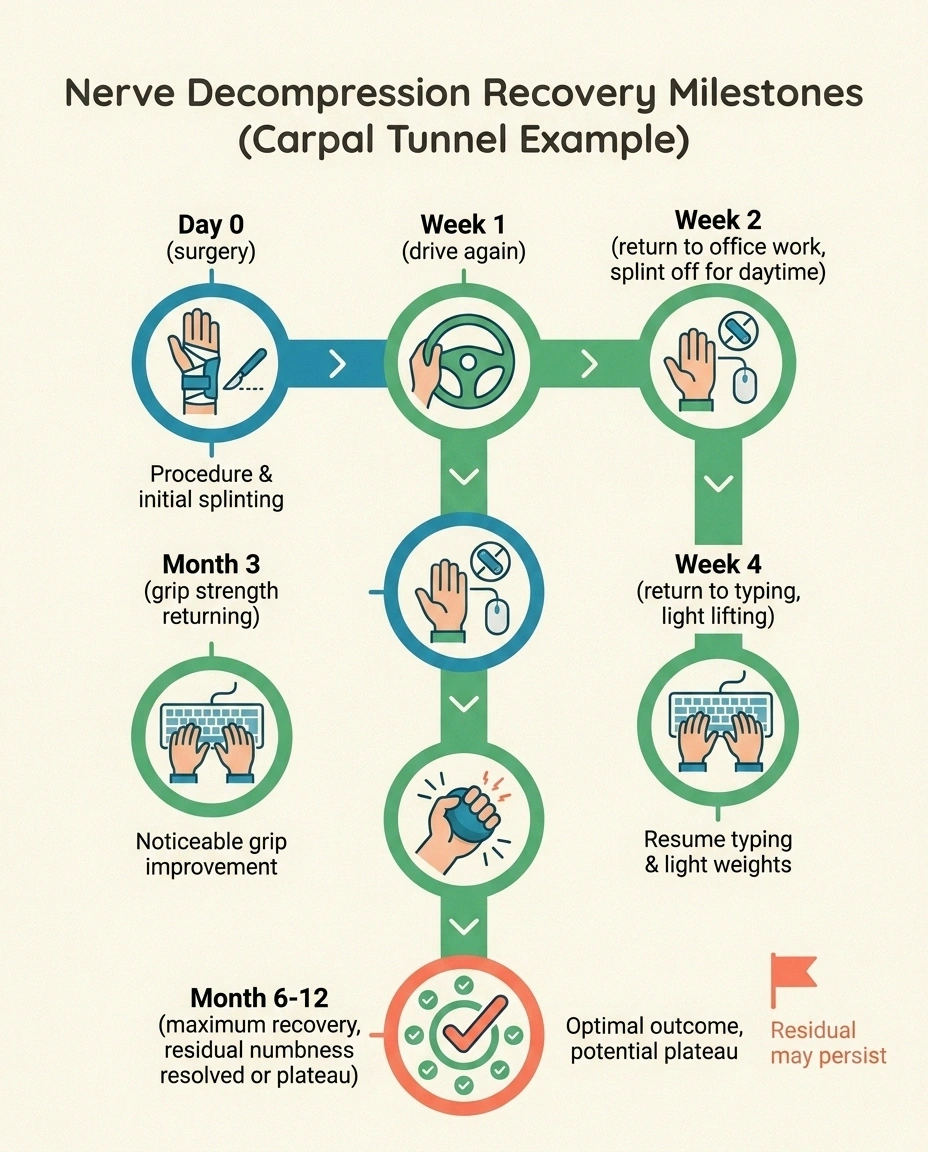
- When can I drive? Typically 1 to 2 weeks for carpal tunnel, longer for cubital or peroneal — depends on the specific procedure and your normal activity.
- When can I return to office work? To manual work? To typing? To lifting? Ask for specific weight limits and time frames.
- What activities are permanently restricted?
- Will I need occupational therapy or physical therapy, and how many sessions? Post-surgical hand therapy is a specialty; a certified hand therapist (CHT) is usually the right referral.
- What splints or immobilization are required, and for how long?
- What follow-up appointments do I have with you, and how do I reach you between appointments?
Questions About Non-Surgical Alternatives
A good surgeon should be able to describe the non-surgical alternatives clearly, and should have opinions about when each might be tried before or instead of surgery. Any surgeon who cannot describe conservative management well is worth questioning.
- What is your recommendation for non-surgical management? Splinting (especially night splints for carpal tunnel), corticosteroid injections, physical or occupational therapy, activity modification, ergonomic adjustments, and (in some cases) ultrasound-guided nerve hydrodissection.
- What if we wait 3 to 6 months and see how things evolve? This is a fair question. Many focal entrapments improve with time and conservative measures. Others progress. A good surgeon will help you weigh both risks.
- What is the risk of waiting? Progressive axonal loss over months is not reversed by surgery later. Once atrophy or dense sensory loss develops, surgical outcomes diminish.
- Are there medications that might help while I decide? Gabapentin, pregabalin, duloxetine, or topical lidocaine may reduce symptoms during a trial of conservative management. Our pages on gabapentin, pregabalin, and duloxetine walk through what each does and does not do.
Questions About Second Opinions

- Should I get a second opinion? A good surgeon welcomes this. A defensive answer to this question is diagnostic.
- From which specialty should I seek the second opinion? A fellowship-trained peripheral nerve surgeon is often a valuable perspective — sometimes different from a general hand surgeon or a general orthopedist. A neurologist’s opinion about whether surgery is likely to help is also worth having.
- Can I have a copy of my imaging, EMG, and consultation note to take with me? This is your right. Any resistance is a red flag.
Questions About Cost, Insurance, and Facility
- Are you and the facility in-network for my insurance? Confirm separately for surgeon, facility, anesthesia group, and any pathology or lab work.
- What is my out-of-pocket estimate? Ask for a written estimate before scheduling. Post-op therapy costs are often separate.
- Is this procedure typically approved by my insurance, or does it require prior authorization? Carpal tunnel release is almost always approved with clean documentation. Multi-level DPN decompression is often denied as “experimental” for length-dependent neuropathy.
- What is your fee if I need to return for a complication?
- Which facility will the surgery be at, and why that one? Some procedures are appropriate for an in-office surgical suite; others need an ambulatory surgery center or hospital.
Red Flags That Should Make You Pause
Not every surgeon is the right surgeon for you. Some patterns are worth noting.
- Multi-level lower-extremity decompression recommended for length-dependent diabetic neuropathy without focal entrapment on EMG
- Surgery recommended without an EMG or nerve conduction study on record
- Vague or defensive answers about complication and revision rates
- Active discouragement of a second opinion
- Cash-pay only, out-of-network, package pricing out of line with local norms
- Testimonials offered instead of published outcome data
- Language of “cure” or “reversal” applied to neuropathy in general
- Bundled surgical packages requiring commitment to multiple procedures at once
- Multi-nerve decompression recommended for length-dependent diabetic neuropathy without clear focal entrapment on nerve conduction studies. This runs against the American Academy of Neurology’s position and against most of the evidence.
- Recommendation without an EMG or nerve conduction study on record. Even carpal tunnel deserves confirmatory testing before surgery.
- Vague or defensive answers about complication rates. Specific numbers exist for these procedures; refusal to share them is a signal.
- Active discouragement of a second opinion. A confident surgeon welcomes them.
- Cash-pay only, out-of-network, or a package price that seems out of line with local norms. Not disqualifying, but worth understanding why.
- Testimonials from patients rather than published outcome data. Individual patient stories are not evidence; ask for the peer-reviewed data supporting the specific procedure in your specific clinical situation.
- Language of “cure” or “reversal” applied to neuropathy in general. Focal entrapment relief is one thing; “curing neuropathy” is another. See our page on whether neuropathy can be reversed for the honest picture.
- Bundled surgical packages that require you to commit to multiple procedures at once. Each procedure should stand on its own indication.
Green Flags That Suggest a Good Fit
- Fellowship training in hand, peripheral nerve, or the specific anatomic area.
- Recent, high-volume experience with the specific procedure.
- Willingness to share complication rates and revision rates as numbers.
- Documentation of the entrapment on nerve conduction studies before recommending surgery.
- Clear discussion of conservative alternatives and their expected outcomes.
- Openness to second opinions and easy release of medical records.
- Realistic expectation-setting: names what surgery will and will not fix.
- A physical therapy or occupational therapy plan built into the recovery pathway.
How to Take These Questions Into the Consultation
You will not remember all forty. That is fine. Here is how I suggest using this list.
The diagnosis questions (focal vs. length-dependent, EMG confirmation), surgeon-experience questions (volume, training, complication rates), and realistic-expectation questions (percent improvement, recovery timeline).
Specific risks, anesthesia, recovery milestones, therapy referrals, non-surgical alternatives, second-opinion recommendation.
Cost estimates, facility details, follow-up logistics, complication-return-visit fees, records release for second-opinion consult.
- Fellowship training in hand, peripheral nerve, or the specific anatomic area
- Recent, high-volume experience with the specific procedure (not lifetime totals)
- Complication rates and revision rates shared as numbers, not as reassurances
- Entrapment documented on nerve conduction studies before surgery is recommended
- Clear discussion of conservative alternatives and their expected outcomes
- Openness to second opinions and easy release of medical records
- Realistic expectation-setting: names what surgery will and will not fix
- A physical therapy or occupational therapy plan built into the recovery pathway
Print it or open it on your phone. Highlight the questions in three tiers: the ones you absolutely need answered before you decide (usually the diagnosis questions, the surgeon-experience questions, and the realistic-expectation questions), the ones you want answered before you schedule (specific risks, recovery, alternatives), and the ones you can send by email or portal afterward (cost, facility, follow-up logistics).
Bring someone with you if you can. A spouse, an adult child, a close friend — someone whose only job is to listen and take notes. You will be doing most of the talking; they will catch what you miss. Ask the surgeon if you can record the consultation on your phone; many will say yes. If they say no, take handwritten notes.
Ask “why” more than “how.” A surgeon who can explain the reasoning behind their recommendation is different from one who describes procedure steps. You want the reasoning.
Do not sign the consent form in the room. Take it home. Read it. Look up any terms you do not recognize. Come back with follow-up questions if you have them. A confident surgeon expects this and will not push you to commit on the first visit.
What to Do Between the Consultation and the Decision

Give yourself a real interval — at least 2 weeks, sometimes longer — between the consultation and the decision. Use that time to:
- Get the second opinion. Even for carpal tunnel, even from a surgeon you like.
- Complete or verify the systemic workup. If your B12, A1C, and thyroid have not been checked recently, do that now.
- Try or continue any reasonable conservative measures — night splints, activity modification, physical therapy — and note whether they help.
- Optimize the modifiable factors: quit smoking, tighten diabetes control (see our diabetic neuropathy overview for what “good control” looks like), address weight if that is a factor.
- Talk with people who have had the specific procedure — support groups, patient forums, or friends. Their stories are not evidence, but they can surface questions you had not thought to ask.
- Read the consent form carefully. If any listed complication would be unacceptable to you at any probability, that is a conversation to have with the surgeon.
- Consider your logistics. Recovery from cubital tunnel or peroneal decompression can affect driving, work, and self-care for weeks. Plan for that before the date on the calendar arrives.
The Bottom Line
Nerve decompression surgery is one of the most useful procedures in modern medicine when it is offered for the right indication to the right patient by the right surgeon. It is also a procedure that has been offered too casually to too many patients whose neuropathy is not primarily surgical. Barbara ended up having a carpal tunnel release six weeks after our coffee, with a fellowship-trained hand surgeon who answered every question on this list without defensiveness, and she is now sleeping through the night for the first time in three years. She also declined a multi-level lower-extremity decompression that had been recommended at one of her other consultations for her length-dependent diabetic neuropathy, because after the questions were answered, that recommendation did not hold up.
You do not need to become a nerve surgeon to make a good decision. You need to ask a small number of specific questions clearly, listen to the answers carefully, and give yourself the time to weigh them. The map above is the one I wish someone had given me the first time a surgeon offered me an operation. Take what is useful. Nothing here is medical advice. The right people to help you decide are the surgeon whose care you are considering, the second-opinion surgeon you seek, your primary care physician, your neurologist, and the trusted people in your life who will read this letter with you.
Frequently Asked Questions
Is nerve decompression surgery a cure for neuropathy?
It is not a cure for neuropathy in general. It can be highly effective for focal nerve entrapment — a single nerve compressed at a specific anatomical location — such as carpal tunnel syndrome or cubital tunnel syndrome. For length-dependent neuropathy (the stocking-glove pattern typical of diabetes, chemotherapy, and most idiopathic neuropathy), surgical decompression is unproven and not recommended by the American Academy of Neurology.
How do I know if my neuropathy is focal or length-dependent?
Focal neuropathy affects one specific nerve and shows a clean conduction block on nerve conduction studies at a specific anatomical location. Length-dependent neuropathy is symmetric, starts in the toes and progresses upward, and reflects damage to the longest nerve axons throughout the body. A neurologist can distinguish them with clinical examination, EMG, and nerve conduction studies.
What are the biggest risks of nerve decompression surgery?
The main risks include infection, hematoma, nerve injury during the procedure, incomplete symptom relief, scar-tissue reformation with recurrent entrapment, and complex regional pain syndrome. Reported side-effect rates for nerve decompression procedures generally range from about 10 to 24 percent depending on the specific procedure, patient factors, and surgical experience.
Should I get a second opinion before nerve decompression surgery?
Yes, in most cases. A fellowship-trained peripheral nerve surgeon or a neurologist can offer a valuable perspective on whether surgery is the right next step. A surgeon who welcomes second opinions and easily releases medical records is a good sign. Resistance to second opinions is a red flag.
How long is recovery from carpal tunnel release?
Most people return to light activities within one to two weeks. Full recovery — nerve regeneration and gradual return of sensation — typically takes 6 to 12 months. Grip strength usually returns to normal within 3 to 6 months. Night pain and numbness often improve within days to weeks; residual daytime numbness may take much longer or never fully resolve if axonal damage was severe before surgery.
Does insurance cover nerve decompression surgery?
Standard focal-entrapment procedures (carpal tunnel, cubital tunnel, tarsal tunnel, peroneal decompression) are typically covered by commercial insurance and Medicare with appropriate documentation of diagnosis and failed conservative management. Multi-level decompression for length-dependent diabetic peripheral neuropathy is often denied as “experimental” or “not medically necessary” because it lacks strong supporting evidence.
Can I have carpal tunnel release under local anesthesia only?
Yes, in many cases. Carpal tunnel release is one of the procedures increasingly performed under local anesthesia only (with or without mild sedation), which avoids the risks of general anesthesia and allows a faster recovery. Discuss anesthesia options with your surgeon and anesthesia team.
What is the difference between open and endoscopic carpal tunnel release?
Open release uses a small incision in the palm to visualize and cut the transverse carpal ligament directly. Endoscopic release uses one or two smaller incisions and a camera-guided instrument. Both approaches have similar long-term outcomes. Endoscopic release may allow slightly faster return to work but has a modestly higher rate of transient nerve irritation. Discuss which approach your surgeon prefers and why.
About the Author