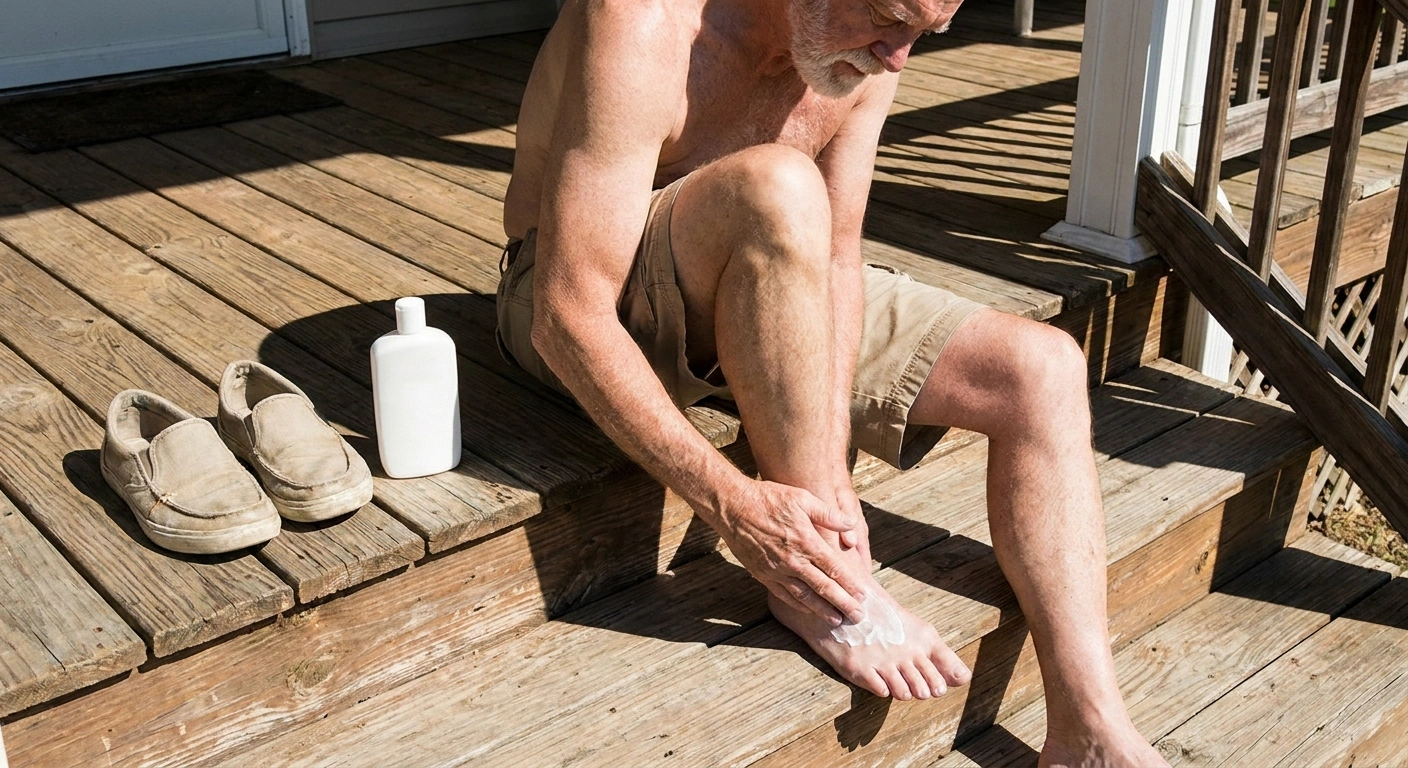
Face, nose, ears, the back of the neck, both arms. Most of us have a sunscreen routine, and it runs from the top down. By the time we get to our feet, the bottle’s back in the bag. Before neuropathy, that mistake got corrected by a sting that evening — numb feet don’t send that message.
The diabetes branch of the National Institutes of Health, NIDDK, puts it bluntly: with diabetic nerve damage, you can get a burn on your feet without ever knowing it happened. Its advice is just as short: “Put sunscreen on the tops of your feet to prevent sunburn.”
That one line leaves a lot of questions. Which sunscreen? What about the soles? Between the toes? How do you reach your feet if bending is hard, and how do you know you didn’t miss a patch when you can’t feel where the cream went? This page works through all of it. My background is patient advocacy rather than medicine, so where the official guidance runs out, I’ll say so and tell you what I do instead.
Why a Burn Can Sneak Up on Numb Feet
Roughly half of people with diabetes have nerve damage of some kind, the CDC estimates, and that damage “can also lower your ability to feel pain, heat, or cold.” Neuropathy from chemo, vitamin deficiencies and other causes does the same. The burning, prickling warning that used to tell you “time for shade” may simply not arrive — or arrive far too late.
Feet are also easy to forget. The FDA lists the tops of the feet among sunscreen’s “frequently forgotten spots,” and the American Academy of Dermatology (AAD) says the same. Add a few things that make summer feet especially exposed:
- Sand and water bounce sunlight back at you. AAD says to use extra caution near water, snow and sand.
- Water doesn’t shield dangling feet. The MSD Manual notes that UV light can reach through about a foot of clear water, and the NHS points out that cool water can make you think you’re not burning.
- Clouds don’t stop it. Up to 80% of the sun’s UV rays can get through clouds, per the MSD Manual.
Then there’s timing. A sunburn can start showing within an hour, but it usually peaks somewhere between 12 and 24 hours. On black or brown skin, the NHS notes, the color may not change at all. So the evening you get home, a numb foot can look and feel completely fine.
Why a sunburned foot is a bigger deal with neuropathy

For most people, a sunburn on the feet is a sore few days. For someone with neuropathy or diabetes, it’s an open door. AAD says that a sunburn that blisters is a second-degree burn. The MSD Manual notes that sunburned skin, especially once it peels, can become infected, and that complete healing may take weeks.
That’s where diabetic foot guidance gets serious. The IWGDF, an international panel that writes diabetic foot guidelines, warns that in people with neuropathy, minor trauma, including a thermal injury, “can precipitate ulceration of the foot.” NIDDK adds that poor blood flow makes sores and infections hard to heal. I couldn’t find a study that tracks sunburns specifically turning into foot ulcers. Burn-unit research on diabetic feet is mostly about scalds and hot surfaces, not sun. But the logic holds: a blister you didn’t feel, on skin that heals slowly, is exactly how foot wounds start.
Covering Up Comes First
Here’s the part that surprises people — sunscreen is plan B. Every diabetic foot guide I read puts covered feet first.
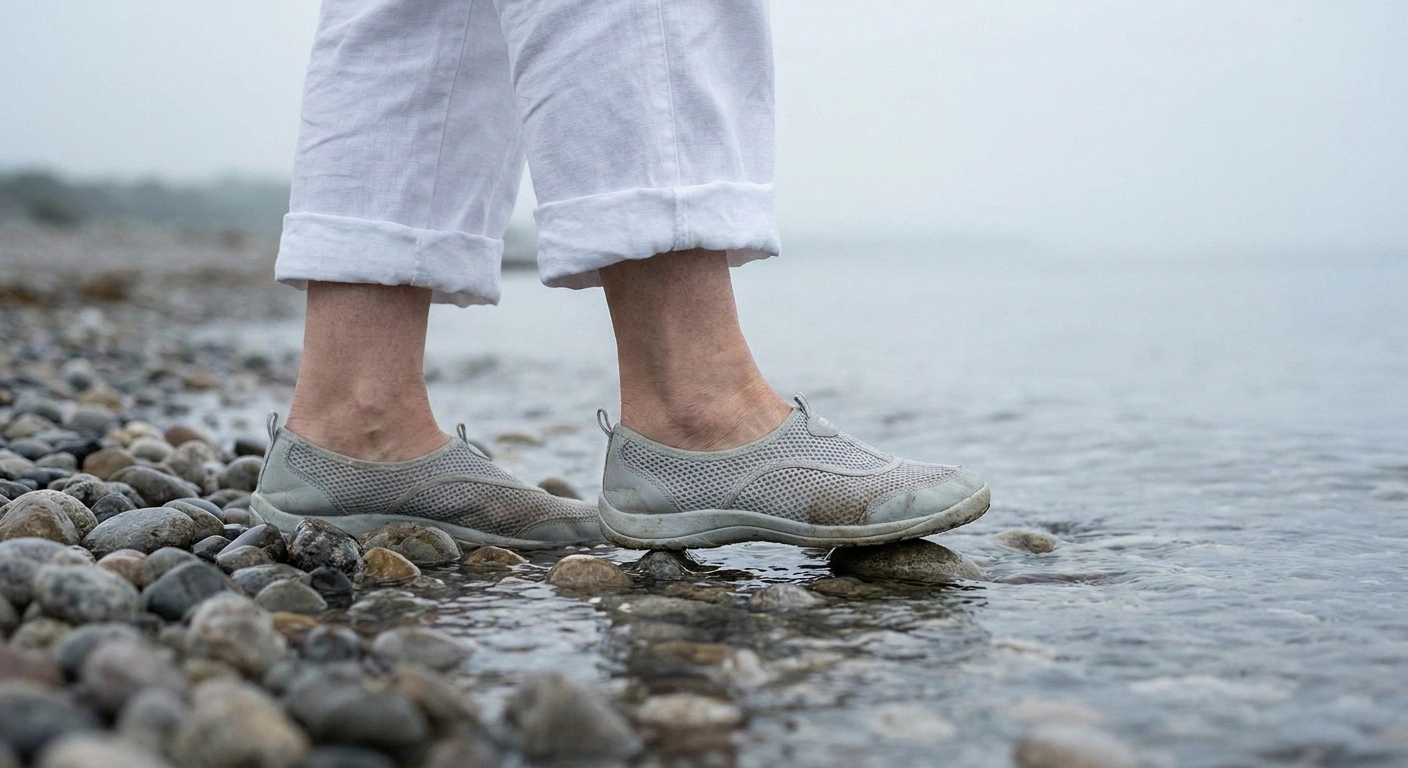
NIDDK’s advice is shoes on hot pavement and at the beach. The American Diabetes Association says that in warmer months you should skip going barefoot, flip-flops and other open shoes. The UK’s Royal College of Podiatry goes further: “Always wear footwear, even on the beach,” and wear something like plastic shoes if you go into the sea. Its holiday leaflet offers a simple either-or: a high-factor sunscreen of SPF 30 or above, “or keep them covered.”
Covering helps with things sunscreen can’t touch. Hot sand and pavement burn by contact, not by UV, and the Royal College of Podiatry warns that beach sand can burn your feet “without realising it.” My guide to walking on beach sand with neuropathy covers that danger in detail.
A few covering tips from the sources:
- Pick light colors. NHS diabetes leaflets warn that dark materials absorb heat and can burn your feet.
- Tight weaves block more sun than loose ones, says the MSD Manual. Clothing with a UPF number on the label is rated for sun protection.
- Closed water shoes beat flip-flops. The Royal College of Podiatry warns flip-flops can cause blisters between the toes.
So when does sunscreen come in? Whenever skin is still showing: the tops of feet in sandals, ankles between a hem and a shoe, feet propped up on a lounger, feet hanging off a dock. That’s a lot of summer — and a lot of skin.
Picking a Sunscreen for Feet
You don’t need a special “foot sunscreen.” You need a good regular one. AAD’s recommendation is clear: choose a sunscreen with SPF 30 or higher that’s water resistant and broad spectrum, meaning it covers both UVA and UVB rays.
| On the label | What it means |
|---|---|
| Broad spectrum | Covers UVA and UVB. FDA says only broad-spectrum SPF 15+ also lowers skin cancer risk. |
| SPF 30 or 50 | How much sun it blocks, not how long. SPF is about the amount of sun, not the time in it. |
| Water resistant (40 or 80 minutes) | How long it lasts while swimming or sweating. Then reapply. |
| Zinc oxide / titanium dioxide | A mineral sunscreen; the type dermatologists suggest for sensitive skin. |
| No expiration date | FDA: treat it as expired three years after you bought it. |
Not allowed on US labels: “waterproof,” or a claim of protection for more than two hours without reapplying.
SPF 30 blocks 97% of UVB rays, according to AAD. Higher numbers add a little more, but they don’t last any longer on the skin. The Skin Cancer Foundation suggests SPF 50 or higher for a full day outdoors.
Water resistant, never waterproof. The FDA says flatly that no sunscreen is waterproof. Labels say whether a product stays effective for 40 minutes or 80 minutes while you’re swimming or sweating. For feet that will be in and out of a pool or wet sand, 80 is the better pick.
Mineral versus chemical. If the active ingredient is zinc oxide, titanium dioxide or both, it’s a mineral (or “physical”) sunscreen. AAD says dermatologists recommend mineral sunscreens for sensitive skin. The Skin Cancer Foundation adds that while mineral formulas may irritate less, both types have been tested as safe and effective. I like mineral for feet for a practical reason: the slight white tint shows me where it landed, which matters when I can’t feel it.
Fragrance-free if your skin is touchy. A Texas Tech dermatologist suggests fragrance-free sunscreen for people sensitive to fragrances, and says some of the gentlest options are made for babies and children.
Lotion, stick or spray? Lotions make it easier to put on enough. AAD says the problem with sprays is knowing whether you’ve used enough; its fix is to spray until the skin glistens, then rub it in. Two cautions with sprays: many contain alcohol and are flammable, so don’t spray near a grill, campfire or candle. And AAD doesn’t recommend combined sunscreen and insect repellent products.
Honestly, AAD’s simplest advice may be its best: “The best type of sunscreen is the one you will use again and again.”
Where It Goes: Tops, Sides, Soles and the Toe Gaps
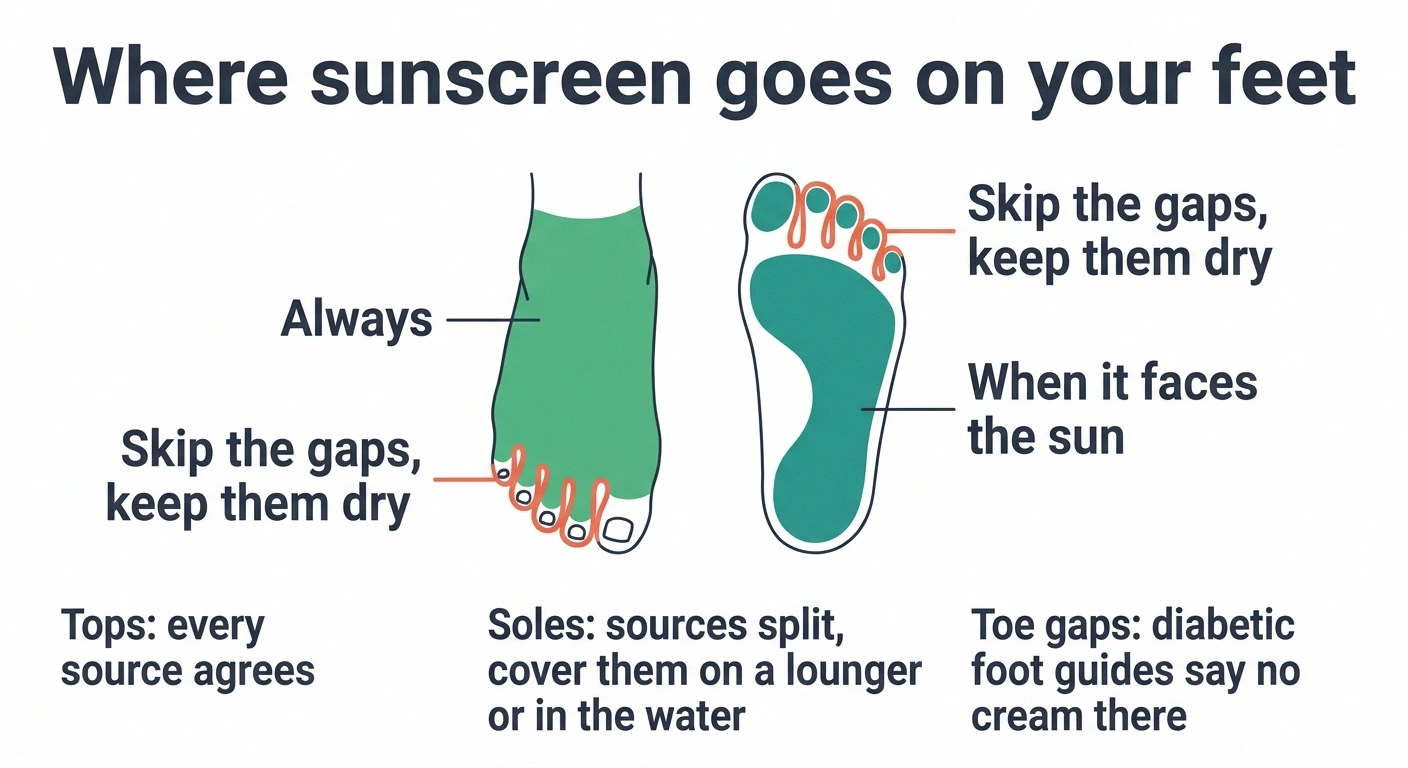
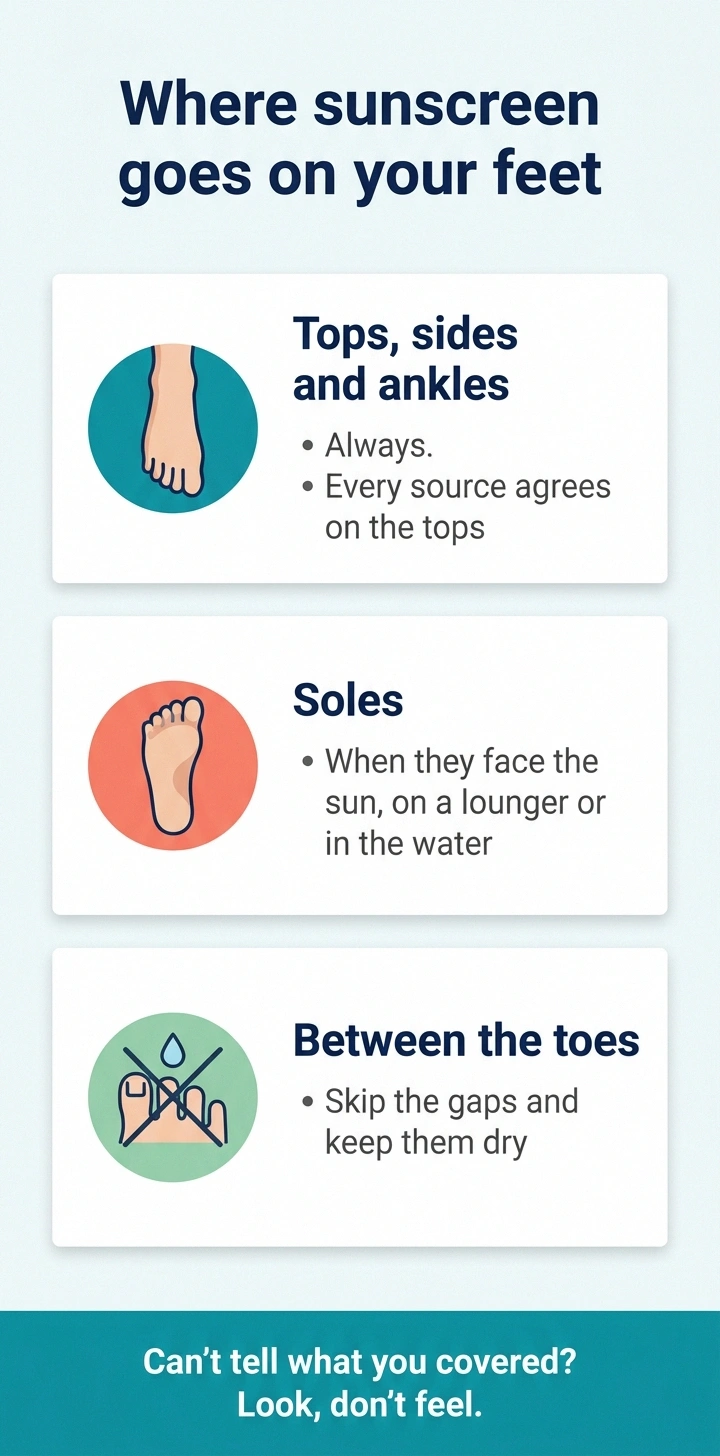
This is where the official advice gets messy — so let me lay it out.
Tops of the feet: everyone agrees. NIDDK, FDA, AAD and every diabetes foot leaflet I found name them.
Ankles and the sides of the feet: no source singles them out, but they’re the same sun-facing skin, and sandal straps leave them bare. I treat them as part of the top.
Soles: here the sources split. NIDDK mentions only the tops. The Royal College of Podiatry, the American Foundation for the Blind’s summer foot tips, an NHS trust leaflet and the Skin Cancer Foundation all say tops and bottoms. Nobody I found measured how easily soles burn. My rule: if your soles will face the sky, cover them. That means lying on a lounger, sitting with your feet up, floating on your back or kicking in the shallows.
Between the toes: this is a genuine conflict. The Skin Cancer Foundation says not to skip between your toes. But NIDDK, the CDC and the IWGDF all say not to put lotion or cream between your toes, because moisture there can lead to infection. NIDDK even suggests dusting the toe gaps with talcum powder or cornstarch, because skin there holds moisture.
No source I found settles this for people with diabetes or neuropathy. So here’s what I do, and it’s my own judgment, not an official rule. I put sunscreen on the tops of my toes and the skin right up to the gaps, but not into the webs. Then I rely on water shoes or socks to shade that strip. If you’re unsure, it’s a good question for your podiatrist at your next visit.
One more thing about soles: sunscreen won’t protect you from every skin cancer down there. A UK dermatology society notes that acral lentiginous melanoma, the type most often found on the soles, is not related to UV exposure. That’s one more reason a regular look at the bottoms of your feet matters, sun or no sun.
How to Put It On When You Can’t Reach or Feel Your Feet
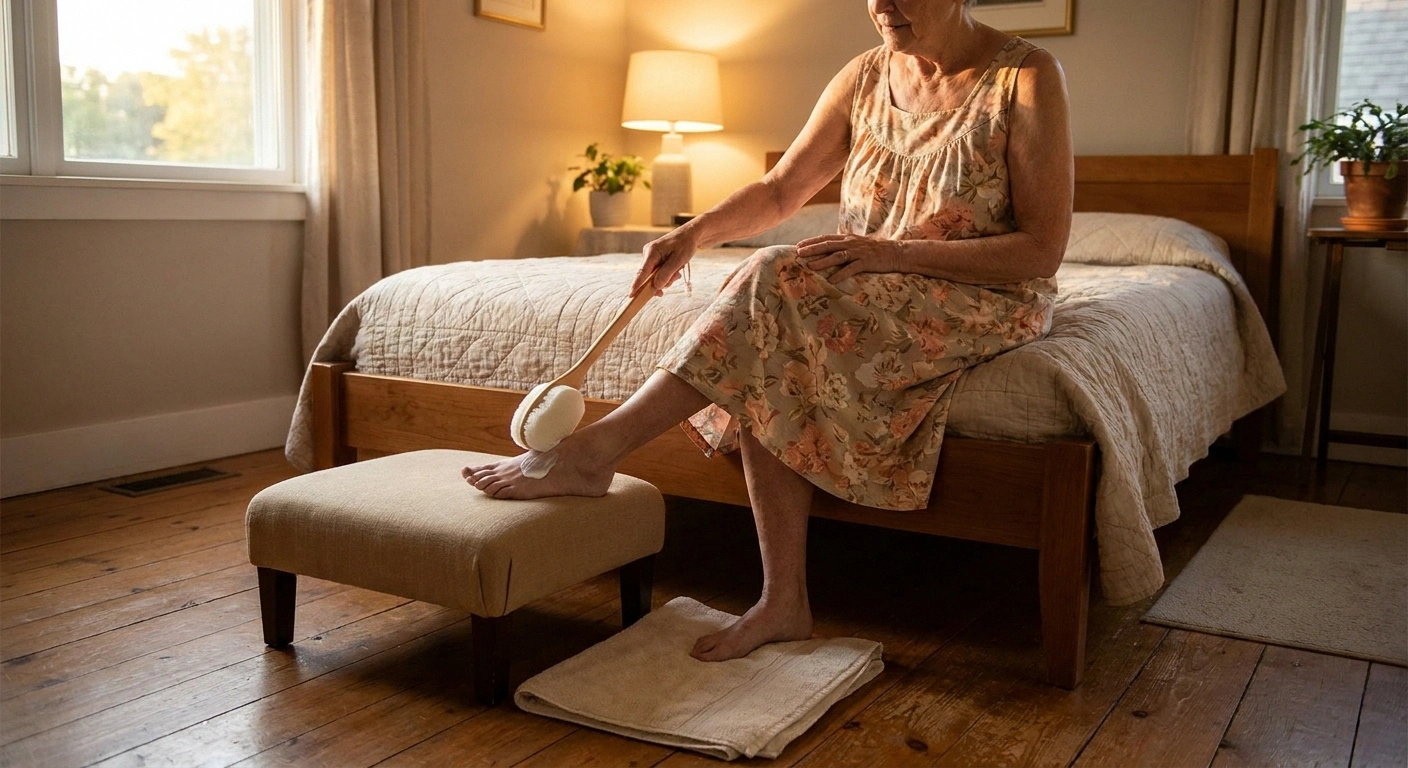
This is the part nobody writes about. Diabetes pages say “sunscreen on your feet” and stop there. But if your back is stiff, your balance is shaky or your fingertips are numb too, getting it on is the hard part.
I couldn’t find any sunscreen advice written for this. But NHS podiatry services have tips for putting cream on feet you can’t reach, and the same tools work for sunscreen. If you already use one of these for moisturizer, you’re set. My guide to applying foot lotion with neuropathy covers the tools in more detail.
Step 1: Sit down first
Do this on the edge of the bed or in a sturdy chair, never balanced at the bathroom sink. Sunscreen makes feet slippery, so put it on where a slip can’t happen, and get your shoes on before you walk across a tile floor.
Step 2: Start with clean, dry feet
AAD says to apply sunscreen to dry skin. If a cut or sore is open, cover it with a bandage first, as NIDDK advises for any foot wound.
Step 3: Let a tool do the reaching
- A long-handled sponge is the classic. Sheffield’s NHS foot-care leaflet suggests one for anyone who has trouble bending.
- A long-handled roller, the kind sold for painting behind radiators, is a Dorset NHS podiatry tip.
- Cream on a plastic bag: spread some on a plastic bag on the floor and rub your foot over it. This is another NHS tip, and it works for the soles.
- A spray while seated avoids bending entirely. Spray until the skin glistens, then rub it in with the sponge.
- Ask for help. AAD says to ask someone to help with hard-to-reach areas, and the NHS leaflet says the same for foot care. There’s no shame in it.
Step 4: Follow the same route every time
When you can’t feel where the sunscreen went, a fixed order keeps you from skipping a patch. Mine goes: top of the foot, outer side, inner side, ankle, back of the heel, tops of the toes. Then I look. A mineral sunscreen’s faint white cast shows any bare spots. AAD says to rub sunscreen thoroughly into your skin, and a 2014 paper on how people actually use sunscreen found that missed areas reduce protection considerably.
Step 5: Give it time before you go out
The FDA and AAD say to apply 15 minutes before sun exposure. The Skin Cancer Foundation, the NHS and the MSD Manual say 30. Simplest fix: do your feet at home, before your socks and shoes go on. The Skin Cancer Foundation recommends applying sunscreen before you dress for the day anyway.
Keeping It On Through the Day
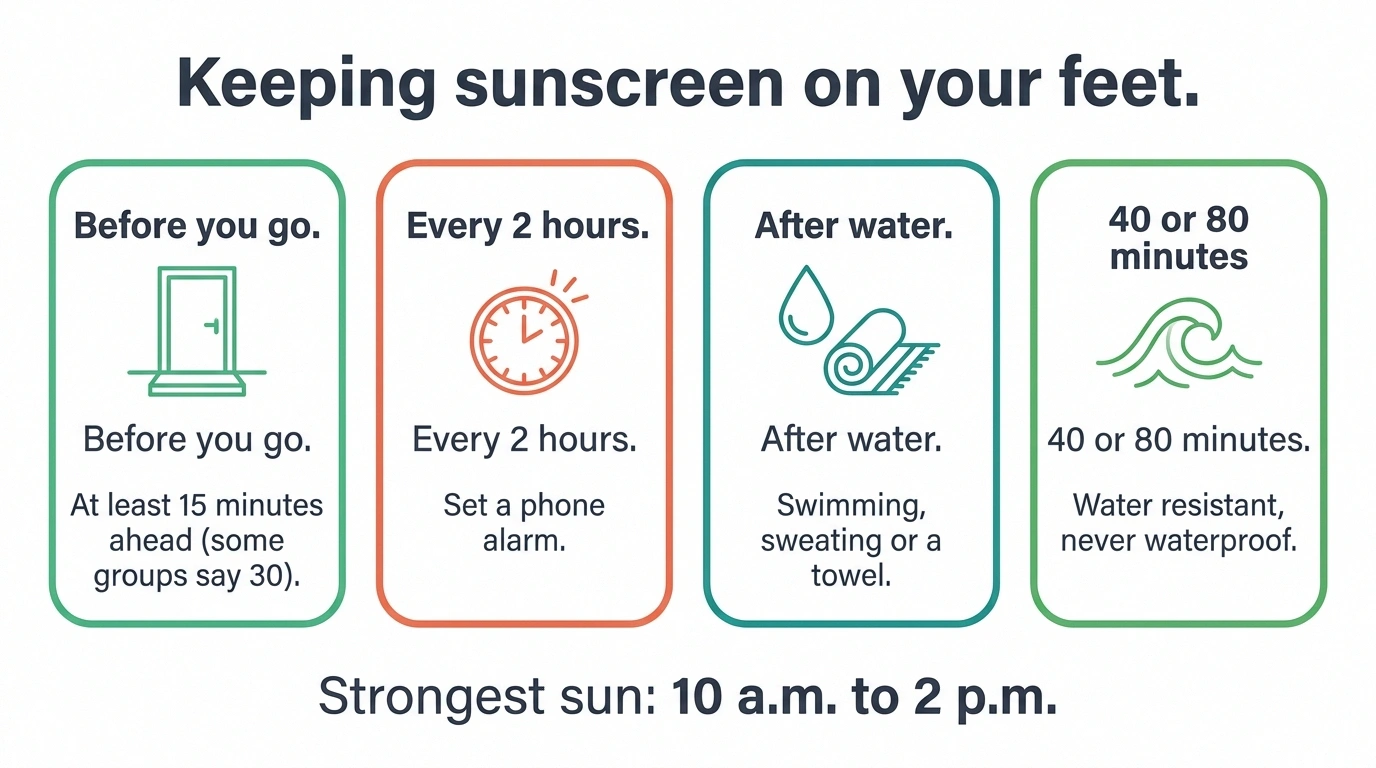
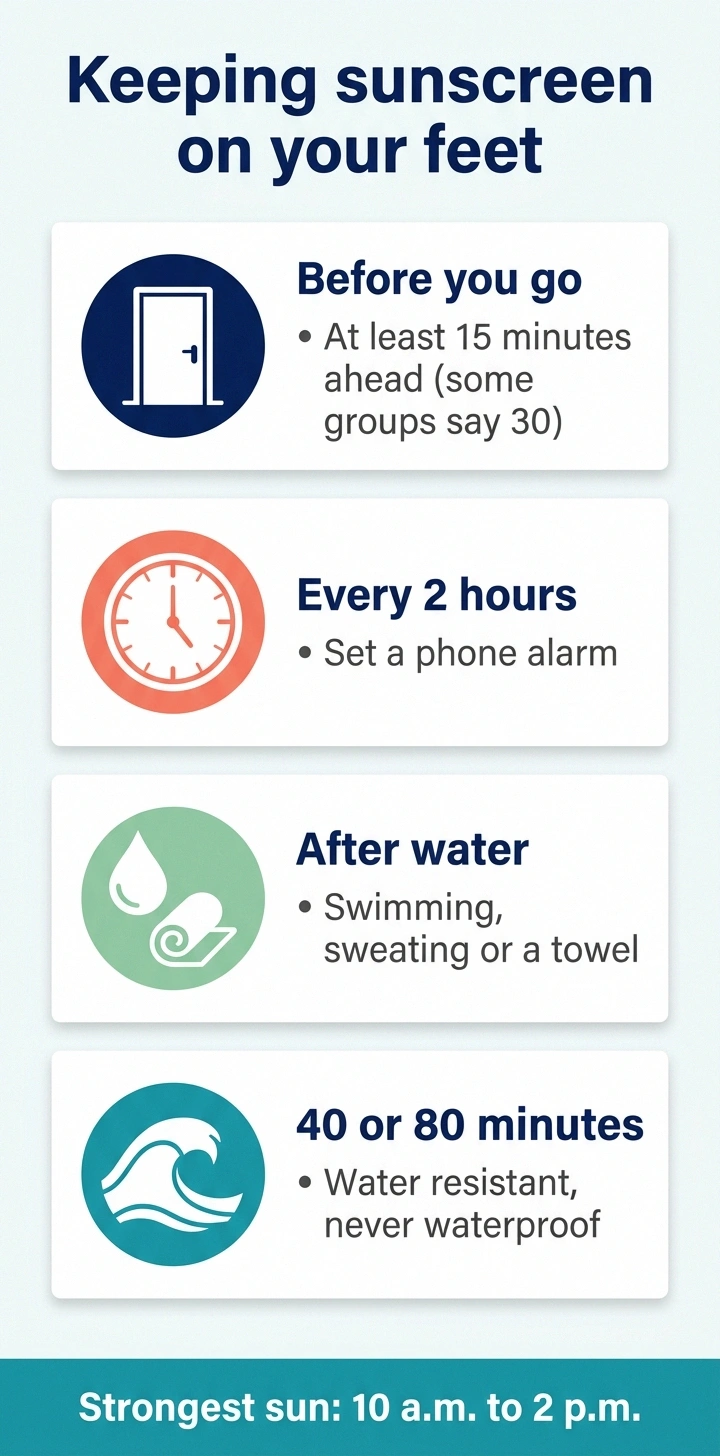
Feet are rough on sunscreen — sand scrubs it off, straps rub it off, water rinses it and a towel wipes the rest away. The FDA says to reapply at least every two hours, and more often if you’re swimming or sweating. The NHS adds after towel drying, or whenever it may have rubbed off.
The trouble is that most of us put on too little to begin with. In one study, the amount on people’s skin after one coat was about 0.43 milligrams per square centimeter. A second coat roughly doubled it to 0.95, still short of the 2 mg used to test SPF. The FDA says an average adult needs at least one ounce, about a shot glass full, to cover the whole body. Feet get a small share of that, but don’t skimp on them.
Some easy habits:
- Set a phone alarm for every two hours. You won’t get a stinging reminder, so borrow one.
- Reapply after every swim or towel-off, even with an 80-minute water-resistant formula.
- Plan around the midday sun. The FDA says rays are most intense between 10 a.m. and 2 p.m.
- Keep the bottle in the shade. The FDA suggests wrapping it in a towel. A hot car can ruin it, AAD notes.
And check the date. The FDA says a sunscreen with no expiration date should be treated as expired three years after purchase. If you don’t know how old it is, throw it out. AAD suggests writing the purchase date on the bottle, and replacing any sunscreen that has changed color or texture. AAD says people who burn usually didn’t reapply, used too little or used an expired bottle. Feet tend to get all three — they’re the last stop on everyone’s routine.
Pool days have their own hazards, from wet tile to rough steps. My pool and locker room safety guide covers those.
Medicines and Devices That Change the Math
Some common medicines make skin burn faster. The FDA’s list of drugs that can cause sun sensitivity includes several that many people with diabetic neuropathy take:
A two-minute check before your next beach day
Line up your pill bottles and look for these generic names. Any match means a stricter foot routine on sunny days:
glipizide, glyburide (diabetes) · hydrochlorothiazide, chlorthalidone, chlorothiazide (water pills) · simvastatin, atorvastatin, lovastatin, pravastatin (cholesterol) · ibuprofen, naproxen, celecoxib (pain)
From the FDA’s list of medicines that can cause sun sensitivity. Don’t stop any of them on your own; just protect your skin harder.
- Sulfonylureas for type 2 diabetes, such as glipizide and glyburide
- Thiazide diuretics such as hydrochlorothiazide and chlorthalidone
- Statins such as simvastatin, atorvastatin, lovastatin and pravastatin
- NSAID pain relievers such as ibuprofen and naproxen
The Royal College of Podiatry tells people on sulfonylureas to take extra care in the sun. If you’re on any of these, give your feet the full routine even on a short outing.
To be clear about what’s not on that list: the FDA’s sun-sensitivity list doesn’t name gabapentin, pregabalin, duloxetine or amitriptyline. I’ve seen claims online that nerve-pain medicines cause sun sensitivity, but the FDA list I checked doesn’t support them.
If you wear a glucose sensor or insulin pump on your leg, Diabetes UK has a tip: keep sunscreen off the insertion site so the next sensor or pump site sticks properly.
The Evening Check, and the Next Morning

Because you can’t count on pain, your eyes do the work. NIDDK ties the check to a habit: look your feet over every evening as your shoes come off. The IWGDF calls for a daily look at the entire surface of both feet, including between the toes.
If you can’t see the soles, the CDC suggests a mirror or a family member. A hand mirror propped on the floor works, as does a phone camera held low.
What you’re looking for after a sunny day:
- Redness on lighter skin, or darker patches on darker skin, as AAD describes.
- Skin that’s hot to the touch. Use the back of your hand or ask someone else, since numb feet can’t judge it.
- Swelling or fluid-filled blisters, both on NIDDK’s watch list.
- Peeling in the days after.
Then look again the next morning. Since a sunburn usually peaks 12 to 24 hours after exposure, the evening check can miss it. I treat the morning-after look as part of the beach day — not an extra.
If You Find a Burn
For a mild burn with no blisters and no broken skin, AAD’s first steps are simple: get out of the sun, take cool baths or showers, pat dry, use a moisturizer with aloe vera or soy, and drink extra water. Test the water temperature with your elbow or a thermometer, not your numb foot. The NHS says no ice or ice packs on sunburned skin, and the MSD Manual advises avoiding numbing creams such as benzocaine, which can trigger allergic reactions.
Sorting what you find on a sunburned foot
- Pink or darker skin, no blisters, skin intact
- Cool shower, aloe or soy moisturizer, water to drink. Check again the next morning, when sunburn is usually at its worst.
- Any blister or broken skin
- Leave the blister intact, cover it, and call your doctor or foot clinic the same day. Diabetic foot leaflets treat a new break in the skin as urgent.
- Swelling, spreading warmth, fever or chills
- Get seen urgently. Peeled or blistered sunburn can become infected, and UK diabetic foot leaflets warn that any delay can threaten the limb.
For pain, AAD suggests aspirin or ibuprofen and the NHS suggests paracetamol or ibuprofen. Remember that ibuprofen and other NSAIDs are on the FDA’s sun-sensitivity list. If you have kidney problems or take a blood thinner, ask your pharmacist which painkiller is safe for you.
Blisters: don’t pop them. AAD, the NHS and the Royal College of Podiatry all agree on this, because a blister protects the skin underneath from infection. Cover it with a bandage, as NIDDK advises. If a blister needs draining, that’s a decision for your clinic, not your bathroom.
When to get help, and how fast, is where the stakes go up for diabetic and neuropathic feet:
- Right away: NIDDK says to call your doctor right away for skin on the foot that becomes red, warm or sore, or a blister or cut that doesn’t start healing after a few days.
- Immediately, per UK diabetes foot leaflets: any new break in the skin or new redness on a toe or foot. They warn that any delay can have “serious life-and limb-threatening consequences.”
- Urgently, per the NHS: blistered or swollen sunburn, a very high temperature, or feeling hot, cold or shivery.
If a sore on your foot isn’t healing, my article on diabetic foot ulcers and neuropathy explains what happens next and why speed matters. For the rest of hot-weather foot care, from swollen feet to hot car floors, see my summer heat tips for neuropathy. Planning a cruise? My cruise vacation tips cover pool decks and shore days.
Frequently Asked Questions
Do you need sunscreen on your feet if you have neuropathy?
Yes, on any skin that is exposed. The NIDDK warns that people with nerve damage from diabetes may burn their feet without knowing it, and advises sunscreen on the tops of the feet. Covering your feet with light-colored shoes or socks is even better where you can.
Can the bottoms of your feet get sunburned?
Several foot-care sources, including the Royal College of Podiatry and the Skin Cancer Foundation, say to put sunscreen on the soles too when your feet are bare. No study has measured how easily soles burn. Cover them whenever they face the sun, such as on a lounger or while floating.
Should I put sunscreen between my toes?
Sources disagree. The Skin Cancer Foundation says not to skip between the toes, but diabetic foot guidance from the NIDDK, CDC and IWGDF says to keep lotion and cream out of the toe gaps to avoid infection. Many people put sunscreen up to the gaps and shade them with water shoes or socks. Ask your podiatrist.
What SPF should I use on my feet?
The American Academy of Dermatology recommends a broad-spectrum, water-resistant sunscreen of SPF 30 or higher. SPF 30 blocks about 97 percent of UVB rays. Mineral sunscreens with zinc oxide or titanium dioxide are recommended for sensitive skin.
How often should I reapply sunscreen to my feet?
At least every two hours, and right after swimming, sweating or drying off with a towel. Feet lose sunscreen quickly to sand, straps and water, and no sunscreen is waterproof. A phone alarm helps when you cannot rely on feeling a burn.
How do I put sunscreen on my feet if I can’t bend over?
Sit down first, then use a long-handled sponge or roller, spread sunscreen on a plastic bag on the floor and rub your foot over it, or spray it on while seated and rub it in with the sponge. Asking a family member or carer to help is fine too.
When should I see a doctor about a sunburned foot?
Call right away if the skin turns red, warm or painful, if you see blisters or broken skin, or if a blister does not start to heal within a few days. Get urgent help for swelling, a high temperature or chills. Do not pop blisters at home.
About the Author