One of the most common questions I get from people newly diagnosed with neuropathy is some version of: “What does motor neuropathy mean? My doctor said I have sensory neuropathy. Are those different things?”
They are. And the difference matters — for what you feel, for what tests will show, for what treatments will help, and for what to expect over time.
I'm Janet Ellis, a community advocate and someone who's lived with peripheral neuropathy for years. The motor-versus-sensory distinction is one of those medical phrases that doctors use casually, assuming you know what they mean. They often don't slow down to explain it, and most patients walk out of the appointment a little hazy. So let's slow down here.
The Foundation: Three Types of Nerves
Your peripheral nervous system — all the nerves outside your brain and spinal cord — comes in three functional flavors. Knowing which kind is affected is the foundation of the whole “type of neuropathy” conversation.
Sensory neuropathy = problems with feeling. Motor neuropathy = problems with moving. Most people have a mix (sensorimotor polyneuropathy). The pattern of which is dominant points to the underlying cause and dictates very different treatment plans — pain medications for sensory, physical therapy and immunotherapy for motor.
Sensory nerves carry information toward your brain. They tell you what you're touching, where it is, whether it's hot or cold, whether it hurts. The texture of a sweater, the temperature of a doorknob, the position of your foot in space, the pebble in your shoe — all sensory information.
Motor nerves carry instructions away from your brain to your muscles. They tell your bicep to bend your elbow, your finger to push a button, your foot to lift toes off the floor as you take a step. Movement, strength, fine motor control — all motor.
Autonomic nerves control the things you don't consciously think about — heart rate, blood pressure, digestion, sweating, bladder function. These get their own discussion in the autonomic neuropathy article. Today's piece focuses on the first two.
Most peripheral neuropathies affect more than one type. But some affect mostly one. Where the damage falls determines what symptoms you have, what tests will show, and what treatment direction makes sense.
What Sensory Neuropathy Feels Like

This is the type most patients hear about first, because the symptoms are loud. When sensory nerves are damaged, the brain either doesn't get the signals it should, gets garbled signals, or gets phantom signals when nothing is happening.
Two Directions of Nerve Traffic
The classic sensory symptoms include:
- Numbness — reduced or absent sensation. Fingers, toes, a stocking-glove distribution if it's progressed.
- Tingling and pins-and-needles — that “fizzy” feeling, often as a constant low-grade buzz.
- Burning pain — hot, sharp, sometimes worse at night. The classic neuropathic pain quality.
- Electric or shooting pain — sudden zaps that come and go, often unprovoked. (See more on these electric shock sensations.)
- Allodynia — pain from things that shouldn't hurt, like a bedsheet on your feet, a sock seam, the wind. Read more in allodynia and neuropathy pain.
- Loss of position sense (proprioception) — not knowing where your foot is in space without looking. This is what causes the balance problems, particularly in the dark or with eyes closed.
- Loss of temperature sensitivity — bath water that should feel warm feels cold, or you can't tell when something is dangerously hot.
Sensory symptoms are usually how peripheral neuropathy first announces itself. The toes go a little numb. There's a strange burning at night. Something feels off. The reason it shows up in the feet first is the length-dependent pattern — the longest nerves in your body, which run all the way from your spine to your toes, are the most vulnerable.
What Motor Neuropathy Feels Like

Motor neuropathy is what happens when the message from brain to muscle gets weak or interrupted. The signature symptom is weakness — but the pattern matters.
Sensory vs Motor: Side-by-Side
- Numbness
- Tingling, pins and needles
- Burning pain
- Electric/shooting pain
- Allodynia (painful light touch)
- Loss of position sense
- Loss of temperature sense
- Worse at night
- Muscle weakness
- Foot drop, tripping
- Hand grip weakness
- Muscle cramps and twitching
- Loss of fine motor control
- Muscle wasting (atrophy)
- Reduced or absent reflexes
- Less pain than sensory
The classic motor symptoms include:
- Muscle weakness — not “tiredness,” but a real difficulty doing something you used to do easily. Trouble climbing stairs, lifting groceries, opening jars, gripping a pen.
- Foot drop — the inability to lift the front of your foot. Toes catch on carpet, you trip more, your gait develops a “slap” sound. A common pattern in peroneal neuropathy and foot drop.
- Muscle cramping and twitching — fasciculations (small visible muscle ripples under the skin) and cramps that come on without obvious cause. Chronic cramping has its own piece in neuropathy and muscle cramps.
- Loss of fine motor control — buttons, zippers, picking up small objects, threading a needle become difficult.
- Muscle wasting (atrophy) — over time, if motor nerves are severely damaged, the muscles they connect to get smaller from disuse. Often visible in the hand or foot intrinsic muscles.
- Reduced or absent reflexes — your knee-jerk and ankle reflexes get quieter or disappear because the reflex arc requires functioning motor nerves.
- Difficulty with balance — but for a different reason than sensory loss. Here it's because the muscles can't react quickly enough, not because you can't feel the floor.
Motor neuropathy is usually less painful than sensory neuropathy. Motor nerves don't carry pain signals — they carry movement instructions. So patients with predominantly motor neuropathy may have fewer painful symptoms but more functional ones: dropping things, tripping, weakness.
Why Most People Have a Mix

Here's the part that often surprises new patients: most peripheral neuropathies are mixed. Both sensory and motor nerves get involved, just often at different rates and to different degrees.
Diabetic peripheral neuropathy is the textbook example. Sensory symptoms come first — burning, tingling, numbness in the feet. Reflexes start to dim. Over years, mild motor weakness shows up — toe weakness, eventually small hand muscles, foot drop in advanced cases. By the time someone has had diabetic neuropathy for fifteen years, the picture is usually mixed even though it started as a “sensory” complaint.
Most other common neuropathies follow a similar pattern. Chemo-induced peripheral neuropathy tends to start sensory and stay mostly sensory. Alcoholic neuropathy often starts sensory and adds motor over time. B12 deficiency neuropathy can affect both. Idiopathic neuropathy (no identified cause) is usually mixed too.
Doctors call this “sensorimotor polyneuropathy” — meaning multiple nerves (poly), affecting both sensation and movement (sensorimotor). It's the most common pattern in clinical practice.
Pure Motor and Pure Sensory: Less Common, More Specific
When a neuropathy stays mostly in one lane — purely motor or purely sensory — it usually points to a more specific underlying cause. Knowing this is important because the workup and treatment differ.
Pattern → Likely Cause
Mostly Motor Neuropathies
Pure or predominantly motor neuropathy is uncommon and tends to suggest one of these conditions:
- Multifocal motor neuropathy (MMN) — an autoimmune disorder that attacks motor nerves, often asymmetrically. One hand weakens before the other. Treatable with IVIG (intravenous immunoglobulin).
- Chronic inflammatory demyelinating polyneuropathy (CIDP) — the chronic cousin of Guillain-Barré syndrome. Usually mixed but with significant motor involvement. Often responds well to immunotherapy. See CIDP explained.
- Hereditary motor and sensory neuropathies (Charcot-Marie-Tooth) — inherited conditions, often present from young adulthood with progressive weakness, foot deformities, and difficulty walking. See CMT and hereditary neuropathy.
- Guillain-Barré syndrome — acute, post-infectious autoimmune attack on nerves, primarily motor, rapid onset (days to weeks). A medical emergency. See Guillain-Barré syndrome.
- Amyotrophic lateral sclerosis (ALS) — technically a motor neuron disease (the cell bodies, not just the nerve fibers) but presents with progressive motor weakness without sensory loss. Pure motor symptoms without sensory involvement should always trigger careful evaluation.
- Compression neuropathies — peroneal nerve compression at the knee, ulnar nerve compression at the elbow. Local mechanical damage to a single motor or mixed nerve.
The take-home: predominantly motor neuropathy without sensory symptoms is a red flag worth getting evaluated by a neurologist promptly. It's not always serious, but the diagnostic work needs to be specific.
Mostly Sensory Neuropathies
Pure or predominantly sensory neuropathy has its own list of usual suspects:
- Small fiber neuropathy — affects only the small unmyelinated sensory fibers. Burning, autonomic symptoms, but normal strength and reflexes. Standard nerve conduction studies are often normal; diagnosis usually requires a skin biopsy. See small fiber neuropathy.
- Sensory ganglionopathy — damage to the sensory nerve cell bodies in the dorsal root ganglia. Often associated with autoimmune conditions like Sjögren's syndrome.
- Paraneoplastic sensory neuropathy — sensory damage triggered by an immune response to an underlying cancer.
- Some chemo-induced neuropathies — particularly the platinum agents (cisplatin, oxaliplatin). Pure sensory damage that can persist long after treatment ends.
- Vitamin B6 toxicity — paradoxically, too much B6 supplementation causes a sensory neuropathy.
Pure sensory neuropathy with normal strength is usually a red flag for the small-fiber group of causes, especially if standard nerve conduction is unrevealing.
How Doctors Tell Them Apart
The clinical exam is most of the answer. The tests confirm and refine.
How Doctors Distinguish Motor from Sensory
Bedside Examination
A skilled neurologist or primary care doctor can already tell a lot from a simple exam:
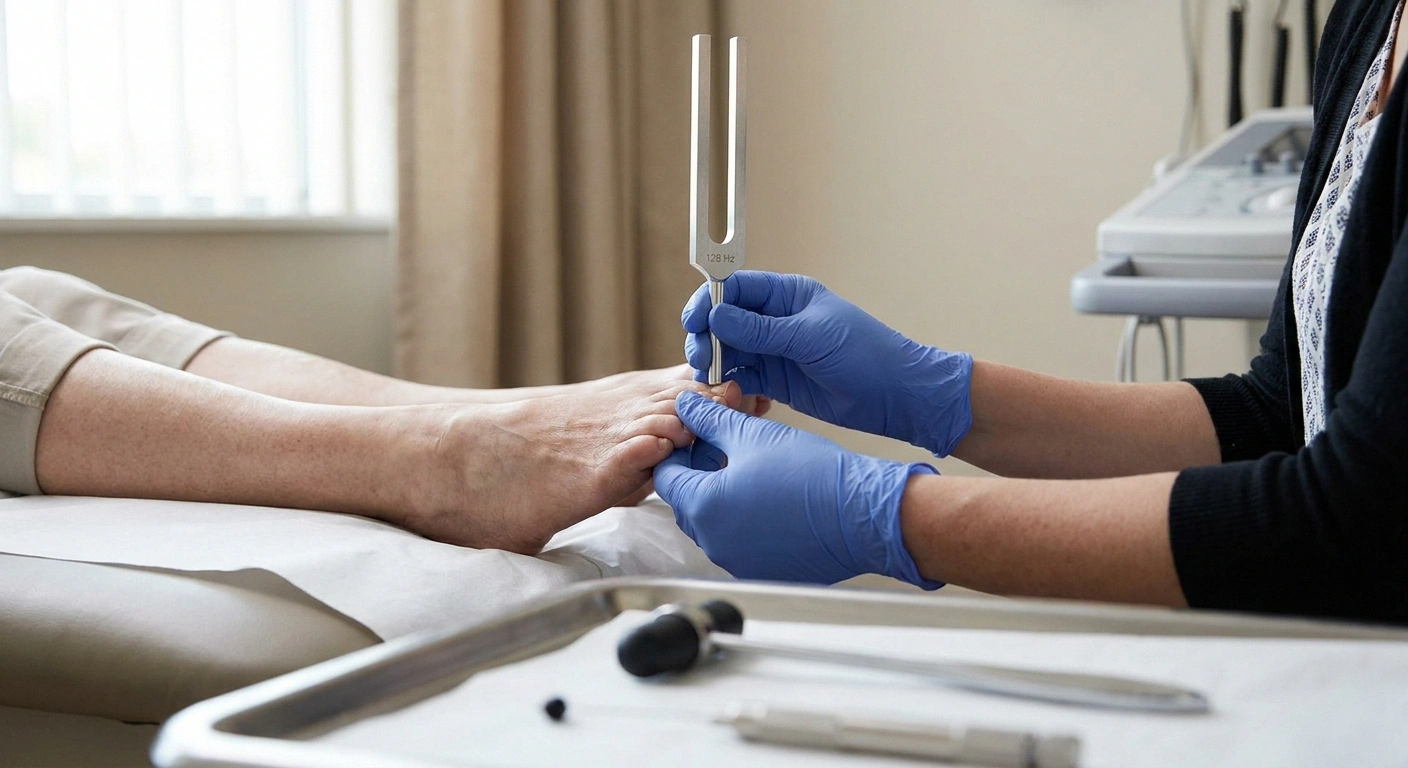
- Sensory testing — monofilament (10g nylon), tuning fork (128 Hz), pinprick, temperature discrimination, joint position sense.
- Motor testing — strength testing (graded 0-5), looking for atrophy, watching for fasciculations.
- Reflex testing — knee-jerk, ankle, biceps. Reduced or absent reflexes are a motor system finding.
- Coordination and balance — finger-to-nose, heel-to-shin, Romberg test (standing with eyes closed), tandem walking.
- Gait observation — heel walking (tests dorsiflexion), toe walking (tests plantarflexion), foot drop, balance.
An exam that finds preserved strength, normal reflexes, but reduced sensation suggests sensory neuropathy. An exam that finds preserved sensation, normal reflexes, but weakness suggests motor neuropathy. Mixed findings suggest sensorimotor.
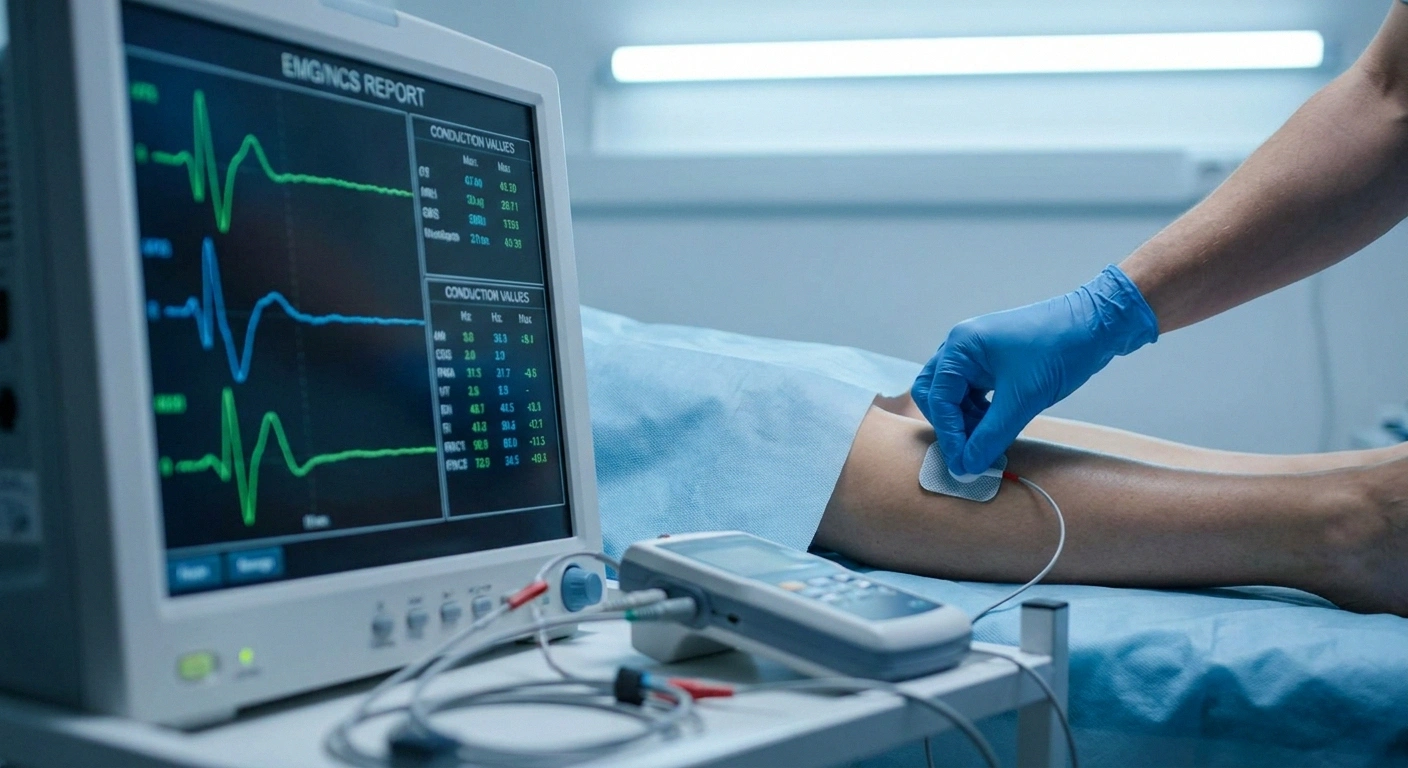
Nerve Conduction Studies and EMG
The gold standard objective test. Two parts to it.
- Nerve conduction studies (NCS) — small electric pulses are delivered to a nerve, and recordings are made farther down its course. Conduction speed (m/s) and amplitude (size of the response) are measured. Sensory and motor nerves are tested separately.
- Electromyography (EMG) — a thin needle electrode is inserted into selected muscles to record electrical activity at rest and with contraction. Detects denervation (motor nerve damage to the muscle) and other patterns.
The NCS results can show sensory-nerve involvement, motor-nerve involvement, or both. The pattern (axonal vs demyelinating, focal vs diffuse, length-dependent vs not) further refines the diagnosis. For more on what to expect, see EMG and nerve conduction study.
Skin Biopsy
A small punch biopsy from the lower leg can measure intraepidermal nerve fiber density — the small unmyelinated sensory fibers. Useful when standard NCS is normal but small-fiber sensory neuropathy is suspected.
Lab Workup
Once the type is established, blood tests look for the cause. The standard neuropathy lab panel includes blood sugar/HbA1c, B12, thyroid function, kidney function, and basic immune markers, with additional testing tailored to the pattern (autoimmune panel, paraprotein screening, genetic testing for hereditary neuropathies).
Why It Matters for Treatment
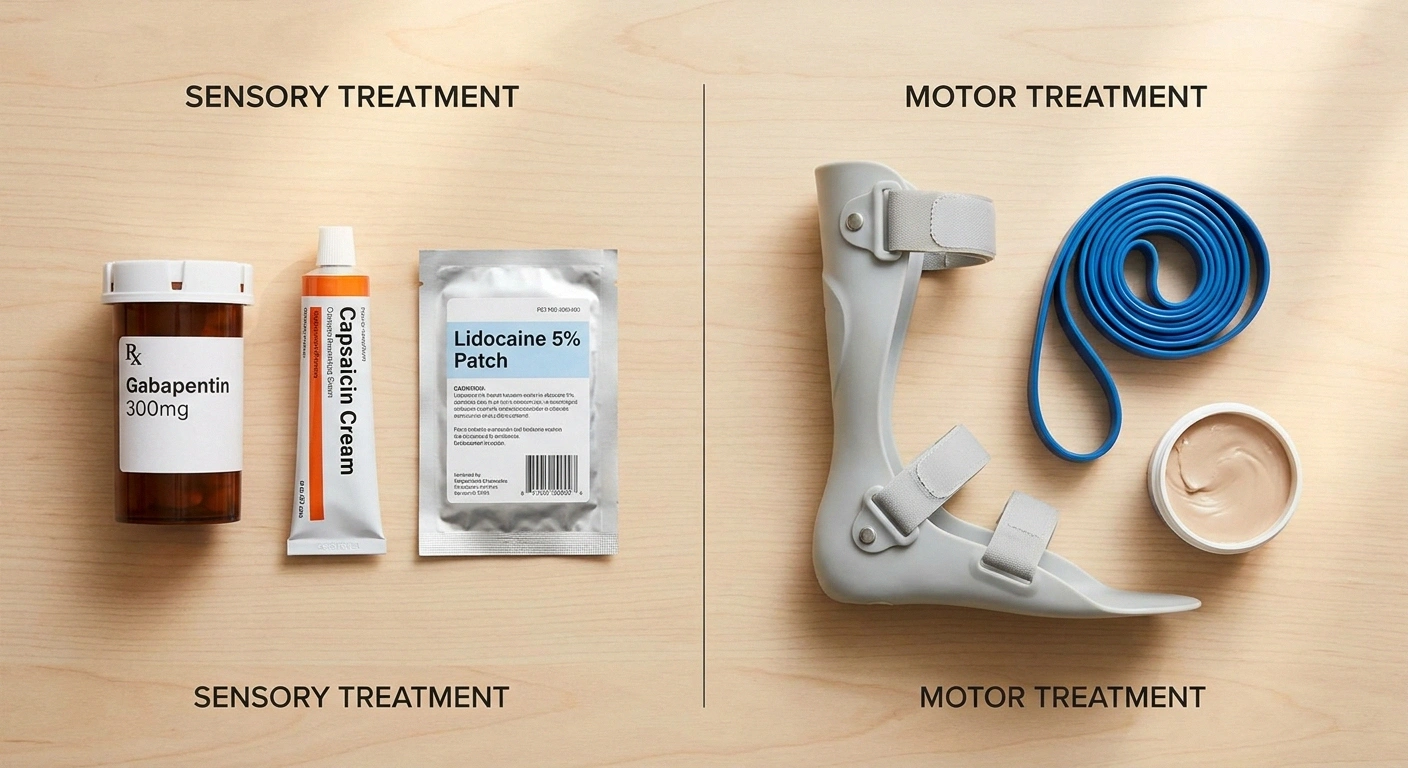
This is the practical payoff of distinguishing motor from sensory.
Treatment Direction by Type
- Gabapentin / pregabalin
- Duloxetine
- Amitriptyline / nortriptyline
- Lidocaine patches
- Capsaicin cream
- Treat the underlying cause
- Physical therapy + gait training
- AFO bracing for foot drop
- Occupational therapy
- IVIG for autoimmune motor (CIDP, MMN, GBS)
- Surgical decompression
- Adaptive tools for hand weakness
Pain medications don't treat weakness. Bracing doesn't treat burning. Knowing the type focuses the plan.
Sensory Neuropathy Treatment
For predominantly sensory neuropathy with painful symptoms, the standard approach is symptom control with neuropathic pain medications:
- Gabapentin — first-line for many patients
- Pregabalin (Lyrica) — similar mechanism, sometimes better tolerated
- Duloxetine (Cymbalta) — SNRI with strong evidence for nerve pain
- Amitriptyline or nortriptyline — tricyclics, especially for burning night pain
- Lidocaine patches — for localized burning
- Capsaicin cream — slow but useful long-term
Plus addressing the underlying cause — tight blood sugar control in diabetes, alcohol cessation in alcoholic neuropathy, B12 replacement in deficiency, etc.
Motor Neuropathy Treatment
The treatment for motor neuropathy depends heavily on cause, and looks quite different from sensory pain control:
- Immune-mediated motor neuropathies (CIDP, MMN, GBS) — IVIG, corticosteroids, plasma exchange, and other immune-modulating treatments. Many of these conditions are highly treatable when caught early.
- Compressive neuropathies (peroneal, ulnar, carpal tunnel) — sometimes surgical decompression is the right answer.
- Foot drop and gait problems — bracing (ankle-foot orthoses, AFOs), physical therapy, gait training.
- Hand weakness — occupational therapy, adaptive tools, strengthening exercises.
- Hereditary neuropathies (CMT) — supportive care, bracing, physical therapy, surgical correction of foot deformities when needed.
- Pain medications — less central than in sensory neuropathy, but used when there's mixed disease.
Notice: gabapentin and duloxetine, which are workhorses for sensory neuropathy, don't really treat motor weakness. They treat the pain that often accompanies it. The motor side of the equation needs different tools.
What the Pattern Tells You About Cause
The pattern of involvement gives clues about the underlying cause. A useful (though imperfect) shortcut:
- Distal symmetric sensory or sensorimotor (gradual, both feet, then both hands) — classic for diabetes, alcohol, B12 deficiency, idiopathic, chemo, HIV, hepatitis C, hypothyroidism.
- Asymmetric or patchy motor (one limb weaker than another, sudden onset) — vasculitic neuropathy, multifocal motor neuropathy, mononeuritis multiplex.
- Rapid-onset motor weakness (over days to weeks) — Guillain-Barré syndrome, severe vasculitis. This is an emergency; go to the ER.
- Pure small fiber sensory (burning, autonomic symptoms, normal strength) — small fiber neuropathy from many causes, including idiopathic.
- Predominantly motor with cramps and atrophy in young to middle-aged adult — Charcot-Marie-Tooth disease (hereditary).
The pattern doesn't replace the workup — it points the workup in the right direction.
What This Means for You
If you've been told you have neuropathy, ask your doctor specifically: is this primarily sensory, primarily motor, or sensorimotor? The answer should be in your nerve conduction report if you've had one. If it isn't clear, ask for it to be explained.
Predominantly motor symptoms — especially without sensory loss — deserve a prompt neurology evaluation. Several causes (CIDP, multifocal motor neuropathy, compression neuropathies) respond well to specific treatment when caught early.
Treat as an emergency: rapid-onset weakness over days, breathing difficulty, swallowing trouble, or weakness ascending up the legs. These can be Guillain-Barré syndrome — go to the ER.
From there, ask the second question: what does the pattern suggest about the cause? “Length-dependent sensorimotor polyneuropathy” and “asymmetric pure motor” point to very different lists of underlying conditions, and the diagnostic workup branches accordingly.
And the third question: based on the pattern, what's the treatment direction? Pain control, immunotherapy, bracing, surgery, addressing an underlying disease — the answer differs. Knowing the type points everyone — you, your neurologist, your pharmacist, your physical therapist — at the right toolset.
The good news is that for the most common types of neuropathy, there is genuinely useful treatment available, even when full reversal isn't possible. The bad news is that “neuropathy” alone isn't enough information to plan that treatment well. The motor-versus-sensory distinction is the first step toward more precision.
Frequently Asked Questions
What is the main difference between motor and sensory neuropathy?
Sensory neuropathy affects the nerves that carry sensation to your brain — touch, temperature, pain, position. Symptoms include numbness, tingling, burning, and balance problems. Motor neuropathy affects the nerves that carry movement instructions from your brain to your muscles. Symptoms include weakness, muscle cramping, foot drop, and difficulty with fine motor tasks. Most peripheral neuropathies involve both to some degree, but the primary type guides diagnosis and treatment.
Can you have both motor and sensory neuropathy at the same time?
Yes, and this is actually the most common pattern. It is called sensorimotor polyneuropathy. Diabetic neuropathy, alcoholic neuropathy, B12 deficiency neuropathy, and idiopathic neuropathy almost always involve both types of nerves, though sensory symptoms usually appear first. The mix is part of why “neuropathy” is such a broad term — different conditions hit the two types in different proportions.
Which is worse, motor or sensory neuropathy?
Neither is universally worse. Sensory neuropathy is often more painful and emotionally distressing in the short term because of burning, tingling, and disrupted sleep. Motor neuropathy tends to be more functionally limiting in the long term because of weakness, falls, and loss of independence. Severe forms of either can be debilitating. The right comparison is usually about what kind of damage limits your daily life most, not which type sounds scarier on paper.
How does the doctor know which type I have?
The bedside exam plus nerve conduction studies and EMG are the standard combination. Sensory testing with monofilament, tuning fork, and pinprick reveals sensory nerve function. Strength testing, reflex testing, and watching for atrophy reveal motor nerve function. The nerve conduction study tests the two types of nerves separately and gives an objective picture. A skin biopsy can confirm small fiber sensory damage when standard nerve conduction studies are normal.
Are the treatments different?
Yes, often dramatically so. Sensory neuropathy is usually managed with neuropathic pain medications like gabapentin, pregabalin, duloxetine, and amitriptyline, plus topicals and addressing the underlying cause. Motor neuropathy is often managed with physical therapy, bracing for weakness, and immune-modulating treatment for autoimmune motor neuropathies. Pain medications do not treat weakness, and bracing does not treat burning. Knowing the type focuses the treatment plan.
Why does sensory neuropathy usually start before motor symptoms?
This is a well-observed pattern but not entirely understood. The leading explanation is that the small unmyelinated sensory fibers, which carry pain and temperature, are particularly vulnerable to many of the metabolic and toxic stresses that damage nerves. They are often the first to show damage. Motor nerves tend to be larger, more myelinated, and more resilient, so they show effects later in the disease course. Some neuropathies, like multifocal motor neuropathy, break this rule and start with motor symptoms — those tend to have a different underlying mechanism.
Can pure motor neuropathy be reversed?
Some can be substantially improved or reversed when the underlying cause is treated. Multifocal motor neuropathy, CIDP, and Guillain-Barré syndrome often respond well to immune-modulating therapy if caught early. Compressive neuropathies improve with decompression. Hereditary motor neuropathies cannot be reversed but can be supported. Severe long-standing motor weakness with significant muscle atrophy is harder to fully reverse because the muscles themselves have changed, but function often improves with treatment of the nerve cause and dedicated rehabilitation.
Should I see a neurologist if I think I have motor symptoms?
Yes, especially if the weakness is new, asymmetric, or progressing. Motor symptoms without sensory symptoms are uncommon and the differential includes conditions where early treatment makes a big difference. Compression neuropathies, autoimmune motor neuropathies, and rapid-onset weakness all warrant prompt evaluation. Your primary care doctor can refer you. If the weakness is rapid (over days), severe, or affects breathing or swallowing, treat it as a medical emergency.
About the Author