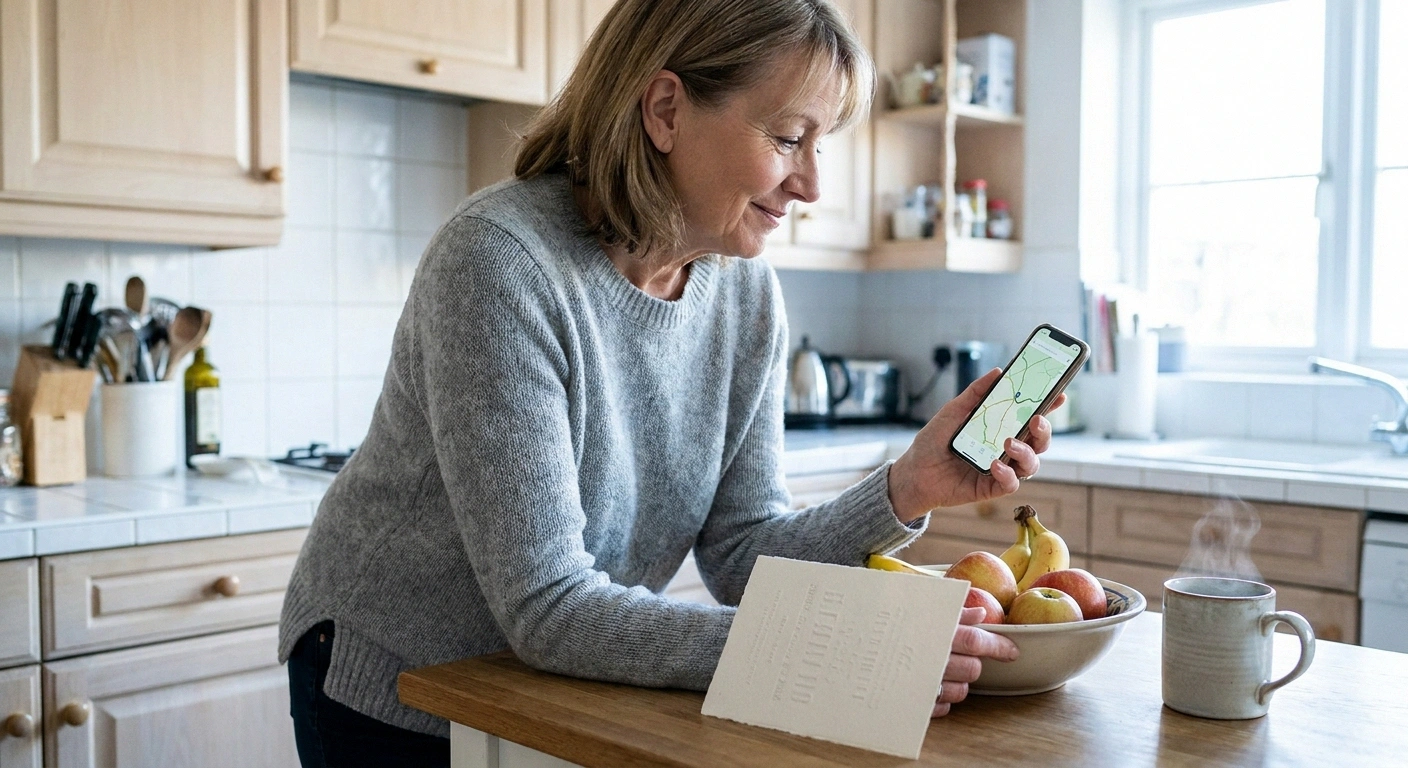
The invitation is on the counter, propped against the fruit bowl, and it is lovely. Your niece. Late September. An hour and a half away.
And somewhere in the second read-through the arithmetic starts. Outdoor ceremony means grass. Cocktail hour means standing. The reception card says dinner at seven, which means the gap between the ceremony and sitting down is anybody's guess. Shoes.
Every wedding article on the internet is written for the bride. She controls the schedule, she has a room to disappear into, and somebody is carrying her things. A guest has none of that. A guest is a passenger in someone else's day, on someone else's timetable, on ground they have not seen.
Which is the actual problem, and it is a solvable one. Almost everything that goes wrong at a wedding for someone with neuropathy is predictable a week ahead, and most of it can be arranged around without anyone noticing you arranged anything.
Start With the Invitation, Not the Shoes
Before thinking about what to wear, work out what the day physically demands. The invitation and the couple's wedding page usually tell you more than they appear to.
Ten minutes with a satellite view answers all four
Each answer changes one specific decision. None of them changes whether you go.
| What to check | Where it is | What it changes |
|---|---|---|
| Ceremony surface | Venue photo gallery | Grass rules out a narrow heel entirely and moves a cane from optional to worth bringing |
| One venue or two | Invitation and reception card | Two venues adds a second parking walk and a second stretch of standing while everyone regroups |
| Gap between ceremony and dinner | The two stated times, subtracted | Anything over ninety minutes means finding a seat is a plan rather than a hope |
| Parking distance and surface | Satellite view | A field decides how early you arrive, since the close spots go first and the walk back happens in the dark |
Where is the ceremony held. A church or a hotel usually means seating you can count on, though it is worth checking rather than assuming: older churches often have steps at the entrance, worn or uneven flagstone floors, no handrail on the way in, and pews with nothing to push up from. A garden, a vineyard, a barn or a beach means uneven ground outright, and uneven ground is the highest-risk part of the day when your feet cannot report back accurately about what they are standing on.
Is the ceremony in one place and the reception in another. A change of venue adds a car journey, a second parking walk, and a second stretch of standing while everyone gets sorted out.
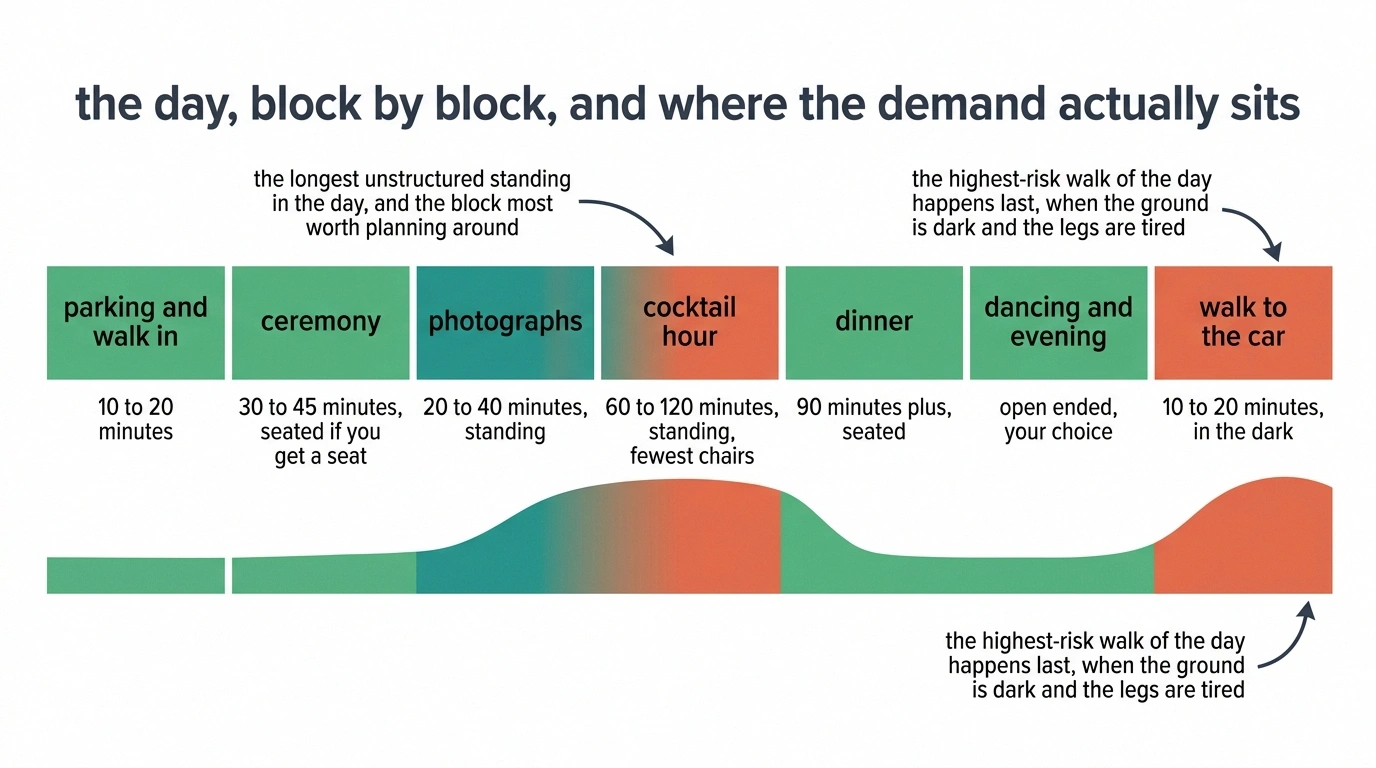
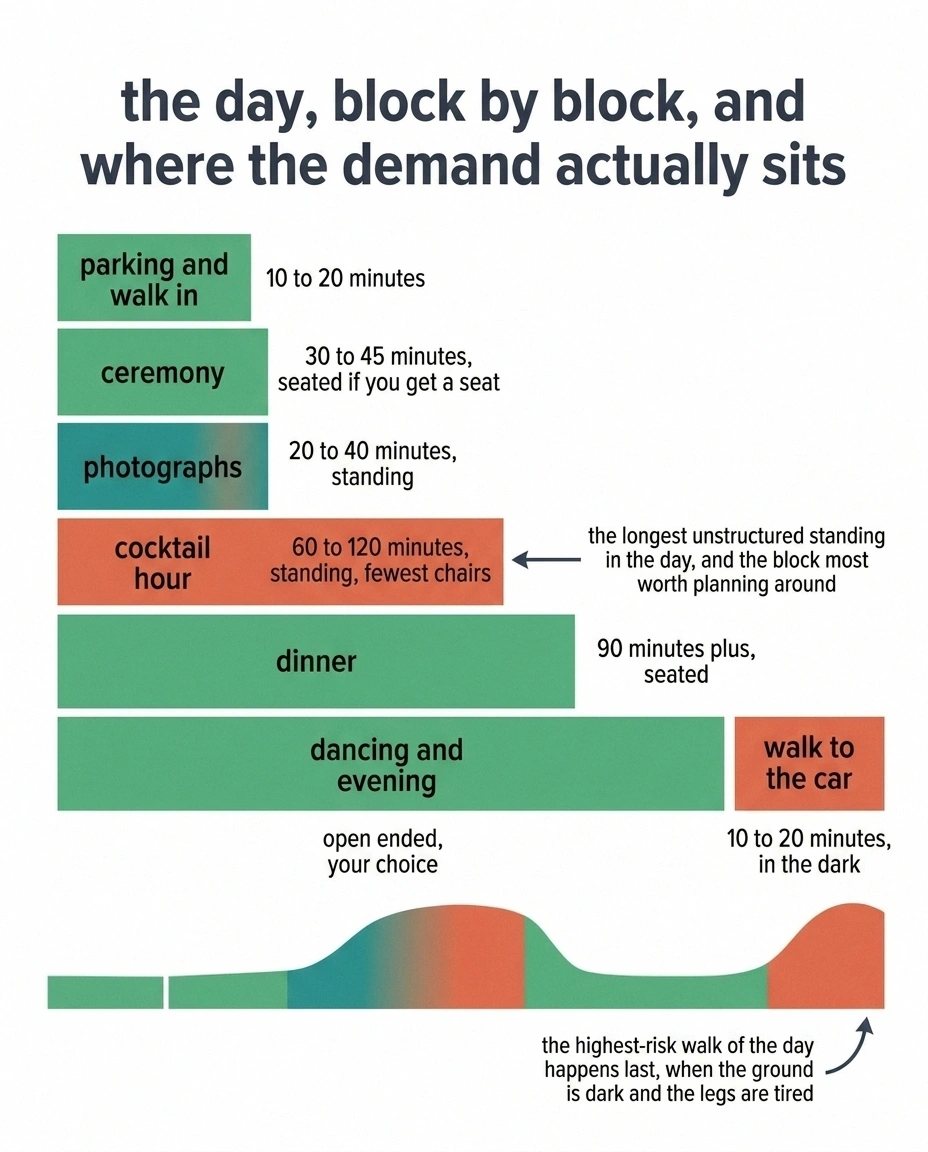
What is the gap. Ceremony at four, dinner at seven, is a three-hour middle. That middle is where guests stand, and it is the single most demanding block of the day.
How far is the parking. Rural venues park in fields. A grass field at the end of an evening, in the dark, is a very different walk from the one you did in daylight.
Ten minutes with the venue's website, satellite view, and a look at the photographs on their site answers all four. What you are building is not a worry list. It is the list of things you can quietly solve before you go.
The Questions Worth Asking Ahead
People hesitate here, because asking feels like making someone else's day about you. It is not. Couples want their guests to actually enjoy the day, and a quiet question three weeks out is infinitely easier for them than a problem on the day.
Keep it short, practical, and unfussy. A text works.
Something in the shape of “so excited for the day, quick practical one: is the ceremony seating chairs or standing, and is the ground grass or paved? Just working out shoes.” That reads as a guest being organised, not a guest being difficult.
If seating is limited or the ceremony is standing, asking to be seated near an aisle or at the end of a row is a small request that gets granted almost every time. Same for a reception table near the door rather than across the room.
If there is a wedding coordinator or a venue manager, they are often the better person to ask on the day itself, and they are genuinely used to this. Chairs appear from nowhere when a coordinator is involved.
One thing worth doing quietly: tell one person you are with what your plan is. Not as a warning, just so somebody knows you might sit out the cocktail hour and that this is fine rather than a sign something is wrong.
Choosing Shoes You Can Actually Stand In
Formal footwear and neuropathy are a genuine conflict, and the resolution is a compromise rather than a perfect answer.
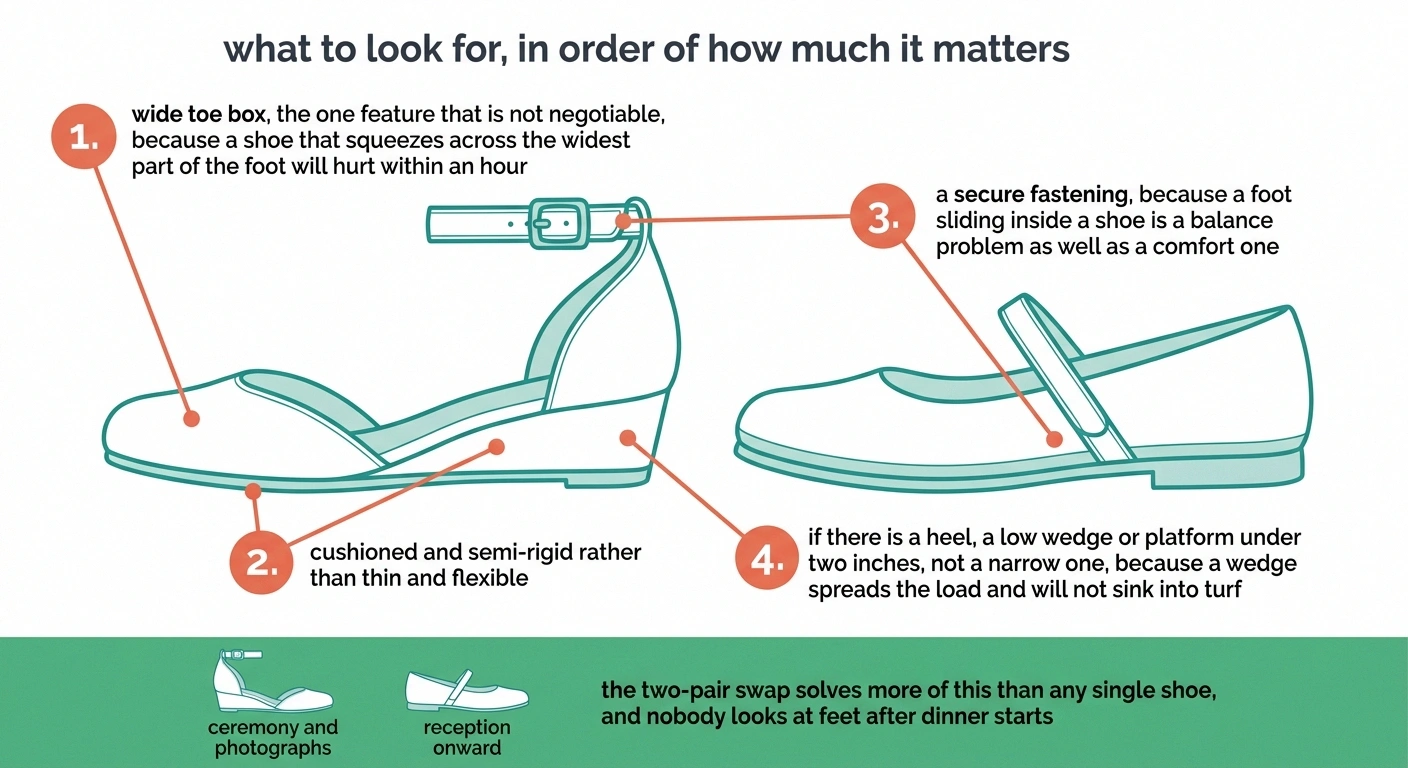
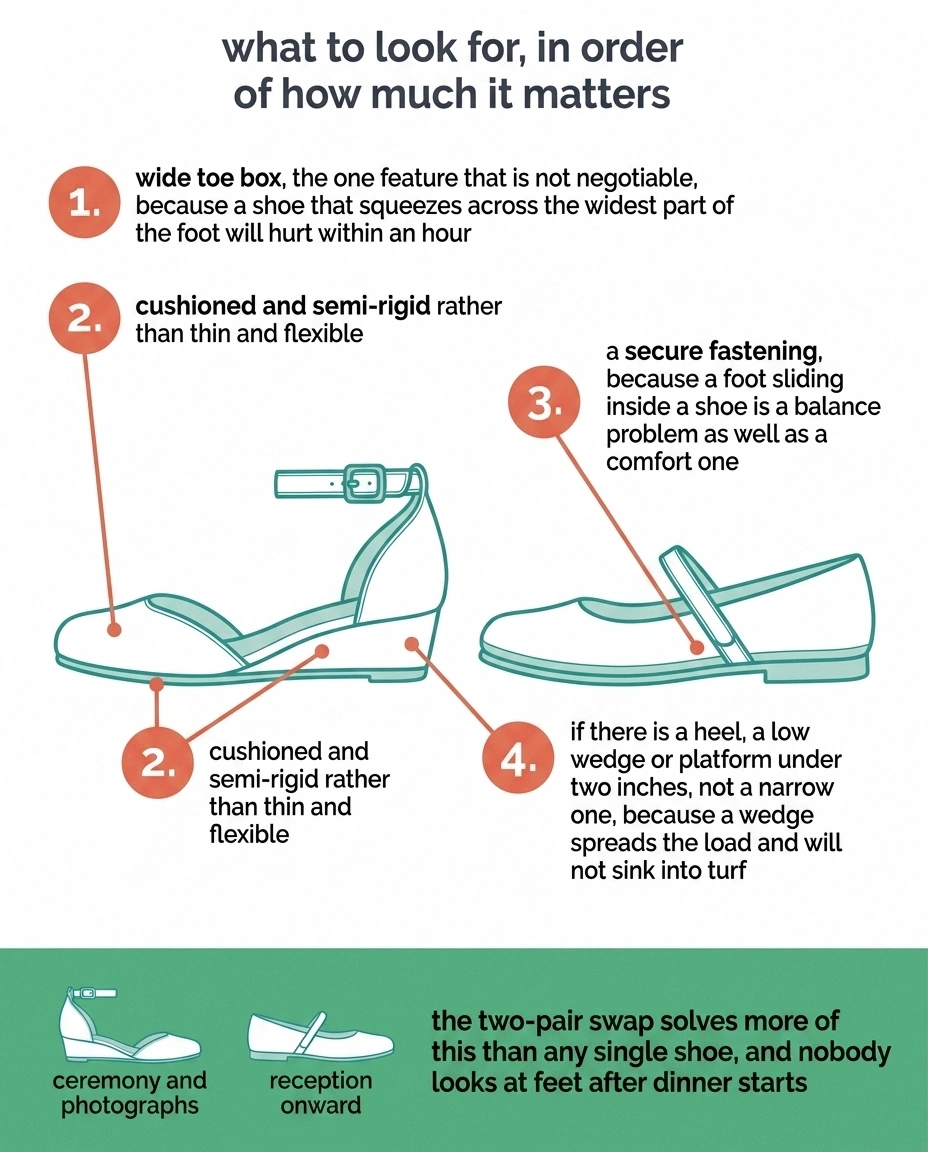
The single most important feature is a wide toe box. A shoe that squeezes across the widest part of the foot will hurt within an hour regardless of how well cushioned it is elsewhere. Everything else is negotiable; this is not.
After that, in order: a cushioned, semi-rigid sole rather than a thin flexible one; a secure fastening, because a shoe your foot slides around inside is a balance problem as well as a comfort one; and if a heel is happening at all, a low-profile wedge or platform with a substantial ankle strap rather than a narrow heel. A wedge spreads the load and gives a far more stable base. Keep the height under two inches if you will be on your feet for hours.
Two practical rules that matter more than the specification list. Try shoes on late in the evening, when your feet are at their largest, so the fit you test is the worst-case fit. And break them in properly, which means wearing and walking in them at home for at least a week beforehand rather than an hour the night before.
The strategy that solves more of this than any single shoe is two pairs. Wear the dressier pair for the ceremony and photographs, then switch to something cushioned and lower for the reception. Nobody looks at anybody's feet after the meal starts. If your dress shoes have removable footbeds and any spare volume, your own insoles will often rescue a pair that would otherwise be unwearable.
Our fuller guide to choosing shoes when you have neuropathy covers what to look for in more detail, and if you use an ankle-foot orthosis, the dress-shoe options that accommodate a brace are worth sorting out well before the week of the wedding.
What Goes in the Bag
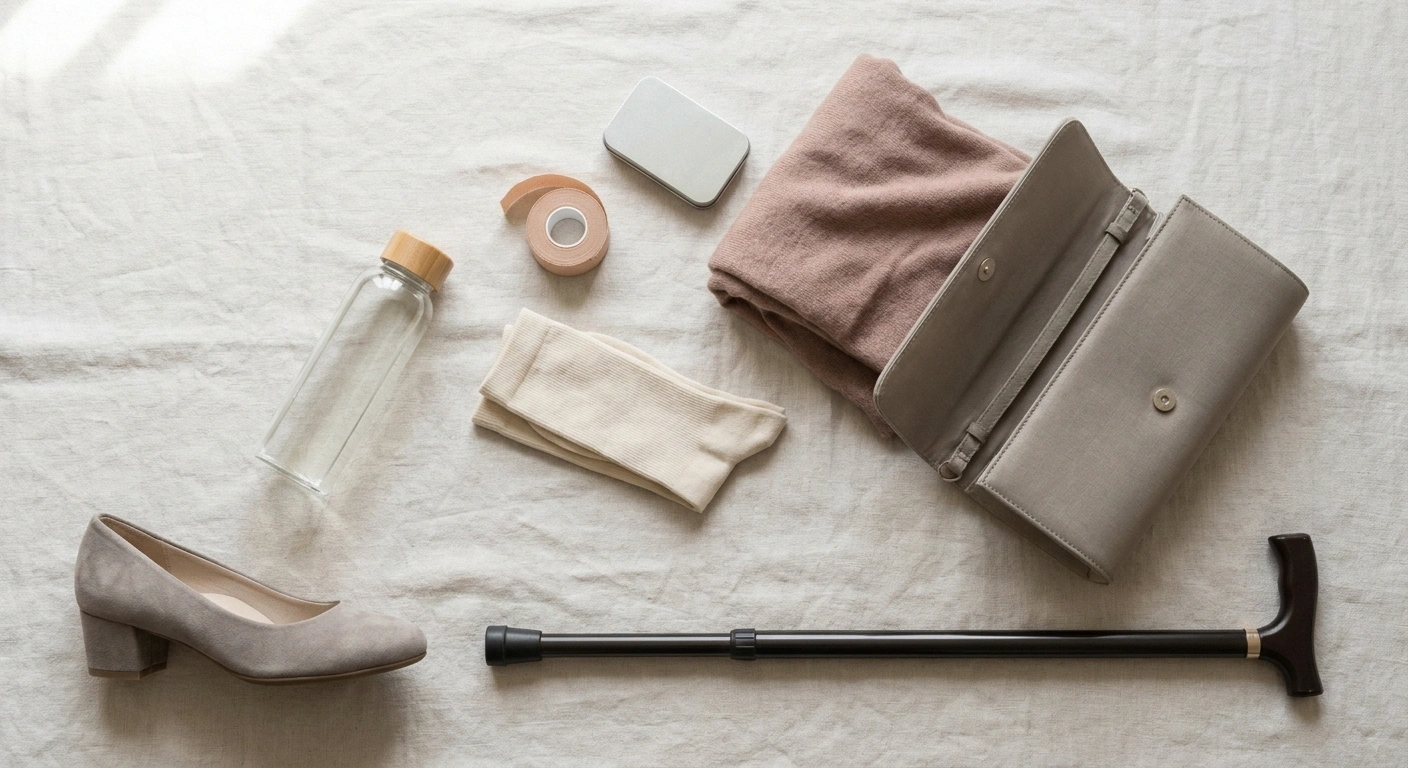
A wedding is one of the few events where a small bag is socially expected, so this costs you nothing in appearance.
Small enough for the bag
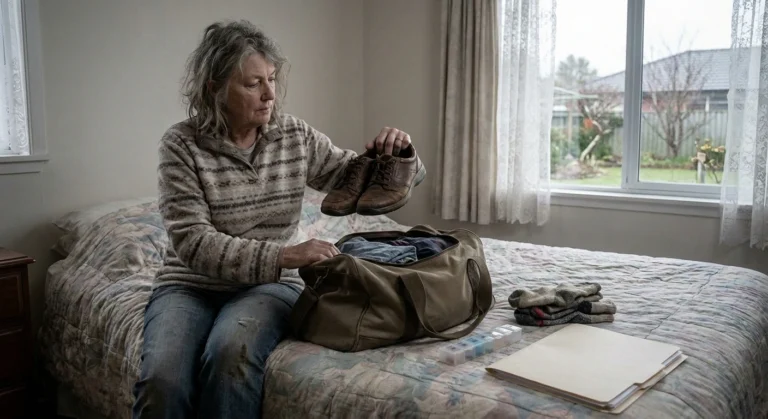
- Medication on its normal timing, not pushed back for a late dinner
- Blister plasters and a short roll of narrow tape
- A folded wrap, because outdoor evenings turn and cold makes symptoms louder
- A folding cane, which lives under a chair without announcing itself
Better left in the car
- The second pair of shoes, which you will collect at some point anyway
- A spare pair of socks, worth more than people expect after hours in dress shoes
- A bottle of water for the drive home, when you will have forgotten to drink any
- A flat cushion, which turns a hard chair or a long drive into a manageable one
The second pair of shoes goes in the car rather than the bag. Everything else is small.
Any medication you might need on schedule, taken on your normal timing rather than pushed back because dinner is late. A wedding day wrecks routines, and a dose missed by four hours is felt at exactly the wrong moment.
Blister plasters and a small roll of tape, which handle the shoe problem you did not predict.
A folded pashmina or wrap. Outdoor evening receptions get cold, and cold makes almost every neuropathy symptom louder.
Water, or a plan for water. Standing for hours in warm weather with a drink in your hand that is not water is how people end up lightheaded on grass.
Compression socks, if they are already part of your routine, worn from the start rather than as a rescue. They do far more for a long day of standing when they go on before the swelling than after. They are not a universal accessory, though. Compression is not appropriate for everyone, particularly with reduced arterial circulation in the legs, and the right pressure grade is something to be fitted for rather than guessed at. A wedding is a poor occasion to try a pair for the first time.
If you use a cane and normally leave it behind for social occasions, a wedding on grass, in the dark, after a drink, is the occasion to bring it. Our page on using a cane with neuropathy covers the practicalities, and a folding one lives under a chair without announcing itself.
Ceremony and Cocktail Hour
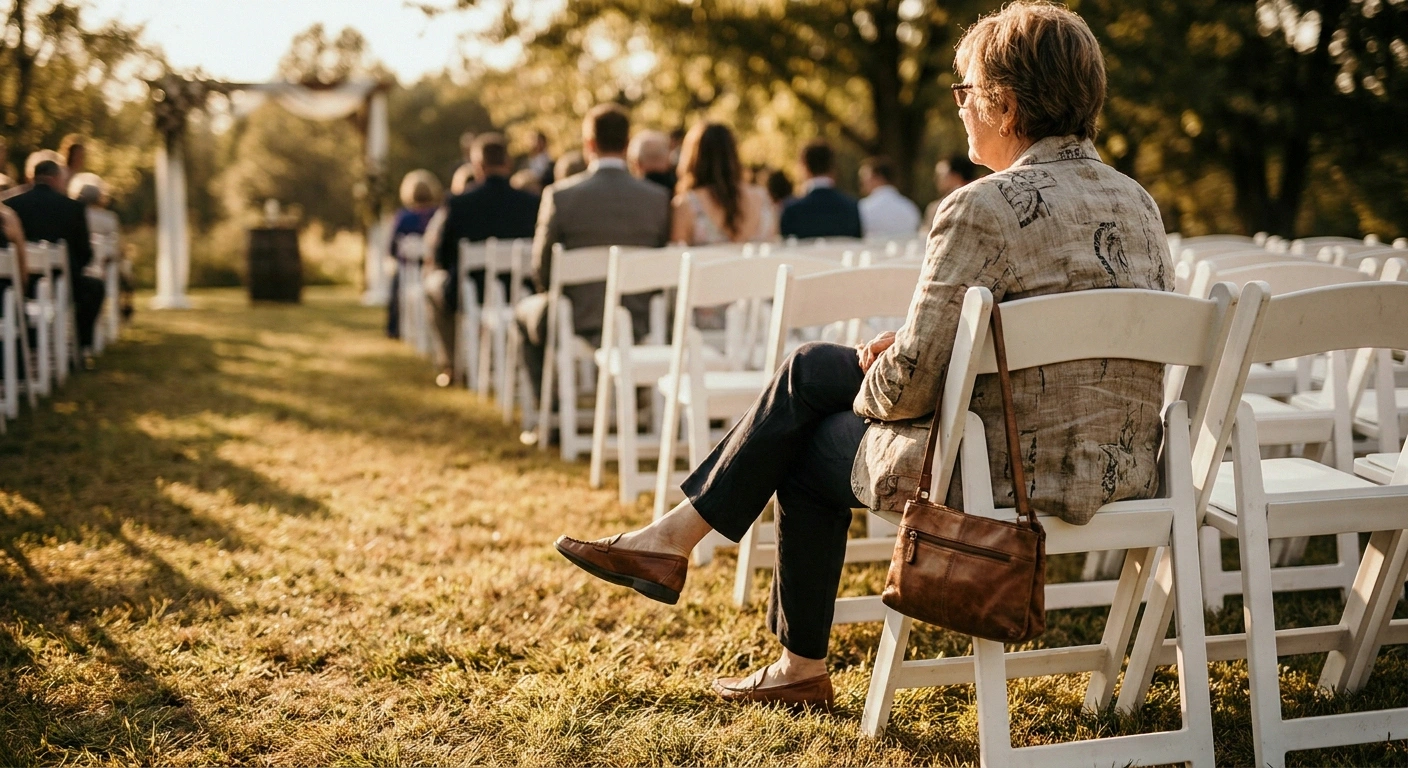
Arrive early rather than on time. Early means parking close, walking unhurried, and choosing where you sit. On time means the far end of the field and the middle of a row.
Four places to sit when the chairs have run out
Cocktail hour reliably has fewer seats than guests. These are the ones that are always there and rarely taken, because everyone else is busy standing.
- A reception table that is already set. Sitting at your own dinner table an hour early is not against any rule, and it puts you exactly where you want to be when the meal is called.
- A low garden wall or the edge of a raised bed. Check the height first, because getting back up from something very low is harder than staying standing was.
- The chairs left over from the ceremony. They are usually still out, usually empty, and usually within sight of everything.
- The bar end, if it has stools. A stool is a seat with a good excuse attached, and people come to you there without being asked.
Take the aisle seat or the end of the row. It gives you room to stretch a leg out, and it means standing and sitting without climbing past anyone.
On grass, walk on the flattest line rather than the shortest one, and take the arm that gets offered. Heels sink into turf, which is another argument for the wedge. Our guide to balance and fall prevention covers why uneven ground is disproportionately hard when sensation is reduced, and it applies to a lawn far more than people expect.
Cocktail hour is the part that hurts. It is the longest stretch of unstructured standing in the day, there are usually fewer chairs than guests, and the social convention is to stay on your feet and circulate.
Do not. Find a chair, a low wall, a bench, or the edge of something, and hold court from there. People come to you. A seated person with a drink who is talking to someone looks entirely normal; the standing is the part nobody actually notices.
If the receiving line is long, join the back of it rather than the front, or catch the couple later. Standing in a slow-moving queue is the specific thing that empties the tank. The same pacing logic runs through our piece on standing through concerts, weddings and funerals.
The Reception, and the Dancing Question
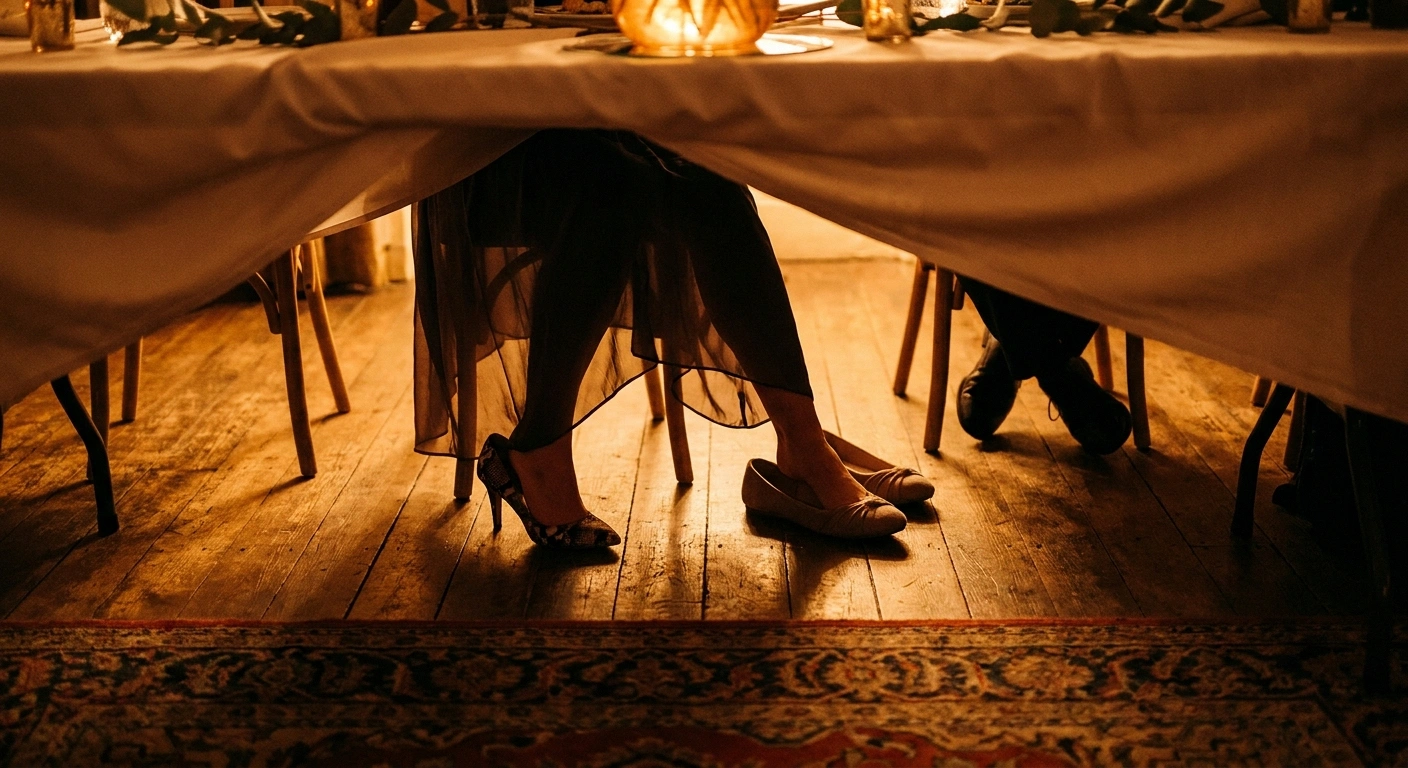
Dinner is the easy part, and it is worth using. An hour or more seated is the best recovery window the day offers. Take your shoes off under the table if that helps, and change into the second pair while everyone is seated rather than during a lull when people are watching.
On dancing, the honest answer is not “don't.”
Dance the ones that matter. The first dance you are invited into, the one your grandchild drags you up for, the song you would regret sitting out. Two or three songs, spaced, with a sit-down between each, is a completely different physical proposition from an hour on a dance floor.
Three things make it work. Do it in the cushioned shoes rather than the dress ones. Stay toward the edge of the floor where the ground is less crowded and you can leave without crossing traffic. And treat a slow song as a rest rather than a reason to stay up for the fast one after it.
If the floor is outdoors, look at it in daylight before you commit to it in the dark. Marquee flooring laid on grass has seams and soft spots that are invisible at eleven at night.
Leaving Well
Decide your leaving time before you arrive, and tell one person. Not a hard rule, just a default that stops the decision from being made at midnight by a tired brain that has stopped negotiating well.
The end of a wedding is when the highest-risk walk happens: dark, uneven ground, tired legs, and a car park that has quietly filled in. Leaving before that becomes true rather than after is worth more than the last hour of the party.
Leave without the round of goodbyes if the goodbyes will cost you twenty minutes on your feet. Say the real ones early, in the good part of the evening, when you can actually enjoy them.
If the venue is far, a hotel near the reception is not an indulgence. It removes a long drive at the end of a demanding day and lets you leave when you want to rather than when the driver does. Our hotel stay guide covers the room questions worth asking when you book.
The Day After
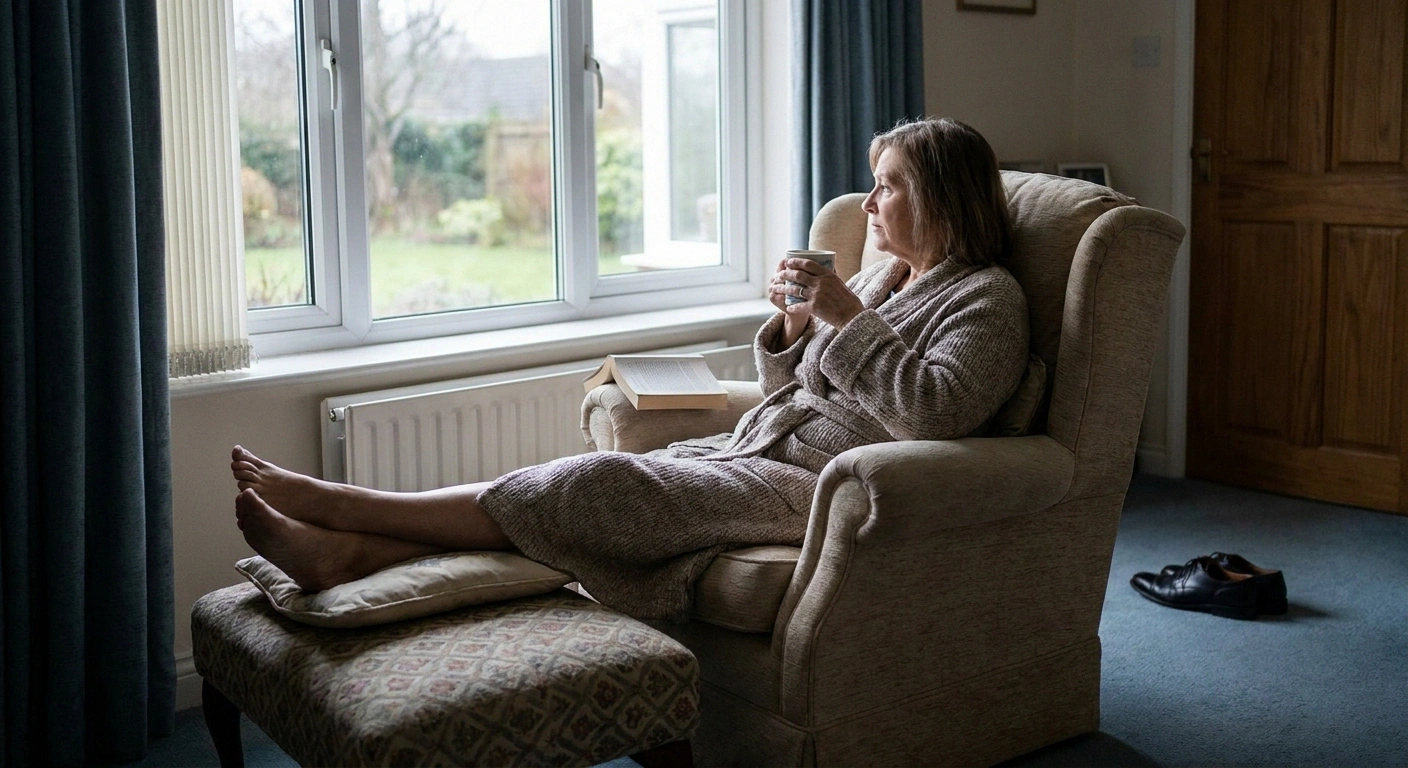
Plan for it, because it is real. A long day of standing usually produces a flare that lands the following morning, and the difference between a bad day and a bad three days is mostly what you do with the twenty-four hours afterward.
The recovery, scheduled like the wedding was
Starting before symptoms peak is what shortens a flare. Waiting to see whether one develops is what lengthens it.
- That night, before bed. Shoes and socks off, feet checked properly under a good light for blisters and pressure spots. Reduced sensation means one can already be there without being felt.
- The first two hours of the morning. Feet up and elevated above hip level, not just propped. This is the window that does the most work and the one most often skipped.
- Midday. Whatever your usual flare routine is, started now rather than held in reserve. Nothing scheduled that has to be driven to.
- The following day. Back to normal movement rather than a second day of rest, because stiffness sets in fast and a short easy walk usually beats another day in the chair.
Keep the next day genuinely empty. No errands scheduled, no visitors, nothing that has to be driven to. Feet up and elevated for the first part of it. Whatever your usual approach to a flare is, many people find it works better started early than held back until symptoms peak. That means the rest, the elevation, the heat or cold you normally use, and the pacing. It does not mean taking extra medication or changing a dose off your own bat, which is a conversation to have with whoever prescribes it, ideally before the wedding rather than the morning after. Our page on managing a flare covers the general approach. The principle in its simplest form is that the recovery is part of the event rather than an accident that happened after it, and it belongs in the calendar alongside the wedding itself.
Check your feet properly that night or the next morning, especially if you were in shoes you do not usually wear. Blisters and pressure spots are much easier to catch on day one than day three, and reduced sensation means you may not feel one that is already there.
None of this is about whether to go. Go. It is about arranging the day so that what you remember is your niece coming down the aisle rather than the ninety minutes you spent standing on a lawn wondering when dinner was.
Frequently Asked Questions
What shoes should I wear to a wedding if I have neuropathy?
Prioritise a wide toe box above everything else, then a cushioned semi-rigid sole and a secure fastening. If a heel is required, choose a low-profile wedge or platform with a substantial ankle strap rather than a narrow heel, and keep the height under two inches. Try shoes on late in the evening when your feet are largest, and break them in at home for at least a week beforehand.
How do I get through a whole wedding day with foot pain?
Break the day into its blocks and plan each one. Arrive early to park close and choose your seat, take an aisle or end-of-row position, sit through the cocktail hour rather than circulating, use the seated dinner as a genuine recovery window, and switch to a second cushioned pair of shoes for the reception. The unstructured standing between the ceremony and dinner is the hardest part of the day, and it is the block most worth planning around.
Is it rude to ask for a chair at someone else's wedding?
No, and asking ahead is easier for everyone than asking on the day. A short practical message three weeks out about whether the ceremony seating is chairs or standing, and whether the ground is grass or paved, reads as a guest being organised. Requests for an aisle seat or a reception table near the door are small and almost always accommodated. On the day itself, the wedding coordinator or venue manager is usually the fastest person to ask.
Can I dance at a wedding with neuropathy?
For most people, yes, in a rationed way. Two or three songs spaced through the evening with a proper sit-down between each is very different from an hour on the floor. Dance in the cushioned shoes rather than the dress pair, stay toward the edge of the floor where you can leave without crossing traffic, and treat a slow song as a rest rather than a warm-up. If the dance floor is outdoors, look at the surface in daylight before committing to it after dark.
What should I bring to a wedding if I have neuropathy?
A second pair of cushioned shoes left in the car, any medication on its normal schedule rather than pushed back for a late dinner, blister plasters and tape, a wrap for an outdoor evening, and a plan for drinking water through the standing hours. If compression socks are already part of your routine, wear them from the start rather than as a rescue; compression is not appropriate for everyone and a wedding is a poor occasion to try a first pair. If you use a cane and usually leave it behind socially, a wedding on grass in the dark is the occasion to bring it.
How do I handle an outdoor wedding on grass?
Uneven ground is the highest-risk element of the day when sensation in your feet is reduced, so treat it deliberately. Choose a wedge over a narrow heel, since heels sink into turf. Walk the flattest line rather than the shortest, and take an offered arm. Look at the ground in daylight so you know what you are crossing after dark, and note where the car is parked relative to the exit before the field fills up.
Should I stay in a hotel near the venue?
If the venue is more than a short drive away, it is usually worth it. It removes a long journey at the end of a physically demanding day and lets you leave the reception when you want to rather than when your driver is ready. It also means the walk from the car happens once, in daylight, rather than twice with the second one in the dark.
Why do I feel so much worse the day after a wedding?
A long day of standing, walking on uneven ground and wearing unfamiliar shoes commonly produces a flare that arrives the following morning rather than during the event itself. Planning an empty day afterward, elevating your feet early, and beginning your usual non-medication flare measures before symptoms peak rather than after is what many people find helps most, though how much it shortens things varies a great deal between individuals. Any change to medication is a question for your prescriber rather than something to improvise the morning after. Check your feet that night or the next morning for blisters and pressure spots, since reduced sensation means one can already be there without being felt.
About the Author