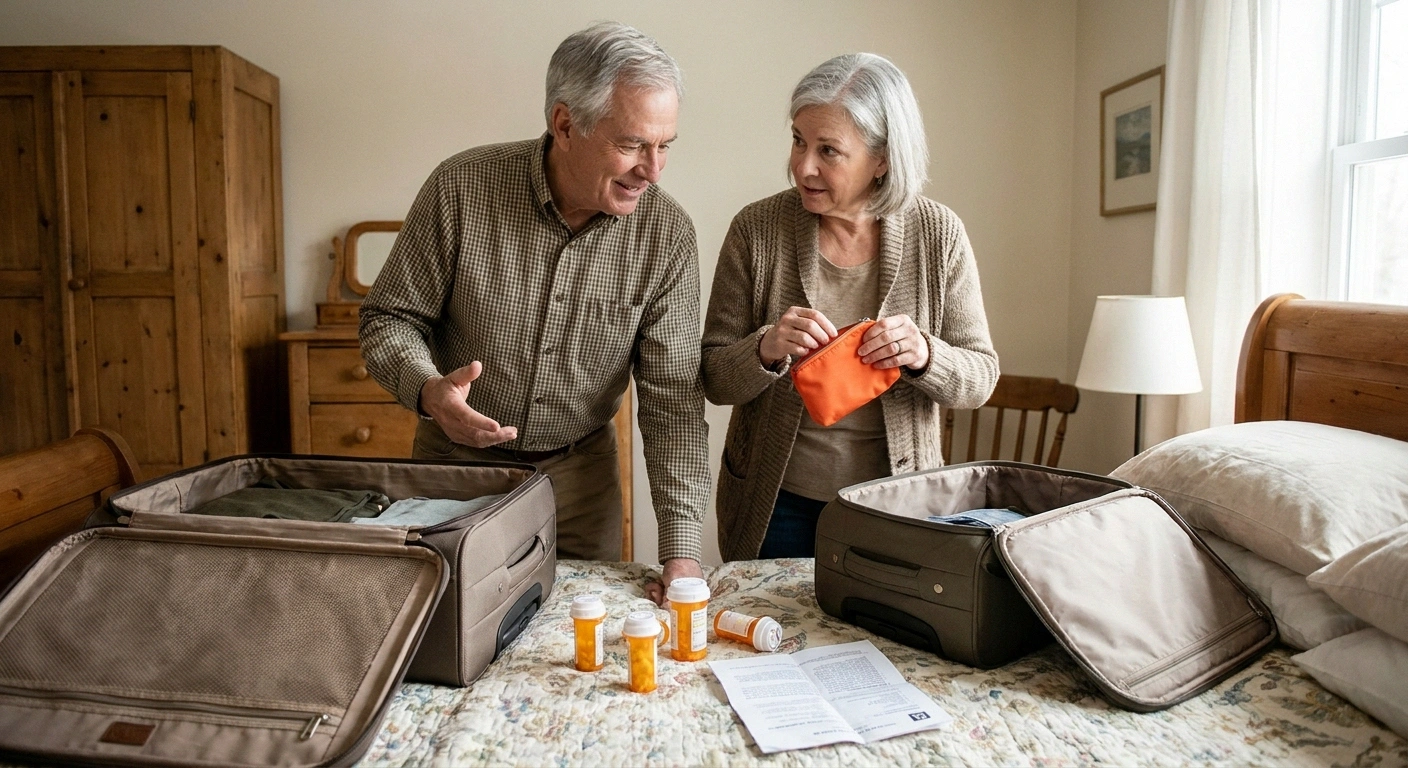
It's day three of a week in Arizona, and the little zippered pouch with your evening gabapentin is in a suitcase that's currently in Denver. The airline says tomorrow, probably. Your pharmacy is 2,000 miles away and closed. You've got two capsules in your handbag because you happened to throw them in on the morning of the flight.
Almost everything written about flying with medication answers a different question than this one. It tells you what TSA allows through the checkpoint, which is genuinely useful for about four minutes of your trip, and then stops. What it doesn't tell you is how to handle a five-hour time change when you take something every eight hours, or what to do when the supply and the person are in different states.
The screening rules are the easy part, and I'll cover them quickly. The rest of this is about the parts that actually go wrong.
The Screening Rules, in About Sixty Seconds
These are straightforward, and knowing them removes a surprising amount of pre-trip anxiety:
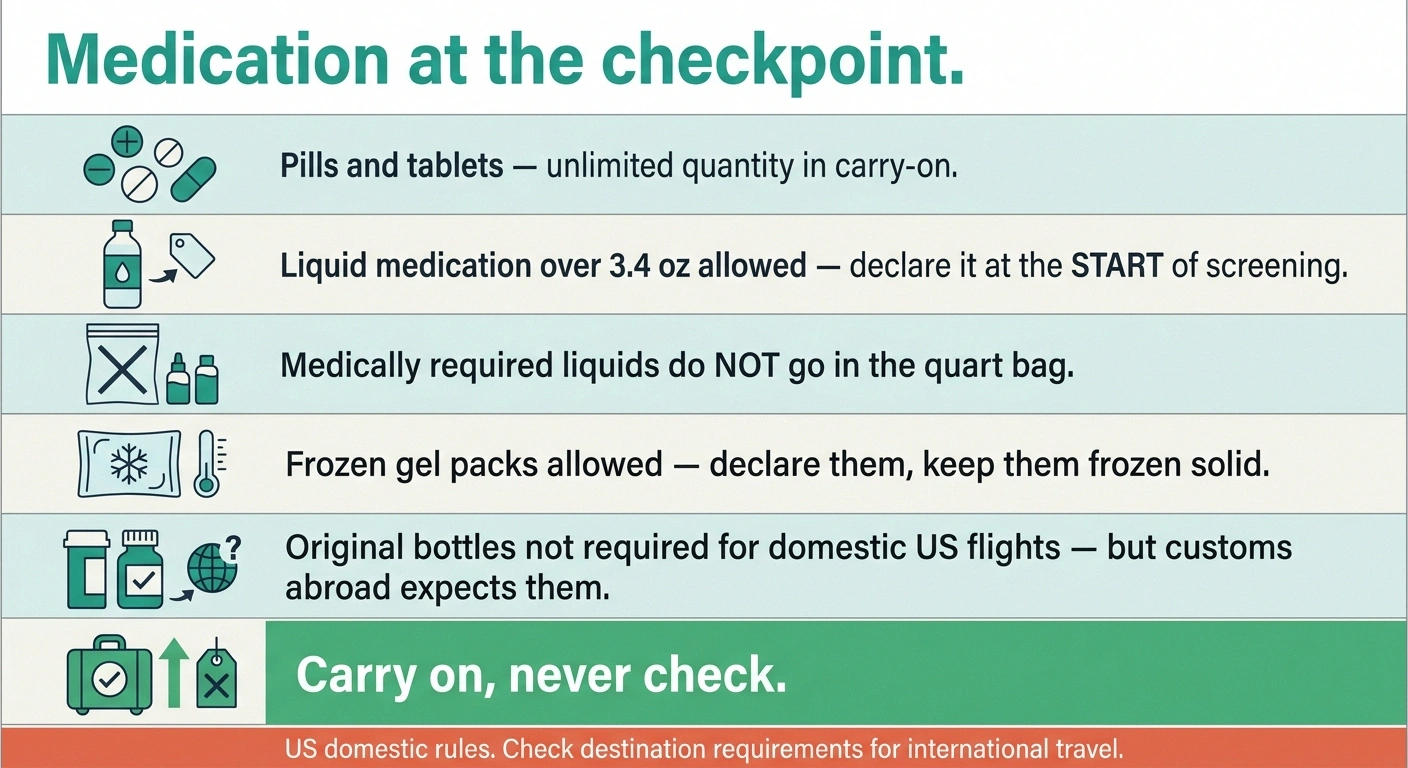
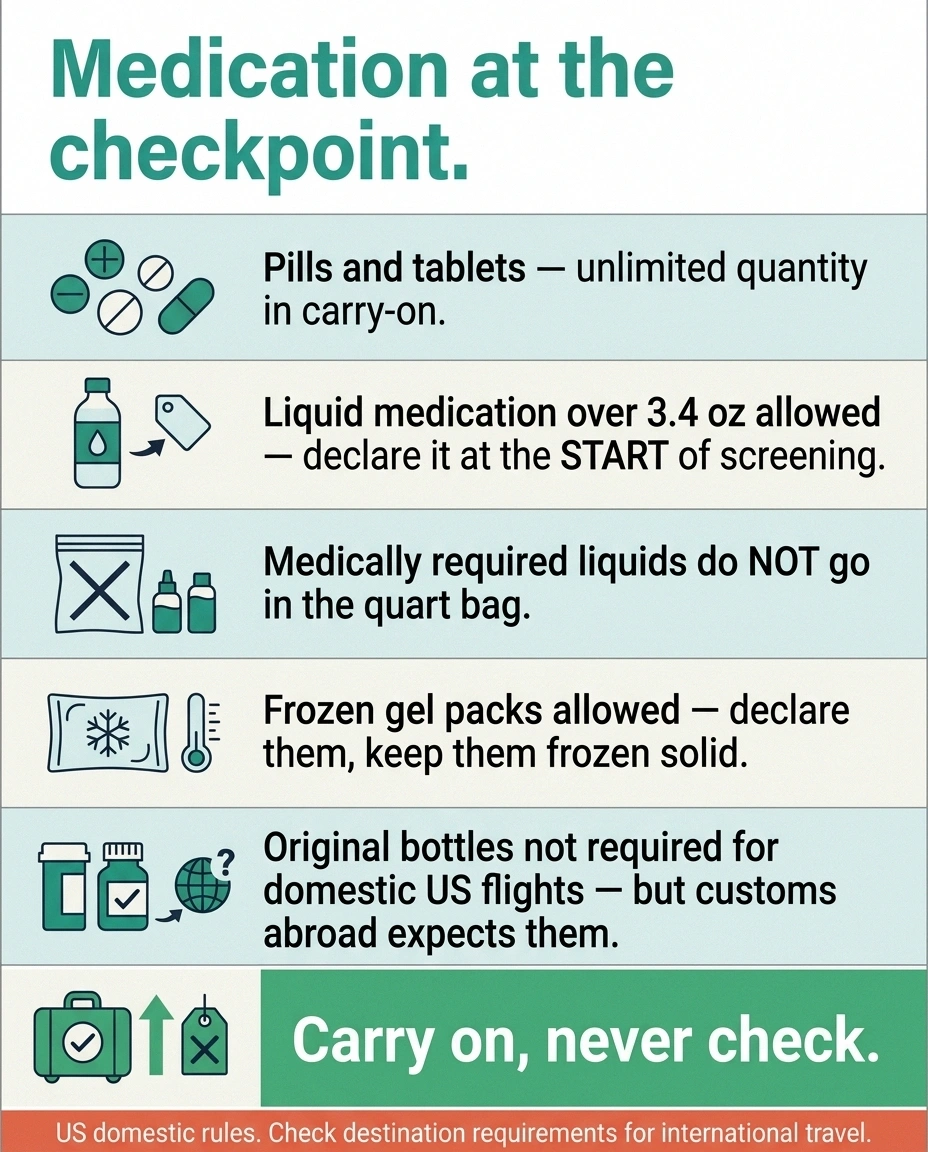
- Pills and tablets: unlimited quantity in carry-on. There's no liquid-style limit on solid medication. Bring as much as you need, and it goes through screening like anything else.
- Liquid medication over 3.4 ounces is allowed in reasonable quantities. Tell the officer you have medically necessary liquids at the start of screening, not after your bag is already on the belt.
- Medically required liquids don't go in the quart-sized bag. Keep them separate.
- Ice packs and frozen gel packs are permitted for medication that needs cooling, but declare them. Medically necessary cooling accessories are allowed even partially melted, though a slushy pack invites additional screening and, occasionally, a refusal, so arriving with it frozen solid saves trouble.
- You don't have to use original bottles for domestic flights. A pill organizer is fine as far as TSA is concerned. Note that this is a TSA position, not a universal one — state rules and foreign customs can differ.
- Carry-on, always. TSA permits medication in checked bags and strongly recommends against it, which is the same advice from the other direction.
That last point isn't a formality. It's the whole Arizona scenario above, and it's the single most common way this goes badly.
Split Your Supply, Every Trip
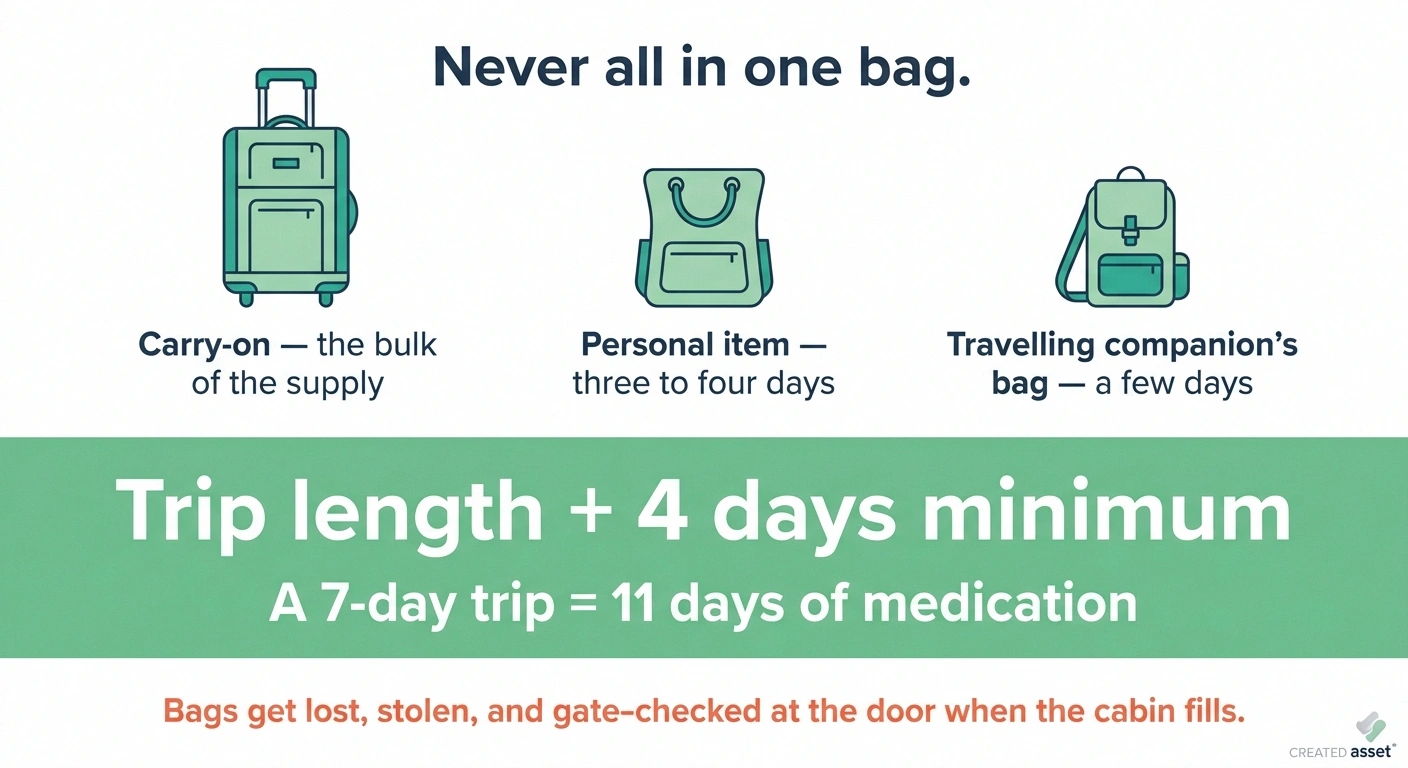
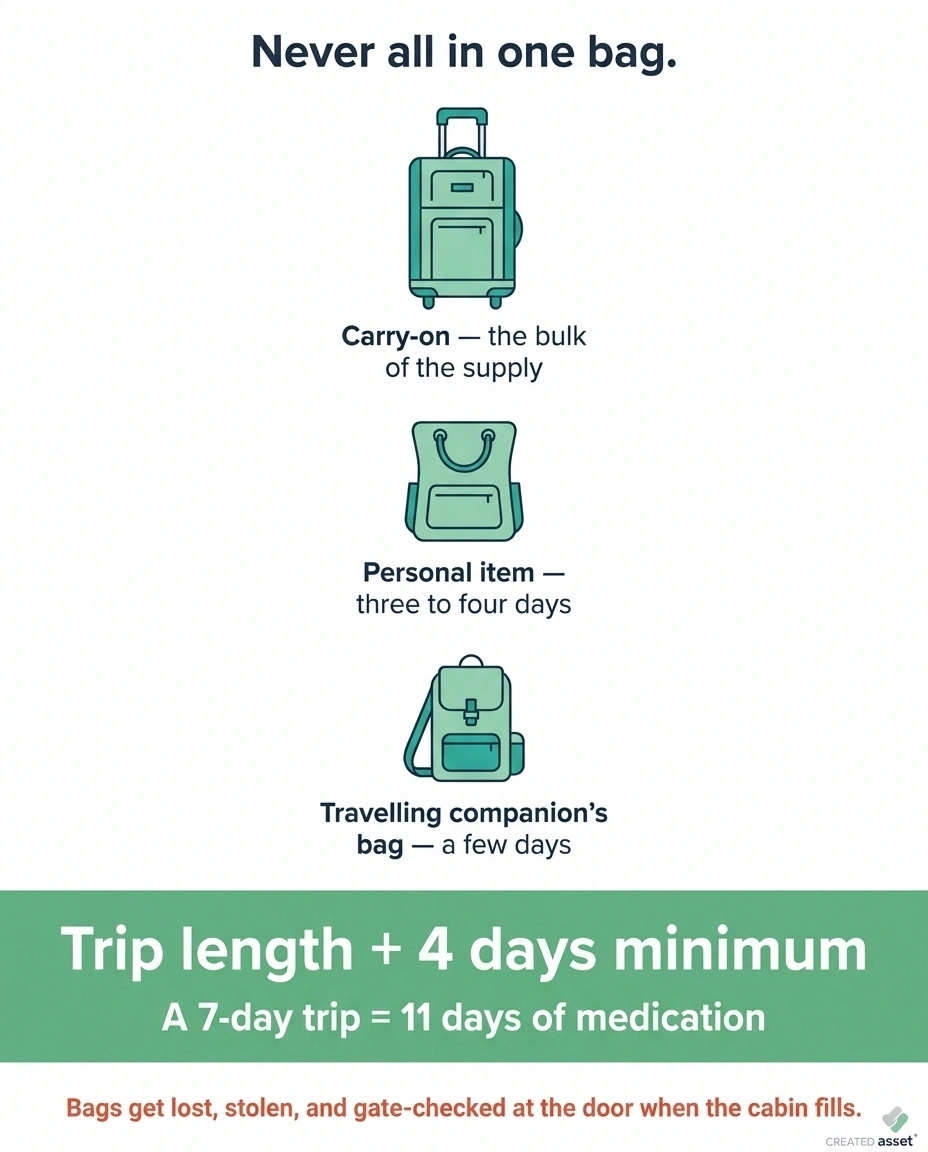
The rule is simple: your medication should never all be in one bag.
| Trip length | Days to pack | Doses in your personal item |
|---|---|---|
| Long weekend (3 days) | 7 | 2 days' worth |
| One week | 11 | 3 days' worth |
| Two weeks | 18 | 4 days' worth |
| One month | 34 | 5 days' worth |
Split it three ways if you can. The bulk of the supply in your carry-on. A few days' worth in a personal item — handbag, backpack, whatever stays on your shoulder. And if you're travelling with someone, a third portion in their bag. Bags get lost, stolen, left in overhead bins and gate-checked at the last minute when the cabin fills up. That last one catches people constantly: you boarded with a carry-on and the flight attendant took it at the door.
How much to bring: your trip length plus at least four extra days. A week away means eleven days of medication. Weather cancellations, a missed connection, an illness that extends the stay — four days of buffer covers almost all of it, and unused pills cost you nothing but space.
If you're on a controlled substance and can't get an early refill for the full amount, that's a specific conversation worth having with your prescriber well before you book. Many will accommodate a documented travel vacation override, but not on two days' notice.
Why the Backup Plan Matters More for This Regimen
Here's the thing that generic travel advice misses entirely.
No prescribed medication is one you want to skip. But missing a few days of gabapentin, pregabalin or duloxetine carries an immediate problem that many other medications don't. These medications are not meant to be stopped abruptly, and doing so can produce genuine withdrawal effects on top of the return of the nerve pain you were treating. Anxiety, sweating, nausea, insomnia, and in the case of the gabapentinoids, more serious effects at higher doses.
So the backup plan isn't about avoiding discomfort on holiday. It's about not being forced into an abrupt stop, hundreds of miles from your prescriber, in an unfamiliar place. That's the reason for the redundancy in this article. Our guide to neuropathy medications covers what each of these drugs does and why they're tapered rather than stopped.
Time Zones and the Dose Clock
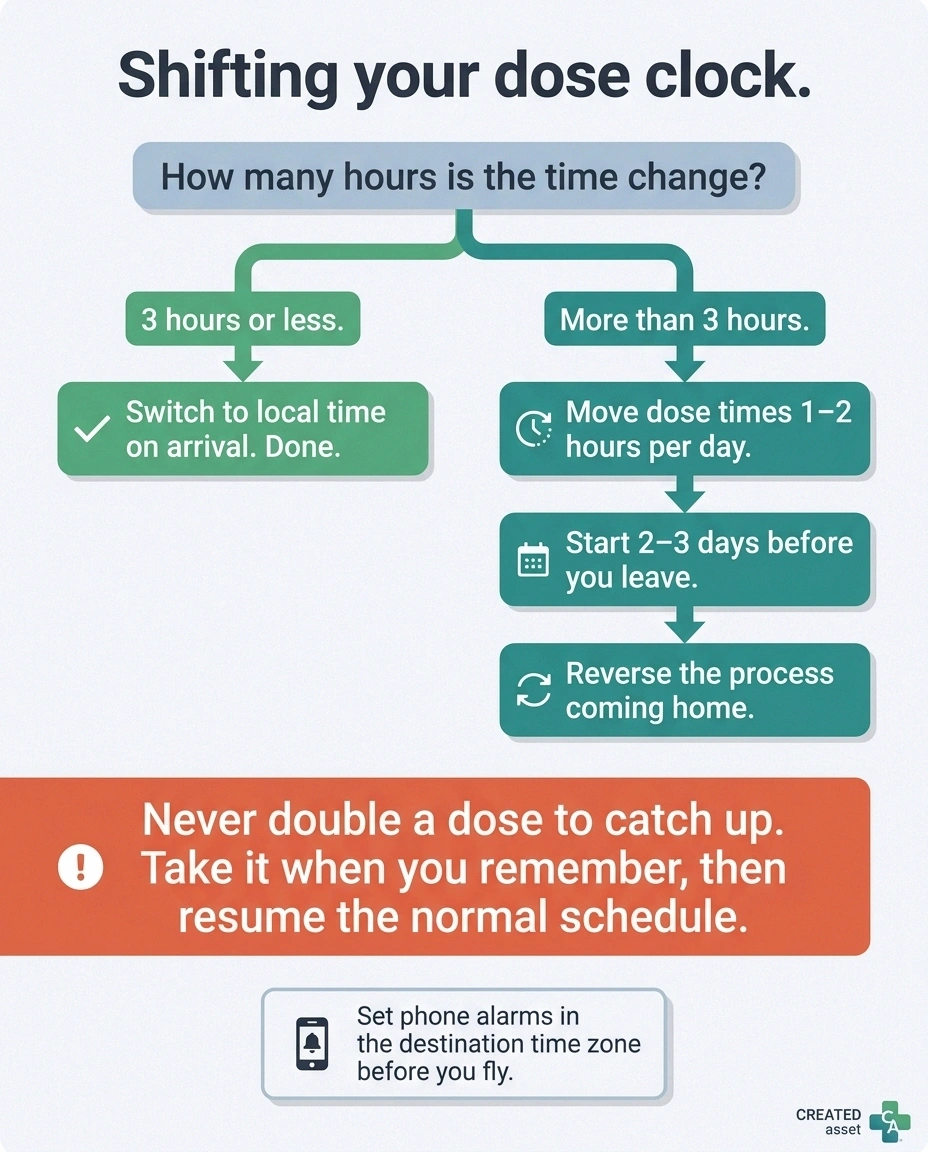
This trips up more people than lost luggage does, and it's entirely solvable in advance.
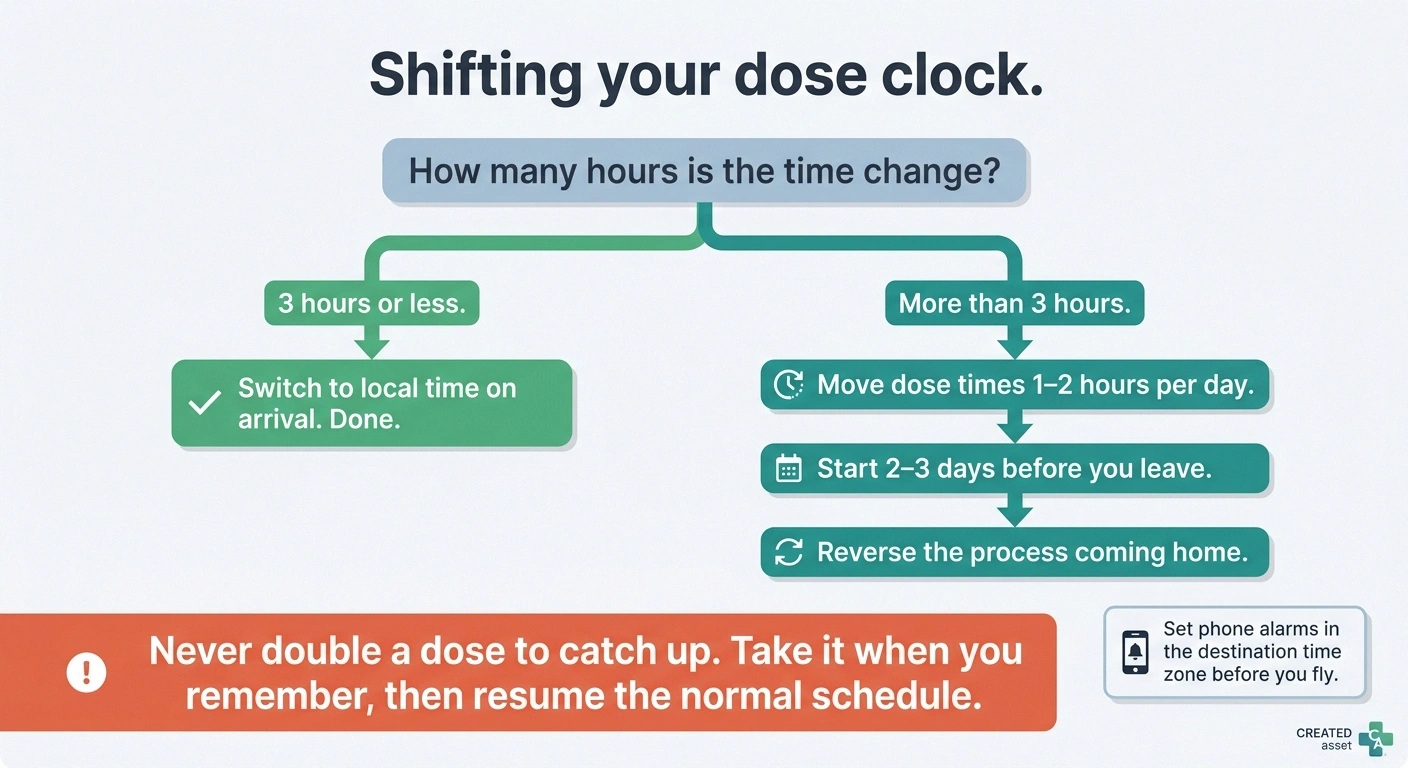
Three hours or less? Usually you can just switch to local time on arrival. A one-off shift of an hour or two matters little for most neuropathy regimens, though it's worth a quick word with your pharmacist if you're on a narrow-window medication or an insulin schedule alongside it.
More than three hours? Shift gradually rather than jumping. Move your dose times by one to two hours per day, starting two or three days before you leave, and you'll arrive already close to local schedule. Coming home, do the same in reverse.
If you didn't plan ahead, shift over the first two or three days of the trip instead. For a medication taken three times daily, spacing doses a little further apart on arrival closes an eastward gap; spacing them slightly closer handles a westward one.
Never double up to catch up. If a dose gets missed or delayed, the usual guidance is to take it when you remember unless it's nearly time for the next one, in which case you skip the missed dose and carry on. Instructions do vary by medication, so the specific wording on your own leaflet wins over any general rule. What's consistent is the thing not to do: doubling a gabapentinoid to get back on the grid is how people end up dizzy and unsteady in an unfamiliar bathroom at 2 a.m., which for someone with neuropathy and compromised balance is a genuine fall risk.
Practical trick: before you leave, add the destination time zone as a second clock on your phone and set your medication alarms in it. Then you're not doing arithmetic while jet-lagged.
The Medication Card
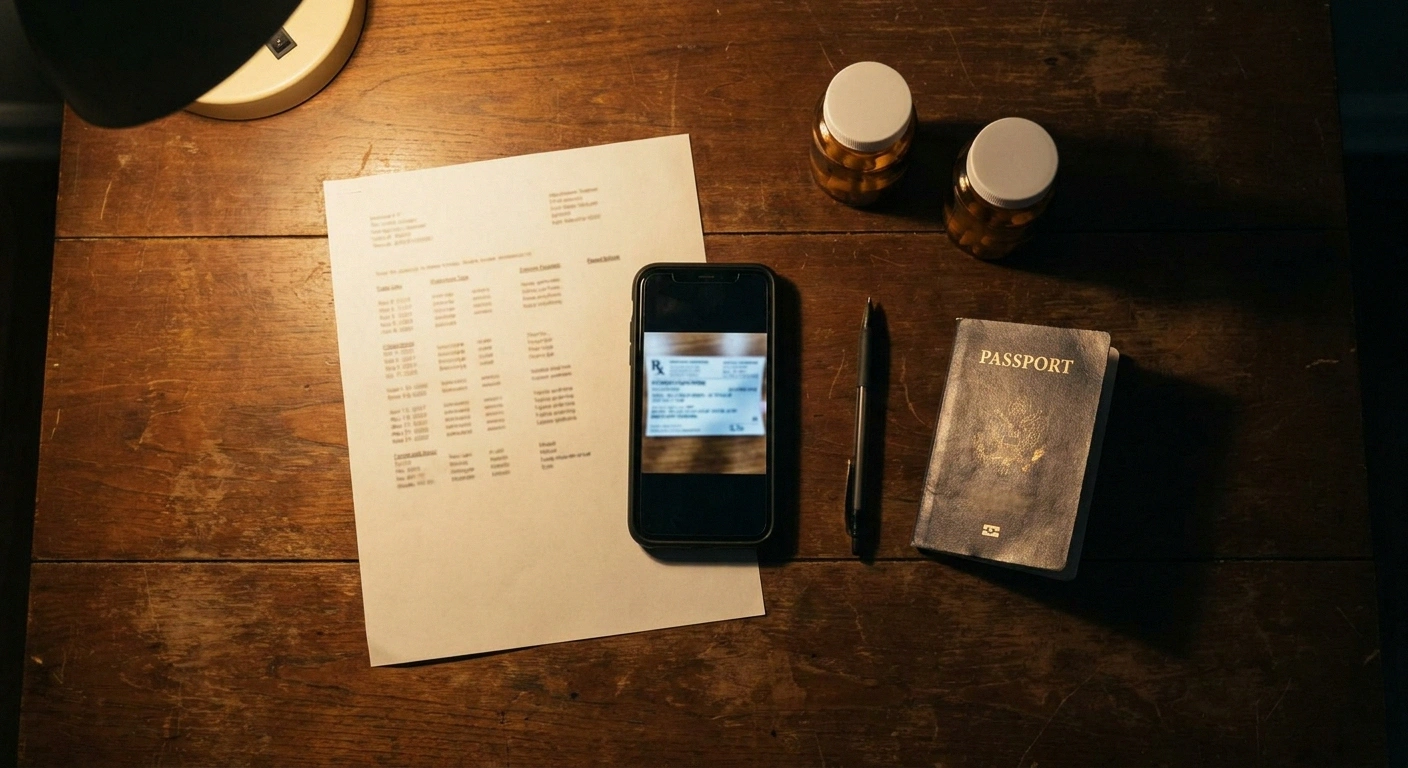
One page, printed, in your wallet. Plus a photo of every prescription label on your phone. This takes fifteen minutes once and it's the thing that saves you if something goes wrong.
What goes on it:
- Every medication: generic name, brand name, strength, how often, what time
- Your prescriber's name and phone number
- Your pharmacy's name and phone number, including the mail-order one if you use it
- Your diagnosis in plain terms — “peripheral neuropathy,” plus the underlying cause if known
- Allergies and past bad reactions
- An emergency contact
- Your insurance details and member number
Generic names matter a lot here. Brand names differ between countries, and a pharmacist in Lisbon will recognize “pregabalin” instantly while “Lyrica” may take longer. Write both.
The printed copy exists because phones die, get stolen, and can't be charged in the back of an ambulance. Paper doesn't have a battery.
Getting an Emergency Refill Away From Home
Worth knowing before you need it, because these options take phone calls and phone calls take time you may not have.
| Route | Typical speed | Catch |
|---|---|---|
| Same-chain transfer | Same day | Needs a branch nearby |
| Pharmacist emergency supply | Same day | State rules vary; controlled drugs usually excluded |
| Prescriber calls it in | Same day on a weekday | Office hours only |
| Mail-order ship-ahead | Days | Must be arranged before you travel |
| Urgent care | Hours, plus a fee | Bring your medication card |
Same-chain transfer. If your pharmacy is part of a national chain, a branch near your destination can usually pull your prescription up and fill it. This is by far the smoothest path. Find out before you leave whether there's a branch where you're going.
Emergency supply from any pharmacist. Many states allow a pharmacist to dispense a limited emergency supply of a maintenance medication without a new prescription, typically a few days' worth. Rules vary and controlled substances are usually excluded, but it's a real option and under-known.
Your prescriber calling it in. Straightforward for non-controlled medications. A short call to the office often solves it same day.
Mail-order shipping ahead. If you use a mail-order pharmacy, some will ship to a temporary address. Set this up well before travel, not during.
Urgent care. The fallback. Bring your medication card, because it turns a difficult conversation into a short one.
The call to make now: ring your pharmacy and ask which of these apply to you specifically. Five minutes on a weekday afternoon beats an hour on a Sunday in a strange city. If cost is a factor in any of this, affording neuropathy medications covers assistance options that travel with you.
Packing the Bag Itself
Keep the pouch findable. A bright-colored zip pouch that doesn't look like everything else in your bag. Numb fingers rummaging through a dark carry-on for a small dark case is a frustration you can design out.
Pre-sort the travel days. A small organizer filled before you leave means you're not opening bottles on a tray table with limited dexterity. Keep the labeled bottles too — the organizer is for convenience, the bottles are for documentation. If filling an organizer is itself difficult, our pill organizer system for numb fingers has a method that doesn't rely on fingertip feel.
Heat is the enemy. Most medications want to stay below 77°F. A car glovebox, a beach bag and a sunny windowsill all exceed that comfortably. In hot destinations, the pouch travels with you rather than sitting in the car.
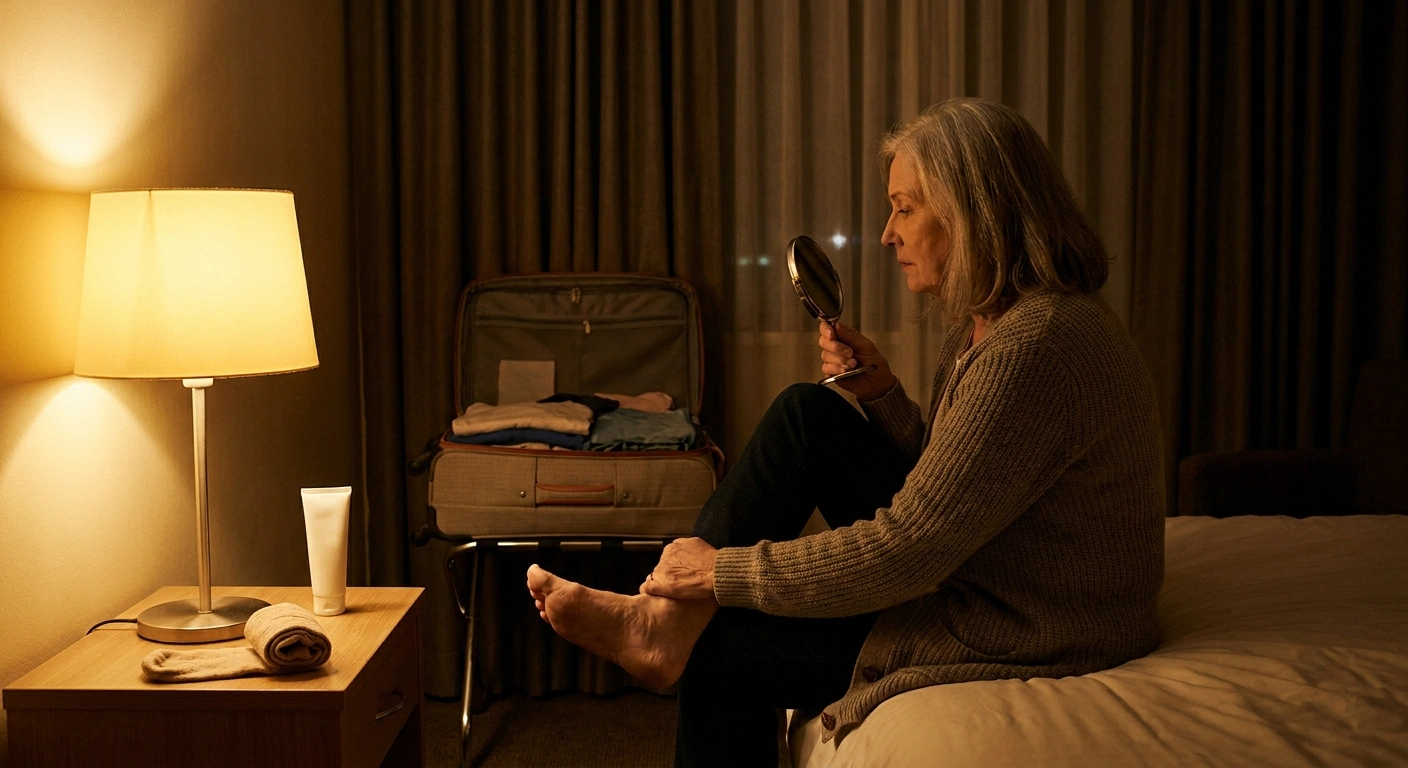
Don't forget the foot kit. The medication bag isn't complete without it: a small mirror for checking soles, lotion, spare socks, and whatever you normally use. Travel means more walking in less familiar shoes, which is exactly when a daily foot check matters most. Doing it every night of a trip catches the blister you couldn't feel forming.
International Trips: Three Extra Steps
Crossing a border adds requirements that domestic travel doesn't have.
Bring original labeled containers. The domestic flexibility about pill organizers doesn't extend to customs. Original packaging with your name on it is what you want to be holding.
Carry a prescriber's letter. On letterhead, listing each medication by generic name with dose and the condition treated. For controlled substances this is close to essential. Pregabalin is a controlled substance in the US and in a number of other countries, with varying rules.
Check legality at the destination. This is the step people skip. Medications that are routine in one country are restricted or banned in others — certain painkillers and sleep aids in particular, with several Gulf states and Japan being the frequently cited examples. Check the destination country's embassy website a few weeks out, not the night before.
Also worth knowing: a medication available over the counter at home may require a prescription abroad, and vice versa.
A Two-Week Countdown
Put these on a calendar and the whole thing becomes routine.
Two weeks out. Count what you have against trip length plus four days. Request refills now, since insurance approvals for early fills take time. Check destination rules if travelling internationally. Request the prescriber's letter if you need one.
One week out. Update and print the medication card, photograph all labels. Confirm a pharmacy option near your destination. If the time change is more than three hours, start shifting doses now.
The day before. Split the supply across bags. Set destination-time alarms. Pack the foot kit. Put liquids and gel packs somewhere you can reach at the checkpoint without unpacking.
On arrival. Move the medication out of the heat first thing. Confirm alarms are on local time. Check your feet that first night, because travel days are long ones.
Most of this you do once and then reuse. Save the medication card as a file you update rather than rewriting, and the next trip takes twenty minutes of prep instead of an evening. For the wider set of travel considerations, travelling with neuropathy covers seating, walking and pacing, and getting through airport security deals with screening when standing and walking are difficult.
Frequently Asked Questions
Can I bring my neuropathy medication in my carry-on?
Yes, and you should. TSA allows solid medications such as pills and capsules in unlimited quantities in carry-on bags, and permits liquid medication over 3.4 ounces in reasonable amounts when declared at the start of screening. TSA explicitly recommends carrying medication rather than checking it so you have immediate access if bags are delayed.
Do my pills need to be in the original prescription bottle?
Not for domestic US flights — TSA permits pill organizers and unlabeled containers. However, state laws vary and international customs officials generally expect original labeled packaging, so bring the labeled bottles for any trip crossing a border. A practical compromise is packing a filled organizer for daily convenience alongside the original bottles for documentation.
How much extra medication should I pack?
Plan on your trip length plus at least four additional days. Delays, cancellations and illness routinely extend trips, and running out of gabapentin, pregabalin or duloxetine away from home is a bigger problem than the extra space in your bag. Split the total across two or three bags so no single lost item leaves you without supply.
How do I handle doses when crossing time zones?
For shifts of three hours or less, simply switch to local time on arrival. For larger shifts, move your dose times by one to two hours per day, ideally starting two or three days before departure so you arrive close to local schedule. Never double a dose to catch up after a missed one; take it when you remember and resume the normal schedule.
What happens if my medication is lost during a trip?
Several options exist. A branch of the same pharmacy chain can often transfer and fill your prescription. Many states permit a pharmacist to dispense a limited emergency supply of a maintenance medication without a new prescription, though controlled substances are typically excluded. Your prescriber can call in a new prescription for non-controlled medications, and urgent care is the fallback. Ask your own pharmacy which applies to you before you travel.
Do I need a doctor's letter to travel with my medication?
Not for ordinary domestic travel, where the original pharmacy label is sufficient. A letter is advisable for controlled substances, unusually large quantities, injectable medication and any international travel. Ask for it on letterhead listing generic drug names, doses and the condition being treated.
Can I take an ice pack for medication that needs refrigeration?
Yes. TSA permits ice packs and frozen gel packs used to keep medication cool, and medically necessary cooling accessories are allowed even when partially melted. You must declare them at screening, and a slushy pack tends to trigger additional screening and is occasionally refused, so arriving with it frozen solid saves time. Use a small insulated case and freeze the packs overnight before departure.
Is it safe to skip a dose while travelling?
Skipping doses of gabapentin, pregabalin or duloxetine is not advisable, because these medications are not meant to be stopped abruptly and doing so can cause withdrawal effects as well as returning nerve pain. This is precisely why packing extra supply and splitting it across bags matters more for a neuropathy regimen than for many other medications.
About the Author


