Two names get written on most first prescriptions for nerve pain. Duloxetine, which you may know as Cymbalta. Pregabalin, which you may know as Lyrica. Which one you walk out with often comes down to what your doctor happened to have good luck with last month.
That bothered me for a long time. It stopped bothering me when I understood why it happens.
The honest summary of the research is that neither drug is reliably better at reducing pain. That sounds like a non-answer. It is actually the most useful thing anyone can tell you, because once the pain relief is a coin flip, every other difference between these two drugs becomes the deciding factor. And those differences are not subtle at all.
So this is not a piece about which drug wins. It is about how to be the person in the room who knows which one fits you.
What the Head-to-Head Research Actually Found
Most trials in nerve pain compare a drug against a sugar pill, which tells you whether it works but not whether it works better than the alternative. For years, comparisons between duloxetine and pregabalin were indirect: researchers lined up separate placebo trials and did the arithmetic. A 2009 analysis in BMC Neurology did exactly that and found the two roughly comparable.
Then in 2022 a British trial called OPTION-DM did the direct comparison properly, and it is worth knowing about because it changed how a lot of pain clinics think.
Researchers at thirteen UK centres recruited people with painful diabetic neuropathy whose average daily pain was at least a 4 out of 10. Each person cycled through three different treatment pathways, sixteen weeks each, without knowing which they were on. One hundred and thirty people were analysed.
The headline result: every pathway landed in the same place. Average pain started at 6.6 out of 10 and finished at 3.3 out of 10. Not approximately the same. The same number, to one decimal place, in all three arms. The differences between pathways came out at 0.1 of a point and 0.0 of a point, well inside the range of statistical noise.
Cutting pain roughly in half is a real result, and worth saying plainly, because people starting these drugs often expect either a miracle or nothing. Half is the realistic middle.
The American Academy of Neurology reached the same conclusion from a different direction when it updated its guideline in 2022. It recommends offering a tricyclic, an SNRI like duloxetine, a gabapentinoid like pregabalin, or a sodium channel blocker, and it declines to rank them. The measured effect sizes for gabapentinoids, SNRIs and sodium channel blockers all cluster in the same modest band. The guideline is also blunt that opioids should not be used for this.
If you want the fuller picture of the whole menu, our guide to neuropathy medication options covers the classes side by side.
Where They Genuinely Differ: The Side Effect Split

Here is where the trial earns its keep. The same study that found no difference in pain relief found large, clean differences in how people felt while taking each drug.
Six weeks on one drug alone: what happened to people
Figures from the OPTION-DM trial monotherapy phase. Amitriptyline is included because it was the third arm and is often the next drug offered.
| Pregabalin | Duloxetine | Amitriptyline | |
|---|---|---|---|
| Dizziness | 18% | 8% | 8% |
| Nausea | 6% | 19% | 4% |
| Dry mouth | 9% | 5% | 21% |
| Quit because of side effects | 5% | 17% | 11% |
| Average dose people tolerated | 397 mg | 76 mg | 56 mg |
| Reached the maximum dose | 55% | 46% | 51% |
The bottom two rows are the ones nobody quotes: roughly half of people never reach the top of the dose range on any of these drugs, so a moderate dose is the normal outcome rather than a failed attempt.
During the first six weeks, when each drug was used on its own:
Dizziness hit 18% of people on pregabalin, compared with 8% on duloxetine. That gap was statistically real, not chance.
Nausea ran the other way. Nineteen percent on duloxetine, 6% on pregabalin. Also statistically real.
That is the choice in one line. Pregabalin is the drug more likely to make the room tilt. Duloxetine is the drug more likely to make breakfast unappealing. Neither happens to most people, and both fade for many who get them, but if you already know which of those two you cannot live with, you already know something useful.
The dropout numbers tell the same story from another angle. Over those six weeks, 5% of people quit pregabalin because of side effects. On duloxetine it was 17%, more than triple. Amitriptyline, the third drug in the trial, sat between them at 11%. Whatever else pregabalin does, most people manage to keep taking it.
Outside the trial, the everyday complaints split just as cleanly. Pregabalin brings swelling in the ankles and feet, weight gain, and drowsiness. In diabetes trials people gained an average of 1.6 kg, around three and a half pounds. Duloxetine brings nausea early on, dizziness on standing, and constipation.
That ankle swelling deserves a flag, because on a foot that is already numb, extra fluid changes how shoes fit and you may not feel a rub starting. If pregabalin puffs up your feet, your usual shoes are no longer your usual shoes. Our page on choosing shoes for neuropathy covers fit checks that do not rely on sensation.
The Question Behind the Question: What Else Is Wrong?
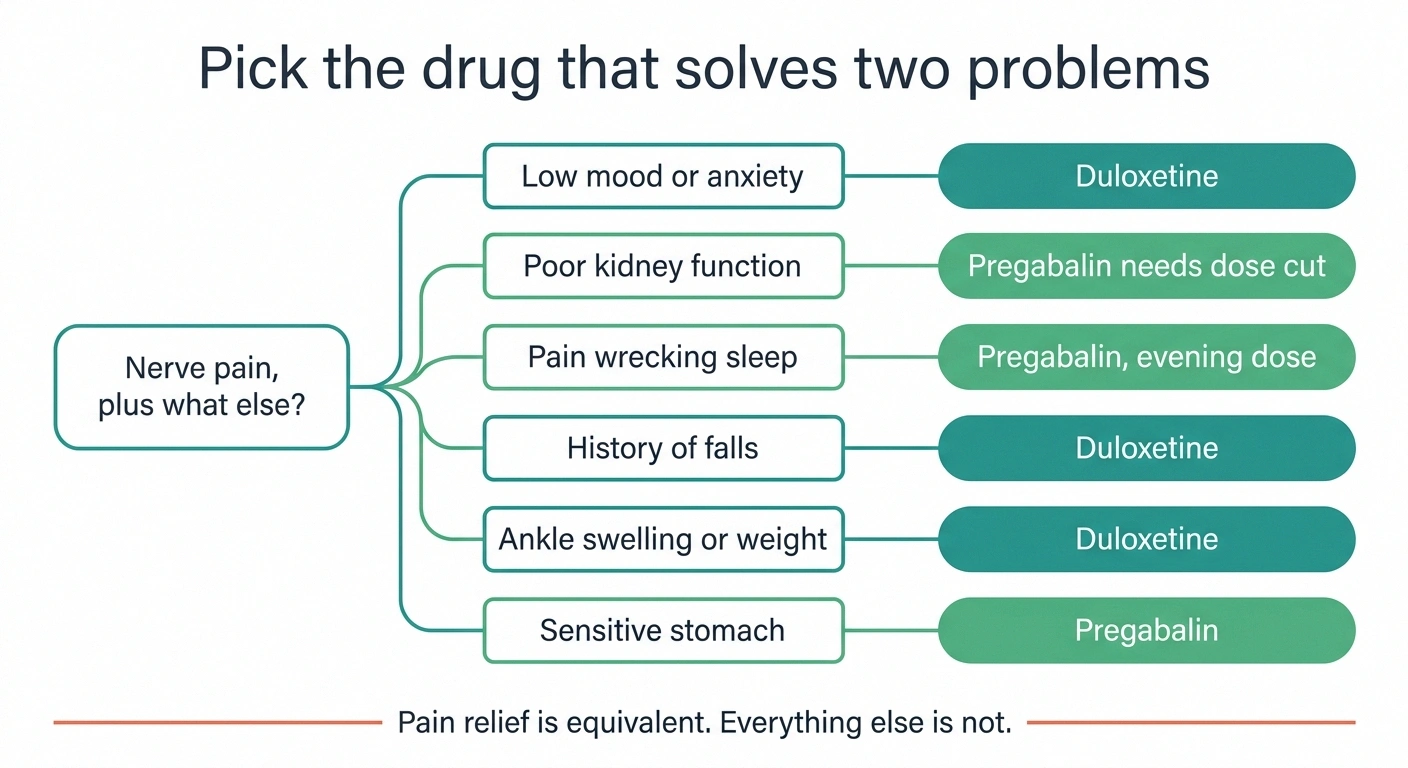
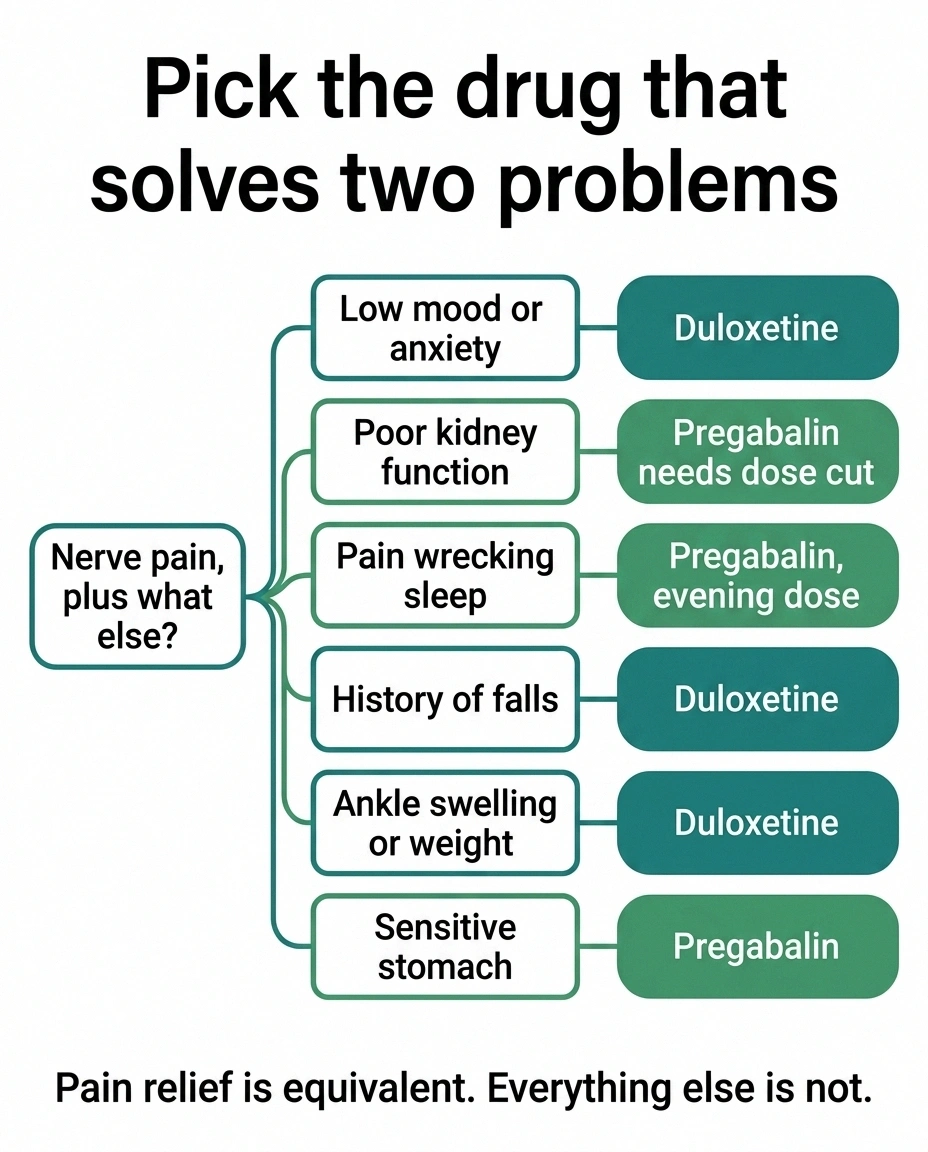
Since the pain relief is a wash, the smartest way to choose is to pick the drug that treats two problems instead of one. Nerve pain rarely arrives alone.
If this is also true of you, it usually settles the choice
- Reduced kidney function
- Pregabalin is cleared by the kidneys and needs the dose cut. This one is decided by your eGFR, not by preference.
- Depression or anxiety alongside the pain
- Duloxetine. It is licensed for both, so one prescription covers two problems.
- Pain is mainly wrecking your sleep
- Pregabalin, weighted toward the evening dose. Its sedation becomes the point rather than the drawback.
- Balance already poor, or a history of falls
- Duloxetine. An 18% dizziness rate is a different proposition when your footing is already unreliable.
- Swollen ankles or weight already a concern
- Duloxetine. Pregabalin adds around 3.5 lb on average and causes fluid retention in the feet.
- You want to avoid controlled-substance paperwork
- Duloxetine. Pregabalin is Schedule V in the US, which tightens refill and travel prescriptions.
If you are also depressed or anxious. Duloxetine is an antidepressant that happens to work on nerve pain, and it is licensed for depression and generalised anxiety in its own right. That is one prescription doing two jobs. The trial found something related and slightly grim: people with low mood did notably worse on amitriptyline than on the other pathways, which suggests mood is not a side issue in drug selection. Given how tightly nerve pain and low mood wind around each other, covered in our piece on neuropathy and mental health, this is often the single most decisive factor.
If your problem is sleep. Pregabalin is sedating, which is a nuisance at ten in the morning and a gift at eleven at night. Weighted toward the evening dose, it can take the edge off the pain and the wakefulness at once. Duloxetine is more likely to do the opposite and keep you alert.
If your kidneys are not what they were. This one is not preference, it is chemistry. Pregabalin leaves the body almost entirely through the kidneys, so reduced kidney function means the drug accumulates and the dose has to come down, sometimes a long way down. Duloxetine is processed by the liver, though it is generally avoided in severe kidney impairment. If you have diabetic kidney disease, your kidney numbers may make this decision before you do, and our page on kidney disease and nerve damage explains why the two travel together.
If you have a history of substance misuse, or you would rather avoid the paperwork. Pregabalin is a controlled substance in the United States, Schedule V. In practice that means tighter refill rules and a prescription that cannot be handled as casually as most. Duloxetine is not scheduled.
If you drive for a living, or operate anything with a blade on it. An 18% chance of dizziness reads differently when you are on a ladder.
If you have high blood pressure that is not well controlled. Duloxetine can nudge blood pressure up and is worth monitoring. Pregabalin does not.
Cost, and Why It Is Not the Tiebreaker It Used to Be

Both drugs went generic years ago, and both are cheap now. Lyrica lost exclusivity in 2019 and generic pregabalin followed quickly. Generic duloxetine has been available even longer.
Prices vary by pharmacy far more than by drug, and the spread between two pharmacies in the same town routinely beats the spread between the two medications. If cost is the pressure point, the lever is where you fill it and which discount programme you use, not which molecule you pick. Our guide to affording neuropathy medication goes through the specific programmes.
One cost wrinkle that does favour duloxetine: pregabalin is dosed two or three times a day, duloxetine once. If a copay is per prescription rather than per pill, and if remembering an evening dose is genuinely hard, once-daily has a quiet advantage that has nothing to do with pharmacology.
How Long Before You Know
Different timelines, and mixing them up is how people abandon a drug that was about to work.
Do not judge either one too early
Pregabalin. Some effect within days at a starting dose. Real assessment at two to four weeks, once the dose has climbed. Dizziness is worst in the first week after each increase and usually settles.
Duloxetine. Little pain benefit in week one. Two to four weeks at 60 mg before a fair verdict. Nausea peaks in the first seven to fourteen days and then fades for most people.
The most common way a working drug gets abandoned is stopping duloxetine during the nausea window, before it has had a chance to do anything for the pain at all.
Pregabalin can take the edge off within a few days at a low dose, though the useful effect usually arrives over two to four weeks as the dose climbs. Duloxetine is slower for pain, typically two to four weeks at 60 mg before you can judge it, sometimes longer.
Both need titration, meaning you start low and climb. That is not caution for its own sake. It is how the dizziness and the nausea get avoided, since both are worst when a dose jumps too fast.
The trial is useful here too, because it recorded where people actually landed rather than where the label says they could. Average tolerated dose was 76 mg of duloxetine, with fewer than half reaching the 120 mg maximum, and 397 mg of pregabalin, with just over half reaching 600 mg. Roughly half of people do not tolerate the top of the range, which is worth knowing before you assume you failed a drug you were only ever on a moderate dose of.
Before you start either one, our list of questions to ask before starting neuropathy medication is designed to be taken into the appointment.
The Finding Almost Nobody Gets Told About
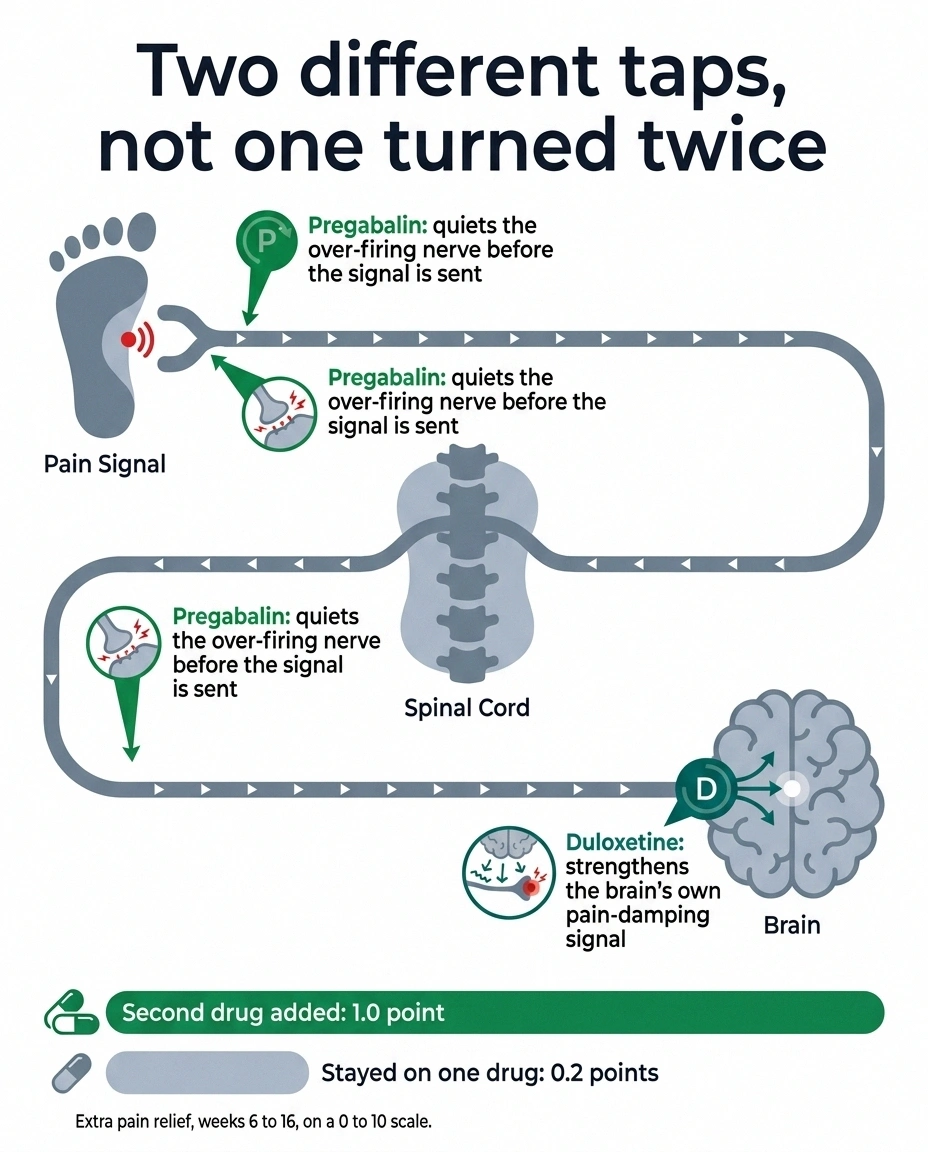
This is the part of OPTION-DM that should have changed more conversations than it has.
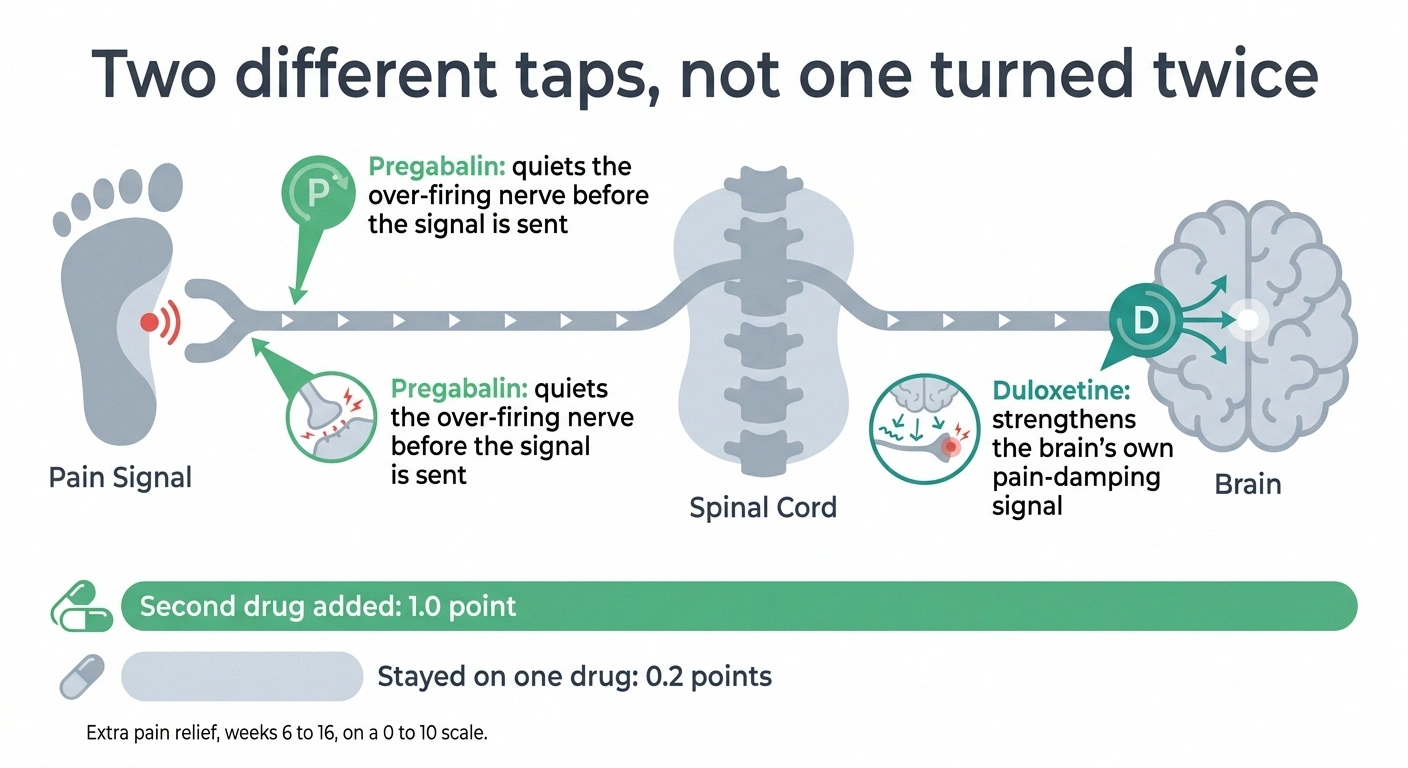
Extra pain relief gained between week 6 and week 16
Second drug added: 1.0 point
Stayed on one drug: 0.2 points
Measured on a 0 to 10 pain scale in people whose pain was still above 3 after six weeks of one drug. Dropouts on the combinations ran at 7% to 11%, no worse than the single drugs. If you have been sitting at partial relief for months, this is the question to raise.
The trial did not only compare drugs. It compared strategies. Everyone started on one drug alone, and at week six, anyone whose pain was still above a 3 out of 10 had a second drug added rather than being switched.
Those people gained a further full point of pain relief between weeks six and sixteen. The people who stayed on one drug gained 0.2 of a point over the same stretch. Five times the improvement, from combining rather than continuing.
The combinations were well tolerated. Dropouts during the combination phase ran between 7% and 11%, no worse than the single drugs.
Duloxetine and pregabalin work on completely different systems. Duloxetine turns up the volume on the brain’s own pain-damping signals. Pregabalin quiets over-excited nerve endings before the signal is sent. Using both is not doubling up, it is closing two different taps.
So if you are on one drug, it helped somewhat, and you have been sitting at partial relief for months, the question to raise is not always “should I switch?” It may be “should we add?” Our page on what to do when neuropathy medication stops working walks through both branches.
What Happens If the First One Fails

The guideline is unusually specific about this, and it is a rule worth carrying with you: if a drug from one class does not help or you cannot tolerate it, move to a drug from a different class rather than another one from the same shelf.
In practice, that means failing pregabalin is not a reason to try gabapentin next, because they are close cousins working the same way. Failing duloxetine is a reason to try a gabapentinoid, or a tricyclic like nortriptyline, or a sodium channel blocker.
Two distinctions matter when you judge whether a drug “failed”:
Did it fail, or did you never reach a real dose? Stopping duloxetine at 30 mg because of first-week nausea is not a trial of duloxetine. That nausea usually settles within one to two weeks.
Did it fail on pain, or fail on tolerability? Those lead different places. A drug that helped but made you too dizzy might work at a lower dose alongside a second drug. A drug that did nothing at a full dose is finished.
Neither drug should be stopped abruptly. Duloxetine has a genuine discontinuation syndrome, with dizziness, electric-shock sensations and irritability, and pregabalin can produce rebound anxiety and disturbed sleep. Both come down on a taper. Our guide to switching neuropathy medications safely covers the overlap schedules.
A Practical Way to Decide
Run through these in order. The first one that applies to you is probably your answer.
Poor kidney function? The kidney numbers decide, and pregabalin needs dose reduction or avoidance. Talk this one through rather than guessing.
Depression or anxiety alongside the pain? Duloxetine, most of the time. One drug, two problems.
Pain wrecking your sleep above all else? Pregabalin, weighted to the evening.
History of falls, or balance already poor? Duloxetine has the lower dizziness rate, and if you already struggle with balance and falls, an 18% dizziness risk is not a small consideration.
Nausea is your dealbreaker, or you have a sensitive stomach? Pregabalin.
Weight or ankle swelling already a problem? Duloxetine.
None of the above apply? Then the trial genuinely does not favour either, and starting with the one your doctor knows best is a reasonable answer rather than a lazy one. Familiarity means better dose management and quicker recognition of trouble.
Two Things Worth Saying Out Loud

First: neither of these drugs repairs nerves. They quiet the signalling. That is worth having, and it is not the same as treatment of the underlying cause, which is why glucose control, B12 status, alcohol, and everything else on the causal list still matters just as much the day after you start. If your neuropathy is diabetic, our diabetic neuropathy treatment guide covers the layers underneath the pain medication.
Second: a 50% reduction is what success looks like in this field. Half. Going from a 7 to a 3 or 4 is what these drugs are capable of at their best, and if that is where you are, you are not underperforming and the drug is not failing you. People who quit an effective medication because it did not reach zero end up worse off than when they started, which is a specific and avoidable kind of loss.
Frequently Asked Questions
Which is stronger for nerve pain, Lyrica or Cymbalta?
Neither, in any way the research can detect. The largest direct head-to-head trial found both cut average pain from 6.6 to 3.3 out of 10, with differences between pathways of a tenth of a point or less. Because pain relief is effectively tied, the choice should be made on side effects, your other conditions, kidney function and dosing convenience.
Can you take duloxetine and pregabalin together?
Yes, and the combination is used deliberately rather than as a last resort. They act on entirely different mechanisms. In the OPTION-DM trial, people whose pain remained above 3 out of 10 on one drug gained a further full point of relief when a second was added, compared with 0.2 of a point for those who continued on one drug alone. Tolerability of the combination was similar to monotherapy. The combination does tend to produce more weight gain than either drug alone.
Which one has fewer side effects?
They have different side effects rather than more or fewer. Pregabalin causes more dizziness, around 18% versus 8%, plus ankle swelling, weight gain and drowsiness. Duloxetine causes more nausea, around 19% versus 6%, plus constipation and dizziness on standing. In practice more people stay on pregabalin: 5% stopped it for side effects in six weeks compared with 17% for duloxetine.
How long does each take to work?
Pregabalin often takes some edge off within days, with the useful effect building over two to four weeks as the dose increases. Duloxetine is slower for pain and generally needs two to four weeks at 60 mg before it can be judged fairly. Stopping either in the first week because of early side effects is the most common reason people conclude a drug does not work for them.
Which is better if I have kidney disease?
Pregabalin is cleared almost entirely by the kidneys, so reduced kidney function causes it to accumulate and the dose must be lowered, sometimes substantially. Duloxetine is metabolised by the liver but is usually avoided in severe kidney impairment. Anyone with diabetic kidney disease should have this decided by their actual kidney numbers rather than by preference.
Is pregabalin a controlled substance?
Yes, in the United States pregabalin is Schedule V, the lowest restriction tier, which affects refill rules and prescribing paperwork. Duloxetine is not a controlled substance. For some people this is irrelevant, and for anyone with a history of substance misuse, or who needs long-distance or travel prescriptions, it can matter a great deal.
What should I try if the first drug does not help?
Move to a different drug class rather than a similar drug. If pregabalin fails, gabapentin is unlikely to succeed since they work the same way; a tricyclic, an SNRI or a sodium channel blocker makes more sense. Before concluding that a drug failed, check two things: whether you reached a genuinely therapeutic dose, and whether it failed on pain relief or only on tolerability, because those lead to different next steps.
Can I just stop taking them?
Not abruptly. Duloxetine has a well-documented discontinuation syndrome that can include dizziness, electric-shock sensations, irritability and flu-like symptoms. Pregabalin can produce rebound anxiety, insomnia and sweating if stopped suddenly. Both should be tapered, and the taper length depends on your dose and how long you have been taking it.
About the Author