Idiopathic. That’s the word.
You get handed it after months of appointments, a drawer full of lab slips, and at least one nerve test you’d rather not repeat. It sounds diagnostic. It isn’t. Idiopathic means the cause has not been found — and it carries no information whatsoever about whether the cause is findable.
Somewhere between a fifth and a third of peripheral neuropathy ends up with that label. For a good number of those people, there is an answer sitting in their DNA that current standard testing was never built to see.
What changed recently is that the tools built to see it stopped being purely experimental. This is a piece about when it’s reasonable to ask for more, what “more” actually means, and one specific thing you can request that costs almost nothing.
Why Your Genetic Test Came Back Negative
If you’ve already had genetic testing for neuropathy, you almost certainly had a targeted gene panel. A lab takes a list of genes known to cause inherited neuropathy, reads those genes, and reports anything that looks wrong.
Targeted panel. Reads a chosen list of genes already linked to neuropathy. Cheapest, fastest, fewest uncertain findings, and the one nearly everyone gets. Its ceiling is the list itself.
Exome. Reads the protein-coding parts of almost every gene, roughly one to two percent of your DNA. Catches genes nobody thought to put on a panel. Still blind to everything in between the coding stretches.
Genome. Reads essentially all of it, coding and non-coding. Best coverage and the only one that can find deep intronic changes and large structural rearrangements.
Each step up raises cost and also raises the count of variants of uncertain significance. More data means more findings, and not all findings are answers.
Panels are good. In groups of people with clinically diagnosed Charcot-Marie-Tooth, a targeted panel produces a definite molecular diagnosis in roughly 30% of cases. That’s a real number and a real service.
It also means seventy people out of a hundred walk out with a negative result — and most of them are told, more or less, that this is the end of the road.
It usually isn’t. A negative panel means one of four things, and they are very different situations:
The cause isn’t genetic. Common, and the first thing to settle. Diabetes, B12 deficiency, thyroid disease, alcohol, chemotherapy, certain medications, and abnormal proteins in the blood cause far more neuropathy than genes do.
The gene wasn’t on the list. Panels cover known genes. New ones are still being described.
The change is in a gene on the list, but in a form the test can’t read. This is the big one, and it’s the reason this article exists.
The change was seen but not understood. Reported as a variant of uncertain significance, which is a genuinely frustrating category to land in.
The Kinds of Damage Short Reads Can’t See
Almost all clinical sequencing today is short-read sequencing. The lab shatters your DNA into millions of fragments about 150 letters long, reads each fragment, and reassembles the picture by matching overlaps against a reference genome.
Imagine reconstructing a book from shredded strips, each holding about a line and a half of text. For most of the book that works beautifully. Then you reach a page where the same sentence repeats four hundred times. Every strip from that page looks identical. You know a repeated passage exists. You have no way to count how long it runs — and its length is the whole point.
That’s the core blind spot, and it has four practical forms:
Repeat expansions. A short DNA motif repeated far more times than it should be. Short reads can’t span the repeat, so its length can only be estimated indirectly, badly.
Structural variants. Large deletions, duplications, inversions, or pieces of chromosome that have moved. A change bigger than the read itself is difficult to characterise from fragments.
Deep intronic variants. Most panels and exome tests read only the protein-coding portions of genes. A change buried in the non-coding stretch between them can still wreck how a gene is assembled, and it sits outside what was sequenced.
Look-alike regions. Where a gene has a near-identical twin elsewhere in the genome, short fragments cannot be confidently assigned to the right one.
What Long Reads Do Differently
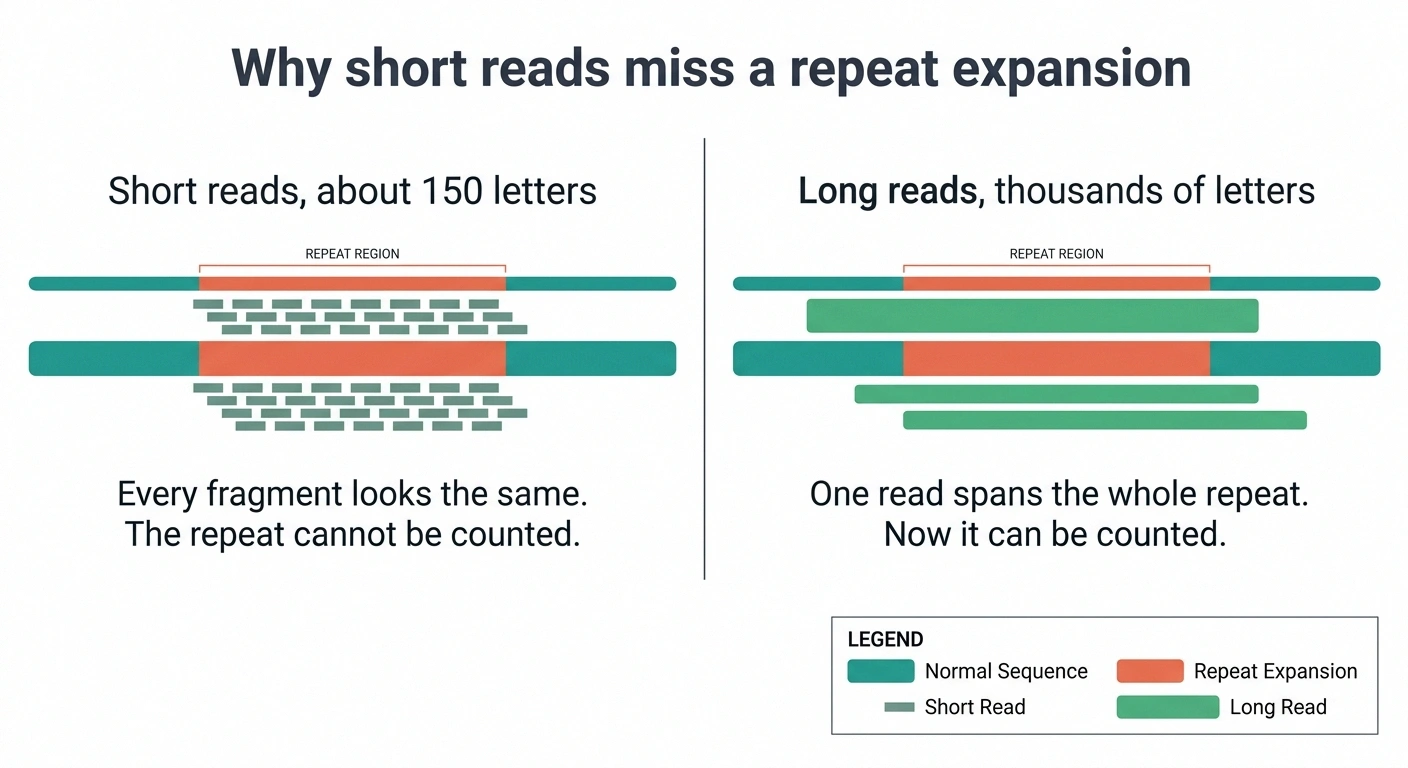
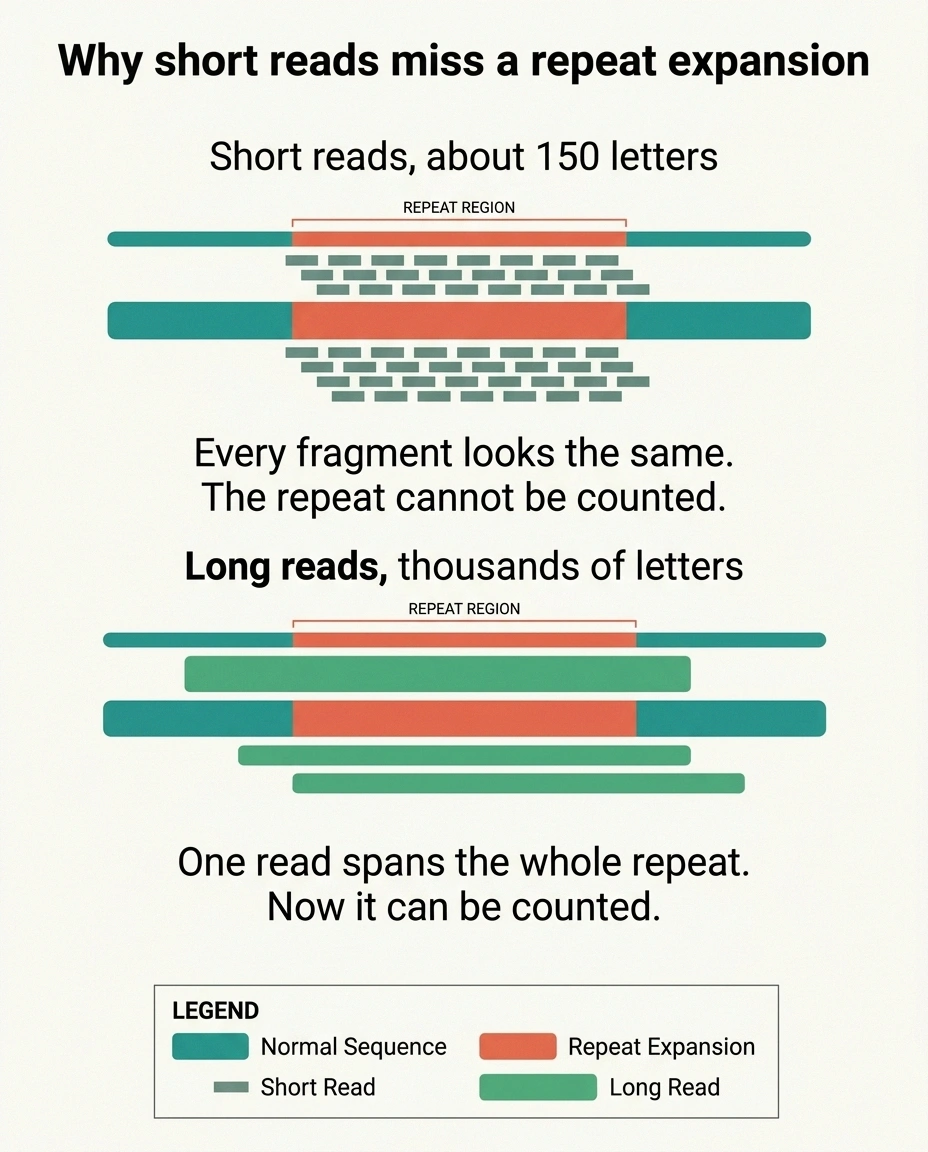
Long-read sequencing, mainly from Oxford Nanopore and PacBio, reads DNA in pieces thousands to tens of thousands of letters long instead of 150.
Back to the shredded book: instead of strips, you get whole intact pages. You can now simply count how many times the repeated sentence appears, because you’re holding the entire page at once.
Longer reads also let a lab work out which changes sit on the copy you inherited from your mother and which on your father’s copy. For recessive conditions, where two hits in the same gene are needed to cause disease, that distinction decides whether a finding explains your symptoms at all.
These are not incremental improvements. They’re the difference between a category of genetic change being invisible and being readable.
RFC1: The One That Keeps Turning Up
Here’s why any of this matters practically rather than theoretically.
| Pattern | Biallelic RFC1 found in | What that means for you |
|---|---|---|
| Pure sensory | ~53% | Roughly a coin flip. Worth raising by name. |
| Predominantly sensory | ~18% | Roughly one in five. Still a strong reason to ask. |
| Sensorimotor | ~2% | Real weakness makes RFC1 unlikely. Look elsewhere. |
| Chronic idiopathic axonal polyneuropathy | ~27% | The specialist-series figure for that diagnosis specifically. |
These come from specialist series, where patients had already been referred onward, so the rates run higher than in unselected clinic populations. In broader idiopathic neuropathy groups the figures were nearer 2.3% overall and 6.9% of pure sensory cases. Both sets of numbers are useful: one tells you the ceiling, the other the floor.
There’s a gene called RFC1. A particular repeat expansion in it, of the motif AAGGG, causes a condition known as CANVAS: cerebellar ataxia, neuropathy and vestibular areflexia syndrome. To carry the risk you need the expansion on both copies of the gene, one from each parent.
It’s a repeat expansion — which means that for years, standard testing walked straight past it.
The prevalence numbers, once people went looking properly, are startling. In series of patients carrying a diagnosis of chronic idiopathic axonal polyneuropathy, biallelic RFC1 expansions turned up in around 27%. Not a rare curiosity — more than a quarter of a group whose neuropathy had been declared unexplained.
The number depends enormously on what kind of neuropathy you have:
Pure sensory neuropathy: about 53%. Sensation affected, strength preserved.
Predominantly sensory: about 18%.
Sensorimotor: about 2%. Once real weakness is part of the picture, RFC1 becomes unlikely.
In wider idiopathic neuropathy populations, less selected than those specialist series, biallelic expansions ran around 2.3% overall and 6.9% of pure sensory cases. Lower, but still a meaningful share of a group who had been told there was nothing more to find.
If you know whether your neuropathy is sensory or sensorimotor, you already know roughly which of those rows you’re standing in. If you’re not sure, the distinction is worth understanding, and I’ve written about motor versus sensory neuropathy separately, along with what an EMG and nerve conduction study can and can’t tell you about which one you have.
The Cough Nobody Connects

This is the detail I most want you to carry away, because it’s absent from nearly every patient-facing page about unexplained neuropathy.
People with CANVAS very often have a long-standing dry cough. Not a smoker’s cough, not an infection — a persistent tickly cough that has been there for years, sometimes decades, and frequently arrives before the neurological symptoms do.
It gets attributed to reflux, to allergies, to post-nasal drip. It gets its own separate specialist and its own separate failed treatments. Almost nobody joins it to the neuropathy, because on the face of it there’s no reason to.
About two-thirds of people with RFC1 expansions have the full syndrome, meaning imbalance and dizziness alongside the sensory loss. Roughly 15% have isolated sensory neuropathy and nothing else obvious. Which is exactly the person most likely to have been told, definitively, that their neuropathy is idiopathic.
If you have unexplained sensory neuropathy, worse balance in the dark, and a dry cough you’ve had forever, those are three facts that belong on the same page of your notes. Bring them together at your next appointment. That combination is a recognised pattern, and it may not have been assembled for you before.
The Free Thing to Ask For
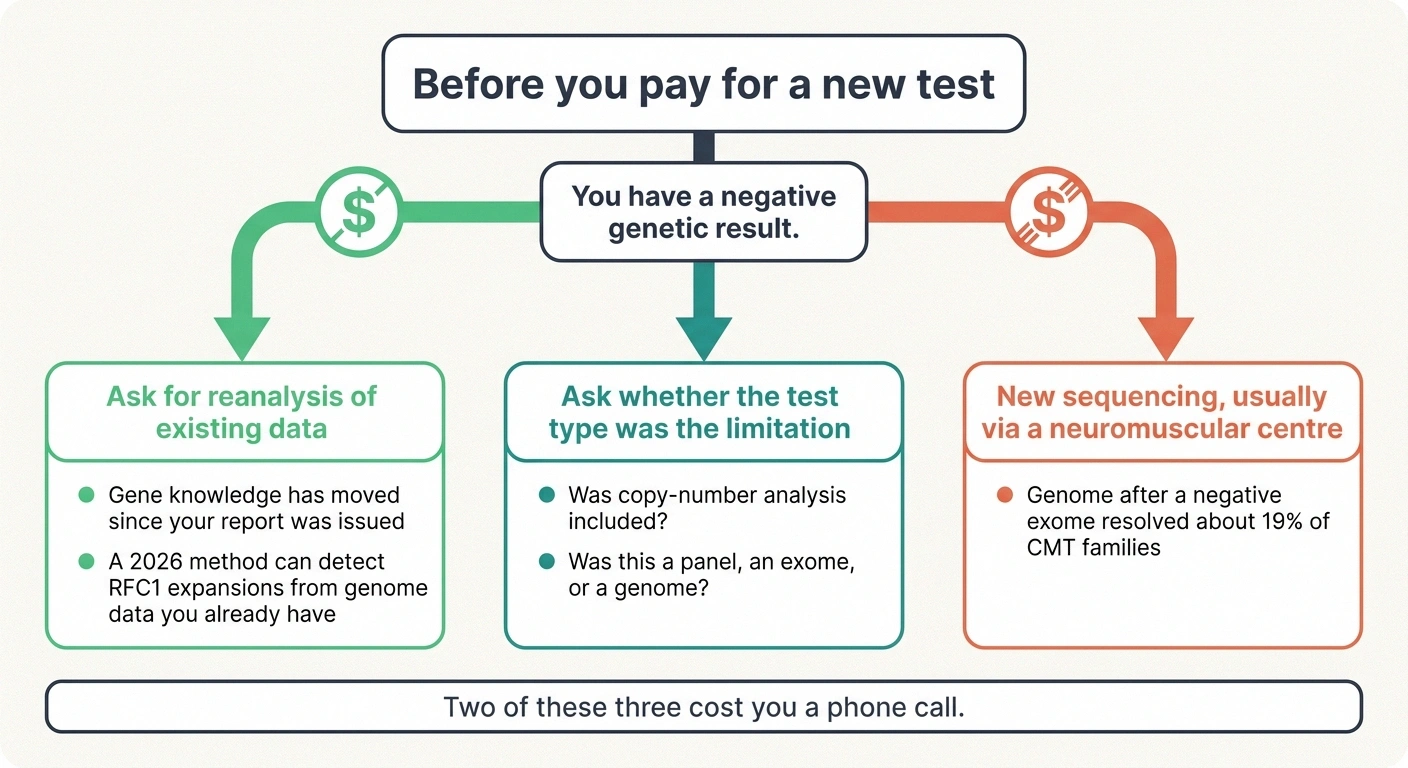
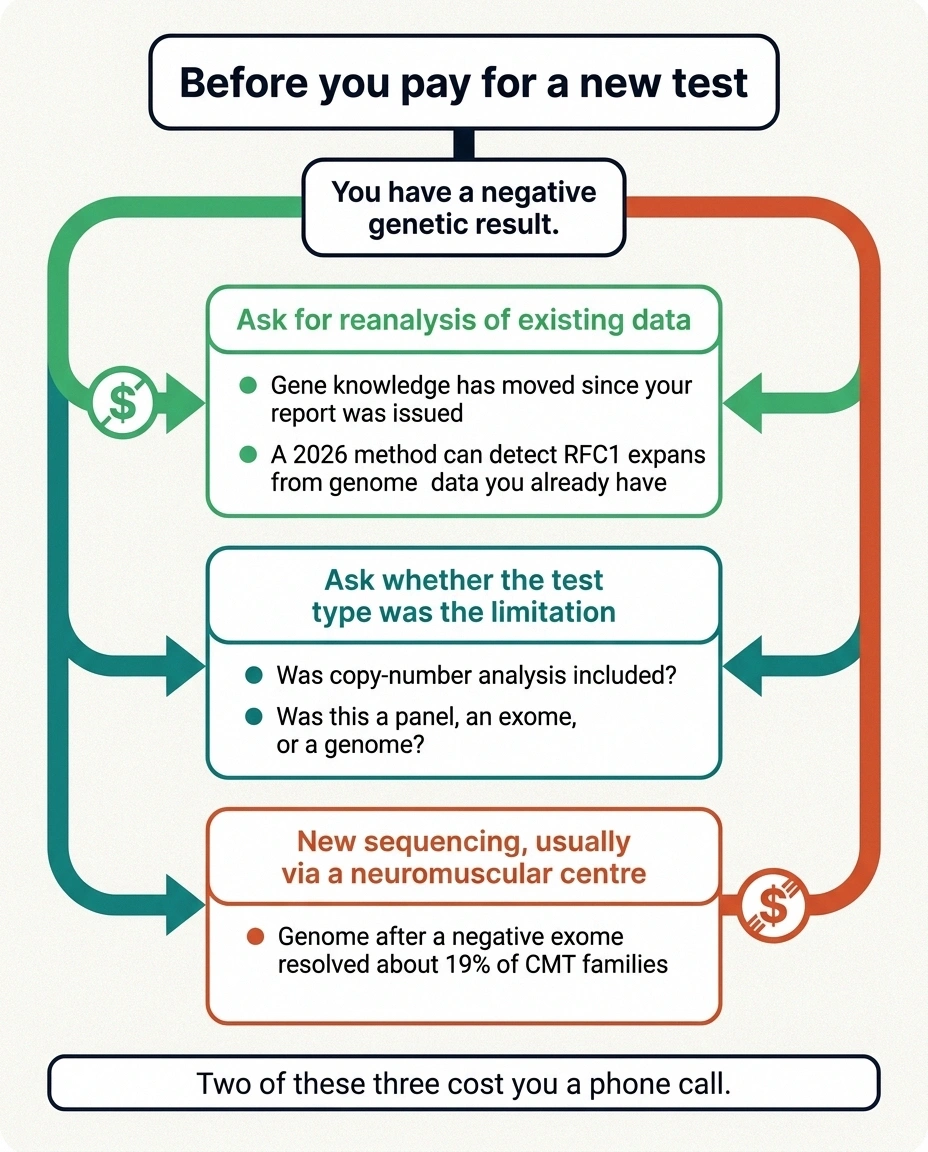
Now the practical part I promised.
“My genetic testing was a targeted panel in [year]. Given what has been added since, is my existing data worth reanalysing rather than ordering a new test?”
“Has RFC1 specifically been assessed? I understand it is a repeat expansion that standard short-read testing does not detect.”
“I have had a dry cough for [number] years and my balance is much worse in the dark. I have never mentioned those alongside the neuropathy before.”
Naming a specific gene changes the character of the conversation. It moves you from “is there anything else?” which invites a no, to a question with a checkable answer.
In May 2026, researchers at Washington University in St. Louis published a machine-learning method for detecting RFC1 repeat expansions from genome sequencing data that already exists. They released it publicly, free to use. Their estimate is that RFC1 expansions account for more than 2% of idiopathic peripheral neuropathy — a small percentage of a very large number of people.
Read that again, because the implication is easy to miss. If you have had genome sequencing at any point, the data is likely still stored. The finding can potentially be extracted from it computationally, without drawing a single new tube of blood.
That reframes the whole conversation. It’s the difference between asking for an expensive new test and asking a question:
“Given how much this has changed, is it worth reanalysing my existing sequencing data rather than ordering something new?”
Reanalysis is a genuinely productive strategy in its own right. In families with Charcot-Marie-Tooth where exome sequencing came back negative, systematic phenotype-driven reanalysis of the original data keeps yielding new diagnoses as gene knowledge advances. The data didn’t change — what we know how to find in it did.
And when reanalysis isn’t enough, going a step further has measurable payoff: in clinically diagnosed CMT that exome sequencing had failed to explain, whole-genome sequencing produced a compatible diagnosis in 14 of 72 families, about 19%. The gains came from better coverage, from structural variants, and from changes outside the coding regions an exome never reads.
Who This Is Actually For
I want to be straight with you, because the last thing anyone with neuropathy needs is another expensive avenue that leads nowhere.
Long-read sequencing is not a first test and it isn’t right for most people with neuropathy. Before genetics comes into the picture at all, the acquired causes need to be properly excluded, and that means real blood work rather than a cursory panel. The article on which lab tests to request covers what a thorough workup includes, and interpreting those results covers the borderline values that get waved through. Most unexplained neuropathy turns out to have an unglamorous acquired cause that was simply missed.
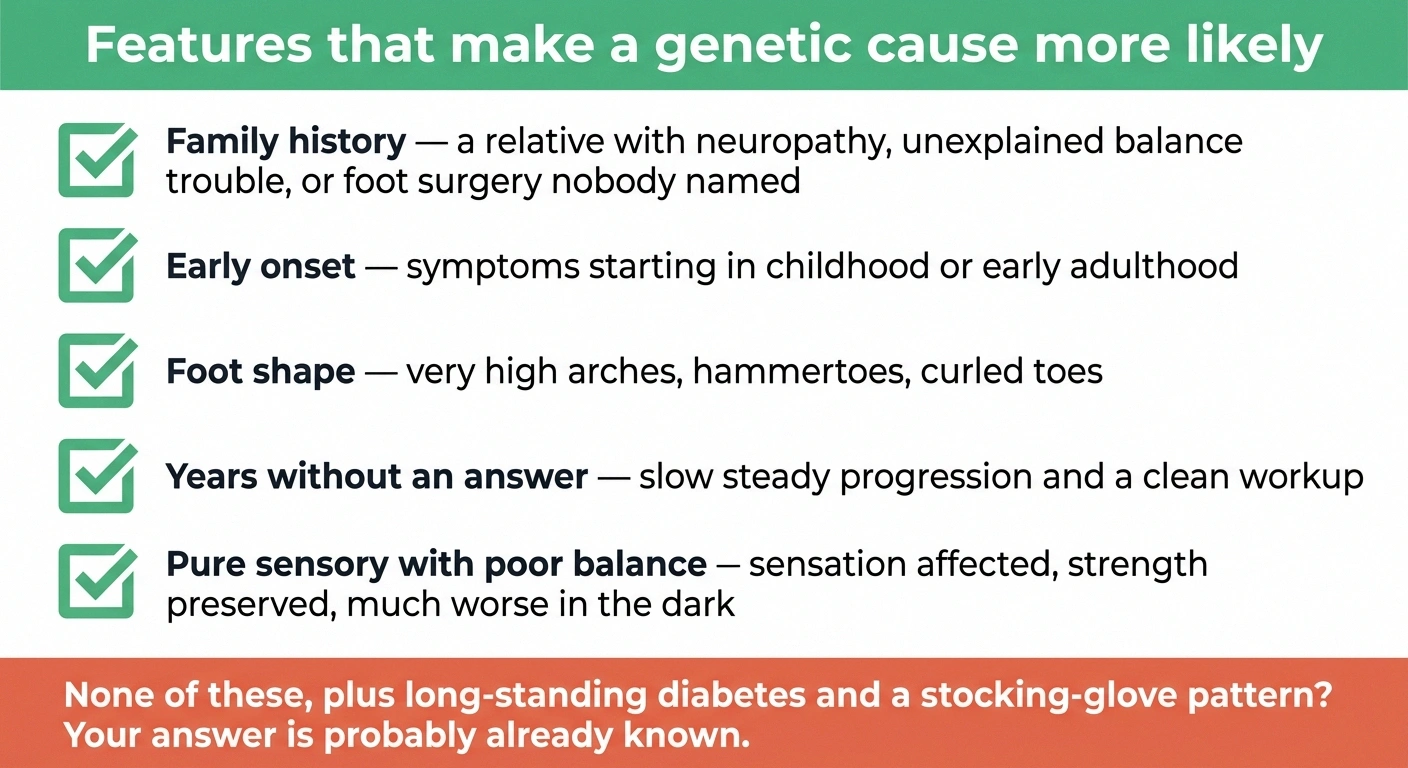
The features that make a genetic cause more plausible, and make pushing further reasonable:
Family history. A parent, sibling, or child with neuropathy, or with unexplained balance problems, foot surgery, or “bad feet” that was never named.
Early onset. Symptoms in childhood or early adulthood, rather than in your sixties with diabetes in the background.
Foot shape. Very high arches, hammertoes, curled toes. Inherited neuropathies shape the developing foot in ways acquired ones usually don’t.
Duration without explanation. Years of investigation with nothing found and slow, steady progression.
A pure sensory picture with ataxia. Sensation affected, strength preserved, balance disproportionately bad, especially in the dark or with your eyes closed. The article on sensory ataxia goes into what that pattern feels like day to day.
If several of those describe you, a referral to a neuromuscular centre with genetics access is a reasonable request. If none do, and you have longstanding diabetes and a classic stocking-glove pattern, your answer is probably already known and further genetic testing is unlikely to serve you.
What a Diagnosis Buys You When There’s No Cure

Fair question, and I’ve been asked it with an edge in the voice: why chase a name for something nobody can treat?
Four honest answers.
It stops the machine. Unexplained neuropathy generates a low-grade permanent investigation. Repeat blood work, periodic re-imaging, another opinion, another possibility raised and dropped. A name ends that — and the relief people describe is out of all proportion to anything clinical.
Your family gets information. Recessive conditions like CANVAS carry very different implications for siblings and children than dominant ones. Real answers replace vague worry.
Trials require a genetic diagnosis to enrol. Gene-specific programmes are the direction research is moving. Without a named gene you cannot be considered, and the process of finding and joining a trial starts with knowing what you have. Some hereditary neuropathies already have approved treatments, which is the situation for hereditary ATTR amyloidosis, and that one is genuinely worth ruling out because the treatment landscape changed fast.
It prevents the wrong treatment. This one has teeth. Hereditary neuropathies get mistaken for CIDP and treated with immunoglobulin infusions, sometimes for years, at considerable cost and inconvenience, for a condition that was never going to respond. A genetic answer stops that.
The Honest Limitations
Four things that pages selling genetic testing tend to leave out.
Access is uneven. Long-read sequencing lives mostly in specialist centres and research programmes. Your local neurologist likely cannot order it, and the route usually runs through an academic neuromuscular clinic.
Coverage is a fight. Insurer policies on genetic testing for inherited neuropathy set specific medical-necessity criteria, and long-read methods are frequently not treated as standard of care. Get pre-authorisation in writing before anything is drawn.
Uncertain results are common. More sequencing produces more findings of unclear meaning. A variant of uncertain significance can occupy your mind for years — and mean nothing at all.
A gene name is not a treatment. For most inherited neuropathies, management after diagnosis looks much like management before it: foot care, balance work, physical therapy, appropriate footwear. The diagnosis changes what you understand, not usually what you do tomorrow.
None of that argues against asking. It argues for asking with clear eyes about what you’re likely to get.
Where I’d Start on Monday

If you’re carrying an idiopathic label and the features above sound like you, here is the sequence I’d use.
- The test name and the year
- A panel from 2016 and a panel from 2024 cover very different gene lists. The year alone may justify a second look.
- The gene list
- Usually printed on the last page or in an appendix, often in small type. Count how many genes were actually read. Some panels cover a dozen, some several hundred.
- Whether copy-number analysis was included
- Look for MLPA, deletion/duplication analysis, or CNV. The most common inherited neuropathy is caused by a duplication, and sequencing alone can miss it entirely.
- Any variant listed as uncertain
- Classifications get revised as evidence accumulates. A variant called uncertain years ago may have been reclassified since, in either direction, and labs will re-issue a report when that happens.
If you cannot find the report, the ordering clinic keeps a copy and you are entitled to it. Ask for the full report rather than the summary letter, since the gene list is rarely in the letter.
Write down what you actually already have. Which genetic test, which lab, which year, which genes were covered, and whether copy-number analysis was included. Most people don’t know, and the answers are on the report.
Then ask two questions at your next appointment. Is my existing data worth reanalysing with current knowledge? And has RFC1 specifically been assessed, given how much of previously idiopathic sensory neuropathy it now accounts for?
Both questions are answerable. Neither requires a new needle — and that is rarer than it should be in this illness. And the second one, right now, is the highest-yield question in the room.
Frequently Asked Questions
What is long-read sequencing?
A DNA sequencing method that reads pieces of DNA thousands to tens of thousands of letters long, rather than the roughly 150-letter fragments used in standard short-read sequencing. The two main technologies are Oxford Nanopore and PacBio. Longer reads can span repeat expansions and structural changes that short fragments cannot resolve.
Why did my genetic test for neuropathy come back negative?
Four possibilities. The cause may not be genetic. The responsible gene may not have been on the panel. The change may be a type the test cannot detect, such as a repeat expansion or a large structural variant. Or a change may have been found but classified as uncertain in significance. A negative panel narrows the field but does not close it.
What is RFC1 and what is CANVAS?
RFC1 is a gene in which a repeat expansion of the motif AAGGG, present on both inherited copies, causes CANVAS: cerebellar ataxia, neuropathy and vestibular areflexia syndrome. It is a leading genetic cause of neuropathy that had been labelled idiopathic, and it is invisible to conventional short-read testing.
How common are RFC1 expansions in unexplained neuropathy?
It depends heavily on the type. In specialist series of chronic idiopathic axonal polyneuropathy, biallelic expansions were found in around 27%. Broken down by pattern, roughly 53% of pure sensory cases, 18% of predominantly sensory and 2% of sensorimotor. In broader, less selected idiopathic neuropathy populations the figure was about 2.3% overall and 6.9% of pure sensory cases.
Is a chronic cough really connected to neuropathy?
In CANVAS, yes. A long-standing dry cough is a well-described feature and often begins years before the neurological symptoms. It is usually attributed to reflux or allergy and treated separately, so the connection is rarely made. If you have unexplained sensory neuropathy, poor balance in the dark and a chronic dry cough, mention all three together.
Can my old genetic test results be reanalysed?
Often yes, and this is the most overlooked option available. Stored sequencing data can be re-examined as gene knowledge improves. A machine-learning method published in May 2026 detects RFC1 expansions from existing genome sequencing data, and reanalysis of exome data continues to produce new diagnoses in families where the original report was negative.
Does insurance cover genetic testing for neuropathy?
Sometimes, under specific medical-necessity criteria that vary by insurer. Panels for inherited neuropathy are more commonly covered than genome or long-read sequencing, which are often treated as investigational. Request written pre-authorisation before any sample is taken.
Should everyone with idiopathic neuropathy get genetic testing?
No. It makes most sense when there is a family history, onset in childhood or early adulthood, foot deformity such as high arches or hammertoes, very long-standing unexplained symptoms, or a pure sensory pattern with disproportionate balance loss. Acquired causes should be thoroughly excluded first, since they account for the majority of neuropathy.
What is the difference between a gene panel, an exome and a genome?
A panel reads a selected list of genes associated with a condition. An exome reads the protein-coding portions of nearly all genes, about 1 to 2 percent of your DNA. A genome reads essentially everything, including the non-coding regions in between. Each step widens what can be found and increases both cost and the number of uncertain results.
About the Author