
The first time your muscle twitches and won't stop, your mind races. You Google it. And within seconds, you're reading about ALS — amyotrophic lateral sclerosis — and your heart drops into your stomach.
I've been there. After years of living with peripheral neuropathy, I still occasionally get new twitches that send a jolt of worry through me. But here's what I've learned after a decade of managing nerve issues, talking to neurologists, and connecting with thousands of people in our neuropathy support community: the overwhelming majority of muscle twitches are harmless. Understanding why they happen — and which red flags actually matter — can save you months of unnecessary anxiety.
This guide breaks down the four most common causes of persistent muscle twitching: peripheral neuropathy, ALS, benign fasciculation syndrome (BFS), and anxiety. We'll cover what makes each one different, which symptoms actually matter, and when you should see a neurologist.
What Is Muscle Twitching, Exactly?
Muscle twitching — medically called fasciculation — is the involuntary contraction of a small group of muscle fibers. You can usually see it as a ripple or flicker under the skin. Sometimes you feel it but can't see it. Other times, it's visible to anyone watching.
of healthy people experience fasciculations (muscle twitches) at some point in their lives
Fasciculations happen when motor neurons (the nerves that control your muscles) fire spontaneously. This can happen for dozens of reasons — from too much caffeine to serious neurological disease. The key isn't whether you twitch. According to Cleveland Clinic research, about 70% of healthy people experience fasciculations at some point. The key is what else is happening alongside the twitches.
The Four Most Common Causes of Persistent Muscle Twitching
When twitching lasts weeks or months rather than minutes, four conditions are most commonly responsible. Here's how they differ — and why the distinctions matter for your treatment path.
🔵 Neuropathy
Twitching + sensory symptoms (tingling, burning, numbness)
🔴 ALS
Twitching + motor symptoms (weakness, wasting, functional loss)
🟢 BFS
Twitching ONLY — no weakness, no wasting, no other symptoms
⚪ Anxiety
Twitching + psychological symptoms (worry, hypervigilance, insomnia)
Peripheral Neuropathy
When peripheral nerves are damaged, they can misfire — sending random electrical signals to muscles. This is a common and often overlooked cause of persistent twitching. If you've already been diagnosed with neuropathy, twitching may simply be another symptom of the same underlying nerve damage.
Neuropathy-related twitching typically occurs alongside other nerve symptoms you're already familiar with: tingling, numbness, burning sensations, or pain. The twitches tend to occur in areas where you already have nerve involvement — most commonly the feet, lower legs, and hands. They may increase during flare-ups or when your neuropathy is progressing.
The critical difference from ALS: neuropathy-related twitching comes with sensory symptoms (things you feel), while ALS twitching comes with motor symptoms (things you can't do). If you feel tingling and burning along with the twitches, that points toward neuropathy. If you're dropping things and your grip is getting weaker, that's a different conversation.
ALS (Amyotrophic Lateral Sclerosis)
ALS is the diagnosis everyone fears when they start twitching — and the fear is understandable. ALS is a progressive, fatal motor neuron disease that affects roughly 2 per 100,000 people per year. But here's the perspective most anxiety-fueled Google searches don't give you: ALS is rare, and twitching alone — without other motor symptoms — is almost never how it presents.

In ALS, motor neurons degenerate and die. Fasciculations happen because dying neurons fire erratically before they go silent permanently. But the twitching is never the only symptom. ALS presents with a specific pattern:
- Progressive muscle weakness — not just feeling tired, but measurable loss of strength (failing to open jars, foot drop, difficulty climbing stairs)
- Muscle atrophy — visible wasting of muscle mass, often asymmetric (one hand thinner than the other)
- Stiffness and spasticity — muscles feel tight and movements become clumsy
- Speech or swallowing difficulties — slurring words, choking on food (in bulbar-onset ALS)
- Fasciculations in the context of weakness — twitching in muscles that are already getting weaker
The hallmark of ALS is progressive functional loss. You don't just twitch — you lose the ability to do things you could do before. And the loss gets steadily worse over weeks and months. According to the ALS Association, the average age of onset is 55-75, and symptoms typically begin in one region before spreading systematically.
Benign Fasciculation Syndrome (BFS)
BFS is probably the most common cause of persistent twitching — and also the most frustrating to diagnose, because it's essentially a diagnosis of exclusion. If you twitch constantly but nothing else is wrong, you likely have BFS.

People with BFS experience fasciculations in multiple body areas — calves, thighs, eyelids, arms, back, even the tongue. The twitches can be constant or intermittent, and they often migrate from one body part to another. They may last for months or even years.
What defines BFS is what's absent: no weakness, no muscle wasting, no changes on an EMG nerve conduction study beyond the fasciculations themselves. Normal neurological exam. Normal strength. Just twitching.
BFS is closely linked to anxiety and stress — which creates a vicious cycle. You notice twitching, you worry about ALS, the worry increases adrenaline and nerve excitability, which causes more twitching, which causes more worry. Many neurologists consider BFS and anxiety to be so intertwined that treating the anxiety often reduces the twitching significantly.
Anxiety and Stress
Anxiety is both a standalone cause of twitching and a powerful amplifier of twitches from other causes. When you're anxious or stressed, your body releases cortisol and adrenaline, which increase nerve excitability throughout your body. The result: muscles are more likely to fire spontaneously.
Anxiety-related twitching has some distinctive features. It tends to be widespread rather than limited to one muscle. It may come and go with your stress levels — worse during high-pressure periods, better on vacation or when you're genuinely distracted. It often affects the eyelids, face, and calves. And critically, it comes with other anxiety symptoms: racing heart, difficulty sleeping, hypervigilance about body sensations, and — often — obsessive Googling of symptoms.
The relationship between anxiety and twitching goes both ways. Health anxiety (sometimes called hypochondria or illness anxiety disorder) can literally cause the symptom you're afraid of. Your brain's threat-detection system puts your nervous system on high alert, muscles twitch, and the cycle feeds itself.
Side-by-Side Comparison: How Each Condition Presents
Understanding the differences between these four conditions is easier when you see them compared directly. Here's how each one typically presents across the most important diagnostic features.
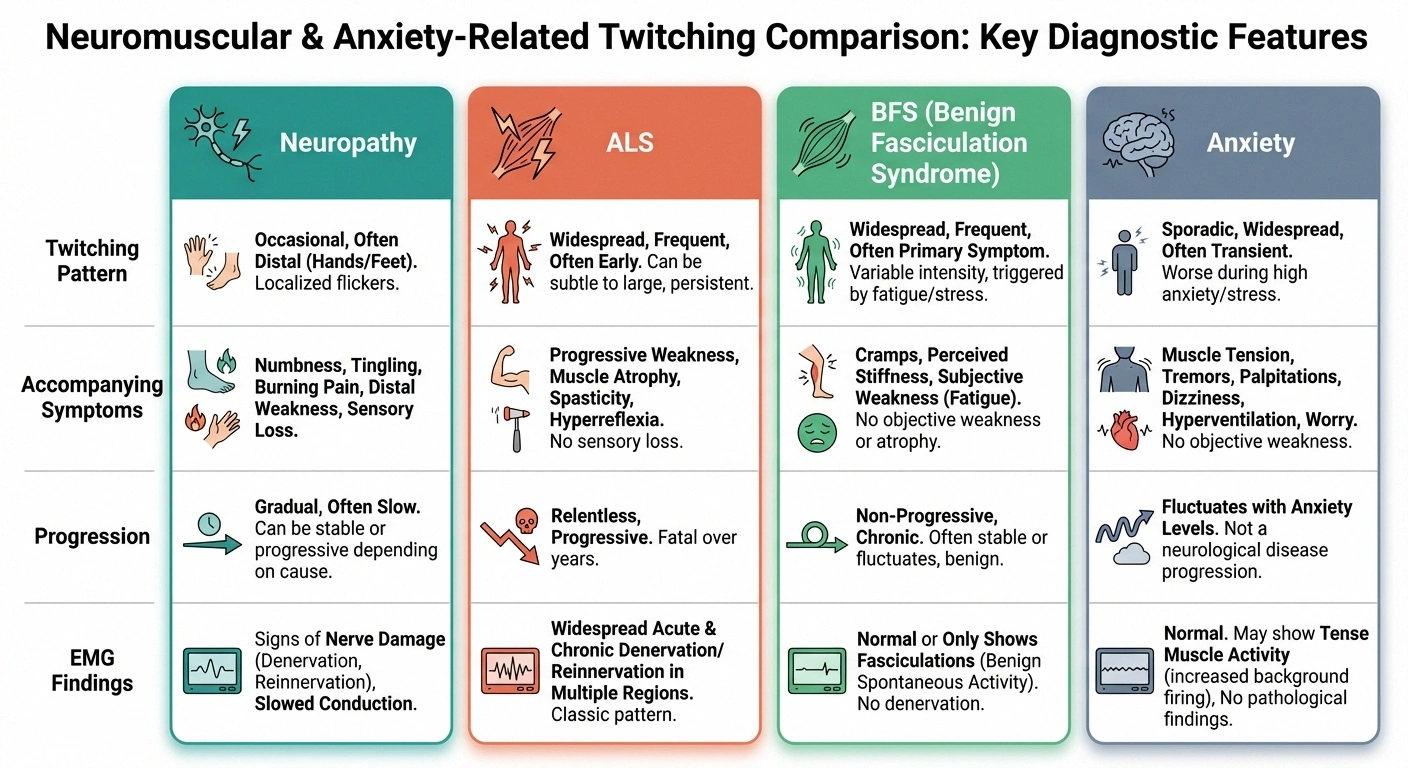
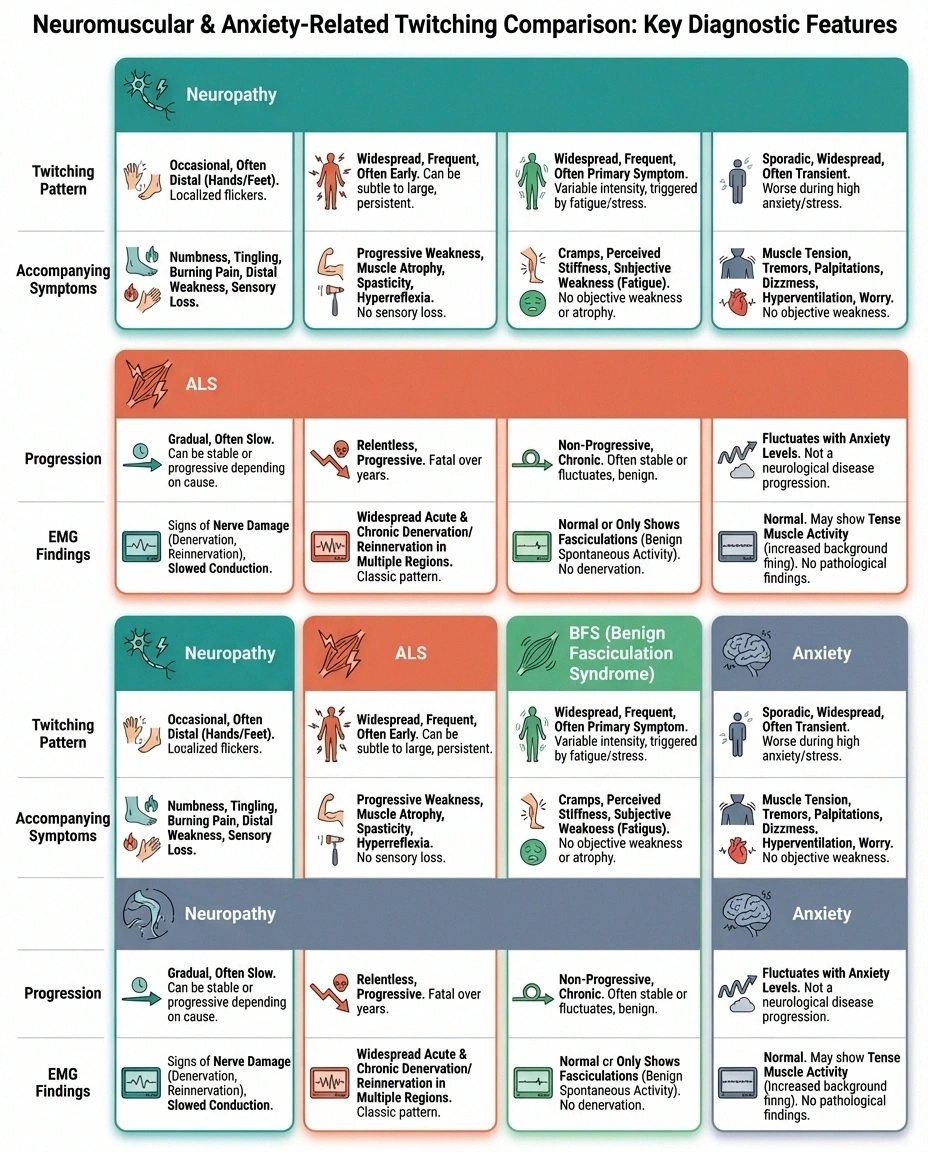
Twitching pattern: Neuropathy twitches tend to stay in areas where you have existing nerve damage — feet, lower legs, hands. ALS twitching often starts in one limb and spreads systematically over time. BFS twitching migrates randomly across the body, appearing in calves one day and eyelids the next. Anxiety twitching is widespread and unpredictable, often worst in the calves and face.
Accompanying symptoms: This is the single most important differentiator. Neuropathy brings sensory symptoms — tingling, numbness, burning, pain. ALS brings motor symptoms — weakness, wasting, stiffness, loss of function. BFS brings nothing else — just twitching. Anxiety brings psychological symptoms — worry, sleep disruption, hypervigilance, and often muscle tension (distinct from twitching).
Progression: Neuropathy progresses slowly over months to years, with gradual changes in sensation. ALS progresses steadily over weeks to months, with measurable functional decline. BFS may persist for years but doesn't progress — no new symptoms develop. Anxiety twitching fluctuates with stress and can last indefinitely but doesn't cause functional loss.
EMG findings: Neuropathy shows nerve conduction abnormalities and sometimes fasciculations. ALS shows fasciculations plus characteristic denervation patterns (fibrillations, positive sharp waves). BFS shows fasciculations only — everything else is normal. Anxiety-related twitching may show fasciculations but all other findings are normal.
When Twitching Is a Neuropathy Symptom
If you already have a neuropathy diagnosis, muscle twitching fits neatly into the picture. Damaged peripheral nerves are electrically unstable — they fire when they shouldn't, creating involuntary muscle contractions in the territory they serve.

Several types of neuropathy are particularly associated with twitching:
- Diabetic neuropathy — high blood sugar damages motor nerve fibers, causing fasciculations especially in the legs
- Small fiber neuropathy — though primarily a sensory condition, damaged small fibers can cause nearby motor neurons to become hyperexcitable
- Alcoholic neuropathy — alcohol's toxic effects on nerves can produce widespread twitching alongside sensory symptoms
- Inflammatory neuropathies — conditions like Guillain-Barré syndrome can cause significant fasciculations during nerve inflammation
If you have neuropathy and notice new or increased twitching, mention it to your neurologist at your next visit. While it may simply reflect progression of existing nerve damage, it can also signal a new cause — such as a vitamin deficiency or medication side effect — that's worth investigating.
The ALS Fear: Why It's So Common and Why It's Usually Wrong
If you've fallen into the ALS anxiety spiral, you're not alone. Neurologists have a name for it: ALS anxiety or cyberchondria. It's so common that ALS clinics regularly see patients whose only symptom is twitching plus overwhelming fear — and who leave with a BFS diagnosis and a recommendation for anxiety treatment.

Key Takeaway
“ALS announces itself with what you can't do, not with what you feel.” If you can still do everything you could six months ago, your twitching is almost certainly not ALS.
Here's why the fear is almost always unfounded. ALS affects approximately 5.2 people per 100,000, with about 6,000 new diagnoses per year in the United States. BFS, by contrast, affects a far larger population. When a young or middle-aged person presents with twitching without weakness, the probability of ALS is extraordinarily low.
Neurologists use a concept called “twitching without weakness.” In ALS, weakness almost always precedes or accompanies fasciculations. If you can still do everything you could do six months ago — open jars, climb stairs, button your shirt, speak clearly — your twitching is almost certainly not ALS. As one neurologist in our support group put it: “ALS announces itself with what you can't do, not with what you feel.”
That said, if you're worried, a neurological examination and EMG test can provide definitive reassurance. Most people find that a clean EMG reduces their anxiety dramatically — and that's a worthwhile outcome.
Diagnostic Testing: What Your Doctor Will Look For
When persistent twitching brings you to a neurologist, here's what they'll typically do to determine the cause.

When to See a Doctor
See a neurologist promptly if you have: progressive weakness in a specific limb, visible muscle wasting, new difficulty with speech or swallowing, or twitching concentrated in muscles that feel weaker. These warrant evaluation — though they still don't necessarily mean ALS.
Clinical neurological exam: This is the most important step. Your neurologist will test your reflexes, muscle strength, sensation, coordination, and gait. In ALS, there are usually detectable findings: brisk reflexes (upper motor neuron signs), weakness, or muscle wasting. In BFS and anxiety, the exam is completely normal.
EMG and nerve conduction study: An electromyography (EMG) test measures the electrical activity in your muscles. It's the gold standard for distinguishing between benign twitching and something more concerning. In ALS, the EMG shows specific patterns of denervation — not just fasciculations, but fibrillation potentials and positive sharp waves that indicate motor neurons are dying. In BFS, the EMG shows fasciculations but everything else is normal.
Blood work: Your doctor may order blood tests to check for treatable causes of nerve irritability: thyroid function, electrolytes (magnesium and calcium are especially relevant), vitamin B12, and blood glucose. Deficiencies in magnesium or B12 can cause twitching that resolves with supplementation.
Follow-up evaluation: If there's any uncertainty, your neurologist may want to see you again in 3-6 months. ALS progresses. BFS doesn't. Time is the ultimate diagnostic test — if nothing has changed or worsened at follow-up, ALS is essentially ruled out.
Treatment Approaches for Each Condition
Treatment depends entirely on the cause of your twitching. Here's what may help for each condition.
For neuropathy-related twitching: Address the underlying neuropathy. This means managing the root cause (blood sugar control for diabetic neuropathy, nutritional supplementation for deficiency-related neuropathy) alongside symptom management with medications like gabapentin or pregabalin. Browse all our treatment guides for detailed options. Magnesium supplementation may help reduce fasciculations specifically, as it plays a key role in nerve and muscle function.
For BFS: There's no cure for BFS, but several strategies can reduce twitching. Reducing caffeine, improving sleep, managing stress, and regular gentle exercise all help. Some neurologists prescribe low-dose anticonvulsants or beta-blockers. But the single most effective treatment for many people is addressing the anxiety that accompanies BFS — through cognitive behavioral therapy, mindfulness meditation, or medication.
For anxiety-related twitching: Treat the anxiety. Cognitive behavioral therapy (CBT) is highly effective for health anxiety. Mindfulness and relaxation techniques can reduce the nervous system hyperactivity that drives twitching. Regular physical exercise is one of the best natural anxiety treatments available. If anxiety is severe, SSRIs or other anxiety medications may be appropriate — discuss with your physician.
For ALS: If ALS is diagnosed, treatment focuses on slowing progression and maintaining quality of life. Riluzole and edaravone are FDA-approved treatments. A multidisciplinary ALS team including neurologists, respiratory therapists, speech therapists, and physical therapists provides comprehensive care. The ALS Association (als.org) offers extensive resources for patients and families.
Self-Assessment: A Practical Checklist
While only a neurologist can give you a definitive diagnosis, this checklist can help you organize your thinking and reduce unnecessary panic. Honestly assess each question.
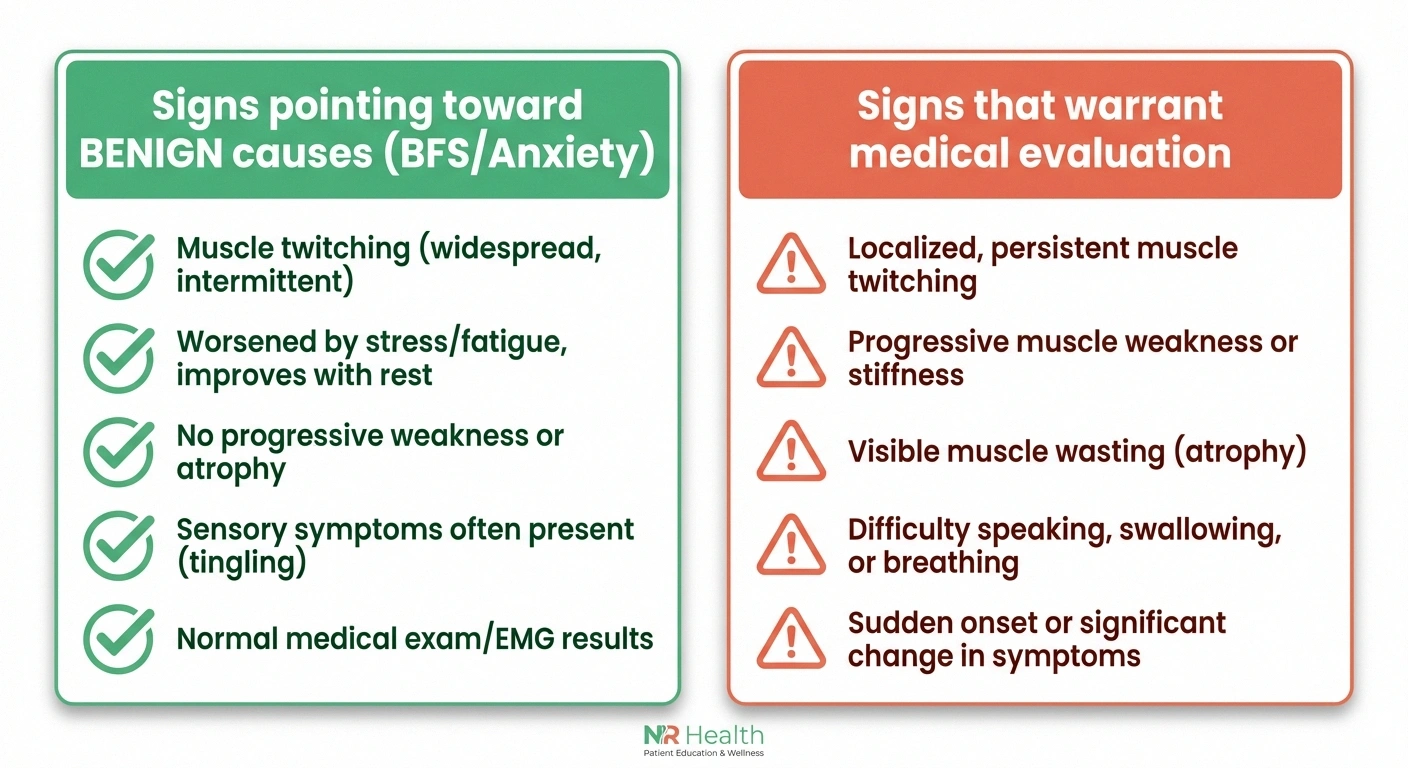
✅ Signs Pointing Toward Benign Causes
Twitching migrates randomly across different body parts
No measurable loss of strength
Worsens with stress, caffeine, or poor sleep
Neurological exam was normal
Started after a period of high stress or illness
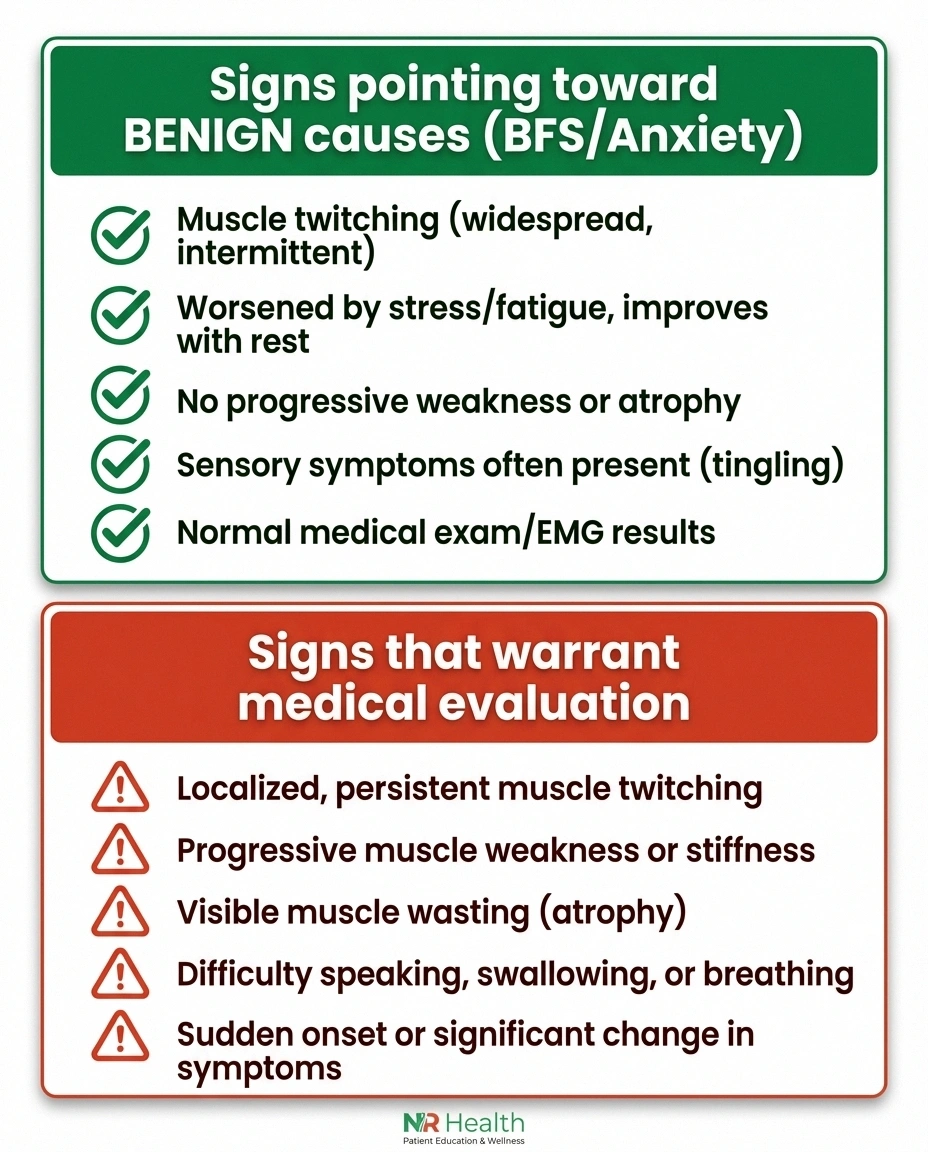
Signs pointing toward benign causes (BFS/anxiety):
- Twitching migrates randomly across different body parts
- No measurable loss of strength (you can do everything you could 6 months ago)
- Twitching worsens with stress, caffeine, or poor sleep
- You spend significant time Googling symptoms
- Your neurological exam was normal
- Twitching started after a period of high stress or illness
Signs that warrant medical evaluation:
- Progressive weakness in a specific limb (not general fatigue)
- Visible muscle wasting (one hand or calf looks smaller than the other)
- Difficulty with previously easy tasks (opening jars, buttoning shirts)
- New speech changes (slurring, difficulty finding words physically)
- Difficulty swallowing that's getting worse
- Twitching concentrated in muscles that feel weak
If any item in the second list applies to you, schedule an appointment with a neurologist. Not urgently, but within the next few weeks. If nothing in the second list applies, your twitching is very likely benign — but you can still see a doctor for peace of mind.
Living with Persistent Twitching: Practical Advice
Whether your twitching comes from neuropathy, BFS, or anxiety, learning to coexist with it is an important skill. Here's what has helped me and the people in our community.

Limit symptom Googling. This is the single hardest but most impactful change you can make. Health anxiety feeds on information-seeking behavior. Set a rule: one Google search per new symptom, maximum. Bookmark one trusted source (like this site or Mayo Clinic) and go there instead of into the search rabbit hole.
Address the basics. Reduce caffeine to one cup of coffee per day or less. Prioritize 7-8 hours of quality sleep. Stay hydrated. Consider a magnesium supplement (magnesium glycinate is well-absorbed and gentle on the stomach). These simple changes eliminate twitching entirely for some people.
Move your body. Regular exercise — even gentle walking — reduces both anxiety and nerve irritability. It's one of the few interventions that addresses every possible cause of twitching simultaneously.
Track your patterns. Keep a brief journal noting when twitches are worse. You may discover triggers you hadn't noticed: certain foods, sleep deprivation, alcohol, specific medications, or stressful situations. Understanding your pattern gives you a sense of control.
Connect with others. Support groups — both for neuropathy and for BFS — can be incredibly reassuring. Hearing that thousands of other people twitch constantly and are perfectly fine takes the edge off the fear.
Frequently Asked Questions
Can muscle twitching be the first sign of ALS?
While fasciculations can occur in ALS, they are rarely the first or only symptom. ALS typically presents with progressive weakness, muscle wasting, or difficulty with specific movements before twitching becomes prominent. Isolated twitching without weakness is far more consistent with BFS or anxiety. If twitching is your only symptom and your neurological exam is normal, the probability of ALS is extremely low.
How long does benign fasciculation syndrome last?
BFS can last anywhere from a few months to many years. Some people experience twitching for the rest of their lives, though it typically becomes less frequent and less anxiety-provoking over time. The twitching itself does not cause harm or indicate progression to a more serious condition. Many people find that as their anxiety about the twitching decreases, the twitching itself diminishes.
Should I get an EMG if my muscles are twitching?
An EMG is recommended if your twitching is accompanied by weakness, muscle wasting, or other neurological symptoms — or if the anxiety about what's causing the twitching is significantly affecting your quality of life. A normal EMG can provide tremendous peace of mind. However, if your neurological exam is completely normal and you have no weakness, many neurologists consider an EMG optional.
Can neuropathy cause twitching in muscles all over the body?
Neuropathy-related twitching usually occurs in areas where nerve damage is present — typically the feet, legs, and hands. Widespread twitching affecting many body parts is more consistent with BFS or anxiety. However, conditions that cause widespread neuropathy, such as diabetic neuropathy or inflammatory neuropathies, can produce twitching in multiple areas.
Does caffeine make muscle twitching worse?
Yes. Caffeine stimulates the nervous system and increases nerve excitability, which can trigger or worsen fasciculations from any cause. Reducing caffeine intake is one of the most commonly recommended first steps for managing persistent twitching. Many people notice a significant reduction in twitching within one to two weeks of cutting back on caffeine.
When should I see a neurologist about muscle twitching?
See a neurologist if your twitching is accompanied by progressive weakness, visible muscle wasting, difficulty speaking or swallowing, or if it persists for more than three months and causes significant anxiety. You should also seek evaluation if twitching develops alongside new numbness or tingling, which may indicate peripheral neuropathy that should be diagnosed and treated.
The Bottom Line
Muscle twitching is extraordinarily common and almost always benign. If you have neuropathy, it's likely just another expression of nerve damage you're already managing. If you don't have neuropathy, BFS and anxiety account for the vast majority of persistent twitching. ALS is rare and presents with progressive weakness and functional loss — not just twitching.

The most important thing you can do is see your doctor if you're worried. A neurological exam and, if needed, an EMG can give you a clear answer. And once you have that answer, focus your energy on the things that actually help: managing stress, improving sleep, reducing caffeine, and staying active.
If you're living with neuropathy and experiencing twitching as part of your symptom picture, talk to your neurologist about it at your next appointment. It may reveal something treatable — or simply confirm that your nerves are doing what damaged nerves do. Either way, knowledge is the antidote to fear.
About the Author