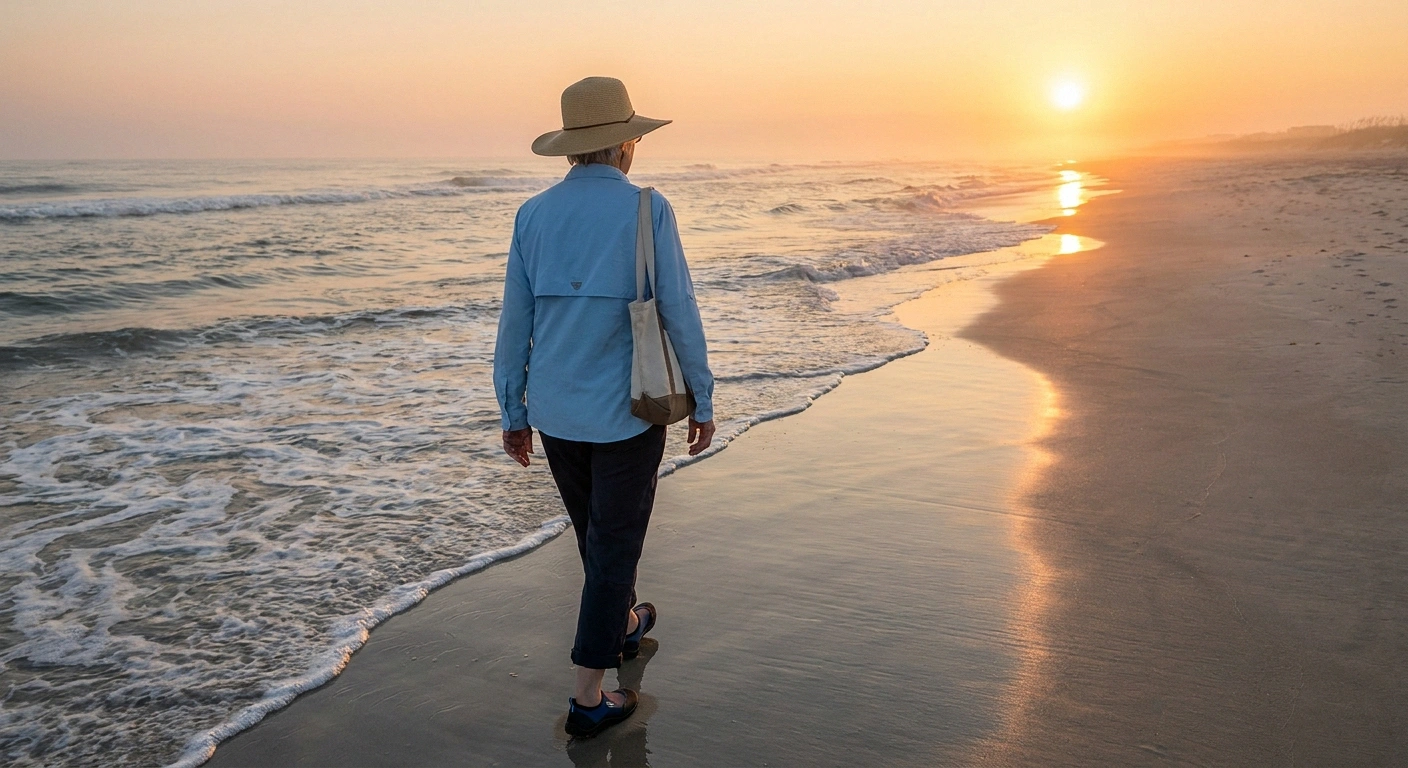
My daughter and her family rented a beach house on the Outer Banks last summer, and I was determined to go. Determined isn't the right word — I was a little scared. The last time I'd walked on sand was probably three years before, and that was a brief, careful shuffle from boardwalk to chair on a vacation right after my neuropathy diagnosis. I'd half convinced myself that the beach was a place I used to go.
It turned out the beach is still a place I go. But the trip taught me a great deal about how to make a beach day actually work with neuropathy, and not in a sad-substitute way — in a real, walk-along-the-water, take-the-grandkids-for-shells way. Most of it came down to preparation. A small amount came down to expectations. None of it required heroics.
Here is what I learned from that trip and the ones since.
Why Sand Is Trickier Than It Looks
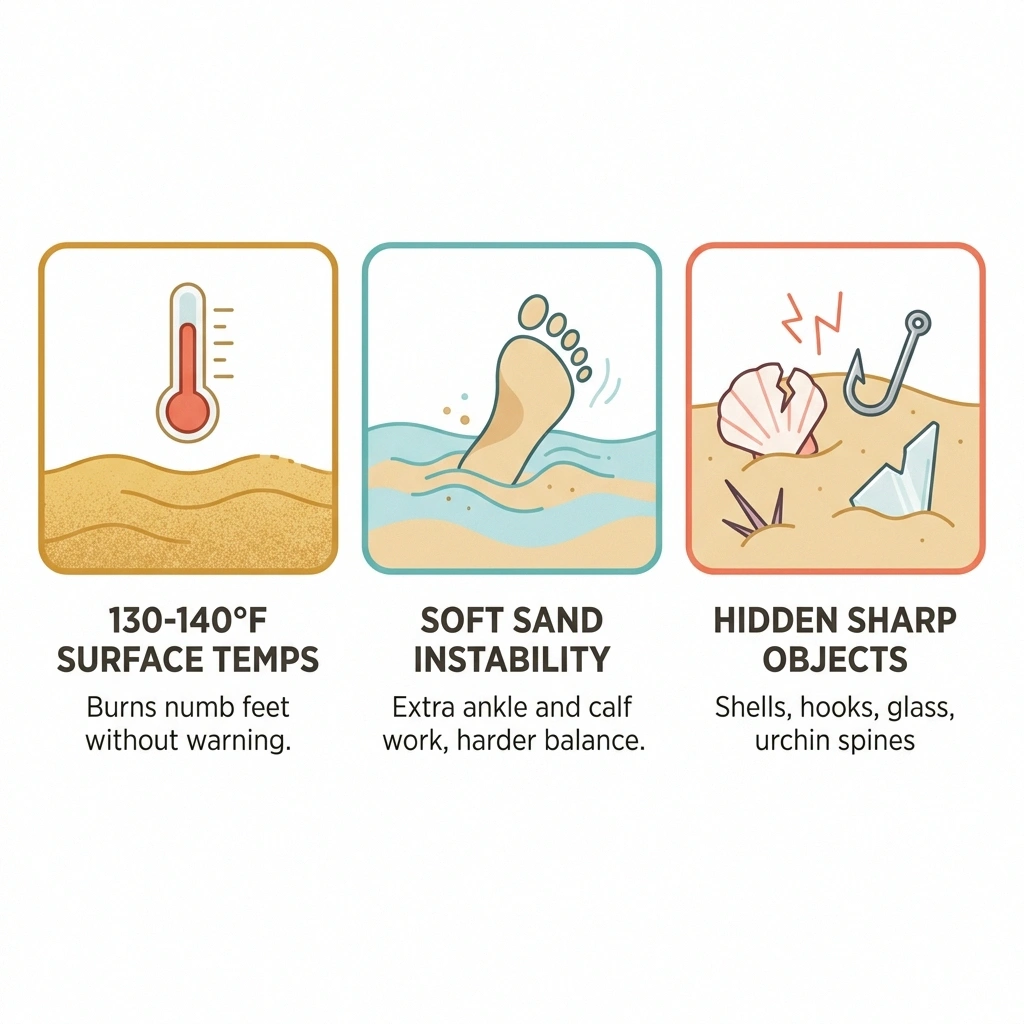
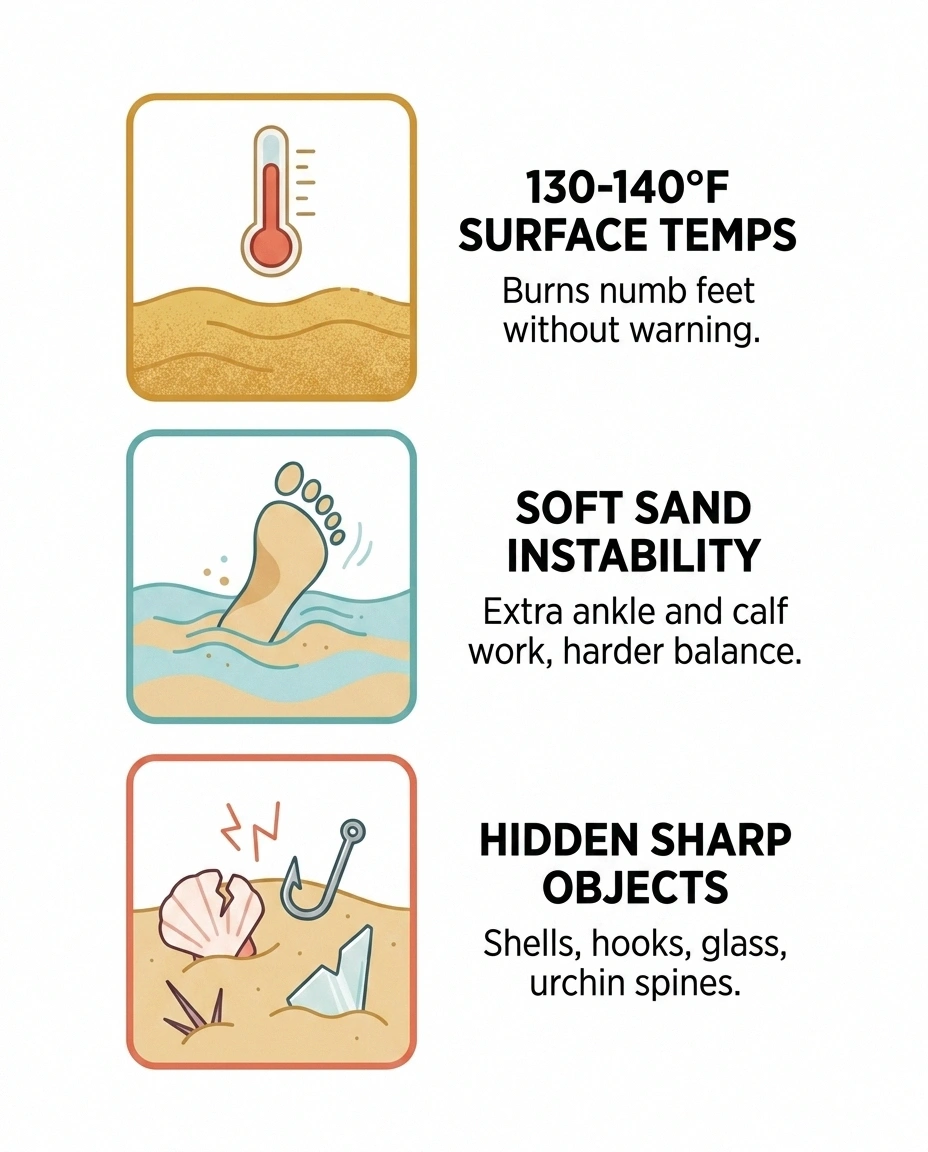
Before you even get to the water, sand presents three problems for someone with peripheral neuropathy.
Key Takeaway
The beach is still a place you can go with neuropathy. Three rules cover most of the safety: don't go barefoot, walk on the wet packed sand at the tide line, and plan around midday heat. The five-minute after-beach foot inspection determines whether you have a great vacation or a bad one.
The first is heat. Dry sand in direct sun in the middle of the day can hit 130 to 140 degrees on the surface — hot enough to produce a second-degree burn on the bottom of a foot within seconds. If your feet are numb from diabetic neuropathy or any other cause, the burn happens without the warning signals that would normally make you yelp and step off. People have made it back to their cars with blistered soles they didn't feel forming.
The second is instability. Soft dry sand shifts under every step. Your ankle has to work harder, your calves work harder, and your balance system gets less reliable information. For people whose balance is already compromised by reduced foot sensation, this compounds the problem. Falls on sand are usually soft, but the energy cost of constantly correcting your gait is high, and a single stumble can wrench an ankle.
The third is what's hidden in the sand. Broken shells with edges sharp enough to slice deli meat. Discarded fishing hooks. Glass from someone's beer bottle. Cigarette ends. Sea urchin spines washed up after a storm. Dried-up bits of jellyfish tentacle that still sting. Your eyes don't see most of these. Your fingertips would feel them if you brushed your hand over the sand. Your numb feet don't get either chance.
None of these problems eliminate the beach as a possibility. They just mean you don't go barefoot, you don't walk through deep dry sand if you can avoid it, and you plan around the heat. The rest of this article is what those three rules look like in practice.
The Footwear Question — Don't Go Barefoot
I know the romance of bare feet on the beach is real. I grew up doing it. If you have any meaningful loss of sensation in your feet, you'll have to let that piece of romance go and replace it with a different one. The good news is that the right beach footwear is so good now that within a few minutes you stop noticing them at all, and you'll get hours on the beach instead of an emergency-room trip in the middle of vacation.
The Burn You Don't Feel
Dry sand in midday sun can hit 130-140°F — hot enough to produce second-degree burns on the bottom of a foot within seconds. Numb feet don't yelp. People have made it back to their cars with blistered soles they didn't feel forming. Wear closed-toe water shoes on the sand at all times.
What works:
Water shoes or aqua socks are the best general-purpose answer. The ones I bought after my Outer Banks trip have a soft synthetic upper, a fitted collar around the ankle that keeps sand out, mesh ventilation, drainage holes underfoot, and a sole that's flexible but thick enough to insulate from hot sand and protect against shells. They go from the sand into the surf without changing. They dry on the walk back to the house. They cost maybe twenty-five dollars at a sporting goods store.
Snug-fitting closed-toe sandals with secure straps are a reasonable alternative for the walk down to the water if you're not planning to swim. The key is closed toes (toe protection) and straps that actually hold the sandal on your foot through soft sand. Loose flip-flops are the worst possible option — they offer no protection, they slide off in sand, they slap against numb soles in a way that bruises without you knowing, and the toe-thong gives blisters between toes.
Light colors over dark. Black water shoes in midday sun get noticeably hotter than white or gray ones. This matters more than you'd think when you're walking on hot sand for a half hour.
What to avoid:
- Flip-flops or thong sandals, for the reasons above.
- Heavy clogs and rubber gardening shoes — they sink in soft sand and twist your ankles.
- Thin slip-on canvas shoes — sand grit gets in immediately and abrades skin you can't feel, like sandpaper inside the shoe.
- Going barefoot to “just walk down to the water” — this is when most of the burns and cuts happen.
Walking on the Sand Itself
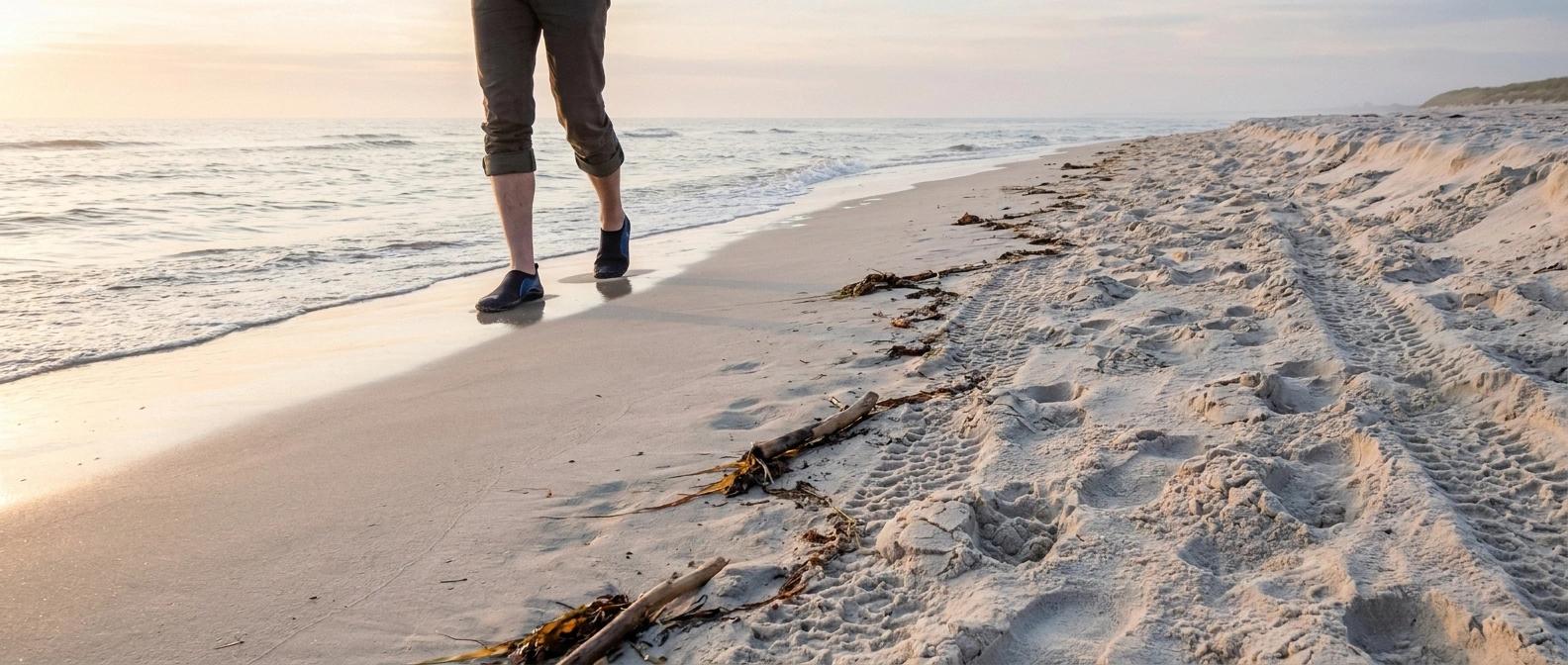
The single most useful piece of beach advice I can pass along is this: walk on the wet packed sand at the tide line, not on the soft dry sand higher up.
Beach Footwear Ladder
✓ Closed-toe water shoes — the answer for almost everything
Snug ankle, drainage holes, light color, ~$25 at sport stores. Go from sand to surf to walk back without changing.
Snug-fit closed-toe sport sandals — reasonable for non-swim trips
Secure straps that hold through soft sand. Closed toe protection.
✗ Avoid: flip-flops, heavy clogs, thin canvas slip-ons
No toe protection, slap or sink, sand grit abrades numb skin like sandpaper.
✗ Avoid: “just walk down barefoot” — this is when burns and cuts happen
No exceptions on hot or unknown sand.
Wet packed sand is dramatically more stable than dry. Your foot doesn't sink. Your gait stays close to what it would be on a sidewalk. Your calves and Achilles tendons aren't doing extra work with every step. Your balance system gets reliable feedback. The transition from a beach chair to a tide-line walk is the difference between a quarter-mile of effort and a quarter-mile of pleasure.
A few more practical points:
Use a trekking pole or walking stick if balance is an issue. A simple collapsible hiking pole gives your nervous system a third point of contact and a way to test what's about to be under your foot. On uneven sand it can be the difference between walking with confidence and creeping along watching every step. They cost very little and they fold into a beach bag.
Walk with someone. The beach is a great place to bring company. It's also a place where a stumble or a foot cut can become a real problem fast if you're alone and your car is a quarter-mile back across hot sand.
Don't push the distance. Sand walking burns roughly twice the calories of pavement walking at the same pace, and it's harder on the calves and feet even if you don't feel it. If you can comfortably walk a mile around your neighborhood, plan on a half-mile maximum on the beach for your first outing, and see how it lands.
Map the route by landmarks. Beaches stretch on indefinitely. It's easy to walk fifteen minutes out and underestimate the return. Pick a visible landmark — a fishing pier, a distinctive house, an umbrella — for your turn-around point and respect it.
The Heat Strategy
The most reliable way to handle beach heat with neuropathy is to be on the beach when the heat isn't a problem. The sand surface, the sun on your skin, and the dehydration risk all stack together in a way that hits people with nerve damage harder than they expect.
Beach-Day Schedule That Works
Sunrise – 10 a.m.
Active beach time. Walking, swimming, shell hunting. Cool sand, gentle sun, thin crowd.
10 a.m. – 4 p.m.
Off the beach. Covered porch, indoors, deep shade. Real meal. Hydration. Rest.
4 p.m. – sunset
Optional second session. Sand is cooling, light is beautiful, wind picks up.
The schedule that works for most people in our group:
- Sunrise to 10 a.m. for active walking, swimming, shell hunting. The sand is cool. The sun is gentle. The crowd is thin.
- Midday back at the house, on a covered porch, or under heavy shade with a real meal and rest.
- 4 p.m. to sunset for a second beach session if you want one. Sand is cooling. Light is beautiful. The wind picks up.
If a midday beach trip is unavoidable, set up under a beach umbrella or a small canopy. Lay a beach towel as a heat shield for any stretch you need to walk between the chair and the water. Drink water steadily — caffeine and alcohol both dehydrate, and dehydration measurably worsens nerve symptoms for many people.
Watch yourself for early signs of heat trouble: lightheadedness on standing, a damp clammy quality to your skin even though you're not sweating heavily, a vague nauseated feeling. Any of those means head inside or under deep shade and rehydrate. Heat exhaustion is sneaky, and being numb in your feet means you're missing one of the early-warning channels.
The Water Itself
This was my favorite discovery. Standing in water up to my waist, my feet didn't hurt the way they hurt on land. The buoyancy took weight off my legs. The cool gentle pressure of moving water around my calves was actually calming. I was upright, supported, and the burning in my feet quieted to a hum.
Why the Water Helps
Buoyancy removes much of your weight from your legs. Hydrostatic pressure of moving water around your calves quiets nerve symptoms for many people. Cool water dampens the burning sensation in damaged C-fibers. For many people with peripheral neuropathy, standing waist-deep in the surf is the most comfortable their feet have been all year.
For many people with peripheral neuropathy, the water is the best part of the beach. A few cautions before you get in.
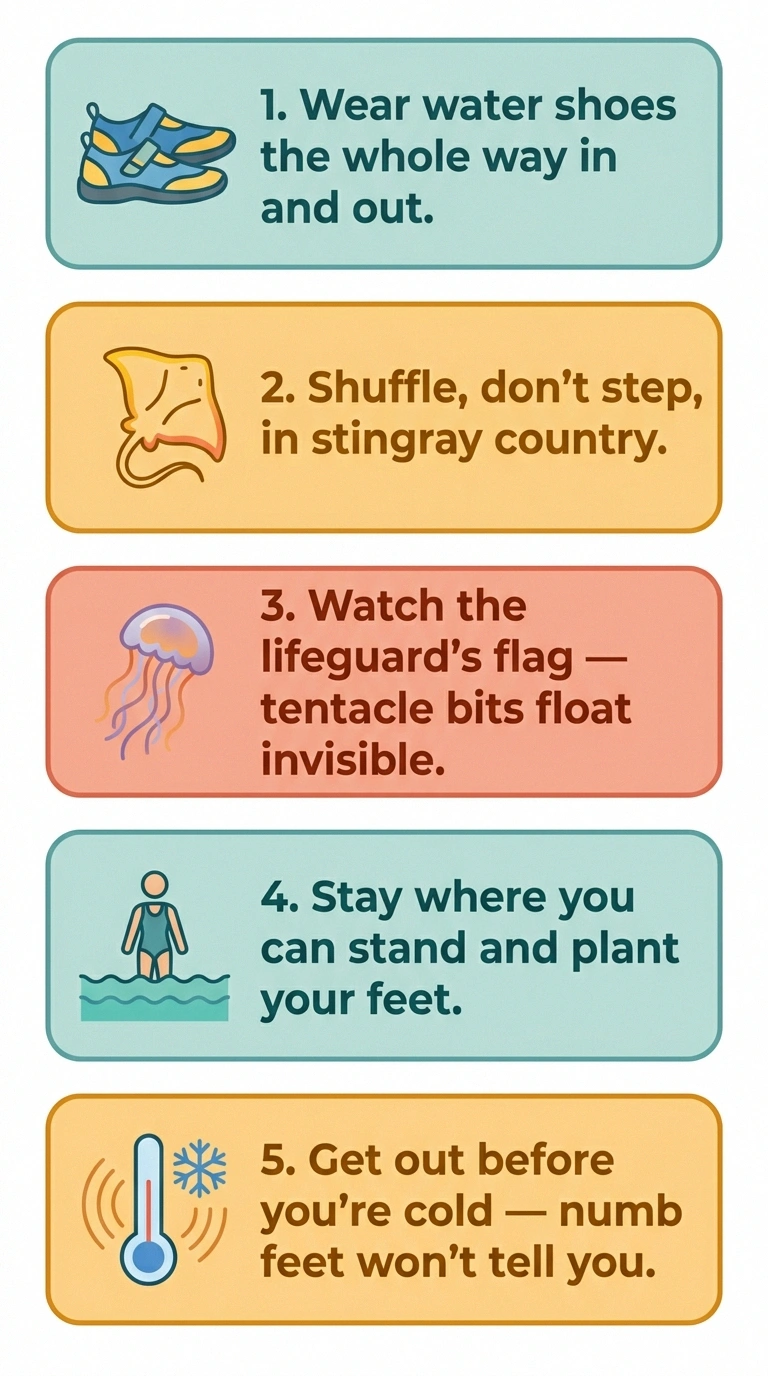
Wear the water shoes into the water. Sharp shells, sea urchin spines, broken glass, and stingrays don't stop at the water line. Wear the water shoes the whole way in and out. If you must take them off to swim, do so once you're in water deep enough to swim and put them back on before you wade back out.
Shuffle, don't step, in stingray country. The Gulf coast, parts of the Atlantic south of Virginia, and most of the Pacific have stingrays that bury in the sand in shallow water. Shuffling your feet (rather than picking them up and putting them down) gives the rays a chance to swim away rather than getting stepped on. A stingray sting on a numb foot can be serious and you might not feel the initial strike.
Know what jellyfish are around. A good rule: if the lifeguard's flag indicates jellies, take the day off the water. If you see jellyfish on the sand, assume there are pieces of tentacle floating in the water you can't see. Numb skin doesn't shield you from a sting; it just means you might miss the warning twinge.
Stay where you can stand. Strong swimmers with neuropathy can get into trouble when a cramp or a wave knocks them sideways. Stay in water shallow enough that you can plant your feet and recover.
Get out before you're cold. Numb feet can't tell you the water is too cold for you. Look for goose bumps on your forearms, a faint shiver, or fingertips going pale — those are your cues.
The Best Investment for a Whole-Family Beach Day
If you're going with younger family who want to be on the beach all day, two things change the experience completely.
The first is a beach wheelchair. Most state and county beaches in the US, and many resort beaches, have free beach wheelchairs available — these have wide balloon tires that roll easily through soft sand and into shallow water. You usually call ahead the day before or check at the lifeguard stand. Even if you can walk on the wet sand fine, having a beach wheelchair available for the trip from the parking lot to your spot saves your legs for the part of the day that matters. Don't think of it as a defeat; think of it as transportation.
The second is a low beach chair set at the water line. The kind that puts you a few inches off the sand with a built-in canopy. Place it where the smallest waves wash over your feet. You can sit in the surf for hours, watch the kids, dip in when you want, and you've taken the standing-and-walking question off the table for most of the day.
The After-Beach Foot Routine
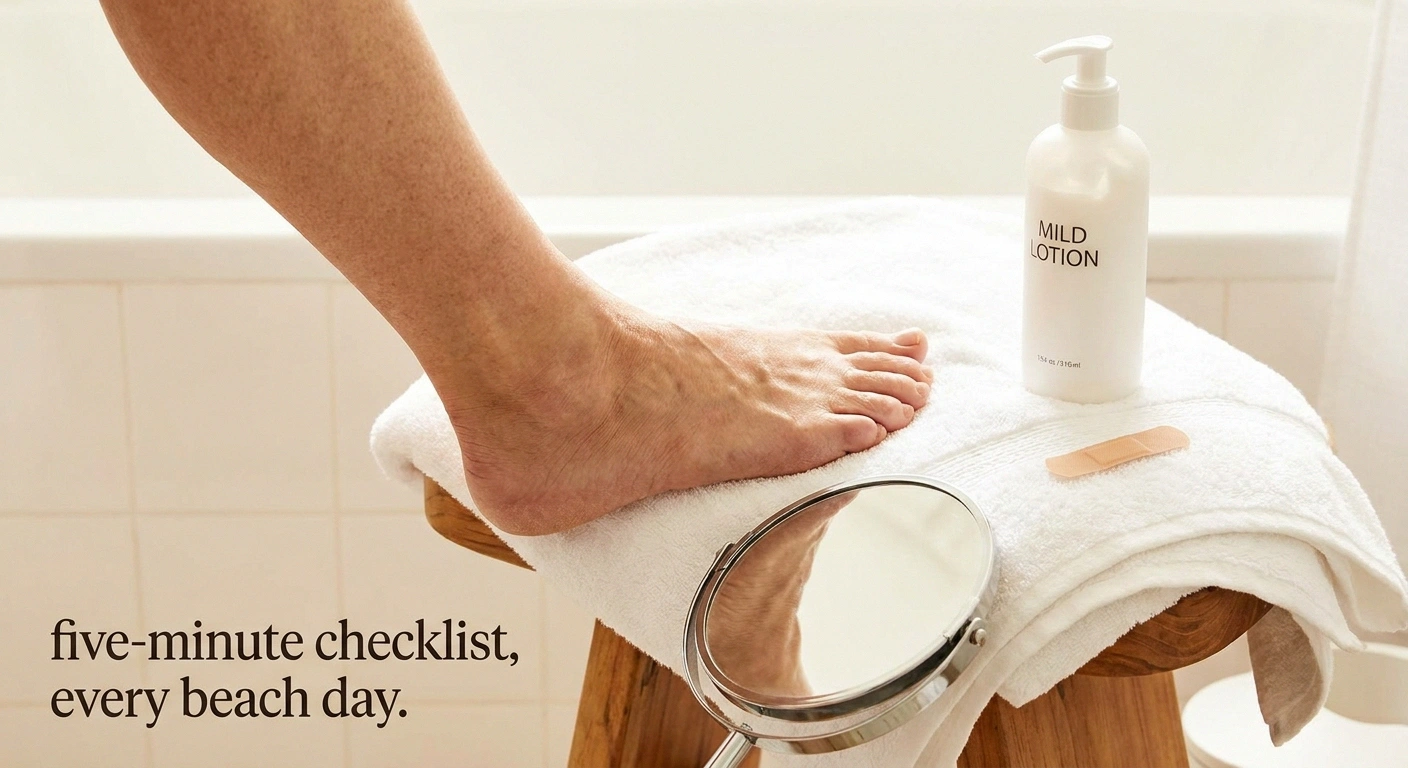
This is the part I want to underline three times. Whatever happens on the beach, your foot routine when you get home determines whether you have a great vacation or a bad one.
5-Minute After-Beach Foot Routine
1. Rinse. Sand and salt off feet and ankles. Between every toe.
2. Dry between every toe. Fungal-infection prevention — especially with diabetes.
3. Inspect both feet. Tops, bottoms, between toes. Use a mirror for angles you can't see.
4. Moisturize. Tops and bottoms. Skip between toes.
5. Change socks. If you put any on for the trip home, damp ones come off now.
The minute you're back at the house or the car:
- Rinse the sand off your feet and ankles thoroughly. Sand grit between toes is a sandpaper environment against numb skin. A long rinse, including between every toe, prevents the small abrasions that turn into trouble later.
- Dry thoroughly between every toe. Wet skin between toes is the favorite environment of athlete's foot. People with diabetes especially need to be vigilant — a fungal infection in numb feet can lead to a bacterial infection in numb feet, which can lead to an ulcer.
- Look at every part of both feet. Tops, bottoms, between toes, around the heels. Use a mirror if you can't see all the angles. You're looking for cuts you didn't feel, embedded sand or shell fragments, blisters forming, redness, hot spots. Any cut gets cleaned and covered. Any embedded splinter or shell fragment that won't come out easily needs a clinician same day.
- Moisturize. Sun and salt are drying. Dry cracked feet are at higher risk for skin breakdown later. A simple unscented lotion on the tops and bottoms (skip between the toes) works fine.
- Change socks if you put any on for the trip home. Damp socks plus warm car equals same fungal problem as wet toes.
This whole routine takes five minutes. It is the single highest-leverage habit for keeping the beach safe with neuropathy.
When to Skip the Beach Day or Cut It Short
A few signs that mean go home now, not later:
- A cramp in a calf that doesn't release within a minute or two of stretching, or that comes back repeatedly.
- Numbness or pain that extends past where it usually lives. New pattern is information.
- Any cut, stick, or possible foreign body in the foot.
- Lightheadedness on standing, persistent nausea, or sweating that stops being noticeable.
- A calf that becomes hard and tight and won't loosen — could be cramp, could be something more serious. Either way, the beach isn't the place to figure it out.
None of these mean you can't come back tomorrow. They mean the budget for today is spent.
What I Take to the Beach Now
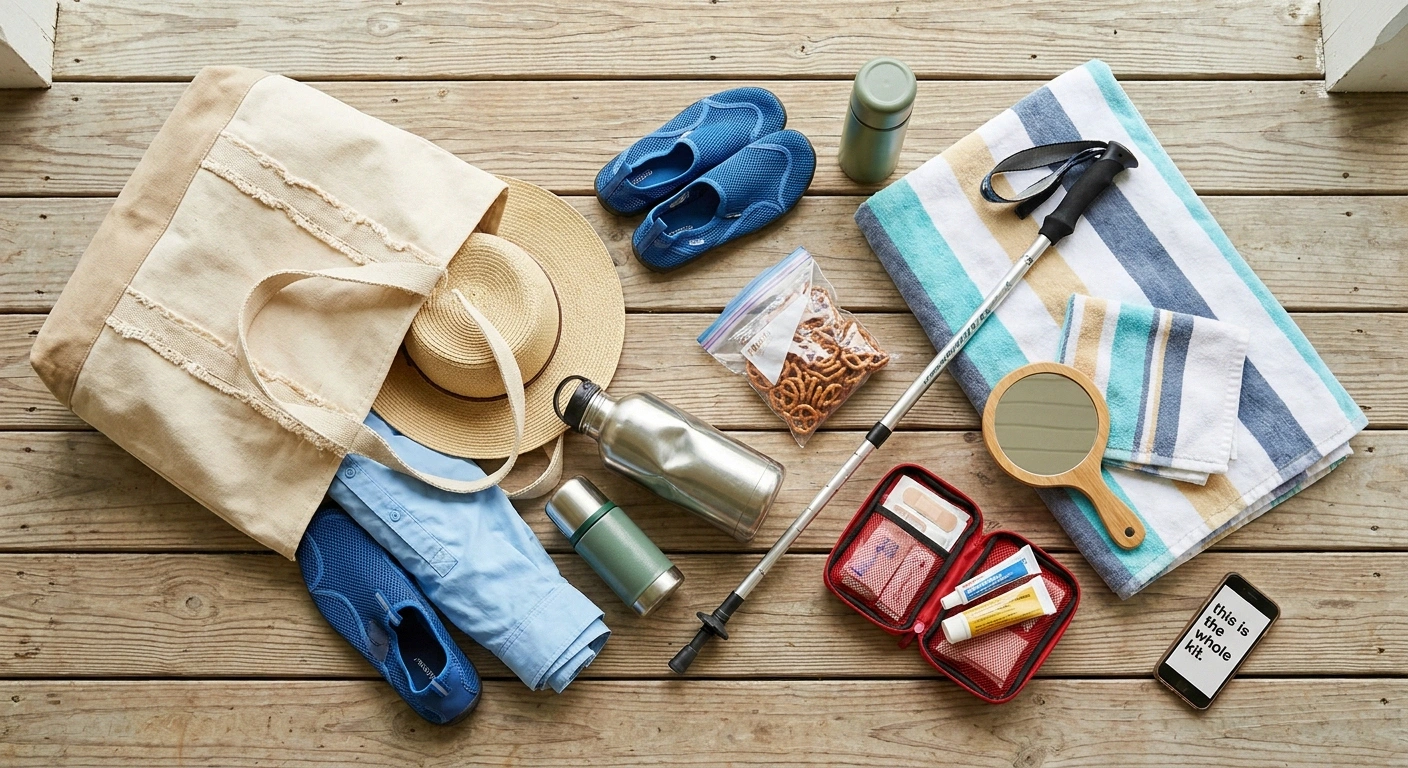
For anyone wanting a checklist, here's what I keep in my beach bag:
- Water shoes (worn from the car).
- A wide-brim hat.
- Long-sleeve light sun shirt and sunscreen (reapplied with attention to feet — the tops of feet sunburn easily and you may not feel it).
- A two-liter water bottle and a small thermos with iced herbal tea.
- A snack with both salt and carbs — pretzels and a banana, or a small sandwich.
- A folding trekking pole.
- A clean dry towel and a separate one for foot drying.
- A small first-aid kit with antibiotic ointment and assorted bandages.
- A mirror for foot inspection.
- My phone with someone's number set up for quick dial.
That bag fits over my shoulder and covers nearly every beach-day need.
The Trip That Changed What I Thought Was Possible
The Outer Banks trip ended better than I'd expected and worse than my grandkids did. I got out four mornings in a row for unhurried walks along the tide line. I sat in a low beach chair in the surf for two of those mornings. I built a sandcastle with my five-year-old grandson that he later flooded on purpose by digging a channel to the water. I rinsed my feet on the porch of the rental every time I came back, dried between every toe, looked at every inch, and went into the trip's last day with my feet in better shape than they'd been in months.
The grandkids were exhausted by Wednesday. They had to nap. I, the woman with the chronic illness, was the most refreshed adult in the house most evenings. There's a lesson somewhere about pacing in there, but mostly there's a lesson about not letting fear retire activities you still love.
If you've been telling yourself the beach is a place you used to go, I'd encourage you to put one short, well-prepared beach morning back on your calendar this summer. Pack the water shoes. Pack the water bottle. Go early. Walk the tide line. Sit in the surf. Do the foot check when you come home. Then decide whether the beach is still a place you used to go, or whether it's a place you go.
Frequently Asked Questions
Can I ever go barefoot on the beach with neuropathy?
For someone with meaningful loss of sensation, my honest answer is essentially no — at least not on hot sand or in any area where shells, fishhooks, or beach debris might be present. The risk of a burn or cut you can't feel is too high relative to the small pleasure of barefoot walking. Rare exceptions for very cool dewy morning sand and very controlled stretches close to your blanket might be tolerable for a few minutes. Otherwise wear protective shoes throughout the day.
What kind of water shoe should I buy?
Look for closed toes, a snug ankle collar to keep sand out, drainage holes underfoot, a flexible but reasonably thick sole, and a light color. The brand matters less than those features. Many people with neuropathy do well in mid-range sport-store options around twenty to thirty dollars. Premium models offer better cushioning and durability if you'll use them often.
Is swimming with neuropathy safe?
For most people with peripheral neuropathy, swimming is one of the best exercises available — buoyancy reduces joint load, the water is gentle on burning nerves, and the rhythmic movement supports circulation. Stay where you can stand, wear water shoes through the surf zone, watch for hypothermia signs you might not feel, and avoid swimming alone. If you have autonomic neuropathy with blood pressure regulation issues, exit the water slowly to give your body time to adjust.
Can I lay in the sun on the beach?
Yes, under an umbrella or canopy and with attention to the tops of your feet. Many people with neuropathy don't feel sunburn forming and end up with bad burns on feet, knees, and shoulders. Reapply sunscreen every couple of hours and keep a long-sleeve sun shirt or beach cover handy.
What if I step on something and don't feel it?
This is the case for the after-beach foot inspection. A glance over every inch of both feet — top, bottom, between toes — when you get home catches what your nerves missed. Anything that looks like a cut, a splinter, a piece of shell, or a developing blister gets cleaned and covered immediately. Anything embedded that won't come out gently needs a clinician same day.
Are there beaches that are easier with neuropathy?
Yes. Beaches with hard packed sand (some Atlantic and Gulf beaches), beaches with boardwalks reaching close to the water, and beaches with available beach wheelchairs all reduce the difficulty. Many state parks and resort areas list these amenities on their websites. A quick call to the local visitor bureau before booking can save a lot of guessing.
What about my balance — can I walk on sand without falling?
Wet packed sand at the tide line is much easier than soft dry sand. Add a trekking pole if balance is a concern, walk with company, and start with short distances. If your walking baseline is shaky on flat ground, plan beach walking only with a companion and a pole, and stick to the wet sand strip exclusively.
How do I get a beach wheelchair?
Most public beaches in the US have one or more available, typically at no charge. Call the local parks department or lifeguard station the day before you visit. Some require reservations on busy weekends. Resort beaches and accessible-vacation rental properties often have them on site.
What if I get a cramp in the water?
If you can stand, plant your feet and stretch the cramped muscle gently. If the cramp is in deep water, signal for help. Drink water and a small electrolyte drink before the beach to reduce cramp risk, especially on hot days. If cramps are happening regularly, talk with your doctor about magnesium and other contributors.
About the Author