Most people who stop taking a neuropathy medication stop in the first two weeks.
That timing matters more than it looks. Two weeks is roughly how long the worst of the dizziness and grogginess lasts on the gabapentinoids, and it is well before most of these drugs have reached a dose where anyone could judge whether they work. So a large share of the people who conclude “that one didn’t help me” never actually found out. They found out they could not tolerate week two.
The chart below is built around that problem. It compares the four medications most often prescribed first for nerve pain, not on how well they work, but on what they do to you while you take them. And it sorts those effects by the only question that changes a decision: does this fade, or does this stay?
Why This Chart Is Not Ranked Best to Worst
There is a good reason no honest version of this page crowns a winner.
The OPTION-DM trial, a multicentre double-blind crossover study, ran three different treatment pathways against each other in people with painful diabetic neuropathy: amitriptyline supplemented with pregabalin, pregabalin supplemented with amitriptyline, and duloxetine supplemented with pregabalin. All three produced similar pain relief.
Read that again, because it reorganizes the whole decision. If the pathways land in roughly the same place on pain, then the thing that separates them is not effectiveness. It is what you have to live with along the way, and what happens to be true about your kidneys, your balance, your weight, your age, and everything else you already take.
Which means the right first drug is not a fact about the drug. It is a fact about you.
The Four First-Line Options at a Glance
Two drug families cover most first prescriptions.
The four drugs, on the details that are not side effects
Clearance route determines whose kidneys or liver matter. Dosing frequency determines whether you will remember to take it.
| Drug | Class | Cleared by | Doses per day | Usual cautious start |
|---|---|---|---|---|
| Gabapentin | Gabapentinoid | Kidneys | Three | One low dose at bedtime |
| Pregabalin | Gabapentinoid | Kidneys | Two | One low dose at bedtime |
| Duloxetine | SNRI | Liver | One | Half the target dose, with food |
| Amitriptyline | Tricyclic | Liver | One, at night | Well below the antidepressant dose |
Three doses a day is a real adherence cost that rarely appears in comparisons. Missing the midday dose of a three-times drug produces a daily trough, and that trough is often what people describe as the medication wearing off.
The gabapentinoids are gabapentin and pregabalin (Lyrica). They act on calcium channels in overactive nerves, they are cleared by the kidneys, and they share a side-effect signature dominated by sedation, unsteadiness, and swelling.
The antidepressant-class drugs are duloxetine (Cymbalta) and amitriptyline. They work on the descending pain pathways rather than on the nerve itself. They are cleared mostly by the liver, and their side-effect signatures differ sharply from each other, which is the detail most summaries flatten.
Duloxetine is an SNRI with a fairly narrow profile: nausea early, dry mouth, sometimes sleep disruption, sometimes sexual side effects. Amitriptyline is a tricyclic with a deliberately broad reach, and its adverse effects follow from that breadth rather than from any single mechanism. One review put it plainly: the drug is effective, but its nonspecific mode of action produces a range of adverse effects wide enough to limit its use.
The Split That Organizes Everything: Fades vs. Stays
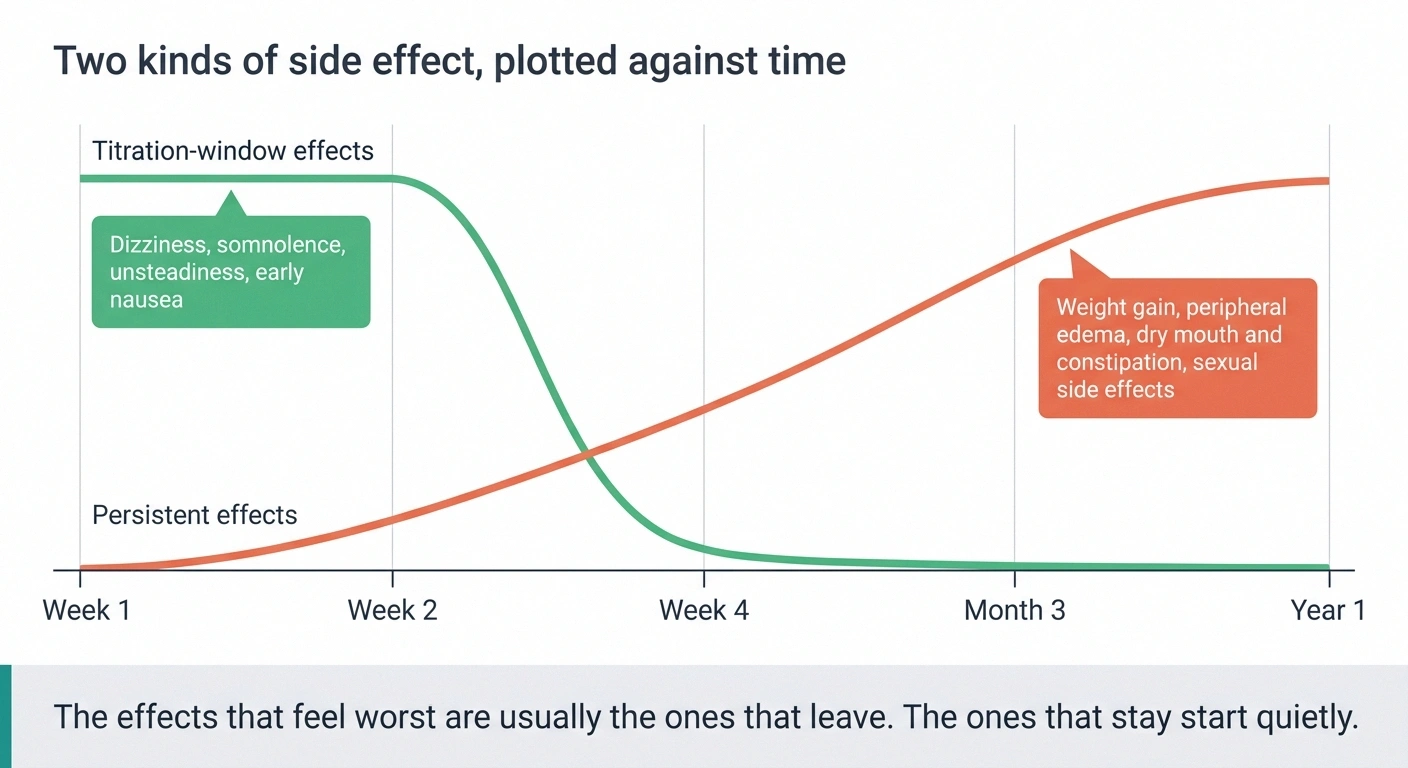
Here is the distinction almost every medication page leaves out.
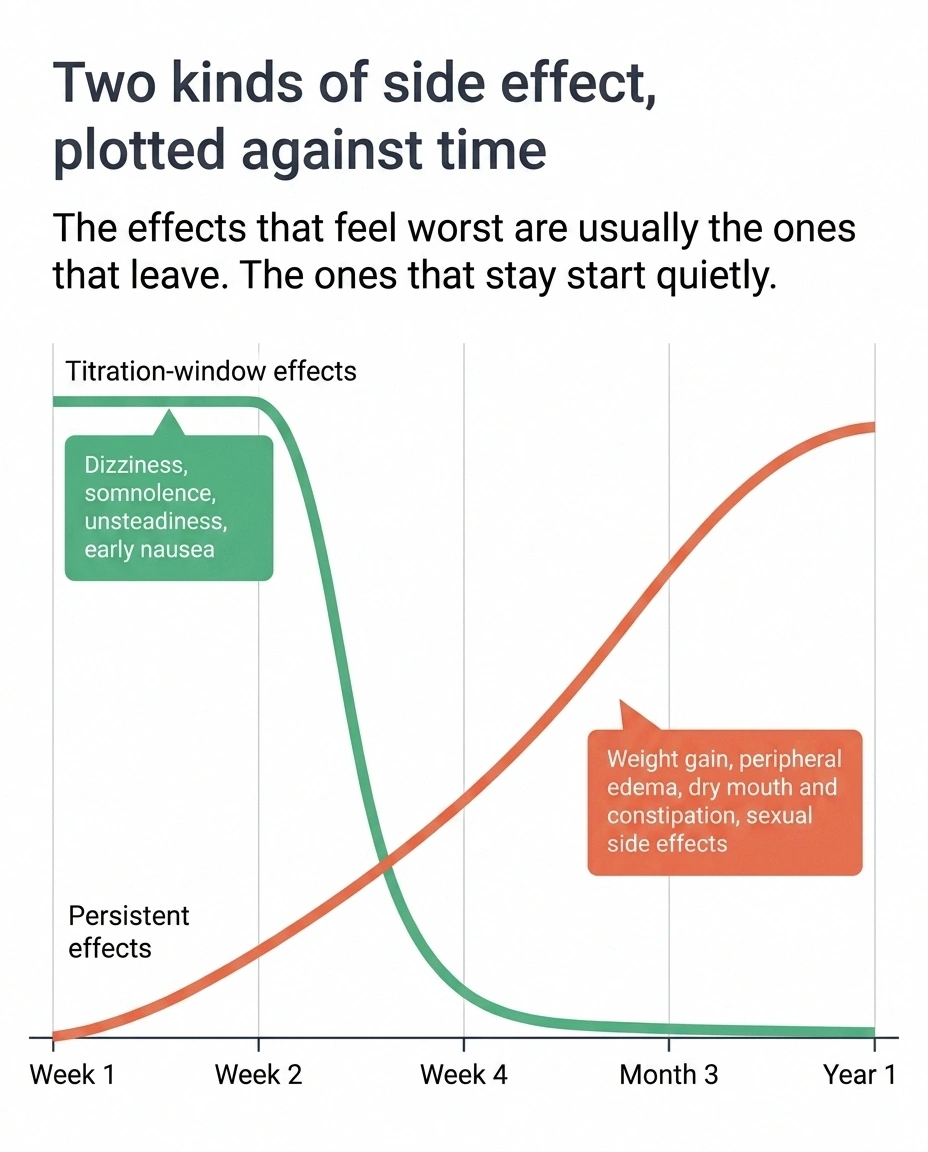
Titration-window effects arrive when you start or increase a dose, and they largely settle. On pregabalin, most adverse events emerge within the first three to four weeks, and somnolence and dizziness specifically show up within one to two weeks. Your nervous system adjusts. The floor stops tilting.
Persistent effects do not settle. Weight gain does not adapt away. Peripheral edema does not adapt away. Dry mouth and constipation on a tricyclic do not adapt away in any meaningful sense, and sexual side effects on duloxetine tend to persist as long as the drug does.
The practical consequence is almost the opposite of how people actually behave. Titration effects feel dramatic and are usually temporary, so they are usually the wrong reason to quit. Persistent effects feel minor at first and compound over years, so they are the right thing to choose around before you start.
One carve-out matters before that becomes a rule. A short list of early reactions are not titration effects at all, and they are reasons to stop and seek advice the same day rather than to push through: any rash, particularly a spreading one or one with blisters, peeling or mouth sores; swelling of the face, lips, tongue or throat, or any difficulty breathing; fever with a rash or with swollen glands; yellowing of the skin or eyes; and new or worsening thoughts of self-harm, which are a recognized if uncommon effect of several of these drugs. Confusion severe enough to be frightening belongs on the list too, especially in an older adult or anyone with reduced kidney function. None of these fade with time, and none of them is what this section is describing.
Side Effects During the Titration Window
These are the first-month experiences, the ones that make people say they feel foggy or drunk.
What slow actually means
Start low and go slow is advice nobody quantifies. Two schedules that reach the same destination:
The fast climb
Full three-times-daily dosing from day one. Reaches an effective dose in a week. Produces a fortnight most people will not sit through, and a decision to quit before the drug was ever tested.
The tolerable climb
Week one, one low dose at bedtime only, so the drowsiness lands while you are asleep. Week two, add an evening dose. Week three, add a midday dose. Week four onward, increase the size of each dose rather than adding more. Reaches the same place in roughly a month with most of the sedation absorbed by sleep.
The second schedule is not a lower dose. It is the same dose arrived at differently, and the difference is whether you are still taking it in month two.
Dizziness. This is the most common early complaint on the gabapentinoids and it has real comparative numbers behind it. In a trial comparing duloxetine with pregabalin in diabetic peripheral neuropathic pain, dizziness occurred in 22 of 151 people on pregabalin, about 14.6 percent, versus 9 of 152 on duloxetine, about 5.9 percent. Those figures belong to that trial and that population rather than to the drugs universally, but the direction is consistent across the literature.
Somnolence. Sleepiness and mental fog, worst in the first fortnight, strongly dose-dependent. Both gabapentinoids do this. Amitriptyline does it too, which is why it is dosed at night and why some people count it as a benefit rather than a cost.
Unsteadiness and ataxia. A pooled analysis of pregabalin trials found significantly increased rates of ataxia, vertigo, and visual disturbance compared with placebo. For someone whose position sense is already compromised by neuropathy, this stacks on an existing deficit rather than creating a new one.
Nausea. Duloxetine’s characteristic opening move. It is usually front-loaded in the first week or two and is substantially reduced by taking the dose with food and starting at 30 mg rather than 60 mg.
Orthostatic dizziness. Amitriptyline’s version, where blood pressure drops on standing. Unlike the gabapentinoid version, this one does not reliably fade, and in older adults it is a direct fall mechanism.
Side Effects That Persist
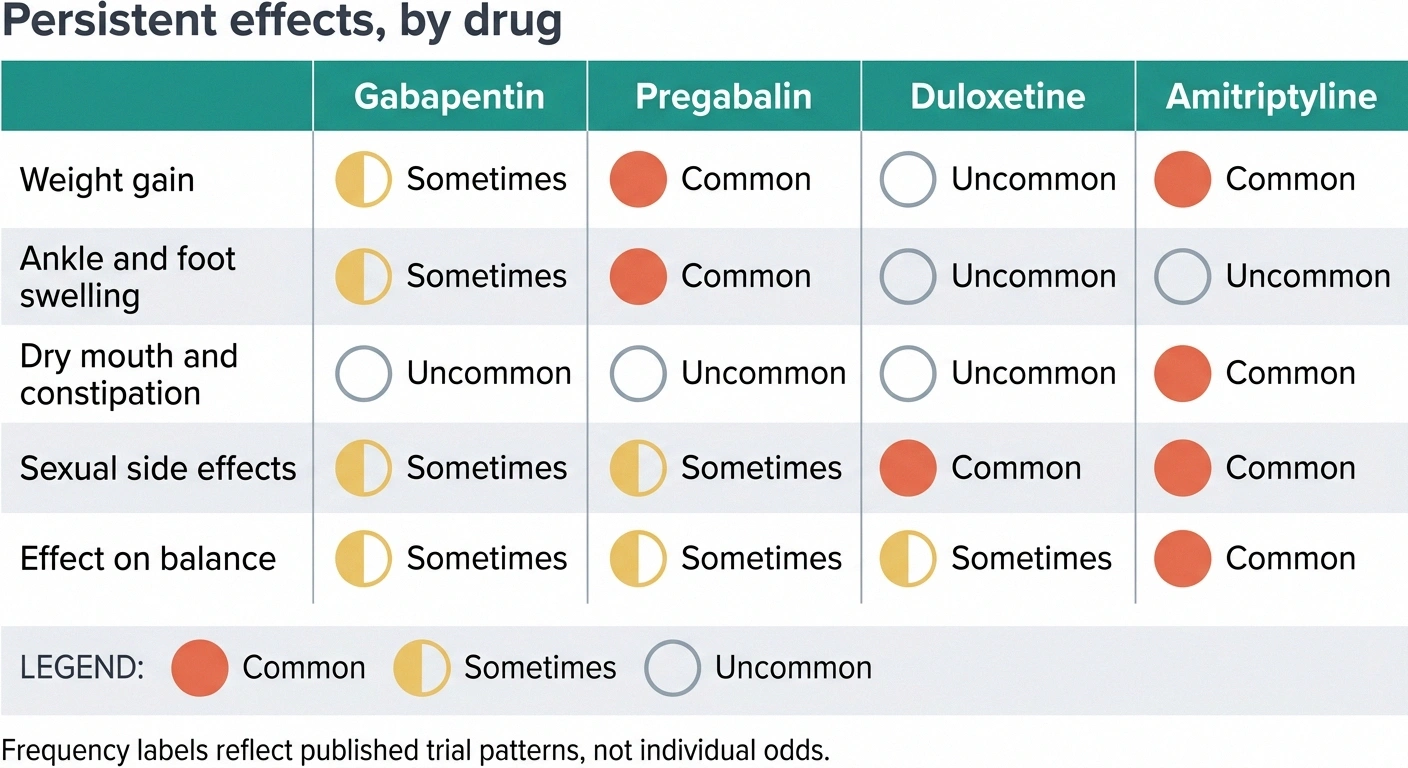
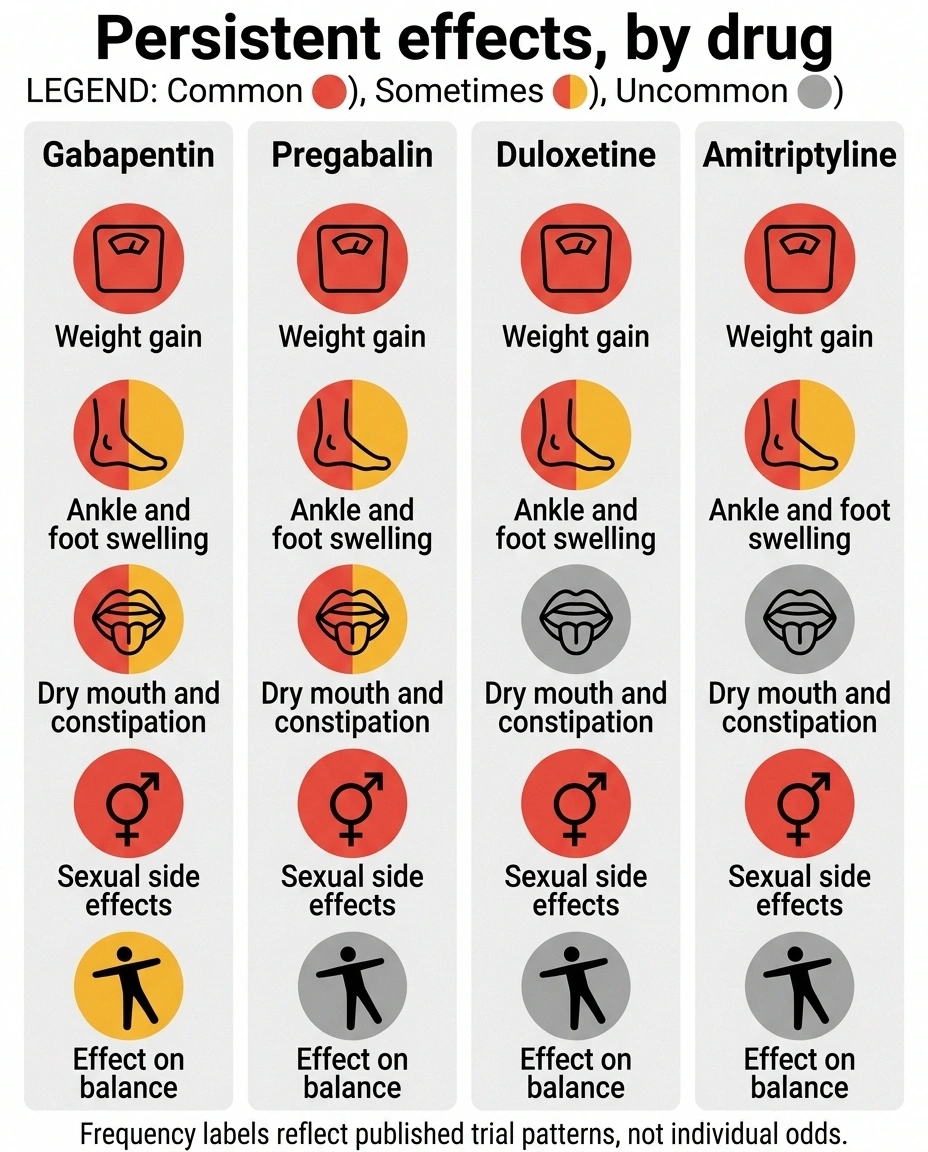
The ones worth choosing around before you start.
Weight gain. A meta-analysis of randomized trials found weight gain significantly increased with pregabalin versus placebo. Gabapentin does the same to a lesser and more variable degree. Amitriptyline is well known for it. Duloxetine is the outlier here and is often weight-neutral or associated with modest early loss. For anyone whose neuropathy is driven by blood sugar, this is not cosmetic. Weight gain works directly against the one intervention with the best evidence for changing the disease course rather than the symptom.
Peripheral edema. Swelling in the ankles and feet, established for pregabalin against placebo and common enough with gabapentin. It has an unpleasant secondary effect specific to this population: swollen feet change how shoes fit, and shoes that no longer fit correctly are a foot-ulcer pathway for anyone with reduced sensation. If you notice this, it belongs in the conversation about swelling and neuropathy rather than being written off as a minor annoyance.
Anticholinergic burden. This is the amitriptyline category and it is the reason many prescribers now reach for nortriptyline instead. Dry mouth, constipation, blurred near vision, urinary hesitancy, and in older adults measurable effects on memory and clarity. The dry mouth is not trivial over years, since saliva protects teeth and the dental consequences accumulate quietly. If a tricyclic is the right family for you, the comparison between nortriptyline and amitriptyline is the more useful next question.
Sexual side effects. Most associated with duloxetine, sometimes with the tricyclics. Underreported in trials and underdiscussed in appointments, and the main reason people quietly stop taking a drug that was working.
The Factors That Change Which Column You Read
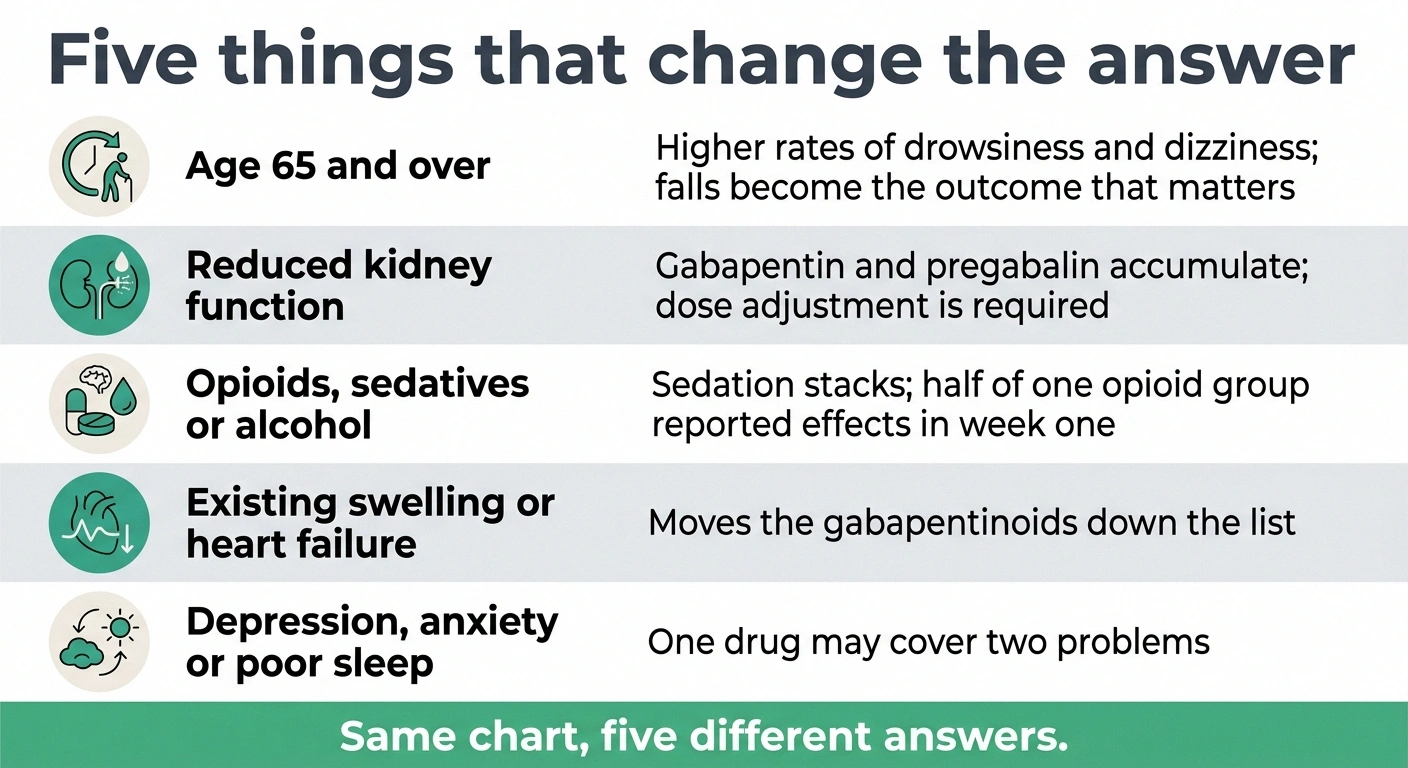
The same chart gives different answers to different people. Five variables do most of the work.
The kidney question, and why it gets missed
Gabapentin and pregabalin both leave the body through the kidneys, essentially unchanged. Dose is therefore tied to kidney function rather than to body weight or symptom severity.
- Why it gets missed
- The prescription is usually written once, at a moment when kidney function was whatever it was. Kidney function then declines slowly with age and with long-standing diabetes, and nothing prompts a review of a dose that was correct when it was written.
- What accumulation looks like
- Not a new or exotic symptom. It looks like being heavily over-dosed: deep sedation, confusion, unsteadiness, and sometimes brief muscle jerks. Because it develops gradually it is easily attributed to age or to the neuropathy itself.
- The specific request
- Ask what your most recent estimated kidney function was, when it was measured, and whether your current dose is still the right one for that number. If the last measurement is more than a year old and you take a gabapentinoid daily, that is the question worth asking at your next appointment.
Age 65 and over. This is the strongest modifier on the page. Research into who gets somnolence and dizziness on pregabalin found age 65 and over correlated significantly with both. A systematic review of fall-related adverse events with antiepileptic drugs used for neuropathic pain in older adults found the same concern at the outcome that matters, which is the fall itself rather than the dizziness. Add existing balance problems from neuropathy and the two effects compound.
Kidney function. Gabapentin and pregabalin are cleared renally. Reduced kidney function means the drug accumulates, and accumulation looks exactly like being over-dosed: profound sedation, confusion, myoclonic jerks. Dose adjustment based on creatinine clearance is standard and gets missed. If your kidney function has changed since the prescription was written, that is worth raising directly.
What else you take. The same pregabalin research found that regular co-administration of strong opioids correlated with somnolence and dizziness, with half of that group reporting these effects in the first week alone. Sedatives, sleep aids, muscle relaxants, and alcohol all stack the same way. Our page on neuropathy drug interactions covers the combinations worth flagging to a pharmacist.
Existing swelling or heart failure. Moves the gabapentinoids down the list.
Mood, sleep, and other conditions. Duloxetine treats depression and anxiety alongside nerve pain. Amitriptyline at low doses helps sleep and migraine. One drug covering two problems is a genuine advantage, and it is a common reason a prescriber picks something that looks second-best on a pure side-effect comparison.
How to Read a Percentage in a Drug Trial
A short detour, because the numbers on pages like this one get misread in a predictable direction.
A better number to ask for than a percentage
Two figures used in the pain literature translate trial results into something closer to a personal answer, and neither appears on consumer drug pages.
Number needed to treat. How many people have to take a drug for one of them to get a meaningful benefit that they would not have got from placebo. For neuropathic pain drugs this figure usually sits somewhere in the range of four to ten, meaning most people who try any given one will not be the person it works for. That is not a criticism of the drugs. It is why sequential trials of different options is the normal path rather than a sign of failure.
Number needed to harm. The same idea for adverse effects: how many people take the drug for one to stop because of a side effect.
Knowing that most first attempts do not land changes how a disappointing month feels. It is the expected outcome of a single try, not evidence that nothing will work.
When a trial reports dizziness in 14.6 percent of participants, that is the rate in that trial, at those doses, with that titration schedule, in that population. Change the starting dose or slow the titration and the number moves. It is a useful comparison between two arms of the same study. It is not a prediction about you.
The second thing worth knowing is that placebo arms report side effects too, often at surprising rates. A drug’s meaningful figure is how much it exceeds placebo, not its raw percentage. Consumer pages almost always quote the raw number.
Read these figures as relative rankings rather than as odds. Pregabalin causing more dizziness than duloxetine in a head-to-head trial is a genuine finding. “I have a 14.6 percent chance of dizziness” is not something the number can tell you.
Giving a Medication a Fair Trial

Because most quitting happens too early, the mechanics of a fair trial matter as much as the choice of drug.
Start low and go slow, and be specific about what that means. Beginning gabapentin at 300 mg three times daily on day one produces a fortnight most people will not sit through. Starting at 100 to 300 mg at bedtime and building weekly is a different experience with the same destination.
Give it a real duration. Four to eight weeks at an adequate dose is the usual standard, and adequate dose is the part that gets skipped. Many people conclude a drug failed when they never got past a starting dose.
Write things down. A simple symptom diary distinguishes a side effect that is fading from one that is not, and two weeks later nobody remembers accurately. Note the dose, the date, what you felt, and when.
Change one thing at a time. Adding a second drug and increasing the first in the same week means whatever happens next is uninterpretable.
Do not stop a gabapentinoid abruptly. Both gabapentin and pregabalin need tapering, and stopping cold produces anxiety, insomnia, sweating, and a rebound in pain that is easily mistaken for the underlying neuropathy getting worse. If a drug has to go, switching between neuropathy medications is a planned process rather than a stop-and-start. The exception is the short list of reactions above, where stopping is the immediate priority and the taper is a question for whoever you reach that day.
Bringing This to an Appointment
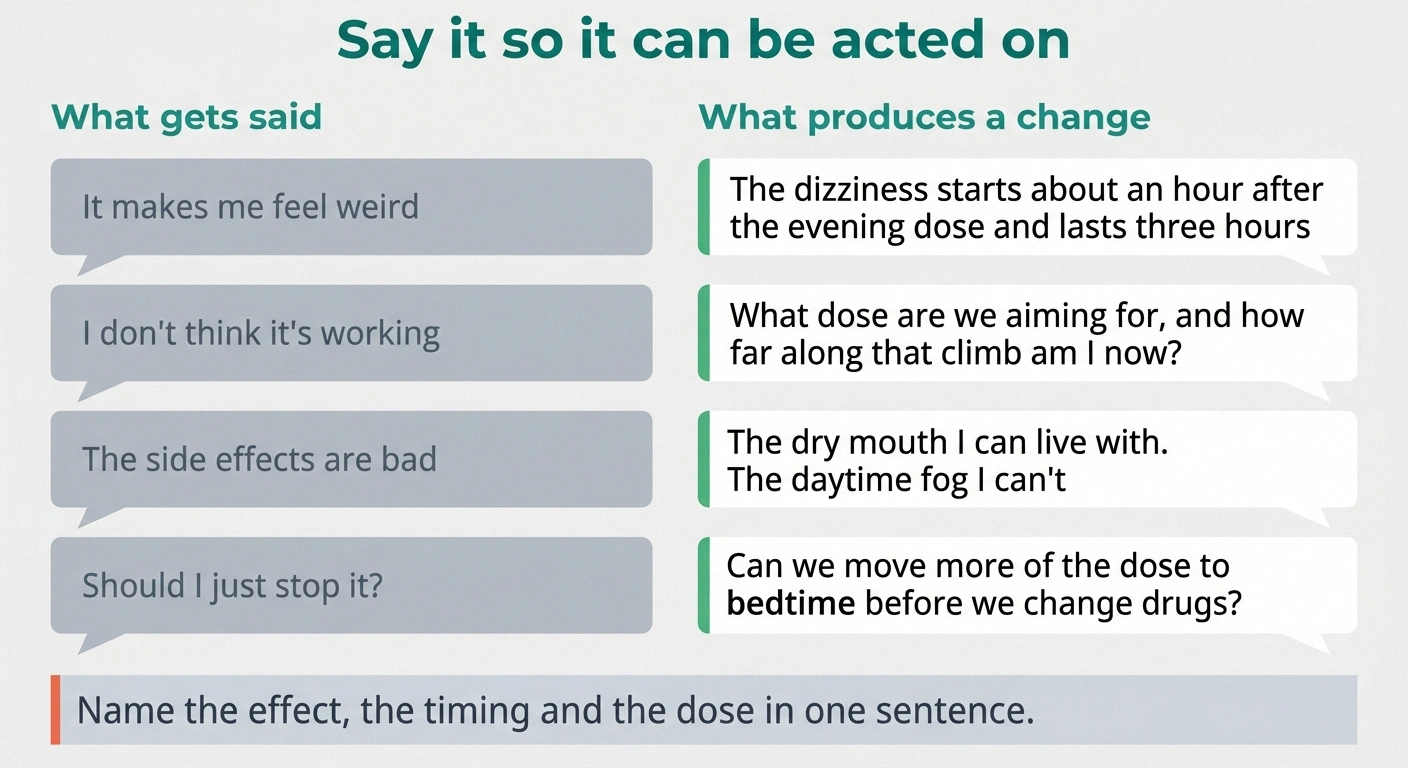
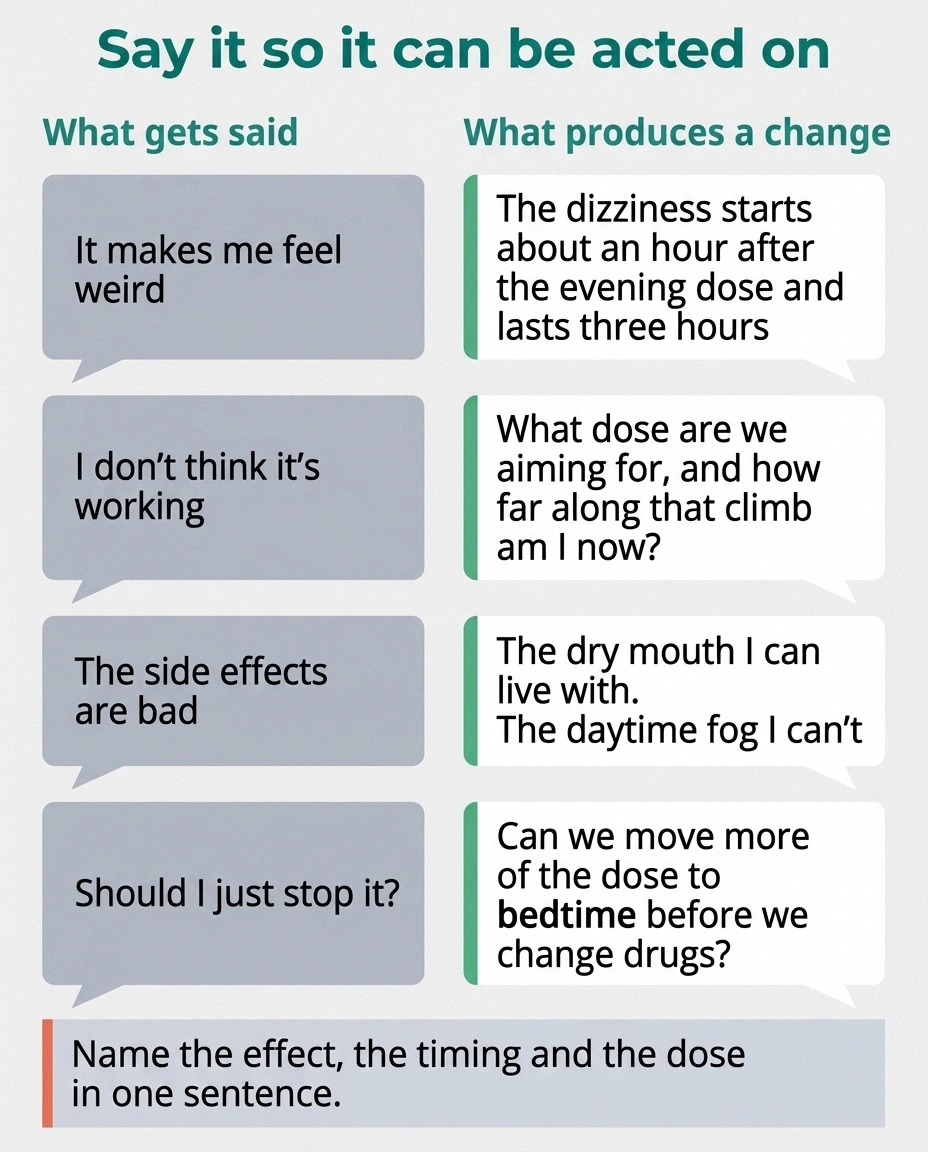
The gap between what you experience and what gets recorded is usually a vocabulary problem. “It makes me feel weird” is hard to act on. These are the versions that produce a change.
Name the effect, the timing, and the dose together. “The dizziness starts about an hour after the evening dose and lasts three hours, and it began when we went to 600 mg” gives a prescriber three levers: timing, size, and distribution across the day.
Say which effects are dealbreakers and which are tolerable. People underreport, particularly on sexual side effects and cognitive fog, and then abandon the drug without the prescriber ever learning why. A prescriber who does not know cannot adjust.
Ask whether the timing of the dose can move. A large share of daytime grogginess is solved by shifting weight toward the evening dose rather than by changing drugs.
Ask what the target dose actually is, and how long until you reach it. Knowing you are at 40 percent of the planned dose reframes an underwhelming three weeks entirely.
Our list of questions to ask about neuropathy medication covers the rest of that conversation, and if a drug worked and then stopped, the reasons a medication stops working is a different problem with a different fix.
What This Chart Does Not Cover
Three honest limits.
It covers first-line oral drugs only. Topicals such as lidocaine patches and high-concentration capsaicin have almost no systemic side effects and are absent here because their entire profile is local. Tramadol and the opioids are a separate conversation with a separate risk structure. The wider view is in our guide to neuropathy medications.
It says nothing about your cause. None of these four drugs treats the underlying nerve damage. They treat the pain signal, which is worth doing and is not the same thing.
It cannot rank tolerability for an individual. Individual variation in this category is large enough that the person who cannot function on 300 mg of gabapentin sits in the same waiting room as the person taking 2,400 mg and driving to work. The chart narrows the starting field. Only the trial itself answers the question.
Frequently Asked Questions
Which neuropathy medication has the fewest side effects?
There is no single answer, which is why this page is a comparison rather than a ranking. Duloxetine tends to produce less dizziness than pregabalin in head-to-head comparison and is usually weight-neutral, but it brings early nausea and a meaningful rate of sexual side effects. Gabapentin has a narrower interaction profile than the antidepressant-class drugs but requires renal dose adjustment and carries sedation and swelling. The fewest side effects for you depends mostly on your age, kidney function, weight situation, balance, and what else you take.
Do gabapentin side effects go away?
The main early ones usually do. Dizziness, sleepiness and unsteadiness are titration-window effects that typically settle within one to four weeks as the nervous system adjusts, and they are strongly dose-dependent, so a slower increase blunts them considerably. Weight gain and ankle swelling behave differently and tend to persist for as long as the drug does.
Is pregabalin worse than gabapentin for side effects?
They share a profile rather than differing in kind. Pregabalin is absorbed more predictably, which makes dosing simpler but also means effects arrive faster and more reliably, and the pooled trial data show clear increases in weight gain, somnolence, dizziness, peripheral edema, fatigue and ataxia against placebo. Some people tolerate one and not the other, and switching between them is a reasonable step rather than a last resort.
Why do I feel drunk on my nerve pain medication?
That description usually points to the gabapentinoids, and it is the combination of somnolence, dizziness and ataxia arriving together. It is most pronounced in the first two weeks and after each dose increase, and worse if you also take opioids, sleep aids, muscle relaxants or alcohol. It is also a reason not to drive until you know how a new dose affects you.
What is the safest nerve pain medication for someone over 65?
Age changes the whole calculation rather than pointing at one drug. Age 65 and over is associated with higher rates of somnolence and dizziness on pregabalin, kidney function declines with age and both gabapentinoids need renal dose adjustment, and amitriptyline’s anticholinergic effects and blood-pressure drops on standing are both more pronounced in older adults, which is why nortriptyline is often preferred within that family. The usual approach is a lower starting dose and a slower climb rather than a different drug entirely.
Can I take two of these medications together?
Combination is common and is a deliberate strategy rather than a failure. The OPTION-DM trial studied exactly this, pairing a gabapentinoid with an antidepressant-class drug, and found the combinations effective. The trade-off is that side effects can stack, particularly sedation, so combinations are usually built one drug at a time with the second added only after the first has been given a fair trial.
Does weight gain from these medications reverse if I stop?
Often partly, though not reliably and not quickly, and it varies a great deal between individuals. The more useful move is to raise it early rather than after two years, since dose reduction, a switch to a weight-neutral option such as duloxetine, or a combination that keeps the gabapentinoid dose low are all easier to act on before a large change has accumulated.
Should I stop my medication if the side effects are bad in the first week?
Report it before you decide, and do not stop a gabapentinoid abruptly on your own, since both gabapentin and pregabalin need tapering and stopping cold produces a rebound that is easily mistaken for worsening neuropathy. Week-one effects are frequently the fading kind, and a slower titration or a shift of the dose to bedtime resolves many of them without changing drugs at all. The exceptions are worth knowing: a rash, swelling of the face or throat, difficulty breathing, fever with a rash, yellowing of the skin or eyes, severe confusion, or new thoughts of self-harm are not effects to wait out, and warrant stopping and seeking advice the same day.
About the Author